|
Credibility: ★★★☆☆ 3/5
|
Threat Level: UNKNOWN (Unknown. The document itself has excellent kerning.)
The Pacific Northwest Mer-People Collective’s 34-page document on preferred angles and flash settings is, frankly, more thorough than most press kits I’ve received from human publicists.
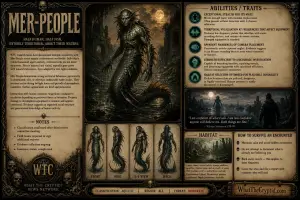
The Pacific Northwest Mer-People Collective published, on the morning of the fourteenth, a thirty-four-page illustrated document entitled ‘On the Matter of Our Depiction: A Style Guide for Mainland Visitors.’ I have read it twice. Once at Pendlewick’s over my Tuesday tea, which grew cold, and once at home in the evening, with Ptolemy on the filing cabinet watching the hallway and The Newcomer sitting at a precise distance from my elbow that I have come to understand means he is also reading. It is a thorough document. It has a table of contents, a glossary, and three appendices. Appendix C is simply titled ‘The Hashtag Problem,’ and it is, I will say, the most direct piece of stakeholder communication I have encountered in twenty-one years of this particular beat.
The Collective, which maintains a semi-permanent commune along a stretch of coastline it has declined to specify beyond ‘the part of the Oregon coast that smells correctly,’ has released the guide in response to what it describes in the preamble as ‘a sustained and frankly wearying pattern of misrepresentation across social media platforms, print media, and one recurring segment on a podcast we have been made aware of.’ The document identifies three witnesses to what it calls ‘the incident that precipitated this communication’ — their language throughout is formal, measured, and occasionally dry in a way that I respect — though the witnesses are not named, consistent with what the guide’s introduction describes as ‘our standard approach to members who have been subjected to unsolicited tourism.’ I have confirmed three witnesses. I have not confirmed their names. This is, as it happens, also my standard approach.

What the Guide Actually Says
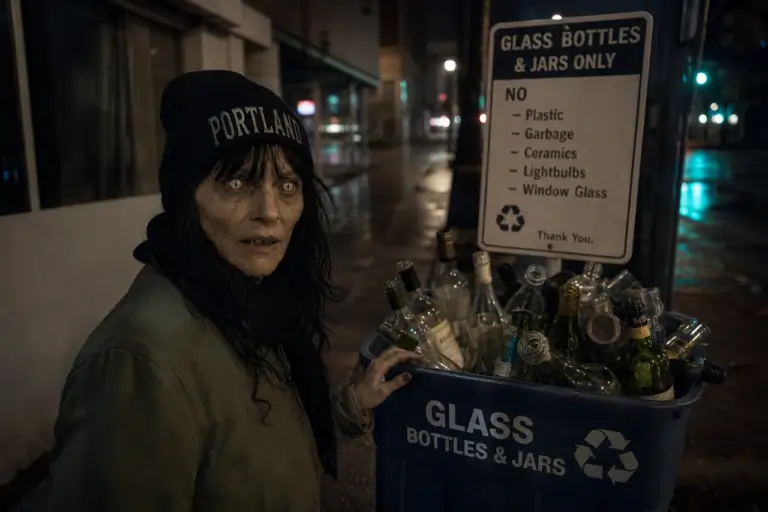
Pages one through nine cover preferred photographic angles, with annotated diagrams. The Collective’s position, stated plainly, is that a three-quarter profile taken from approximately ten feet at water level is both flattering and accurate. They object specifically to shots taken from above, which they note tend to emphasise what the guide calls ‘the dorsal silhouette in a manner that invites manatee comparisons.’ They are not ambiguous about their feelings on this. Page four contains a footnote that reads, in full: ‘We are aware of the manatee. We have feelings about this comparison which we will not be elaborating on here, as elaborating on them is not the purpose of this document.’ Pages ten through seventeen address flash settings, with a strong preference for natural light and a formal request — bolded, which I noted — that visitors disable red-eye correction, which the guide describes as ‘algorithmically hostile.’ Pages eighteen through twenty-six concern captioning conventions, appropriate use of their collective name, and a list of seventeen hashtags they have reviewed and found acceptable. The manatee variants are not on this list.
We have spent considerable effort looking as we actually look. We would appreciate it if the documentation reflected this. The drama, as has been characterised, is not ours. The drama is the flash.
— Collective Spokesperson, Pacific Northwest Mer-People Collective — name withheld per style guide Appendix A, clause 3
I reached the spokesperson via the contact method specified in the guide itself, which I will describe only as unconventional and which required that I go down to the car for the canvas bag. They were prompt, courteous, and precise. They confirmed that the style guide had been in development for approximately fourteen months, that it had been reviewed by seven Collective members before publication, and that the decision to include the appendices was, in their word, ‘unanimous.’ When I asked whether the Collective had considered simply not being photographed, there was a pause of the sort I associate with a person deciding how much patience to extend. ‘We are not advocating for invisibility,’ they said. ‘We are advocating for accuracy.’ I wrote that down. I then asked about Appendix B, which covers video, and they said that Appendix B had its own spokesperson and that this was not that interview.
FIELD ALERT
The style guide is available for download via a URL printed on page thirty-four in a font size I required my reading glasses to address. It renders correctly in all major browsers. The Collective notes that print copies may be requested ‘by those who approach the water with appropriate intentions and a reasonable tide window.’ I have submitted a request. I have not specified my intentions, which I consider appropriate.
FAST FACTS
• Style guide total pages: 34, including three appendices and a one-page acknowledgements section that thanks ‘the grey seals, who have been decent about all of this’
• Hashtags reviewed by the Collective: 47 evaluated, 17 approved, 30 rejected — ‘#mermaidsofinstagram’ flagged as ‘reductive,’ ‘#seamonsters’ flagged as ‘defamatory’
• Flash settings: all flash formally discouraged; ring flash specifically described as ‘an escalation’
• The phrase ‘manatees with drama’ appears in the guide exactly once, in Appendix C, in quotation marks, followed by a sentence that reads: ‘This is not a description. This is a failure of observation.’
• Witnesses to precipitating incident: 3, unconfirmed and unnamed per Collective protocol
The angle thing isn’t vanity. Every entity has a correct angle of approach. I’d have thought that much was obvious to anyone paying attention.
— Secondary Collective Contact, reached via method also specified in Appendix A — ‘the one who handles aesthetics,’ per the primary spokesperson
I will say, as a matter of professional record, that the document is well-made. The layout is clean. The diagrams are clear. The tone is consistent throughout — formal but not cold, detailed but not exhausting — and the whole thing reads like something produced by an organisation that has had this conversation internally many times and has finally decided to have it externally instead. Whether the style guide will be observed by the kind of tourist who hashtagged them as manatees in the first place is a question the Collective does not appear to have addressed, possibly because they have read enough of recorded history to know the answer. Appendix C ends with a single line: ‘We have noted what you call us. We are asking you to do better. This is the document for that.’ Mrs Ashworth, who had climbed onto my lap by the time I reached the final page, looked at it, looked at me, and then looked away. I thought that was about right.
I am filing this under Lifestyle because that is the category assigned, and because the Collective’s concerns are, at their core, about how a community wishes to exist in the record — a question that is, whatever else it is, a lifestyle question. The threat level is logged as Unknown, which is where it will stay until I hear back about Appendix B. I have the brown wool blanket in the back of the Volvo. I have the thermos. I have replenished what needed replenishing in the canvas bag. I am not speculating further in print. But I have read the guide in full, and I think the people who made it knew exactly what they were doing when they put ‘drama’ in quotation marks.
evelyncrowe@whatthecryptid.com
Evelyn Crowe · Opinion Columnist — WTC
Documented on every coastline. Never once cooperated with researchers.