|
Credibility: ★★★★☆ 4/5
|
Threat Level: HIGH (HIGH — pattern density warrants immediate attention)
Forty-seven paid claims. One town. Population 340. The actuaries are calling it an anomaly. I’m calling it something else.
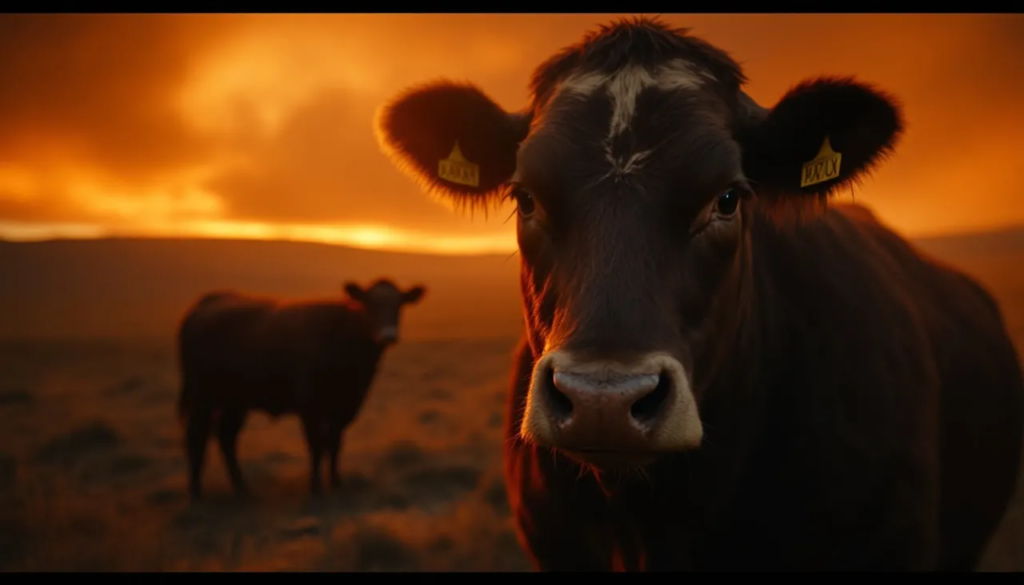
I want to be careful here about the order in which I present things, because the order matters. Start with the insurance data and you have a fraud story — dry, financial, the kind of thing that gets filed and forgotten in a regional agribusiness column. Start instead with the forty-seven animals, the condition in which they were found, and the twenty people I spoke to over eleven days in and around Burden Creek, Wyoming, and you have something the actuaries’ language is not quite equipped to hold. One senior underwriter at Meridian Agricultural Partners — who spoke to me on background, whose name I am protecting at his explicit and somewhat urgent request — described the Burden Creek claims pattern as ‘either fraud or significantly worse than fraud.’ I have been in this work long enough to know that when an insurance professional reaches for the phrase ‘significantly worse,’ they are not being rhetorical.
The numbers, sourced from actuarial records at three agricultural insurers through a combination of public filings and documents obtained by WTC, are not subtle. Burden Creek township — population 340, situated in a high plain basin roughly sixty miles from the nearest town of comparable size — has submitted forty-seven livestock mutilation claims since January 2019 and received payment on all forty-seven. The national figure for paid mutilation claims across all agricultural insurers in the same period is forty-one. I have checked this. I had Mara check it independently. The number holds. A town of 340 people has a higher confirmed, compensated mutilation rate than the entire continental United States combined, and it has maintained that rate consistently, without a single claim flagged for investigation, for just over five years.

FAST FACTS
• Burden Creek, WY — Population: 340
• Paid mutilation claims since 2019: 47 (Burden Creek) vs. 41 (rest of the U.S. combined)
• Insurers involved: Meridian Agricultural Partners, High Plains Mutual, Cornerstone Ag
• All 47 claims paid in full — none flagged for fraud review
• Earliest claim on record: January 14, 2019
• Most recent confirmed claim: September 3, 2024
• Witnesses interviewed by WTC: 20
• Local law enforcement reports filed: 6 (none resulted in investigation)
What I did not expect, driving the V70 up into that basin on a Tuesday morning with my thermos and a printed summary of the claims data, was the degree to which the residents of Burden Creek are neither defensive nor particularly surprised to be asked about it. I have covered enough of these situations to know that communities with something to hide tend to present in a specific way — closed, coordinated, occasionally hostile. Burden Creek is none of those things. What it is, instead, is tired. A rancher named Del Whitmore, who has filed six of the forty-seven claims himself and who invited me to sit at his kitchen table for three hours without my asking twice, described the situation with a flatness that I found more unsettling than distress would have been. ‘We report what happens,’ he said. ‘We’ve always reported what happens. Nobody’s ever come out here before to ask us about it.’ He said this without accusation. That was the part I kept thinking about on the drive back.
We report what happens. We’ve always reported what happens. Nobody’s ever come out here before to ask us about it.
— Del Whitmore, rancher, Burden Creek — six claims filed, all paid
What the Claims Don’t Show
The insurance documentation is consistent across all forty-seven cases in ways that go beyond what coordinated fraud would typically produce. Mutilation claims in the agricultural insurance system are assessed using a standardized loss report that requires, among other things, a veterinary attestation of cause of death — or, in mutilation cases, cause of injury and manner of tissue removal. All forty-seven Burden Creek claims include these attestations. I obtained copies of nineteen of them. The language used by two different local veterinarians across those nineteen reports is, in several instances, nearly identical in its descriptions of incision characteristics — specifically, descriptions of ‘clean excision inconsistent with predator activity’ and ‘absence of hemorrhagic evidence at wound sites suggesting removal occurred post-mortem or under conditions not consistent with known predation.’ These are not phrases a rancher invents. These are phrases a veterinarian writes when they are describing something they cannot otherwise account for and are trying to stay within the boundaries of what their professional language permits them to say.
I spoke to one of those veterinarians — Dr. Patricia Osei, who has served the Burden Creek area for twelve years and who I will note did not hesitate to speak on record, which itself tells you something about where she is after a decade of writing these reports. She told me she has submitted attestations on fourteen of the forty-seven claims. She told me she has, in that time, examined carcasses that she cannot explain to her own satisfaction. She told me, specifically, that in four cases she observed what she described as ‘geometric consistency in the excision patterns across animals found weeks and miles apart’ that she has not reported formally because there is no field on the loss report for geometric consistency. ‘I write what I can document,’ she said. ‘I don’t write what I can’t. But I see what I see.’
I write what I can document. I don’t write what I can’t. But I see what I see.
— Dr. Patricia Osei, DVM — veterinary attestations on 14 of 47 claims
FIELD ALERT
WTC has confirmed that no state or federal agency has opened an investigation into the Burden Creek claims pattern despite the statistical anomaly being present in publicly accessible filings since at least 2022. High Plains Mutual conducted an internal audit in Q3 of that year and concluded — in a three-paragraph summary obtained by WTC — that the claims were ‘consistent with regional environmental stressors.’ No elaboration was provided. No investigator visited the township. The audit took eleven days.
The Question the Data Keeps Asking
There is a version of this story that resolves cleanly into fraud — a small, economically stressed community, aware of a coverage provision, exploiting it with enough veterinary coordination to pass claim review. I have not ruled that out. I want to be honest about that. But I have spent enough time with the twenty people I interviewed — ranchers, a feed store owner, two retired schoolteachers who live on adjacent properties and filed claims on the same night in March 2022, the county deputy who has taken six of the reports and told me he ‘stopped trying to make sense of the scene photographs’ after the third one — to know that the fraud hypothesis requires these people to be collectively, persistently, and very calmly lying to me. Some of them have been reporting incidents since before the insurance claims began. Del Whitmore described losing animals in the same pattern as far back as 2014, before he had mutilation coverage, before there was anything material to gain. He did not file those. He just lost them. I am giving that context time to develop.
I will be returning to Burden Creek. I have left my contact information with twelve of the twenty witnesses and received, as of this writing, three follow-up messages — one from Del Whitmore, who found something in the north pasture two days after I left and wanted me to know, one from Dr. Osei, who has agreed to share her personal case notes with WTC pending a conversation about what we intend to do with them, and one from a number I don’t have saved, sent at 4:17 in the morning, that reads only: ‘it wasn’t the same shape as the others.’ I don’t know who sent it. I know I’m going back.
malcolmshaw@whatthecryptid.com
Malcolm Shaw · Senior Features Journalist & Folklore Correspondent — WTC

Interstellar. Methodical. Professionally uninterested in consent.