|
Credibility: ★★★★☆ 4/5
|
Threat Level: HIGH (HIGH — Do not approach. Do not smell.)
A fourteen-person survey team near Madidi National Park encountered something large, one-eyed, and indifferent to their presence — for exactly three seconds. Three seconds was apparently enough.
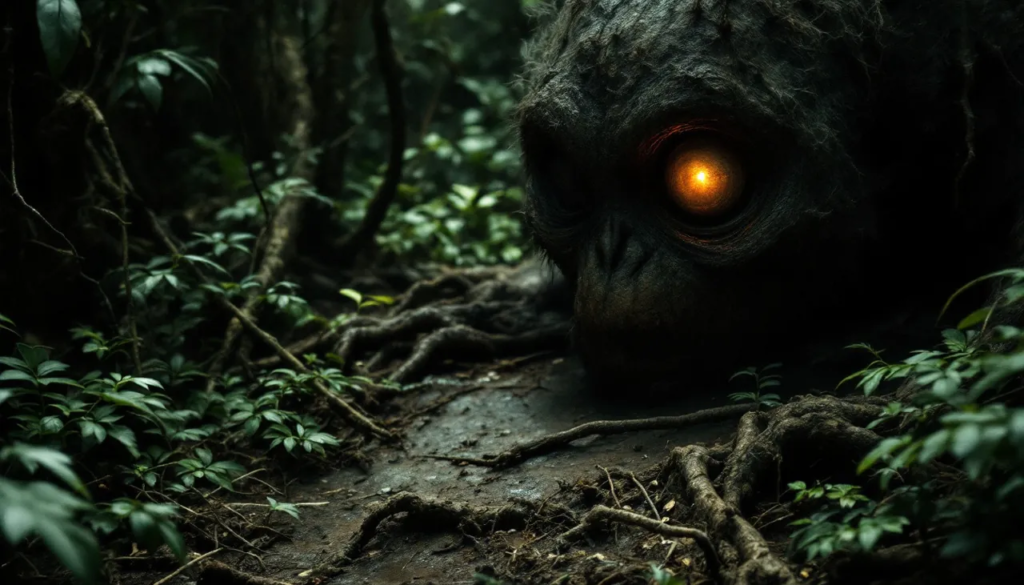
Sometime in the late morning of last Tuesday, a jungle survey team operating near the southwestern perimeter of Madidi National Park in the Bolivian Amazon came to a collective stop. What they stopped for was approximately two and a half meters tall, covered in what witnesses variously described as matted reddish fur, dark fiber, or ‘the kind of thing you see on the forest floor but vertical,’ possessed of a single eye centered in its face, and radiating an odor that survey team member Catalina Ríos Mamani later described as ‘rotting plants and something worse than that.’ The creature looked at them. They looked at the creature. After roughly three seconds — multiple team members counted independently, which tells you something about the kind of people on this survey team — it turned and walked back into the undergrowth. It left behind a path of flattened vegetation approximately four meters wide and a smell that, according to three separate accounts, did not fully dissipate for forty minutes.
Fourteen witnesses. I want to sit with that number for a moment, because in nine years of this work I have learned to treat witness counts the way I treat weather forecasts — directionally useful, frequently imprecise, and occasionally catastrophically wrong. Fourteen people who saw the same thing at the same time in a location with no cell service, no prior agenda, and no obvious motive to fabricate a cryptid encounter in one of the most biologically dense and physically demanding ecosystems on earth. They were there to document tree canopy coverage and soil moisture gradients. They were not there to see a Mapinguari. The Mapinguari, apparently, did not concern itself with their agenda.

It didn’t run. It didn’t charge. It looked at us the way you look at something you’ve already decided isn’t worth your time. Then it was gone. The smell stayed.
— Catalina Ríos Mamani, Survey Team Botanist
What The Mapinguari Is, And Why Bolivia Matters
The Mapinguari — also rendered as Mapinguary, depending on your source and your regional orthographic preferences — occupies a specific and well-documented lane in South American cryptid literature. Indigenous oral traditions across Brazil and Bolivia have described a large, ground-dwelling creature of considerable size and considerable smell for centuries. The smell is not incidental. It is, in most accounts, the first thing mentioned and the last thing forgotten. Ethnobotanist and folklore researcher Dr. Augusto Ferrante, whom I reached by phone at his office in La Paz, described the creature’s odor as ‘a defining taxonomic feature in the traditional accounts — it is as identifying as the eye, as the size, perhaps more so.’ Some researchers have proposed a connection to Megatherium, the giant ground sloth extinct for approximately ten thousand years, though that hypothesis remains contested. What is less contested, as of last Tuesday, is that fourteen people near Madidi smelled something that defied easy categorization and watched something they could not explain walk away from them with apparent disinterest.
The smell is not secondary. In every account I have studied across forty years of field research, the smell arrives before the creature does and leaves after it has gone. It is the most consistent element. More consistent than the eye. More consistent than the size.
— Dr. Augusto Ferrante, Ethnobotanist, Universidad Mayor de San Andrés
FIELD ALERT
Madidi National Park is among the most biodiverse protected areas on the planet and is not accessible for casual independent investigation. The survey team’s location at the time of the encounter was approximately 34 kilometers from the nearest road. WTC is in contact with the team’s project coordinator for additional documentation, including photographs of the flattened vegetation corridor and soil impressions reported at the scene. If you are planning travel to this region on the basis of this report: don’t. If you are already there: you already know what the smell means.
What strikes me, reading through the accounts the team has provided — and they have been thorough, which I respect, the botanist kept contemporaneous notes in the field within twenty minutes of the encounter — is the consistency of the three-second detail. Not ‘a few seconds.’ Not ‘briefly.’ Three seconds, counted by multiple individuals independently. There is something in that specificity that I find more credible than a longer, more dramatic encounter would be. People who are fabricating tend to give themselves more time. They tend to give themselves a chase, a near-miss, a noise that follows them back to camp. These fourteen people got three seconds of direct eye contact — singular eye, centered, described by four witnesses as ‘amber’ and by two as ‘the color of old resin’ — and then nothing. Just a four-meter-wide corridor of pressed-down undergrowth and an odor that one team member, hydrologist Marco Salcedo Vega, described in his written account with a precision I will not soon forget: ‘Like a compost pile that had learned to be angry.’
FAST FACTS
• Location: Near the southwestern perimeter of Madidi National Park, Beni Department, Bolivia
• Witnesses: 14 (survey team, jungle canopy and soil moisture study)
• Encounter duration: Approximately 3 seconds of direct observation
• Creature height: Estimated 2.4–2.6 meters
• Distinguishing features reported: Single centered eye, matted reddish-dark fur or fiber, bipedal movement
• Physical evidence: Flattened vegetation corridor, approximately 4 meters wide; soil impressions reported but not yet formally documented
• Odor persistence: Approximately 40 minutes post-departure, per witness accounts
• Nearest road: ~34 kilometers
• Madidi National Park established: 1995; approximately 18,958 square kilometers
I have the Mapinguari on my timeline. It has been there since year three. The South American accounts are some of the most geographically stable in the literature — the creature does not appear everywhere, it appears in specific corridors, and Madidi sits inside one of them. What I don’t have, and what I am now working to obtain, is access to the soil impression data. The team photographed what they found before breaking camp and moving to a safer distance, and the project coordinator has indicated those photographs may be made available pending consultation with Bolivian environmental authorities. I am also trying to reach two additional team members who have not yet given formal statements. In the meantime, fourteen people smelled something they cannot name and watched something look at them with one eye and find them unremarkable. I have been doing this for nine years. I find that both reassuring and deeply unsettling, and I am still working out which feeling is more appropriate.
maravane@whatthecryptid.com
Mara Vane · Senior Investigative Reporter — WTC
Eight feet tall. One eye. Do not investigate the smell.