|
Credibility: ★★★★☆ 4/5
|
Threat Level: HIGH (HIGH — do not approach, do not rationalise, do not go back for a second look.)
WTC asked readers to describe their exact thought process in the seconds before recognition. The responses suggest the human brain will accept almost anything before it accepts the obvious.
Earlier this month, following a cluster of reports from readers in three contiguous counties, WTC put a question to its readership: what, precisely, were you thinking in the moments before you understood that the tall, thin, pale, motionless figure standing in your garden was not a decorative garden ornament? We received forty-seven responses. Six were detailed enough to publish. The remainder were either too brief, too distressing, or — in two cases — submitted in a handwriting that suggested the correspondent had been writing very quickly and in the dark. We have kept all forty-seven on file. The filing takes up more room than I would like.
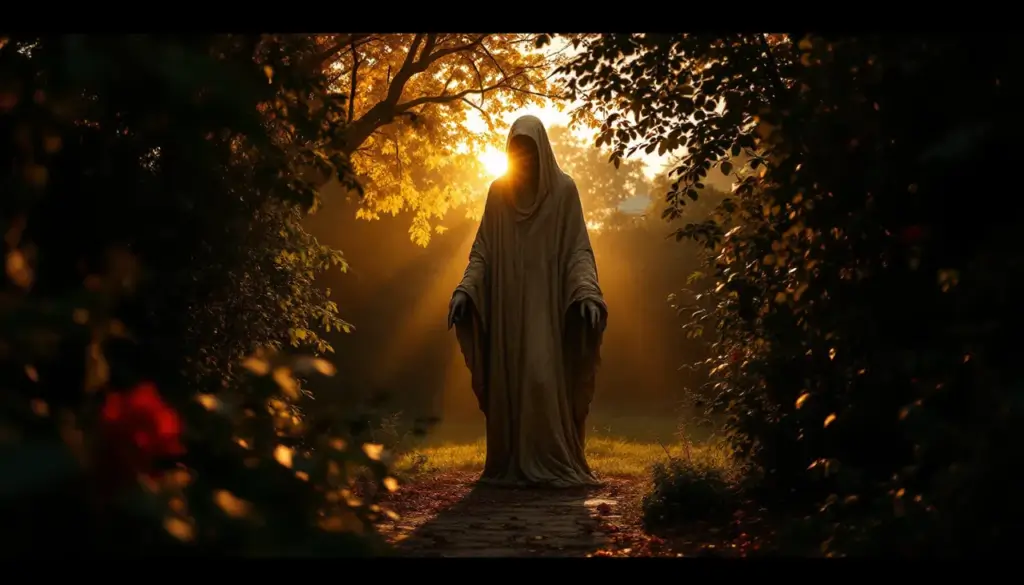
I want to be precise about what we are discussing here, because the word ‘statue’ is doing a great deal of work in this headline and I think it is worth acknowledging that directly. We are not talking about a moment of pleasant surprise. We are talking about the period — sometimes seconds, sometimes, according to several respondents, an uncomfortable number of minutes — during which a person stood at their kitchen window, or back door, or upstairs landing, and looked at a figure that was too tall, too still, too featureless, and too present, and successfully convinced themselves that they had simply forgotten purchasing a piece of garden art. This is the brain doing what the brain does. I do not judge it. I note it, because I think it is important data.

What The Readers Said, In Their Own Words
The responses cluster around a recognisable pattern. There is an initial sighting, usually peripheral. There is a pause. There is a mental inventory — ‘did my partner order something? Is that the new shepherd’s crook? Did the neighbours put something over the fence?’ — and then there is a moment of stillness that the respondent describes, almost universally, as the figure not moving in a way that felt different from the way a statue doesn’t move. Several people used the phrase ‘the wrong kind of still.’ One respondent from Keene, New Hampshire, wrote that she had stood at her bedroom window for eleven minutes before noticing that the figure’s proportions had changed between her second and third looks. She had attributed the first discrepancy to tiredness. She had attributed the second to the window glass. She is to be commended for eventually attributing the third to the correct cause.
I thought it was one of those tall abstract pieces. You know, the elongated ones. I’d been meaning to do something with that corner of the garden for years. Part of me was pleased someone had finally sorted it. That part of me was wrong.
— D. Hartwell, reader submission, Brattleboro area
FIELD ALERT
If you are currently looking at something in your garden and have opened this article to check: stop reading. Step back from the window. Do not return to the window. If the figure is no longer there when you next look, that is not reassurance. That is a different category of concern entirely. WTC advises readers in this situation to contact us directly via the secure submission form, after first ensuring that all ground-floor entry points are secured. Not because it will necessarily help. Because it is a reasonable thing to do with your hands.
What is instructive about the submitted accounts — and I have read all forty-seven, including the ones we are not publishing, including the two written in the dark — is how long the optimism holds. Respondents describe the figure as ‘probably’ a statue for periods ranging from thirty seconds to, in one case, the better part of a fortnight during which they had simply begun to think of it as a fixture. This respondent, who did not provide a name and whose submission postmark I have noted separately, described eventually realising something was wrong only when the figure was no longer present on a morning following heavy frost, and the ground beneath where it had stood was entirely undisturbed. No indentation. No frost shadow. Nothing to indicate that anything had been standing there at all. The reader’s phrasing was: ‘that was when I stopped calling it Gerald.’ I found this detail, specifically, worth passing on.
My first thought was honestly that it was beautiful. Very elegant. I was thinking about where I’d seen something similar in a catalogue. My second thought, about four minutes later, was that it had been facing the house the whole time and I hadn’t noticed it turn.
— M. Okafor, reader submission, submitted via the WTC secure form
FAST FACTS
• Forty-seven reader submissions received in response to the WTC garden figure query. Six published in full; two withheld on grounds of handwriting.
• The average duration of the ‘statue rationalisation phase’ across published submissions: approximately seven minutes. The longest: fourteen days.
• All six published respondents reported that the figure was standing in a part of the garden they described as ‘a spot I’d been meaning to do something with.’ This is noted without conclusion, but it is noted.
• No respondent reported the figure casting a shadow at the time of the initial sighting. Three respondents say they noticed this only in retrospect.
• WTC does not advise naming the figure. Even informally. Especially informally.
I will close with something practical, as I prefer to be useful where possible. If you are reading this because you have already been through the experience described above and are in the afterwards of it — the part where you are thinking very carefully about what you are and are not going to tell people — I would say this: the WTC secure submission form exists precisely for accounts that are difficult to frame in ordinary conversation. We read everything. We keep records. I maintain my own, separately, in a locked filing cabinet, under labels that make sense to me. You are not obliged to explain yourself to anyone who was not there. You are, however, encouraged to document what you saw as soon as possible, in as much detail as you can manage, while the detail is still with you. The brain is generous with its forgetting. In my experience, the things that happened in gardens at night deserve better than that.
evelyncrowe@whatthecryptid.com
Evelyn Crowe · Opinion Columnist — WTC