|
Credibility: ★★★☆☆ 3/5
|
Threat Level: MODERATE (Moderate. Don’t provoke it. Don’t renovate.)
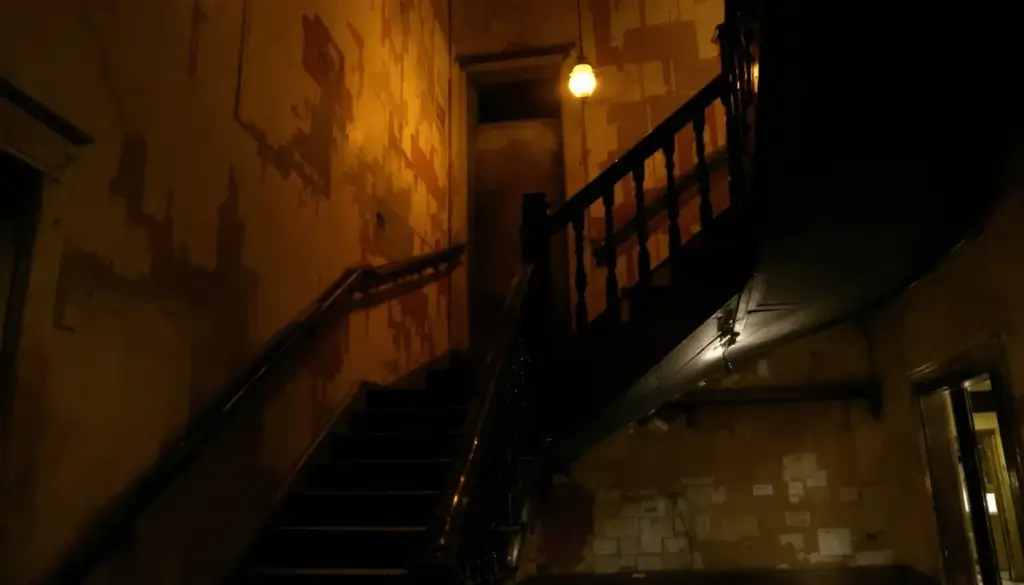
A structural historian says the entity in the Pembrook Building’s east stairwell has been holding things together since 1887 — and she may mean that literally.
Dr. Constance Vail has been studying the Pembrook Building for eleven years, and her position, stated plainly in the written summary she provided to eleven witnesses and one journalist last Thursday, is this: the entity in the east stairwell is not a problem to be solved. It is a condition the building has adapted to. ‘You are not looking at a haunting,’ she wrote. ‘You are looking at an equilibrium.’ She submitted this to the city’s Historic Preservation Board in a fourteen-page report. They have not yet responded. I am choosing to believe they are thinking carefully.
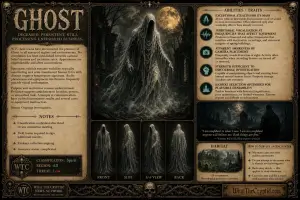
The ghost — and it is classified as a ghost, for the record, though Dr. Vail prefers the term ‘integrated presence,’ which I understand but will not be adopting — has been documented in the east stairwell since at least 1887. It predates the 1912 renovation that widened the staircase. It predates the 1954 re-routing of the electrical conduit through the east wall. It predates the current fire code, which Dr. Vail notes rather pointedly was written without any provision for entities that appear to stabilise ambient temperature in the immediate structural envelope by approximately four degrees. Three separate contractors have flagged the east stairwell as ‘anomalously sound’ during otherwise extensive repair work on the building. None of them were told why. Dr. Vail believes they would not have proceeded if they had been.

The building has had 137 years to account for this presence in its behaviour. The presence, for its part, has not moved. I would be very careful about deciding, at this point, who is accommodating whom.
— Dr. Constance Vail, Structural Historian
I have no formal opinion on whether buildings can become structurally reliant on a non-physical occupant. I have a house that is twenty-two years mine and considerably older than that, and I have learned to hold my opinions loosely where buildings and their longer-standing residents are concerned. What I will say is that Dr. Vail’s argument is not fringe. It is methodical. She has the survey data, she has the temperature logs, she has the contractor reports, and she has the 1887 notation in the building’s original maintenance ledger that reads, in a foreman’s hand: *east stair holds — don’t touch the east stair.* Nobody touched the east stair. The east stair is, by all accounts, fine.
The Preservation Board will do what it does. Remediation proposals will be submitted. Someone will use the word ‘abatement,’ and I will have a feeling about that word that I will keep to myself. But Dr. Vail’s report asks a question worth sitting with before anything is scheduled: if the Pembrook Building has been standing, intact and anomalously sound, for over a century of renovations and code changes and considerable structural stress — and if the one constant in that east stairwell is a presence that preceded all of it — then the question is not how to remove the presence. The question is what you are proposing to put in its place.
evelyncrowe@whatthecryptid.com
Evelyn Crowe · Opinion Columnist — WTC
Deceased. Persistent. Still processing unfinished business.