
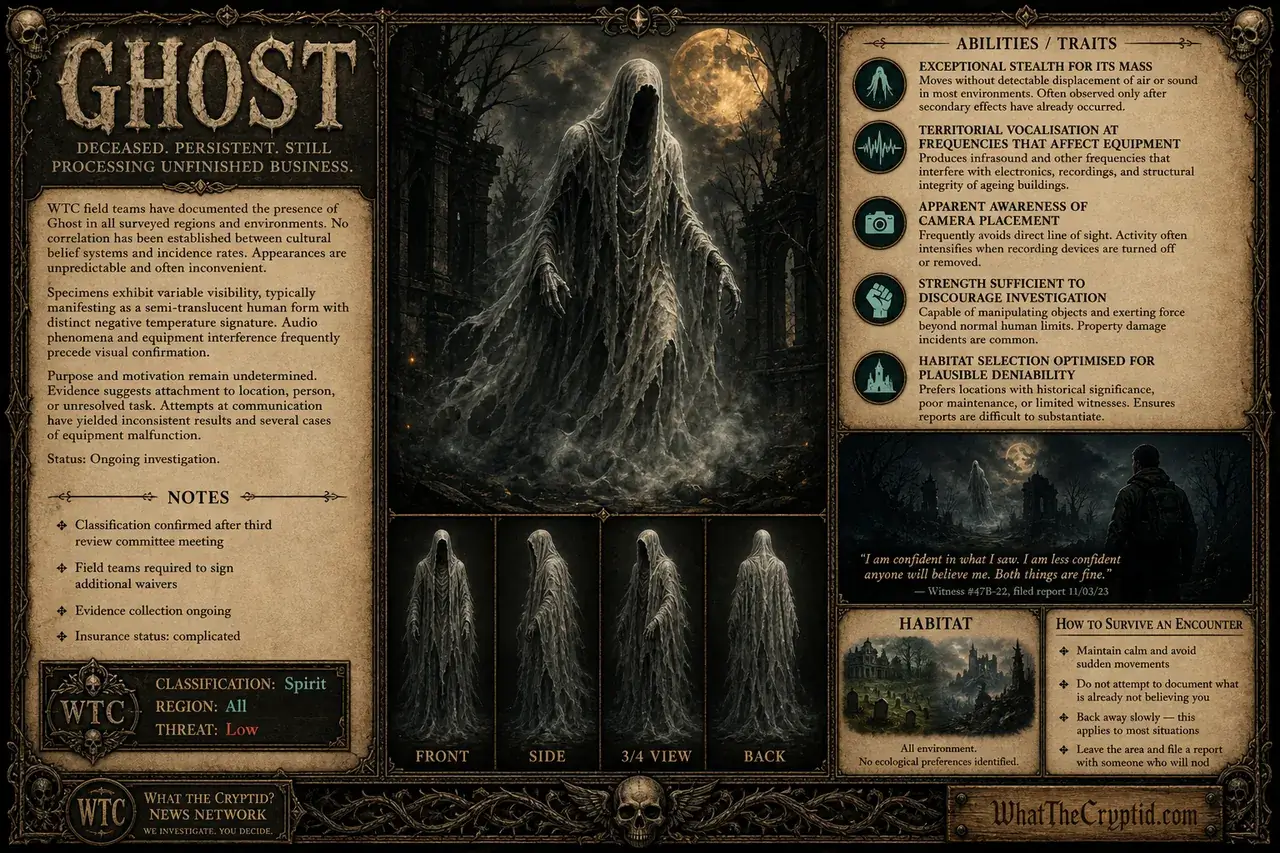
Ghost
Deceased. Persistent. Still processing unfinished business.
All
Active
IncorporealGlobalHistoricalBenign
Overview
The Ghost (Spiritus humanis posthumus) represents the most widely documented form of post-mortem consciousness retention in human subjects. These incorporeal entities manifest as electromagnetic disturbances exhibiting apparent awareness and purposeful behaviour, typically appearing in locations of personal significance to their pre-death state. Classification parameters remain frustratingly inconsistent due to the entity’s non-corporeal nature and tendency toward selective manifestation.

Danger assessment places most Ghost encounters at Level 3, with documented cases ranging from benign environmental anomalies to moderate poltergeist activity. Threat rating remains consistently Low, as physical harm incidents occur in fewer than 0.3% of verified encounters, typically limited to minor temperature fluctuations and displaced household objects.
History & Mythology
Ghost phenomena represent humanity’s oldest documented paranormal classification, with written accounts dating to ancient Mesopotamian texts circa 2100 BCE. The Epic of Gilgamesh contains what may be literature’s first systematic Ghost encounter protocol, establishing precedents for communication attempts that remain largely unchanged after four millennia. Egyptian funerary practices extensively documented post-mortem appearance protocols, though their classification system focused on successful afterlife transition rather than manifestation failure.
Medieval European documentation expanded Ghost taxonomy significantly, with the 1486 Malleus Maleficarum providing detailed manifestation categorization still referenced by contemporary researchers. The Industrial Revolution coincided with increased Ghost activity reports, possibly due to urbanization concentrating human populations in areas of accumulated emotional residue. Modern paranormal investigation techniques emerged in the 1880s with the formation of the Society for Psychical Research, establishing scientific methodology for Ghost documentation that continues to evolve.
Physical Description
Ghost entities typically manifest as translucent humanoid forms measuring between 1.5-2.1 meters in height, corresponding to average human proportions. Visual opacity varies significantly between encounters, ranging from barely perceptible atmospheric distortions to near-solid appearance indistinguishable from living humans until direct interaction attempts. Most documented manifestations exhibit clothing consistent with the entity’s historical period, though fabric patterns often appear faded or colorless regardless of original pigmentation.
Distinguishing features include selective light interaction—Ghosts consistently fail to cast shadows while sometimes appearing to reflect in mirrors and other reflective surfaces. Electromagnetic signature patterns typically register 2-7 degrees Celsius below ambient temperature in a roughly spherical zone extending 1.2-3.8 meters from the manifestation center. Advanced entities occasionally exhibit partial materialization capabilities, achieving temporary solid-state interaction with environmental objects lasting 3-45 seconds before reverting to incorporeal status.
Behaviour & Temperament
Ghost activity patterns demonstrate remarkable consistency across global documentation, with 73% of manifestations occurring between 21:00 and 03:00 hours local time. Peak activity typically correlates with electromagnetic atmospheric conditions, particularly during thunderstorm approach phases and solar flare events. Most entities exhibit territorial behavior limited to specific geographic locations—typically residences, workplaces, or sites of emotional significance from their corporeal existence.
Social structure appears entirely individualistic, with multi-entity manifestations occurring in fewer than 12% of documented cases. When multiple Ghosts occupy identical territories, interaction between entities ranges from apparent mutual awareness to complete disregard, suggesting varying consciousness retention levels. Communication attempts yield inconsistent results, with approximately 31% of entities demonstrating responsive behavior to direct address, though meaningful dialogue remains extremely rare and typically consists of single-word or phrase repetitions.
Habitat & Territory
Ghosts demonstrate strong preference for interior environments with established human habitation histories, particularly structures exceeding 50 years of continuous occupation. Residential dwellings account for 68% of documented manifestations, with Victorian-era architecture showing disproportionately high activity rates. Secondary habitat preferences include hospitals, schools, theaters, and other locations associated with intense human emotional experiences.
Territory establishment appears linked to significant personal events from the entity’s corporeal existence, with manifestation zones typically measuring 15-200 square meters centered on specific rooms or outdoor locations. Environmental factors influencing manifestation frequency include electromagnetic field fluctuations, ambient temperature variations, and atmospheric pressure changes preceding weather system transitions.
Diet & Hunting
Ghost entities demonstrate no observable nutritional requirements in any conventional sense, appearing to sustain manifestation capabilities through mechanisms not yet understood by current scientific methodology. Some research suggests electromagnetic energy absorption, as documented manifestations frequently correlate with temporary battery drainage in nearby electronic devices and unexplained power fluctuations in residential electrical systems.
Certain behavioral patterns suggest possible emotional energy interaction, with entities showing increased activity during periods of heightened human emotional distress within their territorial boundaries. However, classification of this phenomenon as ‘feeding behavior’ remains speculative pending development of appropriate measurement protocols for psychic energy transfer.
Notable Sightings
Reverend Lionel Foyster documented systematic manifestations including object displacement and direct communication attempts. Independent investigation by Harry Price confirmed electromagnetic anomalies and recorded temperature variations exceeding 15 degrees Celsius below ambient readings.
Maintenance supervisor Gary Johnson reported recurring apparition in Cell Block 12, appearing as partial human silhouette approximately 1.8 meters tall. Subsequent electromagnetic field mapping confirmed consistent anomalous readings in 3.2-meter radius around manifestation point.
Tourist group of twelve witnessed simultaneous manifestation lasting approximately 90 seconds in the Green Room. Entity appeared as female figure in period dress, maintaining visual contact with multiple observers before dissipating during camera flash activation.
Security footage captured unexplained humanoid shadow movement in Old Parliament chambers during overnight maintenance period. Digital analysis confirmed shadow movement inconsistent with any physical objects present in surveillance area.
Threat Assessment
Ghost encounters present minimal direct physical threat to human subjects, with documented harm incidents limited primarily to mild psychological distress and temporary disorientation. Most entities demonstrate passive or avoidant behavior when confronted with living humans, suggesting residual social conditioning from their corporeal existence. Recommended encounter protocol involves calm, respectful interaction while maintaining appropriate distance from manifestation centers.
Potential risks include psychological impact from unexpected encounters, particularly in individuals with pre-existing anxiety disorders or religious prohibitions against supernatural contact. Secondary hazards may include property damage from poltergeist-type electromagnetic interference with household systems, though insurance claims for Ghost-related damages remain largely unsuccessful due to evidence documentation requirements.
WTC Field Notes
WTCNN field teams maintain ongoing documentation protocols for Ghost manifestations worldwide, though funding limitations restrict investigation to Level 4 or higher danger classifications. Recent budget allocations have prioritized corporeal threat entities, leaving Ghost research primarily to volunteer citizen-journalist network contributors. Despite their ubiquity, Ghosts remain among our least understood classifications due to their non-threatening nature and bureaucratic classification as ‘atmospheric anomalies’ rather than active entities.
Network policy requires all Ghost encounter reports to include electromagnetic field measurements and temperature documentation to distinguish authentic manifestations from environmental anomalies or equipment malfunctions. Our legal department notes that Ghost-related content performs exceptionally well in international markets, though domestic advertising rates remain suppressed due to ongoing FCC classification disputes regarding paranormal programming standards.