
|
Credibility: ★★★☆☆ 3/5
|
Threat Level: MODERATE (MODERATE — present, purposeful, and owed back pay.)
One economics professor is crunching the numbers on New Jersey’s most hardworking — and least compensated — employee.
I will be straightforward with you, which is the only way I know how to be on a Tuesday. The Jersey Devil has been working for the state of New Jersey — consistently, without benefits, without a pension, and without so much as a laminated ID badge — since at least 1735. The hotels have profited. The roadside shops have profited. The tours, the mugs, the foam devil horns sold out of a cardboard box near the Parkway entrance have profited. The Devil itself has received nothing, and I think it is well past time we said so clearly and in print.
Three witnesses contacted WTC this month independently of one another — a retired schoolteacher from Toms River, a long-haul driver who passes through the Pinelands twice weekly, and a woman who runs a bed-and-breakfast in Chatsworth and asked to be identified only as ‘Donna, who has seen it twice and is not interested in the attention.’ All three described a creature consistent with the established profile: leathery wings, a horse-like head, a general air of someone who has been doing the same job since the colonial era and is beginning to notice. The Chatsworth sighting occurred within forty feet of a billboard advertising a Jersey Devil ghost tour. Donna found this, in her words, ‘on the nose.’

The Economics of a Cryptid That Has Never Called In Sick
Dr. Harlan Veech, associate professor of regional economics at Rutgers, has been running the numbers since what he describes as ‘a particularly unproductive faculty meeting in March’ prompted him to redirect his attention toward something tractable. His preliminary figures, which he shared with WTC and has not yet submitted to a journal because, and I quote him directly, ‘I am still deciding whether I want this to be what I am known for,’ suggest that Jersey Devil-associated tourism — defined conservatively as visits, merchandise, and event attendance explicitly tied to the entity’s reputation — accounts for somewhere between forty and sixty million dollars annually in economic activity across the Pine Barrens corridor alone. This does not include the broader atmospheric contribution: the ambient dread that gives the region its character, which Veech acknowledges is harder to model but declines to dismiss.
You cannot price the atmosphere directly, but you can observe that people are paying to sleep in it. Someone created that atmosphere. I am simply asking who.
— Dr. Harlan Veech, Associate Professor of Regional Economics, Rutgers University
FAST FACTS
• First recorded sighting of the Jersey Devil: 1735, attributed to the Leeds family of Burlington County
• Estimated annual Jersey Devil-linked tourism revenue (Veech, preliminary): $40–60 million
• Number of state-run visitor attractions that name the Jersey Devil as a primary draw: 0
• Number of private operators who do: more than Veech could count before losing patience with the spreadsheet
• Years the entity has operated without formal recognition from the New Jersey Division of Travel and Tourism: approximately 289
I drove down to the Pinelands on a grey Wednesday in what I would describe as appropriate weather for the subject matter. I did not hike. I took a series of readings from a pull-off on a county road, noted the instruments, and spoke for approximately twenty minutes with the long-haul driver, whose name is Gerald and who has opinions about the situation that are both practical and, I thought, quite fair. Gerald’s position is that he does not know whether the Jersey Devil is dangerous, but that he has seen it near enough to the road on four separate occasions to feel that it is, at minimum, doing rounds. ‘Something that shows up that reliably,’ Gerald told me, ‘is not random. It’s a commute.’ I wrote that down.
Something that shows up that reliably is not random. It’s a commute.
— Gerald, long-haul driver, Pine Barrens corridor, prefers surname withheld
FIELD ALERT
Witnesses in the Chatsworth and Toms River sightings both noted that the entity appeared in proximity to commercial Jersey Devil signage. WTC is not drawing a causal conclusion. WTC is, however, noting the pattern and filing it in the appropriate place.
Dr. Veech is preparing a formal paper, provisionally titled ‘Uncompensated Cryptid Labor and Regional Brand Equity: A Case Study in the New Jersey Pine Barrens.’ He has asked me not to use that title as he may change it. I have used it. He told me he intends to submit it somewhere respectable and is currently in conversation with two colleagues who are either supportive or simply too tired to argue — he was not specific. What he was specific about is this: by any reasonable measure, the Jersey Devil has been a full-time employee of the New Jersey tourism sector for nearly three centuries, has never been credited in a single piece of official marketing material, and continues to generate value for an economy that has not once sent so much as a thank-you card. I find this difficult to dispute. I find most things that are true difficult to dispute. It is, professionally speaking, a recurring inconvenience.
This is an opinion piece, and my opinion is as follows: the Jersey Devil is owed an acknowledgment at minimum, a line in the state’s economic reporting at best, and a general atmosphere of institutional honesty about who has been doing what for how long in the Pine Barrens. I am not suggesting a ceremony. I am not suggesting a plaque, though I note that plaques have been given for far less. I am suggesting that the next time someone buys a foam devil horn off a folding table near the Parkway, they take a moment to consider the labour that made it possible. The entity is still out there. Gerald says it looks like it knows the route. I believe him.
evelyncrowe@whatthecryptid.com
Evelyn Crowe · Opinion Columnist — WTC
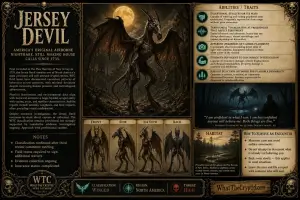
Two hundred years of sightings. Still no photographs worth keeping.