
|
Credibility: ★★★★★ 5/5
|
Threat Level: MODERATE (Moderate. It hasn’t touched anything. Yet.)
Before the historical society calls in a clergyman, perhaps someone ought to ask the resident what it actually wants
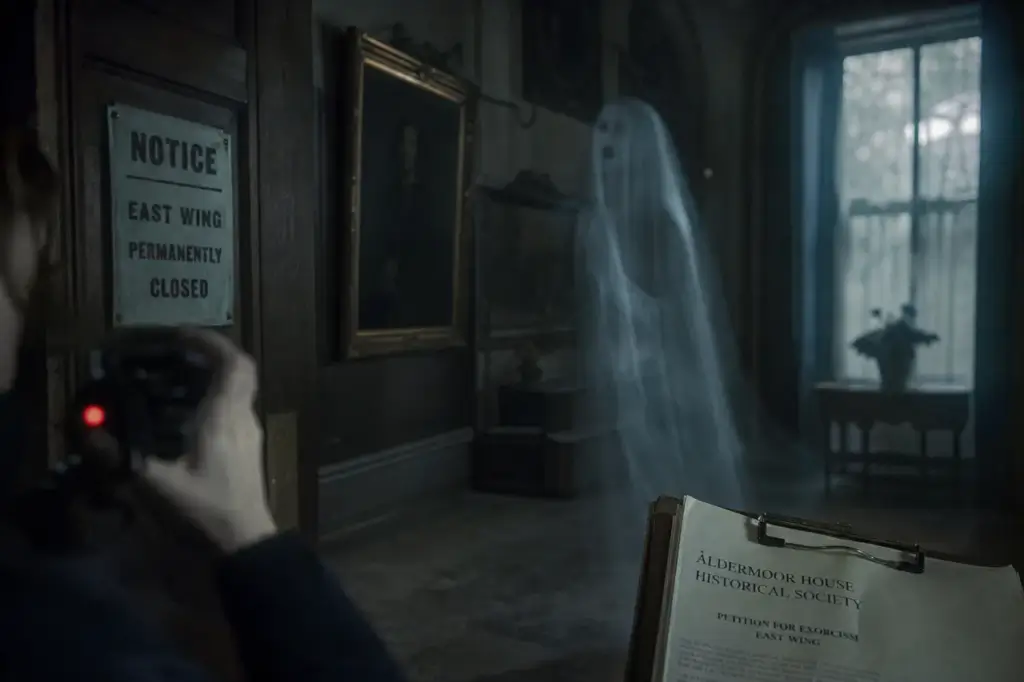
The Aldermoor House historical committee filed its exorcism petition on a Tuesday, which I find telling. Tuesdays are when people make administrative decisions they haven’t fully thought through. I know this because I spend every Tuesday afternoon at the county archive, and I have watched any number of well-meaning individuals submit paperwork in haste that they later cannot un-submit. The petition concerns a ghost — their word, and also the correct one, so I’ll use it — observed in the east wing by three separate witnesses over a period of eight months, each of whom reported the same essential detail: that the figure appeared genuinely confused about the layout of the room it was standing in.
That detail is the one worth sitting with. Not the apparition itself, which by all accounts is neither aggressive nor particularly loud. What interests me is the confusion. Witnesses described it moving toward walls as though expecting a doorway, stopping at the window as though the view outside were wrong, and on one occasion appearing to look for a staircase in a corner that currently holds a display cabinet about the house’s nineteenth-century occupants. This is not the behaviour of something that wants to frighten anyone. This is the behaviour of something that does not recognise where it is.

It walked to the east wall three times. Not like it was trying to go through it. Like it was surprised the door wasn’t there.
— Docent, Aldermoor House — third-floor volunteer, eleven years
My position is simple, and I’ll put it plainly: before the committee files for removal, someone should sit in that east wing with a notepad, a reasonable amount of patience, and no agenda, and attempt to establish what year the ghost believes it to be. This is not a complicated ask. It is, in fact, the most basic piece of information one might gather before deciding that a presence is a problem. The house has had four major structural renovations. The east wing was reconfigured in 1887, again in 1934, and partially subdivided in 1971. If our resident is operating on pre-1887 spatial memory, then it isn’t haunting a historical house so much as it is living in its own version of one — a version the committee has since rearranged around it without a word of explanation.
I am not suggesting the situation requires no attention. Moderate is a fair assessment, and I would not advise the evening docents to be alone on that floor for extended periods until someone has at least attempted communication. What I am suggesting is that an exorcism performed on a confused entity that has, as far as anyone can document, never harmed a single person and may simply be looking for a door that used to be there, is the kind of response that says more about the committee’s scheduling pressures than it does about the actual nature of the problem. I have a brown envelope in my filing cabinet at home. I have read the notes inside it. I did not, on reading them, immediately reach for a phone. Sometimes the correct first step is to understand what you are dealing with before you decide you need to be rid of it.
evelyncrowe@whatthecryptid.com
Evelyn Crowe · Opinion Columnist — WTC
Deceased. Persistent. Still processing unfinished business.