|
Credibility: ★★★☆☆ 3/5
|
Threat Level: HIGH (HIGH — structurally considered, per the ornithologist)
A retired ornithologist in Skamania County has submitted documentation to three institutions. One confirmed receipt. We read the documentation.
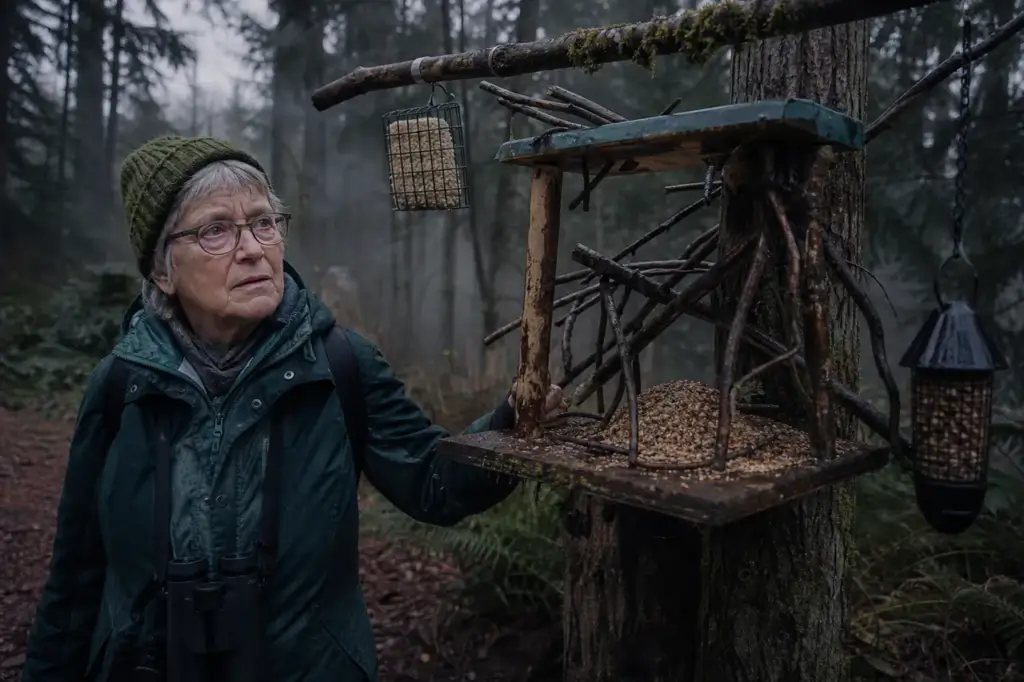
Dr. Rosalind Vance spent thirty-one years studying Pacific Northwest bird populations for the U.S. Geological Survey. She knows what a bird feeder looks like when a bear gets into it. She knows what wind damage looks like. She knows what squirrels do, which she describes as ‘chaotic and without vision.’ What happened to the cedar platform feeder in her backyard in Skamania County, Washington, over the course of six weeks this past autumn, is not any of those things. ‘Each modification built on the previous one,’ she told me over the phone, her voice carrying the particular flatness of someone who has already decided they will not be rattled by the implications of their own data. ‘The structure, taken as a whole, reflects an awareness of what the structure was for.’ She submitted her documentation — timestamped photographs, measurements, a materials analysis, and a four-page narrative summary — to the Washington Department of Fish and Wildlife, the University of Washington’s biology department, and the Cascades Raptor Center, on the grounds that some of the modifications appeared to improve seed access for larger ground-feeding birds. The Cascades Raptor Center confirmed receipt. The other two have not responded. This is, in my professional assessment, their loss.
Dr. Vance has ten neighbours who have, between them, confirmed seeing a large bipedal figure in or near her property on at least four separate occasions over the same six-week period. None of them called it Bigfoot by name in their initial statements, though three used the phrase ‘too big to be a person’ and one said ‘definitely not a bear, I have seen a bear’ with a confidence that I found compelling. I have driven the Civic out to Skamania County before. I have the right notebook for this. I am choosing to call what happened to Dr. Vance’s bird feeder what it is: a sequence of deliberate, escalating, structurally considered interventions. Here are the five things, in order.

The Five Modifications, Documented and Ranked by Degree of Oh No
The Pole Was Straightened
Dr. Vance’s feeder hangs from a galvanized steel pole she installed in 2019 and which had, over the years, developed a roughly eight-degree lean toward the northeast. She had not corrected this because, in her words, ‘the birds didn’t care.’ On the morning of October 3rd, the pole was vertical. Perfectly, measurably vertical — she got out a level. The ground around the base showed evidence of compression consistent with something having gripped the pole and applied controlled lateral force. The seed tray was undisturbed. Nothing was eaten. Whatever did this came to a bird feeder, decided the pole was crooked, fixed the pole, and left. I have sat with this for several days and I am still sitting with it.
A Second Hook Was Added
By October 11th, a second hook had been affixed to the pole approximately fourteen inches below the primary feeder mount. It was fashioned from what Dr. Vance’s materials analysis identified as a length of stripped alder branch, split and bent back on itself with enough precision to hold a load. ‘It’s a functional hook,’ she said, and then paused, and then said it again. ‘It’s a functional hook.’ She subsequently hung a secondary nyjer sock feeder from it to see what would happen. What happened is item three on this list.
The Nyjer Sock Was Repositioned
The nyjer sock feeder Dr. Vance hung from the new hook was, within forty-eight hours, moved. Not removed. Moved — specifically, rotated approximately ninety degrees on the hook so that its open feeding ports faced away from the prevailing wind direction off the Columbia River Gorge. Dr. Vance, being an ornithologist, checked her records. Her Pine Siskin visits to that feeder increased by roughly forty percent in the week following the repositioning. ‘I’m not saying it understood the wind,’ she told me. ‘I’m saying that whatever it did produced the optimal outcome for finch access, and I don’t know how else to account for that.’ I’m saying it understood the wind.
The Squirrel Baffle Was Reinforced
Dr. Vance’s original squirrel baffle — a standard dome model — had been compromised for approximately two years by a particularly determined Douglas squirrel she’d named Gerald. Sometime during the night of October 19th, a secondary deterrent was added below the original baffle: a loose collar of interwoven green branches, still supple enough to spin freely when tested, fixed to the pole in a way that made the surface ungrippable. Gerald has not accessed the feeder since. Dr. Vance has mixed feelings about this, having developed what she calls ‘a complicated respect’ for Gerald over two years of watching him work. The branch collar showed, in her words, ‘joinery.’ I looked at the photographs. I agree about the joinery.
A New Perch Was Installed at an Unusual Height
This is the one that made Dr. Vance call the three institutions. On October 28th, she found a horizontal branch approximately twenty-two inches long affixed to the pole at a height of roughly six feet — well above the functional range of the existing feeder setup, and at a diameter suitable for a bird significantly larger than anything she typically receives at the feeder. ‘That perch height and diameter is consistent with corvid use,’ she told me. ‘Large corvids. Raven-sized.’ She reviewed her camera trap footage. A Common Raven used the perch on November 1st, and again on November 3rd, and has been a semi-regular presence since. ‘Something built infrastructure for a raven,’ she said, and then went quiet for long enough that I didn’t fill it. Whatever is doing this — and Bigfoot is not a name Dr. Vance uses, though she stops pointedly short of ruling anything out — appears to be managing a multi-species access system with a coherent design logic. The raven perch was not added for the raven’s benefit alone. Ravens, in the documented literature on large primate cognition, are associated with food-finding partnerships. I have a folder on my laptop. I am going to find the relevant files.
Each modification built on the previous one. The structure, taken as a whole, reflects an awareness of what the structure was for.
— Dr. Rosalind Vance, Retired Ornithologist, Skamania County
I want to be precise about what Dr. Vance has and hasn’t claimed. She has not claimed a cryptid is gardening her bird feeder. She has claimed that five sequential, escalating, structurally interdependent modifications were made to her feeder installation by an agent that demonstrably was not her, was not any of her neighbours, was not Gerald, and was not a bear. She has the photographs. She has the measurements. She has a materials analysis from a colleague at Portland State she called in a favour from, who identified the branch collar as alder and the perch as Douglas fir and then apparently asked no further questions, which is a choice. She also has ten neighbours who described something large and bipedal, repeatedly, over six weeks, in the vicinity of a yard where something large and bipedal was apparently engaged in a sustained home improvement project. I have reported on a lot of cases in a lot of notebooks with a lot of colour-coded tabs. This is the one I started a new notebook for.
FIELD ALERT
If you reside in or near Skamania County and have observed modifications to outdoor structures, feeding installations, or other yard infrastructure that you did not make and cannot account for, WTC News would like to hear from you. Please document before touching. We cannot stress this enough. Document before touching.
I’m not saying it understood the wind. I’m saying that whatever it did produced the optimal outcome for finch access, and I don’t know how else to account for that.
— Dr. Rosalind Vance, Retired Ornithologist, Skamania County
FAST FACTS
• Skamania County, Washington has had documented large bipedal sighting reports since at least the 1920s and passed a Bigfoot protection ordinance in 1969 — one of the only jurisdictions in the U.S. to do so.
• Dr. Vance’s documentation runs to 47 pages including appendices. She formatted it according to USGS field reporting standards ‘because that’s how you do it.’
• The Cascades Raptor Center confirmed receipt of her submission on November 12th. As of publication, no substantive response has followed. We have emailed them.
• Ravens (Corvus corax) are documented to form cooperative foraging relationships with large mammals in multiple ecosystems. This is established science. We are simply noting that it is established science.
The institutions that haven’t responded will, eventually, have to account for this record. Documentation doesn’t expire. Dr. Vance is retired, she is methodical, and by her own description she has time. The feeder modifications stopped after the raven perch — nothing new has been added in three weeks — but she told me she hasn’t moved anything, changed anything, or altered the setup in any way. ‘I want to see if there’s a phase two,’ she said. I told her I’d like to be notified if there is. She said she’d think about it, which I’m taking as a yes. I drove home through the gorge with the heat on and the radio off and thought about what it means to build something for a raven. Mr. Whiskers was asleep on the research notebooks when I got in. I moved him carefully and opened a new tab and did not immediately find the file I was looking for, but I know it’s in there. I built a whole folder structure last January. It was colour-coded and everything.
pennyhart@whatthecryptid.com
Penny Hart · Features Writer & Community Content Specialist — WTC
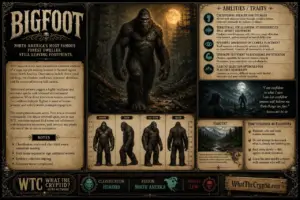
North America’s most famous forest dweller. Still leaving footprints.