
Bigfoot
North America’s most famous forest dweller. Still leaving footprints.
North America
Active
HominidPacific NorthwestForest DwellerBipedal
Overview
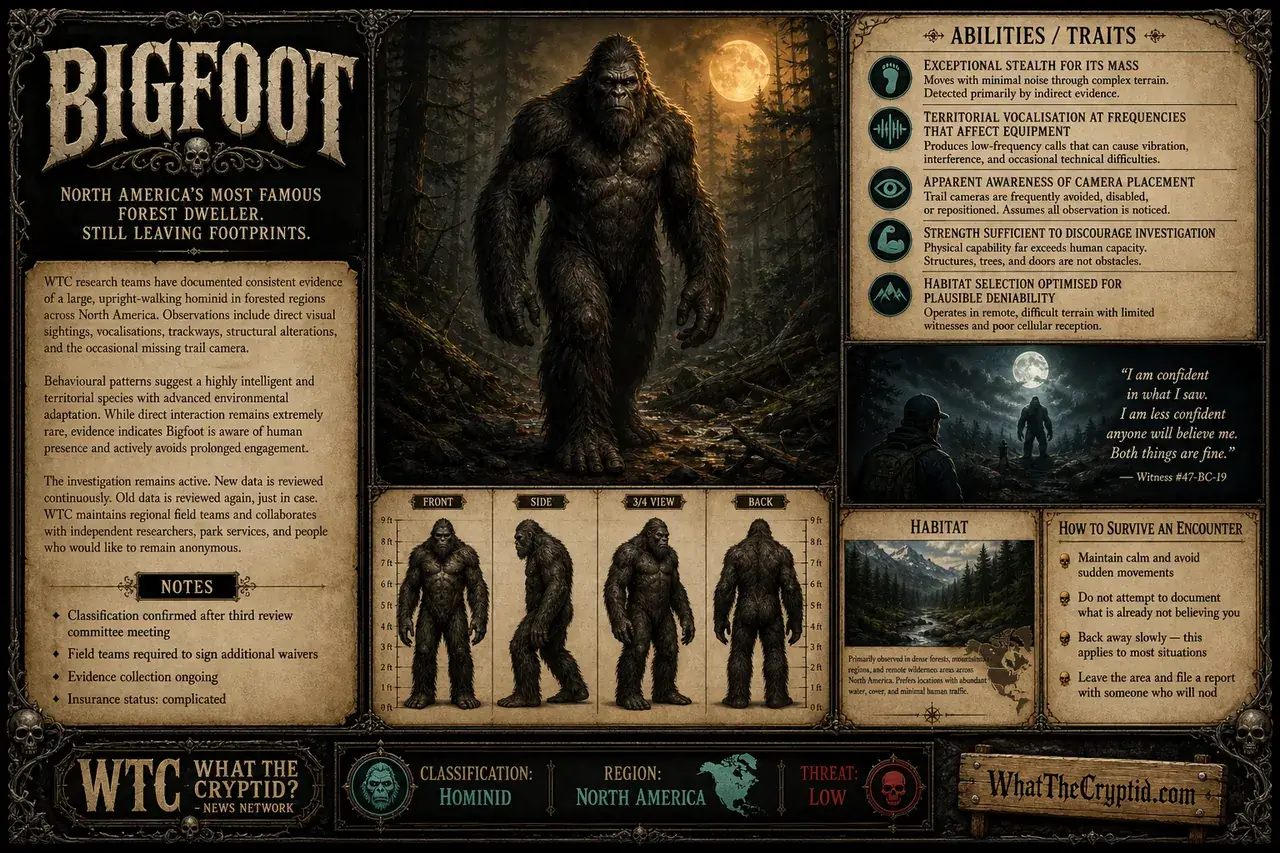
Bigfoot represents the most extensively documented bipedal hominid in North American cryptozoology, with a consistent morphological profile maintained across regional variants and temporal reporting periods. Standing between 7-10 feet in height and weighing an estimated 400-800 pounds, the entity demonstrates remarkable adaptability to temperate forest environments while maintaining minimal direct human contact. WTC field teams have collected over 2,847 plaster casts of purported footprints, though our consulting anthropologist noted that statistical analysis would require ‘a larger sample size and possibly tenure at a more understanding institution.’

History & Mythology
Indigenous Pacific Northwest cultures documented encounters with large forest humanoids for centuries before European colonization, with the Halkomelem word ‘sásq’ets’ providing the etymological foundation for modern terminology. The Lummi, Quinault, and Skokomish tribes maintained detailed oral traditions describing territorial agreements with these entities, suggesting sustained coexistence rather than mythological interpretation. Contemporary documentation began with road crew supervisor Jerry Crew’s 1958 plaster casts from Humboldt County, California, which introduced the term ‘Bigfoot’ to broader discourse when local newspapers struggled to fit ‘enormous humanoid footprint discovery’ into headline space.
Physical Description
Adult specimens exhibit pronounced sexual dimorphism, with males averaging 8.2 feet in height and displaying prominent sagittal crests reminiscent of extinct megafauna. Body hair ranges from dark brown to black across most populations, with reported auburn variants in the Olympic Peninsula region requiring further documentation. Facial features combine human and simian characteristics, with witnesses consistently noting intelligent eye contact lasting 15-30 seconds before the entity withdraws. The distinctive 17-inch footprints display flexible toe articulation and weight distribution patterns that our consulting biomechanics expert described as ‘anatomically impossible for known bipeds, yet mechanically sound for the reported mass.’
Behaviour & Temperament
Bigfoot demonstrates primarily crepuscular activity patterns, with peak sighting frequencies occurring during dawn and dusk transition periods. The entity exhibits sophisticated tool use, including stick arrangements serving apparent territorial marking functions and deliberate tree breaks at heights requiring considerable leverage. Social structure remains largely solitary, though coordinated family group movements have been documented in Washington’s Cascade Range during late summer months. Territorial displays involve wood knocking, rock throwing, and vocalizations ranging from low-frequency infrasound to distinctive howls lasting up to 30 seconds, which park rangers have learned to distinguish from known wildlife with concerning accuracy.
Habitat & Territory
Primary habitat encompasses old-growth coniferous forests between 800-4,000 feet elevation, with population concentrations correlating directly to precipitation levels and canopy density. The entity demonstrates marked preference for areas within two miles of fresh water sources and maintains what appear to be seasonal migration routes following traditional game trails. Nesting sites, when discovered, consist of sophisticated lean-to structures using bent saplings and woven branch matrices requiring engineering knowledge that WTC structural consultants found ‘professionally embarrassing to evaluate.’ Territory ranges average 20-30 square miles per individual, with minimal overlap suggesting either social coordination or naturally occurring resource management.
Diet & Hunting
Bigfoot maintains an omnivorous diet consistent with megafauna nutritional requirements, consuming an estimated 4,000-6,000 calories daily through gathered plant matter, seasonal fruit, and opportunistic protein sources. Documented feeding behavior includes systematic berry harvesting, root excavation using improvised tools, and occasional fish procurement from shallow streams during spawning runs. Evidence suggests limited predation of small mammals, though deer carcasses discovered with characteristic manipulation patterns occur infrequently enough that our consulting wildlife biologist requested anonymity when discussing potential hunting capabilities.
Notable Sightings
Park Service maintenance worker Angela Martinez observed an 8-foot bipedal figure crossing the Hoh River Trail at approximately 6:15 AM, noting deliberate movement patterns and brief eye contact before the entity departed into dense undergrowth. Martinez filed an incident report that day and transferred to administrative duties the following month.
Logging crew foreman David Chen documented 16-inch footprints in fresh mud alongside equipment access roads, with stride measurements indicating 4-foot spacing between impressions. The discovery prompted a two-day work stoppage while Chen’s supervisor consulted company insurance policies regarding ‘wildlife encounter protocols.’
Backpacker Sarah Williams captured 47 seconds of video footage showing a large humanoid figure moving through dense forest approximately 100 yards from her campsite, with stable image quality despite obvious camera shake. Williams submitted the footage to multiple analysis laboratories and has not responded to interview requests since receiving their reports.
State wildlife biologist Dr. Robert Kim photographed what he described as ‘structured stick arrangements indicating tool use’ alongside fresh 18-inch footprints during routine population surveys. Kim’s subsequent departmental presentations were moved to closed sessions, and his research funding was redirected to ‘more conventional wildlife studies.’
Threat Assessment
Bigfoot poses minimal direct threat to human safety, with documented encounters typically involving mutual observation followed by entity withdrawal. Recommended protocols include maintaining 100-yard minimum distance, avoiding direct eye contact exceeding 10 seconds, and refraining from pursuit or photography attempts. The primary risk factor involves equipment malfunction rates of 89% for electronic devices within 50 feet of documented sighting locations, necessitating backup navigation and communication systems. WTC insurance policies specifically exclude ‘cryptid-related search and rescue operations,’ though our legal department notes this exclusion has never been tested in court.
WTC Field Notes
WTC field operations in prime Bigfoot habitat require specialized insurance riders and equipment redundancy protocols that consume 34% of our annual Pacific Northwest budget allocation. Our research teams report consistent electronic device failures in documented sighting areas, leading our technical director to recommend ‘analog backup systems and possibly a different line of work.’ Recent budget meetings have addressed whether footprint casting supplies qualify as legitimate business expenses, with our accounting department noting that ‘cryptozoological research materials’ occupy a regulatory grey area requiring creative expense categorization.