|
Credibility: ★★★☆☆ 3/5
|
Threat Level: MODERATE (Moderate — mostly to one academic’s publication record.)
Clear footage from the Tarkine wilderness has sixteen witnesses buzzing — and one very quiet zoologist.
TARKINE WILDERNESS, TASMANIA — A wildlife cameraman operating in one of Australia’s last great temperate rainforests has returned from the bush with what colleagues are already calling the most compelling footage of a living thylacine captured in the modern era. The footage, shot over two consecutive mornings near a creek drainage in the western Tarkine, shows a striped, dog-sized animal moving with the characteristic stiff-tailed, loping gait that field naturalists have associated with the species since before its supposed extinction in 1936. Sixteen individuals — including four other crew members, two park rangers, and a group of bushwalkers who happened to be in the area — have independently confirmed seeing the animal. The one person we most wanted to talk to about all of this, however, is apparently not picking up his phone.
The Footage: What We’re Looking At
The cameraman, Marcus Holt, 41, has been working wildlife documentary contracts in Tasmania for over a decade. He is not, by his own repeated insistence, ‘a cryptid guy.’ He told WTC News that he initially assumed the animal was a large feral dog or possibly a quoll with some kind of mange condition affecting its coloration. It was only on the second morning, when the animal returned to the same location and he was able to shoot nearly eleven minutes of continuous footage in decent early light, that he started to get uncomfortable with that explanation. ‘The stripes aren’t paint,’ he said flatly. ‘The tail is wrong for a dog. The hips move wrong. I’ve filmed hundreds of animals in this country. I know what I’m looking at, and I genuinely wish I didn’t, because my life would be a lot simpler right now.’

The stripes aren’t paint. The tail is wrong for a dog. The hips move wrong. I’ve filmed hundreds of animals in this country. I know what I’m looking at, and I genuinely wish I didn’t.
— Marcus Holt, Wildlife Cameraman
The footage has been reviewed by three independent zoologists willing to go on record — none of them from the University of Melbourne — and all three have used the phrase ‘consistent with thylacine morphology’ while simultaneously finding ways to avoid committing to anything that would make their department heads call them. Dr. Priya Subramaniam of the Australian Museum offered the most direct assessment, telling WTC News that the gait analysis alone ‘rules out every extant species I can account for in that region.’ A full frame-by-frame analysis is reportedly underway at a facility that asked not to be named, which in my experience means someone is taking this seriously and trying to protect their career at the same time. Fair enough.
FIELD ALERT
The Tarkine wilderness covers approximately 477,000 hectares of largely inaccessible terrain in northwestern Tasmania. If a breeding population of thylacines has persisted there undetected, wildlife authorities and independent researchers are both advising against uncoordinated public search efforts, which risk disturbing the area and contaminating any evidence trail. WTC News concurs. Do not go traipsing into the Tarkine on our behalf. We mean it.
The Silence From Melbourne
Which brings us to Dr. Alan Forsythe, Associate Professor of Zoology at the University of Melbourne, and the author of a 2019 peer-reviewed paper titled, with remarkable confidence, ‘The Thylacine: A Closed Case.’ In that paper, Dr. Forsythe argued that the probability of surviving thylacine individuals was, and I am quoting directly here, ‘statistically indistinguishable from zero,’ and called for the scientific community to formally redirect resources away from any further field investigation of the species. WTC News has now attempted to contact Dr. Forsythe on three separate days via email, phone, and through his department’s general inquiry line. We have received no response. His department confirmed he is ‘available and on campus.’ They did not explain why a man who is available and on campus cannot return a media call in seventy-two hours.
His department confirmed he is available and on campus. They did not explain why a man who is available and on campus cannot return a media call in seventy-two hours.
— Daryl, WTC News
FAST FACTS
• The thylacine (Thylacinus cynocephalus) was officially declared extinct in 1986, fifty years after the last captive specimen died at Hobart Zoo on September 7, 1936.
• The Tarkine wilderness in northwestern Tasmania is one of the largest temperate rainforests in the Southern Hemisphere and has historically been the region generating the highest volume of credible post-extinction thylacine sighting reports.
• Sixteen witnesses have confirmed the current sighting — the largest single-incident witness count in any thylacine report logged in WTC’s tracking database.
• Dr. Forsythe’s 2019 paper has been cited 47 times. At least three of those citations may age poorly.
• Marcus Holt has agreed to provide WTC News with raw, unedited footage pending legal review of his contract with the documentary production company currently threatening to claim ownership of it.
I want to be careful here, because WTC News covers a lot of stories where ‘expert goes quiet’ means something dramatic and probably bad. This one feels different. Dr. Forsythe isn’t missing. He isn’t in danger. He is a man sitting in a university building who wrote a paper with a definitive title and is now watching footage circulate online that is making that title look like a dare the universe decided to accept. His silence is not a mystery in the cryptid sense. It is a silence most of us would probably maintain if we were in his position, which is the position of being very publicly and very inconveniently wrong. I have some sympathy for that. But he did call it a closed case. In print. With citations.
WTC News will continue to follow this story as the footage analysis progresses and as the search for anyone willing to officially confirm what sixteen people already saw continues. If Dr. Forsythe decides he would like to comment — to explain, revise, or simply acknowledge that cases sometimes reopen — our line is available. Unlike his, apparently. Marcus Holt will be returning to the Tarkine next week with additional equipment and, he told us, ‘a much better attitude about what might still be out there.’ Sixteen witnesses tend to do that to a person.
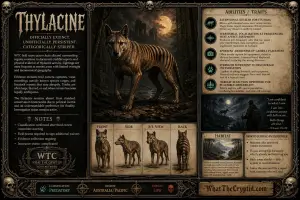
Officially extinct since 1936. Unofficially, less certain.