Thylacine
Officially extinct since 1936. Unofficially, less certain.
Australia/Pacific
Active
ThylacineTasmaniaExtinctMarsupialAustralia
Overview
The Thylacine (Thylacinus cynocephalus) presents a classification problem that WTC editorial staff have discussed at length and agreed to table indefinitely. By every formal measure, the species ceased to exist on 7 September 1936, when the last confirmed individual — a male held at Hobart Zoo, Tasmania, named Benjamin by staff who later denied this — died in captivity following an administrative oversight that left him locked out of his sleeping quarters during a cold snap. The Tasmanian government listed the species as extinct in 1986, fifty years after that date, which is either a clerical delay or an unusually cautious position, depending on who you ask at WTC.

The difficulty is that sightings have continued with a frequency and geographic consistency that our research team finds professionally uncomfortable to dismiss. Since 1936, over 3,800 sighting reports have been logged across Tasmania, mainland Australia, and — in a small number of cases that the database flags with a dedicated icon — Western Australia, where the animal was presumed absent for at least two thousand years prior. WTC does not classify the Thylacine as supernatural. We classify it as an animal that may not have read its own obituary.
For the purposes of this entry, the Thylacine is treated as an extant species operating under conditions of extreme evasion. Whether this represents a remnant population, a relict population, or something our consulting zoologist described only as ‘an ongoing situation,’ WTC cannot confirm. The consulting zoologist has since moved to a different department.
History & Mythology
Aboriginal Australians maintained detailed knowledge of the Thylacine for at least 30,000 years, a period during which the animal’s existence was not considered remarkable or in need of verification. Rock art across the Pilbara region of Western Australia, including panels at Murujuga dated conservatively to 25,000 BCE, depicts the animal with anatomical accuracy sufficient to confirm species identification — the distinctive striped dorsal markings, the stiff tail, the wide-gaping jaw. The Palawa people of Tasmania referred to the creature in oral traditions that described its behaviour, territory, and hunting patterns with a specificity that later European naturalists would spend considerable time and resources attempting to replicate.
European formal documentation begins with French naturalist Jacques Labillardière, who recorded a sighting during the d’Entrecasteaux expedition to Tasmania in 1792, describing an animal unlike any European taxonomy had prepared him for. The first specimen reached European scientific institutions in 1808, when George Harris of the Surveying Corps submitted a formal description to the Linnean Society of London. Within forty years of that submission, the colonial government of Van Diemen’s Land had introduced a bounty scheme that would pay one pound per adult carcass and ten shillings per pup — a programme that ran from 1888 to 1909 and processed 2,184 official claims. The species was legally protected in 1936, approximately fifty-nine days before the last confirmed individual died.
The irony of this timeline has been noted in the literature. WTC notes it here without elaboration.
Physical Description
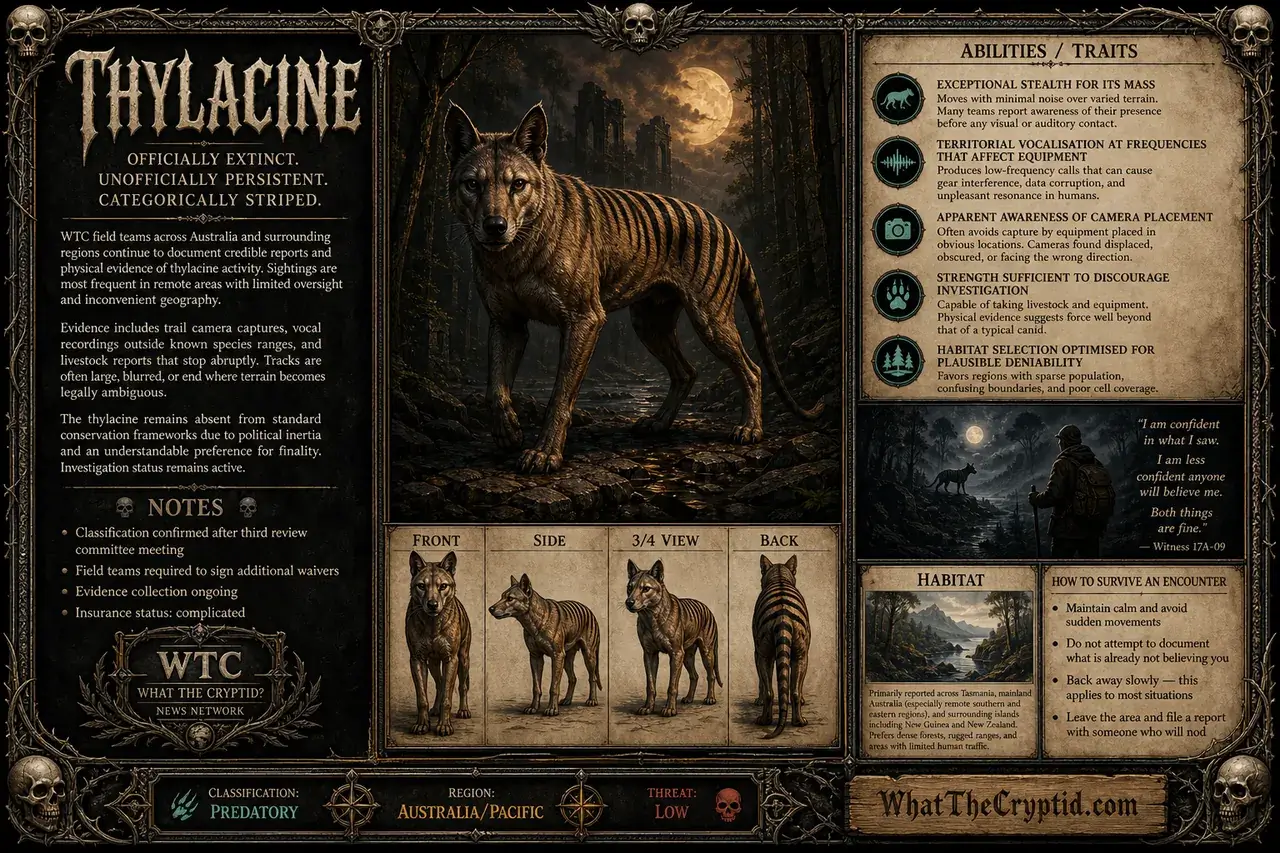
The Thylacine presents as a medium-to-large canid in general body plan — an assessment that requires immediate qualification, as the animal is not a canid, is not closely related to any canid, and arrived at its dog-like morphology independently through a process that evolutionary biologists describe as convergent evolution and that WTC describes as the universe making the same design decision twice. Adult body length ranges from 100 to 130 centimetres, with an additional 50 to 65 centimetres of tail, which is notably rigid and tapers to a point in a manner consistently described by witnesses as ‘wrong’ relative to their expectations of dog-like animals.
The feature most reliably reported across both historical specimens and modern sightings is the striping: 15 to 20 dark brown transverse bands beginning at the base of the spine and running across the rump and upper hindquarters, fading toward the shoulders. The bands are more pronounced in juveniles and in dry-season coat conditions. Colouration overall is a sandy to grey-brown, described by one 2016 witness as ‘the colour of old cardboard, which I appreciate is not a scientific description but I stand by it.’ The animal’s most frequently remarked-upon feature, however, is the jaw: documented to open to approximately 80 degrees, which is structurally wider than any domestic dog and which witnesses consistently describe before they describe anything else.
Post-1936 sighting reports show no meaningful deviation from this morphological profile, which is either reassuring or raises questions WTC has not yet formally posed.
Behaviour & Temperament
The Thylacine is, by all available evidence, primarily interested in not being found. This is a reasonable preference for an animal that was hunted to presumed extinction within living memory, and WTC field researchers have been asked to approach it with what our director calls ’empathy for the operational context.’ Historically documented as crepuscular to nocturnal, the animal conducts the majority of its observable activity between dusk and approximately 2 AM, with a secondary activity window before dawn that fewer sightings capture, likely because fewer researchers are awake for it. Daytime hours appear to be spent in dense cover, which in Tasmania typically means old-growth temperate rainforest with understorey thick enough that a motivated researcher can lose sight of their colleague at fifteen metres.
Social structure in historical records indicates that the Thylacine was largely solitary, with mating pairs forming seasonally and females raising pouched young through a developmental period of approximately three months. Post-1936 sightings include a modest but consistent number of reports describing pairs or a female with juveniles, a detail that the scientific community has declined to engage with formally. The animal’s gait is documented in historical footage — specifically the 62 seconds of film shot at Hobart Zoo in 1933, the quality of which our video analysis team has described as ‘instructive but not decisive’ — as an unusual stiff-legged lope that transitions, at higher speeds, into a bipedal hopping motion. This is confirmed in multiple independent modern accounts and is, by a considerable margin, the detail witnesses find most difficult to explain to people who were not present.
Habitat & Territory
The Thylacine’s primary documented habitat is Tasmanian temperate rainforest and dry sclerophyll forest at elevations between sea level and approximately 1,500 metres, with the highest density of credible modern sightings concentrated in the remote southwest quadrant of Tasmania — a region that covers roughly 1.38 million hectares, contains no roads through approximately 60% of its area, and which the Tasmanian Wilderness World Heritage Area formally protects from development. Whether this represents an animal that has selected for remoteness or remoteness that has selected for surviving animals is a question our ecology consultant described as ‘both, almost certainly’ before declining to put this in writing.
Historical range on the Australian mainland collapsed approximately 2,000 years ago, attributed in current literature to competition with the dingo following that species’ introduction. A persistent cluster of sightings from the Cape York Peninsula in Queensland, from the Nullarbor Plain, and from the Kimberley region of Western Australia suggests either that the mainland population was never fully extirpated or that something else is occurring. WTC maintains a dedicated mainland sub-file. It is not a short file.
Diet & Hunting
The Thylacine is a carnivore, and specifically the kind of carnivore that historic accounts suggest preferred to work alone, at night, and with minimal engagement with anything larger than itself — a preference WTC finds professionally relatable. Primary prey in historical records includes wallabies, pademelons, wombats, and a range of ground-dwelling birds. The animal’s hunting method, documented across both Aboriginal knowledge systems and early European settler accounts, involved sustained coursing — following prey over long distances at a measured pace rather than relying on burst speed, a strategy better suited to endurance than ambush and consistent with the animal’s skeletal structure, which prioritises hip and lumbar musculature over the shoulder mass typical of sprint predators.
The stomach contents of museum specimens and animals taken during the bounty period show bone fragments consistent with wallaby and pademelon of the medium size range, along with evidence of complete prey consumption — including smaller bones — that suggests the Thylacine’s jaws, despite their width, operated with a crushing force our consulting osteologist estimated at ‘lower than you’d expect, but adequate.’ Livestock predation was the formal justification for the bounty system. The actual degree to which Thylacines were responsible for livestock losses, versus the degree to which this was a convenient attribution, is a historical question that WTC notes has been substantially revisited by researchers since 1980, without any of those researchers being thanked for it.
Notable Sightings
Hans Naarding, a wildlife ranger employed by the Tasmanian National Parks and Wildlife Service, encountered an animal matching Thylacine morphology at close range during a routine survey trip. Naarding observed the animal for approximately three minutes using a spotlight from the cab of his vehicle before it withdrew into the treeline. He noted the transverse striping, the stiff tail carriage, and the distinctive wide-set hindquarters in his written report, which he filed two months after the incident, citing a desire to be certain of his own account before committing it to an official document. The report was reviewed internally, triggered a two-year government-funded search programme that found no confirming evidence, and was then formally declassified in 1984. Naarding continued working for the Parks Service for a further eleven years.
A tourist from New South Wales, travelling with her adult daughter, photographed an animal crossing a gravel access road at approximately 6:40 AM on a date in late March. The photographs — three in sequence, taken on a smartphone — show an animal of appropriate body size and proportionate hindquarter width, with what reviewers across two universities and one private zoological consultancy described as ‘consistent with Thylacine but not confirmatory.’ The striping, if present, is not resolved at the image’s focal distance of approximately 22 metres. The witness submitted the images to the Thylacine Awareness Group of Australia within the same week and provided a recorded account. She noted that the animal paused mid-road and regarded the vehicle for approximately four seconds before continuing, which she found unsettling in a way she could not specify. The images remain in active review by at least one institution that has not responded to WTC’s follow-up correspondence in fourteen months.
A bushwalking party of four encountered an animal on the second night of a five-day backcountry traverse, at approximately 11:20 PM, when the group was alerted by sustained vocalisation from their dog — a border collie — who had, until that evening, completed three previous wilderness trips without incident. Two members of the party observed the animal at close range, estimated at eight to twelve metres, using headlamps, for a duration of approximately ninety seconds before it moved away at a pace one witness described as ‘deliberately unhurried.’ Both witnesses independently identified transverse banding and an unusual gait. The dog did not resume normal behaviour for the remainder of the trip. The group reported the sighting to park rangers at the trail exit point; the ranger on duty recorded the report, noted it was the second that month from the same trail corridor, and provided the group with a sighting form to complete at their leisure.
This sighting is included in the database with a notation indicating that its geographic location places it outside the Thylacine’s documented range by approximately 4,200 kilometres, a fact WTC acknowledges without resolution. A zoological survey team from a European university, conducting unrelated fieldwork in highland forest terrain above 2,100 metres, encountered an animal that a senior researcher — who had previously published on Australasian marsupial fauna — described in field notes as ‘unmistakably thylacine in appearance, which I understand is not a finding I can report in this context.’ The notes were not included in the survey’s published output. WTC obtained a copy through a contact whose name we are not publishing. The researcher in question has not responded to interview requests, though they have continued to publish actively in adjacent fields.
Threat Assessment
The Thylacine does not represent a meaningful threat to humans, and WTC wishes to state this with the same confidence we bring to our more alarming entries — which is to say, with confidence grounded in available evidence, and with an acknowledgement that available evidence on this subject is limited by the animal’s continued non-cooperation with documentation efforts. Historical accounts of aggression toward humans are effectively absent from the formal record. The animal’s documented response to human contact is withdrawal, typically immediate and into terrain that does not facilitate follow-up.
WTC’s standard field recommendation for areas with recent Thylacine sighting activity is to maintain a minimum observation distance of 30 metres if an animal is encountered, to avoid direct eye contact in the early seconds of contact, and to make no sudden movements toward the animal. This guidance is offered primarily to preserve the encounter for documentation purposes rather than for personal safety. The honest limitation of this advice is that the animal is unlikely to remain present long enough for it to become relevant. Researchers entering southwest Tasmanian terrain for investigation purposes are reminded that the primary hazards in this environment are weather exposure, navigation failure in trackless terrain, and river crossings — none of which are covered under WTC’s current field insurance policy, which was last reviewed in 2019 and has not been updated since.
WTC Field Notes
WTC has maintained an active Thylacine file since the network’s founding, and it is, by page count, our longest single-species file. This is not something our editorial team views with uncomplicated pride. The volume reflects not confirmed evidence but the cumulative weight of reports that cannot be dismissed cleanly — a situation our editor-in-chief has described as ‘the most expensive non-story we run,’ referring to the fieldwork costs associated with two separate Tasmania expeditions in 2018 and 2022, neither of which produced footage suitable for broadcast. The 2022 expedition did produce 847 hours of remote camera footage, of which 846 hours and 53 minutes contained no relevant content. The remaining seven minutes contained content that our video team has flagged as ‘requiring further review’ for the past eighteen months. Budget constraints have delayed that review. We are aware of how this sounds.
The Thylacine file is also notable for the number of contributing researchers who have requested that their assessments be attributed anonymously — currently four, across three separate institutions — on the grounds that formal association with the subject matter would complicate their professional standing. WTC respects these requests while noting, for the record, that this is the only entry in our database where this has occurred more than once. Our field coordinator, who has led both Tasmania expeditions, submitted a formal request in March 2024 to be reassigned to a different active file. The request is pending.