|
Credibility: ★★★★☆ 4/5
|
Threat Level: MODERATE (Moderate — bureaucratic and wool-adjacent)
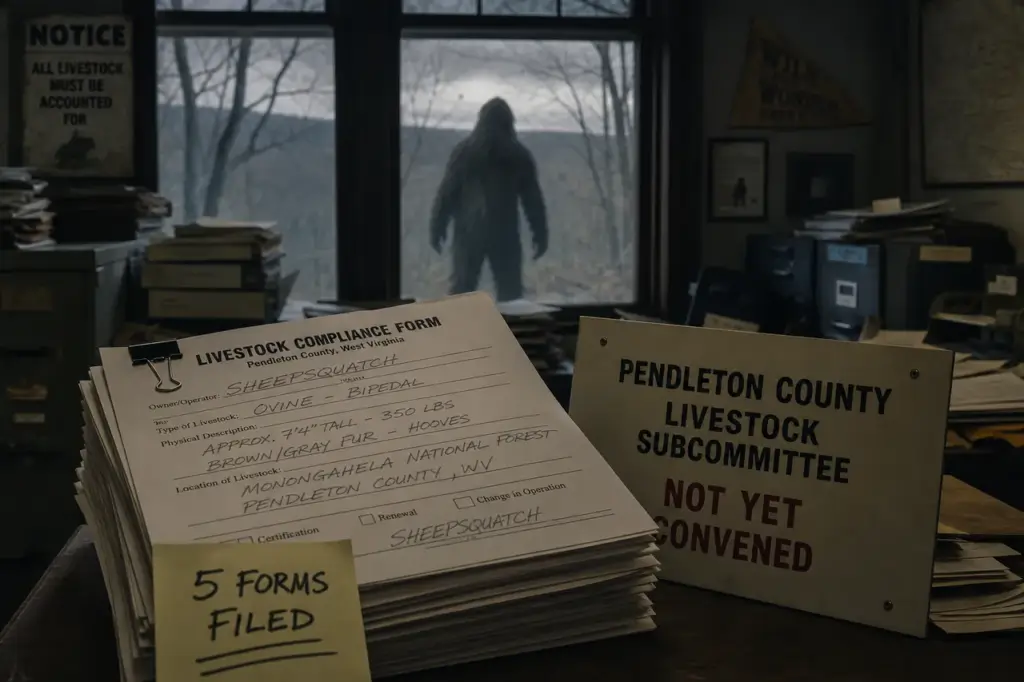
Pendleton County’s Agricultural Compliance Office has processed more paperwork about a cryptid than most counties process about actual sheep, and they have nothing to show for it except a subcommittee that hasn’t met yet.
Here is something I want you to sit with for a moment: somewhere in Pendleton County, West Virginia, there is a filing cabinet that now contains five separate agricultural compliance forms, each one dutifully filled out, each one technically void, each one representing a county employee who looked at the description of the entity in question — large, white, vaguely sheep-shaped, bipedal, not cooperative with standard livestock handling procedures — and thought, yes, this is a form situation. This is the story of those forms. It is also, unavoidably, the story of a county bureaucracy encountering something it did not have a box for and responding by checking every box it could find anyway.
The entity in question is, for the record, a Sheepsquatch. This is not my word. This is the word that thirteen witnesses across a three-week period used when filing reports with the Pendleton County Sheriff’s office, the West Virginia Department of Agriculture tip line, and, in one case, a handwritten letter addressed simply to ‘whoever handles the wool thing.’ The Agricultural Compliance Office, to its credit, took all of this seriously. To its detriment, it then attempted to process it.

We don’t have a form for ‘not livestock but presenting as livestock.’ We have forms for livestock. We have forms for non-livestock. We do not have a form for the middle ground, and I want to be clear that we did not expect there to be a middle ground.
— Agricultural Compliance Officer, Pendleton County, who asked not to be named but who I am choosing to believe had a very long week
The Five Forms, Ranked By How Close They Got
AGL-7: Stray Livestock Report
This was the first attempt, and in fairness to whoever filed it, it represents the most optimistic possible interpretation of the available evidence. AGL-7 is designed for cattle, horses, sheep, and goats found wandering outside their designated enclosures. The Sheepsquatch was found wandering. It was outside an enclosure. It did have wool. The form was filed at 9:14 AM on a Tuesday and was voided by 11:00 AM the same day when someone pointed out that the ‘owner contact information’ field could not be completed because, as one internal note reads, ‘there is no owner, there is not going to be an owner, please see attached witness statements.’
AGL-8: Feral Livestock Classification
AGL-8 exists because sometimes livestock escapes and goes feral, which is a real agricultural phenomenon that West Virginia has a form for, because West Virginia is a state that takes its livestock seriously. The logic here was sound on its face: if it looked like livestock and couldn’t be claimed by an owner, perhaps it had simply been livestock for a very long time without supervision. This theory lasted approximately forty-eight hours before a field inspector submitted a supplemental note describing the entity as ‘not feral in any conventional sense’ and ‘approximately eight feet tall, which is outside the standard range for domestic sheep by a meaningful margin.’
AGL-9: Exotic or Non-Native Species Livestock Declaration
This one, I have to admit, shows a kind of creative thinking I respect. Someone in that office looked at AGL-8’s failure and thought: what if the issue isn’t that it’s feral, but that it’s exotic? AGL-9 covers non-native livestock species introduced from outside the continental United States, which technically creates some philosophical space for an entity whose geographic origin is unclear. The form was completed in full. It was submitted. It was returned with a note from the state agricultural board that read, in its entirety, ‘This does not appear to be an exotic livestock matter. Please consult your regional office.’ The regional office has not yet been consulted.
AGL-10: Livestock of Ambiguous Origin Declaration
I did not know this form existed before this story. I want to be honest with you about that. AGL-10 is, according to the West Virginia Department of Agriculture’s own documentation, designed for situations in which an animal ‘presents characteristics of multiple livestock categories or cannot be definitively classified within existing taxonomic frameworks for agricultural purposes.’ Someone in Pendleton County found this form. Someone read that description and thought: that’s it. That’s the one. They were wrong — the form was voided along with all the others — but I want to acknowledge that they were, in spirit, closer than anyone else had gotten. They were reaching toward something true. They just needed a form that doesn’t exist yet.
AGL-11: Livestock Incident Report (Property Damage, Potential)
By the time AGL-11 was filed, I think something had shifted in the office. This form doesn’t attempt to classify the entity at all. It simply documents an incident involving something in the vicinity of a livestock designation, with potential property implications. It is the bureaucratic equivalent of a shrug. It was filed, it was voided with the others, and it represents, in my professional assessment, a county government that had done its best and arrived somewhere honest: they didn’t know what this was, they couldn’t categorize it, and they were tired. I respect the AGL-11. I think we all have an AGL-11 in us.
FAST FACTS
• Total forms filed: 5 (AGL-7 through AGL-11)
• Total forms currently valid: 0
• Witnesses on record: 13
• Subcommittee convened to determine next steps: Not yet
• West Virginia statutes containing language applicable to Sheepsquatch: 0, currently
I called the Agricultural Compliance Office three times while working on this piece. On the first call, I was transferred to a voicemail that was full. On the second call, I spoke briefly with someone who said they couldn’t comment on active compliance matters and then paused for a long moment and asked if I had any idea what form would actually apply here. I said I didn’t. They said they didn’t either. We sat with that together for a few seconds. On the third call, I was told the subcommittee would be meeting ‘in the coming weeks’ and that a determination on the appropriate form structure was ‘forthcoming.’ I have written ‘forthcoming’ in my green notebook — the one I bought at that stationery shop in January with every intention of using consistently — and underlined it twice.
I’ve been in agricultural compliance for nineteen years. I’ve handled escaped emus. I handled a situation with a bison in 2017 that I am still not allowed to discuss in full. This is different. This is a different kind of situation.
— Second Agricultural Compliance Officer, Pendleton County, also unnamed, also clearly having a very long three weeks
FIELD ALERT
If you are in the Pendleton County area and encounter what you believe may be a Sheepsquatch, the Agricultural Compliance Office respectfully requests that you do not file a livestock report at this time, as they are still determining which form applies and additional voided paperwork is, quote, ‘not helpful right now.’ The Sheriff’s office is accepting general incident reports. The regional office continues to be uncontacted. The subcommittee has not met.
I’ve covered a lot of encounters in this job. I’ve covered sightings, I’ve covered footprints, I’ve covered a town council meeting about a Dogman that went three and a half hours and ended without a formal resolution. But there is something specifically affecting about this story — about five forms, filed in good faith, by people who were genuinely trying to use the tools available to them and discovering, incrementally, that the tools weren’t built for this. The world keeps presenting things that the existing categories don’t cover. The subcommittee will meet eventually. They will determine, presumably, that a new form is needed. Somewhere in West Virginia, someone is going to have to write AGL-12 from scratch. I would like to be there when that happens. I’m putting it in the notebook.
Mr. Whiskers knocked my green notebook off the desk while I was finishing this piece. I’m choosing to interpret that as editorial feedback. The notebook is fine. The forms remain void. The subcommittee has still not met.
pennyhart@whatthecryptid.com
Penny Hart · Features Writer & Community Content Specialist — WTC
Wool-bearing. Four-horned. Not interested in your questions.