
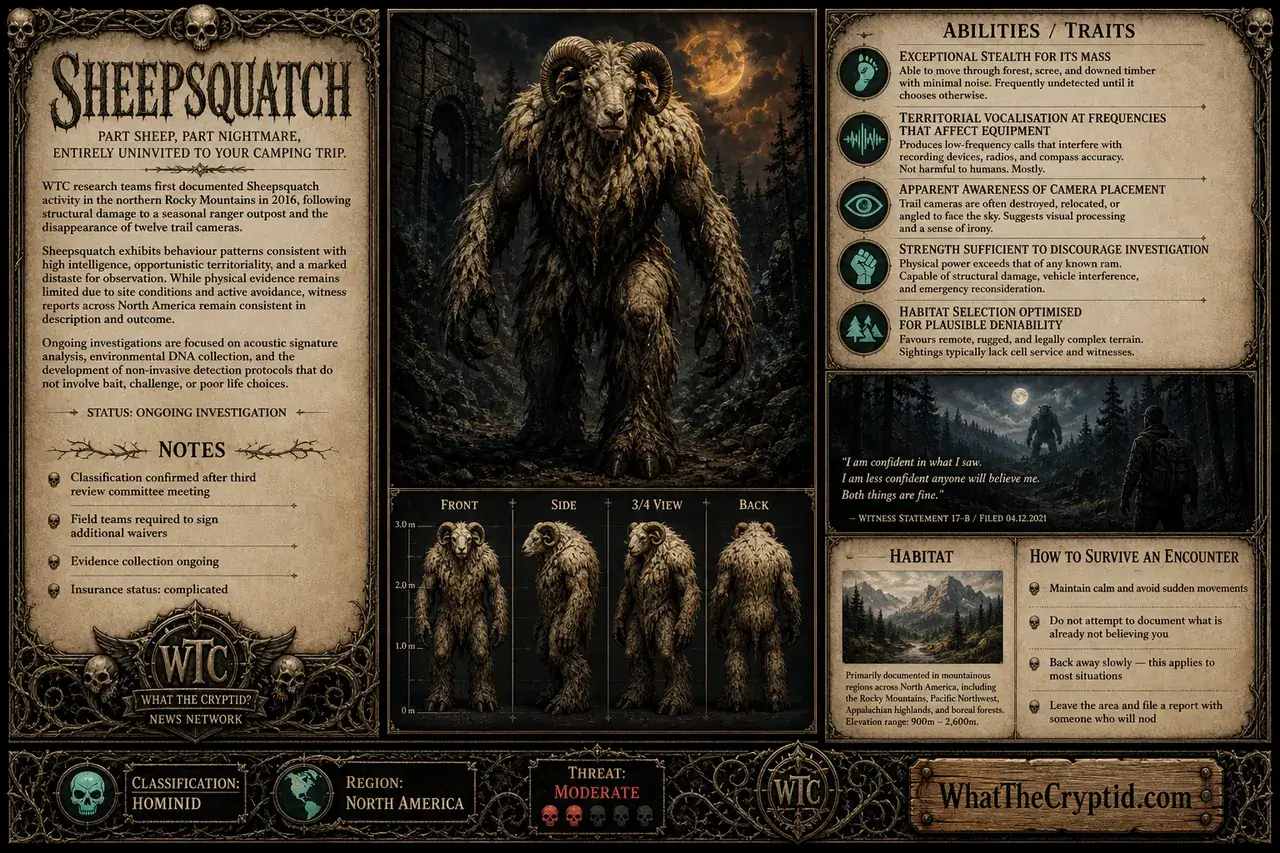
Sheepsquatch
Wool-bearing. Four-horned. Not interested in your questions.
North America
Active
West VirginiaQuadrupedAppalachiaWoolHornedPredatoryActive
Overview
Sheepsquatch is a large, quadrupedal cryptid documented primarily in Boone, Kanawha, Putnam, and Mason Counties in the state of West Virginia. The entity presents as a bear-sized mammal covered in dense white wool, bearing a superficial resemblance to no animal in any known taxonomic category, which WTC notes is something of a recurring theme in this region. It has been reported with sufficient consistency — and sufficient sobriety, in most cases — to warrant its own database entry, a distinction it shares with fewer than three hundred other documented entities worldwide.

What distinguishes Sheepsquatch from comparable Appalachian fauna, real or otherwise, is the specificity of the witness accounts. Multiple independent observers across multiple decades have described the same constellation of features: white wool or fur, a long dog-like or pig-like muzzle, a hairless tail described as resembling that of an opossum, and — most distinctively — a set of four horns arranged in two pairs. This last feature has proven difficult to account for within conventional zoology, which has not stopped WTC from trying.
The entity is considered active. Sightings have continued into the present decade with no apparent reduction in frequency, and no reduction in the consistency of the physical description. WTC has assigned Sheepsquatch a danger level of 7, based on documented aggressive encounters, evidence of livestock predation, and the general principle that anything with four horns and the temperament to use them deserves a rating above five.
History & Mythology
The first formally documented sightings of Sheepsquatch emerge from the mid-1990s in Boone County, West Virginia, though oral accounts from the region suggest encounters with a large white animal pre-date this period by at least two to three decades. The 1994 sighting by a former Navy officer in the Boone County woods is typically cited as the watershed report: the witness, described by those who know him as a man not given to imaginative storytelling, encountered the entity at close range and provided a physical description detailed enough to serve as the basis for every subsequent identification guide WTC has produced.
Local West Virginia folklore does not contain a specific pre-existing figure that maps cleanly onto Sheepsquatch, which is itself notable. Most regional cryptids arrive with at least a partial cultural backstory. Sheepsquatch appears to have simply shown up in the early-to-mid twentieth century and begun being seen, without the courtesy of a mythological framework to explain it. Some local historians have connected its increased sightings in the 1990s to the closure of the Ammunition Depot at the former Naval Station in McNeill, West Virginia, speculating about environmental disturbance driving the entity from established territory. WTC has logged this theory without endorsing it.
By 2000, the concentration of sightings in the TNT Area near Point Pleasant — already a location of considerable cryptid interest due to its Mothman associations — had prompted several independent researchers to suggest Sheepsquatch might represent a distinct regional population rather than a transient individual. The implication that West Virginia may be sustaining a breeding population of an unclassified four-horned wool-bearing predator has not been addressed by the relevant state wildlife agency, whose public communications on the matter have been limited to a single response letter describing the reports as ‘outside their jurisdiction.’
Physical Description
Witnesses consistently describe Sheepsquatch as approximately the size of a large bear, with body length estimates ranging from five to seven feet and weight estimates that our consulting wildlife biologist declined to formalize without physical evidence but informally suggested would exceed 300 pounds based on described track depth and stride pattern. The most striking feature is the coat: dense, cream-to-white wool or fur of a texture observers have compared to unwashed sheep’s fleece, covering the body trunk and most of the limbs. The tail, by contrast, is uniformly reported as hairless and pink, 12 to 18 inches in length, and structurally similar to that of a Virginia opossum — a detail witnesses tend to mention with particular discomfort, as though the tail is somehow the most troubling part of an otherwise manageable situation.
The head is elongated and muzzled, described variously as pig-like or dog-like depending on the angle of observation, with the mouth reported to contain prominent teeth visible even when closed. The eyes, where described, are typically noted as yellow or amber, with a reflective quality in low light consistent with tapetum lucidum — the same reflective structure found in cats, dogs, and most nocturnal predators. The four horns, two positioned forward and two behind in what one witness described as ‘an arrangement that doesn’t make sense,’ have been reported as curved and smooth, approximately six to eight inches in length. No shed horn specimens have been recovered.
One regional variant deserves mention: a subset of sightings from Mason County describe an entity with a slightly more upright posture and darker wool, which some WTC researchers have categorized as a separate population. The majority position within WTC’s research team is that this represents normal individual variation. The minority position is that there are two of them, which no one has yet found a comfortable way to say out loud in a formal report.
Behaviour & Temperament
Sheepsquatch is primarily documented as a crepuscular and nocturnal entity, with the majority of sightings occurring between dusk and midnight, and a secondary cluster in the pre-dawn hours. Daytime encounters are rare and, based on the available accounts, appear to surprise the entity as much as the witness. The creature has been observed moving at considerable speed through dense forest terrain, its bulk notwithstanding, and at least three witnesses have described a sound accompanying its movement through underbrush that they found difficult to reconcile with what they were seeing — a kind of rapid, rhythmic impact suggesting an animal that moves with more purpose than its apparent build would suggest.
The temperament is variable and appears context-dependent. The majority of documented encounters involve the entity detecting a human presence and withdrawing, usually at speed. However, a meaningful minority of reports describe Sheepsquatch adopting a stationary threat posture — described as head lowered, horns oriented toward the witness, emitting a sound variously characterized as a hiss, a sulfurous exhalation, or, in two separate accounts from different decades, ‘a sound like a dog trying to bark and choosing not to at the last moment.’ Actual charges have been documented in at least four cases, two of which resulted in property damage and one of which resulted in a witness leaving the area at a pace their friends later found difficult to believe.
Sheepsquatch appears to be a solitary entity. No witness has reported more than one individual at a time, and territorial marking behaviour — broken saplings, ground disturbance, and in two cases a distinctive odor described as sulfurous or similar to gunpowder — suggests single-individual ranging patterns across relatively large territories. The sulfurous odor is an unusual detail that WTC’s research team has noted repeatedly without yet arriving at a satisfying explanation for.
Habitat & Territory
Sheepsquatch is documented almost exclusively within the forested ridges and creek hollows of the central Appalachian highlands, with the highest concentration of sightings between 800 and 2,400 feet elevation across Boone, Kanawha, Putnam, and Mason Counties in West Virginia. The terrain in question is characterized by dense mixed hardwood forest, irregular terrain with significant drainage features, and a general inaccessibility that has made systematic survey work impractical for reasons that are partly logistical and partly budgetary, in proportions WTC’s field team prefers not to specify.
The entity demonstrates a marked preference for proximity to water — most documented encounters have occurred within a quarter mile of a creek, river, or standing water feature — and appears comfortable in both deep woodland and the transitional zones where forest meets cleared agricultural land. This latter preference accounts for a significant portion of the livestock-related incidents in the documented record. The TNT Area near Point Pleasant, a tract of former ordnance storage land with significant wetland features and limited public access, has produced a disproportionate share of sightings relative to its area, a fact that either reflects genuine habitat preference or reflects the kind of location where witnesses feel safe admitting what they saw.
Diet & Hunting
Sheepsquatch is classified by WTC as an opportunistic predator with omnivorous tendencies, based on the available physical evidence and the somewhat grim aftermath of several documented encounters with domestic livestock. Chicken coops, small goat enclosures, and outdoor rabbit hutches in the proximity of reported Sheepsquatch territories have been found in states of disruption consistent with a large, strong animal motivated by food rather than curiosity, a distinction that matters somewhat less to the livestock in question. Deer are the presumed primary wild prey based on track evidence found in association with deer remains in Boone County in 1998 — the remains themselves providing more information than the tracks, and more information than the landowner had particularly wanted.
Foraging behaviour has also been documented. Several witnesses have reported Sheepsquatch moving through the edge of agricultural land in what appeared to be a systematic pattern, pausing at intervals in a manner consistent with an animal investigating food sources rather than patrolling territory. One witness in Putnam County reported that the entity spent approximately four minutes investigating an overturned feed barrel before departing, which is the kind of detail that becomes more interesting the longer you think about what a four-horned wool-bearing predator the size of a bear needs with deer corn.
Notable Sightings
A former United States Navy officer encountered the entity while walking a trail in a wooded area of Boone County during the afternoon hours. He described the animal as white, heavily built, roughly the size of a large bear, and possessed of a pig-like snout and two pairs of curved horns. The witness observed the entity for what he estimated as 90 seconds before it moved into dense brush and was lost from sight. He reported the encounter to a family member immediately upon returning home, described himself as certain of what he had seen, and did not file a formal report with any agency, a decision he later told a local researcher he stood by.
A couple driving a rural route in Putnam County reported their vehicle was approached by a large white animal that emerged from roadside brush and crossed the road at close range, estimated at 15 feet from the front bumper. The male witness described the entity’s eyes catching the headlights and reflecting ‘like a dog’s but wrong somehow,’ and noted the hairless tail trailing behind it as the animal continued into the tree line on the opposite side of the road. The encounter lasted under ten seconds. Both witnesses gave consistent independent accounts when interviewed separately by a local newspaper, which ran the story on page seven.
Three individuals conducting informal night photography in the former Naval Ammunition Depot area near Point Pleasant reported hearing a heavy bipedal or quadrupedal movement in the brush approximately 40 yards from their position, followed by a visible white shape moving at the tree line. One member of the group attempted to photograph the entity; the camera’s flash fired twice and the entity withdrew rapidly. The photographs, when developed, showed light reflecting off an indistinct white mass that the group’s most skeptical member described as ‘consistent with a large pale animal and inconsistent with anything else I can come up with.’ All three witnesses had previously visited the location to look for Mothman. They have not returned for either.
A homeowner in a rural area of Kanawha County reported damage to a chicken enclosure overnight, including a section of heavy gauge wire fencing that had been compressed outward rather than torn, suggesting sustained pressure from a large body rather than a targeted breach. Footprints were found in soft ground adjacent to the enclosure measuring approximately nine inches in width with an unusual hoof-like impression inconsistent with any domestic animal or known regional wildlife. A neighbor confirmed hearing an unfamiliar vocalization — described as ‘not a coyote, not anything’ — in the early morning hours preceding the discovery. The homeowner filed a report with the county sheriff’s office, which logged it under ‘livestock incidents — unknown animal’ and closed it the same day.
Threat Assessment
WTC rates Sheepsquatch as High threat, based on documented charges, confirmed livestock predation, and a body mass sufficient to cause serious injury to an adult human without any assistance from the horns. Persons entering documented Sheepsquatch territory are advised to maintain a minimum distance of 100 yards from any observed individual and to avoid positioning themselves between the entity and any water feature, which field data suggests Sheepsquatch treats as a resource worth defending. Do not approach a stationary Sheepsquatch with its head lowered. This should not require stating, but experience has shown that it does.
In the event of a direct encounter, WTC recommends slow lateral movement away from the entity rather than direct retreat, which may trigger a pursuit response. Avoid eye contact if the entity is in a threat posture, and do not make sudden movements or loud sounds. Carrying a bright torch is advisable, as the reflective quality of the entity’s eyes suggests light sensitivity may be a factor in disengagement behaviour — though WTC acknowledges this recommendation is based on a sample size of two incidents and should be understood accordingly. There is currently no documented method for reliably deterring a committed Sheepsquatch charge, and WTC’s threat assessment team recommends not arriving at a situation where this becomes relevant.
WTC Field Notes
WTC’s initial field survey of Boone County, conducted in the spring of 2019, produced seventeen hours of audio recording, four trail camera deployments, and a customs dispute over the importation of a specialised track-casting compound that delayed the expedition by eleven days. Of the four trail cameras, two returned usable footage of deer and one returned footage of what the reviewing editor described as ‘possibly something, but we would need the other half of the frame to say that with confidence.’ The fourth camera was found face-down in a creek bed. The camera was not positioned near a creek.
WTC’s consulting zoologist reviewed the compiled sighting data and physical evidence in early 2020 and produced a six-page assessment concluding that the consistency of witness descriptions across a 30-year period, combined with the physical evidence of unknown track impressions and livestock incidents, constituted ‘a pattern that would be difficult to account for without a real animal at its center.’ She then noted that she was not in a position to speculate about what that animal might be, requested that her name not appear in any published materials, and concluded the engagement. The entry you are currently reading represents the full extent of what WTC was able to confirm from a safe distance, which our editor has asked us to note is a longer distance than it looks on the map.