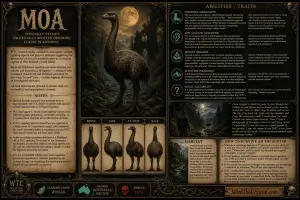
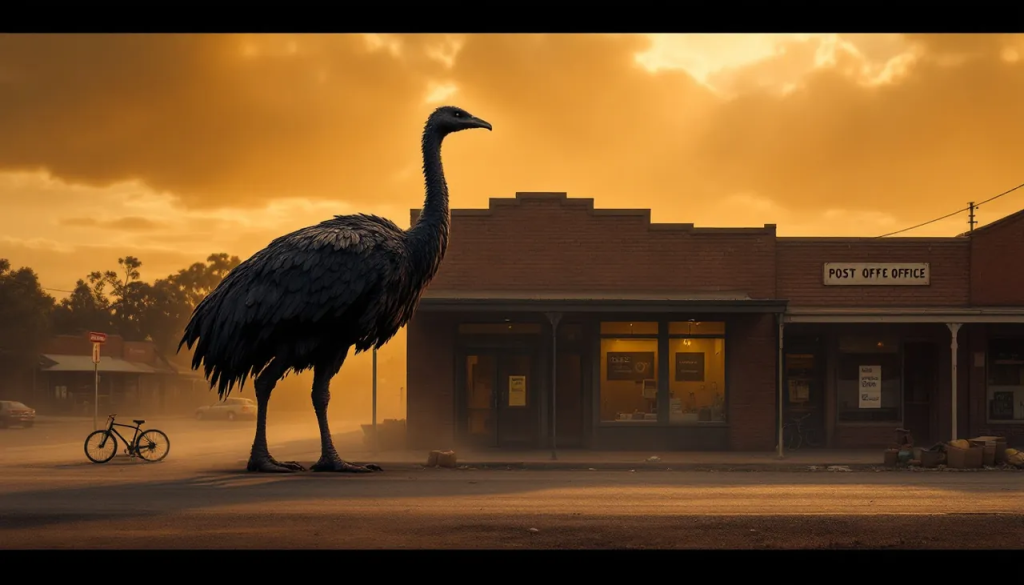
Walgett residents sheltered indoors for four hours while an extinct three-metre flightless bird stood in the main street and stared at the post office. Authorities are describing the situation as ‘ongoing.’ The bird has not blinked. Here is what we know.
The call came in at approximately 11:15 a.m. on Tuesday. A moa — a species classified as extinct since the fifteenth century — was standing in the middle of Walgett’s main street, oriented toward the post office, and showing no inclination to move. It was, witnesses agree, extremely large. It was also, witnesses agree, extremely focused. On the post office. For four hours. What follows is everything WTC has been able to establish, in order of what we consider most significant, beginning with the bird and ending, as these things tend to, somewhere else entirely.

The bird did not respond to questions. Residents describe its posture as ‘purposeful.’ The post office was closed at the time. Possibly relevant.
Ten Things We Know About the Walgett Moa Incident
1
The Bird Is Extinct
Officially, Dinornithiformes — the order encompassing all moa species — has been absent from the living world since approximately 1440 CE. This places the Walgett moa outside standard incident classification by a margin of roughly six hundred years. The DCA has issued a preliminary statement confirming the bird’s ‘non-standard temporal status’ and noting that a form is being prepared.
2
It Was Observed by at Least Ten Separate Witnesses
Accounts are consistent on the following points: the bird was very tall, it was not moving, and it was looking at the post office. Accounts diverge on whether it appeared ‘patient’ or ‘annoyed,’ with opinion split roughly six to four in favour of patient. WTC considers this distinction potentially significant and is continuing to gather testimony.
3
No One Approached It
This was, by all accounts, a collective decision reached without discussion. Several witnesses described beginning to walk toward the bird and then simply not doing that. One resident, a retired schoolteacher named Bev, stated that the bird ‘had an energy’ that she found ‘discouraging.’ She was unable to elaborate further but said she stood behind her screen door for two hours and did not regret it.
4
The Post Office Was Closed at the Time
Tuesday is the Walgett post office’s half-day. It closes at noon. The bird arrived at 11:15 a.m., which means it had forty-five minutes to conduct whatever business it had come to conduct. It did not enter the post office. It did not attempt to enter the post office. It stood outside the post office and waited in the manner of something that had been waiting for a long time before this particular Tuesday and would continue waiting afterward.
5
The DCA Response Team Arrived Four Hours Later
A spokesperson confirmed that the delay was due to ‘standard interdepartmental processing timelines’ and that the relevant forms had been submitted with the correct attachments. By the time the response team arrived, the bird had gone. The team spent ninety minutes on site, filed a Form 7-C (Extinct Entity, Unverified Purpose), and recommended a follow-up assessment within six to eight weeks. The post office remained closed.
6
There Is a Package at the Post Office That Has Been Undelivered Since March
This detail was raised by three witnesses independently, without prompting. A package arrived at Walgett post office in late March addressed to a name nobody in town recognises, in handwriting described as ‘very deliberate.’ It has not been collected. It has not been returned. WTC is not saying the moa came for the package. WTC is noting that three unconnected witnesses raised the package before WTC asked about it. We are giving the context time to develop.
7
Dr. Amelia Cross Estimates It Was a South Island Giant Moa
Specifically, Dinornis robustus, which was the largest moa species and could reach three and a half metres in height. Dr. Cross notes that moa were browsers, not predators, and that their eyesight was ‘competent but not exceptional,’ making a four-hour sustained visual focus on a single building ‘behaviourally atypical and genuinely interesting.’ She has submitted a request to examine any shed feathers. The DCA has acknowledged the request. A form is being prepared.
8
Professor Finch Has a Precedent
Professor Leonard Finch has identified a reference in an 1863 survey journal to a ‘great black bird, still as carved wood, watching the telegraph office’ near Bourke, New South Wales — approximately two hundred kilometres from Walgett. The telegraph office was, at the time, holding an undelivered message. The message was never claimed. Professor Finch describes the parallel as ‘striking’ and notes that the 1863 bird was present for six hours before departing, which he considers ‘consistent with a pattern we have perhaps not been tracking carefully enough.’
9
Walgett Residents Returned to the Main Street Without Incident
When the bird left — at approximately 3:20 p.m., walking north with what several witnesses described as ‘no particular urgency’ — people came out of their houses, looked at where it had been standing, and then largely continued with their afternoons. One witness said it felt like the end of a very long queue. Another said she felt, obscurely, that an appointment had been missed, though not by her. The footpath where the bird had stood was undamaged. There were no prints. This has not been explained.
10
The Package Is Still There
As of the time of filing, the undelivered package remains at Walgett post office, uncollected and unreturned. Post office staff have confirmed they are ‘looking into it,’ which is the same thing they said in April. WTC has submitted a request for information about the package under standard disclosure provisions. We have been informed that a form is being prepared. We will continue to monitor the situation. We have also, quietly, begun researching the post office forwarding procedures for packages addressed to species that are no longer extant. Just in case.
It had an energy. I stood behind my screen door for two hours. I don’t regret it.
— Bev, retired schoolteacher, Walgett NSW
Official Response: A Summary
DCA spokesperson Arthur Pritchard confirmed in a written statement that the incident has been logged, classified as a Category 3 Temporal Fauna Event, and flagged for ‘expedited review,’ which the DCA defines as review occurring within the current fiscal year. Mr. Pritchard noted that the moa’s departure prior to the response team’s arrival was ‘not ideal’ but that ‘the important thing is that no one was harmed,’ which WTC notes is technically accurate and entirely unsatisfying. The DCA did not address the package.
⚠️
FIELD ALERT
If you are in or near Walgett: The moa has departed and the main street is clear. The post office is open Thursday through Saturday, 9 a.m. to noon. If you have information about a package addressed to an unfamiliar name in very deliberate handwriting, WTC would appreciate hearing from you. Do not attempt to open the package. This is standard advice. It feels especially relevant here.
FAST FACTS
• Moa (Dinornithiformes) have been extinct since approximately 1440 CE — roughly 585 years before Tuesday
• The bird stood motionless for four hours and twelve minutes, per witness accounts
• DCA response time: four hours. Bird departure time: also four hours. The DCA has not commented on this
• No tracks, feathers, or biological material were recovered from the scene
• The undelivered package has been at Walgett post office since March
It walked north. No particular urgency. Like it had somewhere else to be, or had simply decided to stop waiting.
— Malcolm Shaw, WTC Features
malcolmshaw@whatthecryptid.com Malcolm Shaw · Senior Features Journalist & Folklore Correspondent — WTC