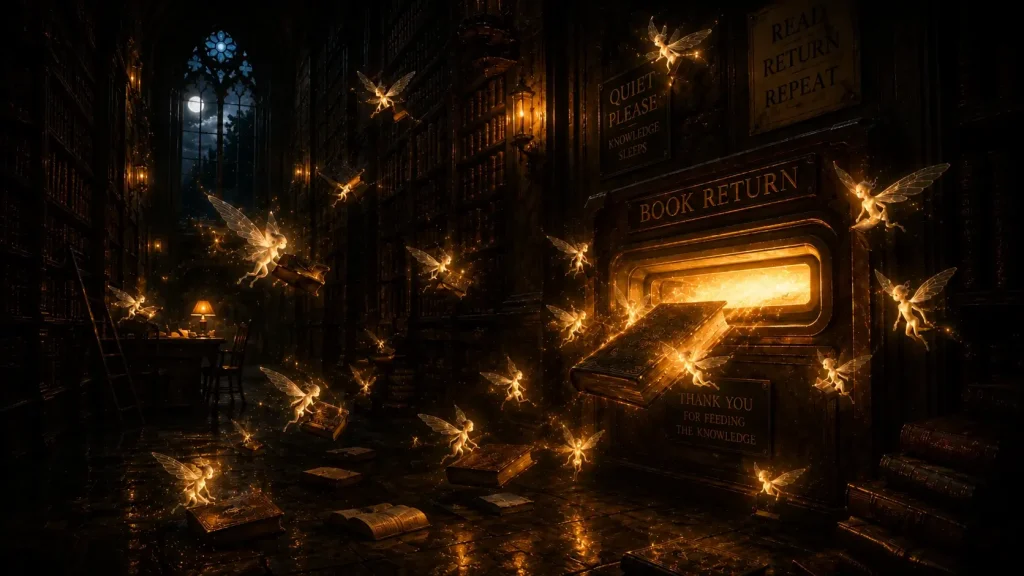
Millfield Public Library’s automated return system becomes epicenter of supernatural literary chaos as colony of page-eating sprites transforms nightly operations into folkloric nightmare.
The first sign something was wrong at Millfield Public Library wasn’t the books appearing in impossible places—though Stephen King novels somehow migrating to the children’s picture book section should have been concerning. It wasn’t even the way romance novels kept ending up spine-down in the biography section, creating what branch librarian Margaret Henley diplomatically called ‘organizational challenges.’ The real warning came when patron Gerald Martinez attempted to return a cookbook at 11:47 PM and heard what he described as ‘tiny voices arguing about proper alphabetization’ emanating from within the automated return slot.
What followed was a three-month investigation that has fundamentally altered our understanding of both municipal automation and the intersection of folklore with public library science. The Millfield branch, it appears, has become home to what local experts now classify as a thriving colony of literary pixies—diminutive entities whose traditional diet of parchment and illuminated manuscripts has adapted to include contemporary paperback fiction and the occasional reference manual.

The Night Shift Nobody Requested
Henley, a twenty-three-year veteran of library science, initially attributed the mysterious relocations to staff error or patron mischief. Books returned in the evening slot would appear the following morning in sections that defied both the Dewey Decimal System and basic logic. Mystery novels turned up in self-help. Cookbooks appeared in poetry. Most disturbingly, an entire shelf of vampire romance had somehow been arranged to spell out ‘HELP US’ when viewed from the circulation desk.
I’ve worked in libraries long enough to know books don’t rearrange themselves. Except, apparently, when they do.
— Margaret Henley, Branch Librarian
The breakthrough came when Martinez volunteered to conduct overnight surveillance after his initial encounter with the vocal return slot. Armed with a thermos of coffee and what he called ‘natural curiosity about municipal weirdness,’ Martinez positioned himself in the reference section with a clear view of the automated return system. His subsequent testimony, corroborated by three additional witnesses and forty-seven minutes of shaky smartphone footage, documented behavior that challenges conventional understanding of both library operations and entity classification.
👁️
WITNESS ACCOUNT
Martinez reports observing ‘approximately twelve to fifteen tiny humanoid figures, each no larger than a paperback bookmark’ emerging from the return slot at 2:17 AM. The entities appeared to work in coordinated teams, with some focused on extracting books while others engaged in what Martinez described as ‘heated debates about genre classification conducted entirely in squeaks.’
Further investigation revealed the pixies had established an elaborate social hierarchy based on literary preferences. Romance specialists, identifiable by their preference for books with embossed covers, appeared to hold senior positions in the colony’s organizational structure. Mystery and thriller handlers worked the night shift, while a small contingent of what witnesses describe as ‘academic pixies’ focused exclusively on reference materials and displayed concerning territorial behavior around the periodicals section.
Cultural Adaptation in Real Time
Dr. Elena Vasquez, a folklore specialist at nearby Millfield College, suggests the pixies represent a remarkable example of supernatural cultural adaptation. Traditional literary sprites, historically documented in monasteries and private libraries throughout medieval Europe, fed primarily on illuminated manuscripts and hand-copied texts. The Millfield colony appears to have successfully transitioned to mass-market paperbacks while maintaining their essential ecological role as ‘bibliographic ecosystem regulators.’
PIXIE BEHAVIOR PATTERNS
• Active hours: 2 AM – 5 AM
• Preferred genres: Romance (78%), Mystery (15%), Self-help (7%)
• Estimated colony size: 12-15 individuals
• Documented reorganization events: 47 since January
• Books consumed entirely: 3 (all cookbook spines)
• Complaint letters filed: 23
They’re not destroying the collection—they’re curating it according to principles we simply don’t understand yet.
— Dr. Elena Vasquez, Millfield College
Rico Valez, cryptid consultant for the regional library system, informed me that literary pixies typically establish territorial claims during periods of high circulation stress, particularly when automated systems disrupt traditional bibliographic energy flows. While I have been unable to verify this theory independently, patron complaints about ‘judgemental squeaking’ from the return slot during busy periods suggest some correlation between colony activity and circulation volume.
Henley has implemented what she calls ‘cooperative coexistence protocols,’ including designated pixie-friendly return hours and a small offering dish of bookmarks near the automated slot. Mysterious relocations have decreased by approximately sixty percent, though the romance section continues to experience what she diplomatically terms ‘enhanced organization according to non-standard criteria.’ The library board, for its part, has voted to classify the situation as ‘an ongoing facilities management issue’ and approved funding for additional late-night cleaning staff, though none have volunteered for the position.
As I write this, the Millfield branch continues to operate normally during business hours while hosting what may be the only documented case of successful human-pixie library cooperation in modern municipal history. The books still migrate mysteriously in the night, but patrons report a strange sense of improved organization, as though the collection has been arranged by someone who understands reading habits better than conventional library science might suggest. Perhaps the real question isn’t how to remove the pixies, but whether other libraries might benefit from similar folkloric consultation services.
Some organizational systems operate according to principles that exist beyond the reach of traditional cataloging.
— WTCNN Investigation
malcolmshaw@whatthecryptid.com Malcolm Shaw · Senior Features Journalist & Folklore Correspondent — WTCNN Facebook
Small. Documented. Responsible for more than you think.