
|
Credibility: ★★★★☆ 4/5
|
Threat Level: MODERATE (MODERATE — it is large and it has opinions about your porch)
Six witnesses, two moved objects, and a step-by-step framework for a conversation you didn’t know you needed to have
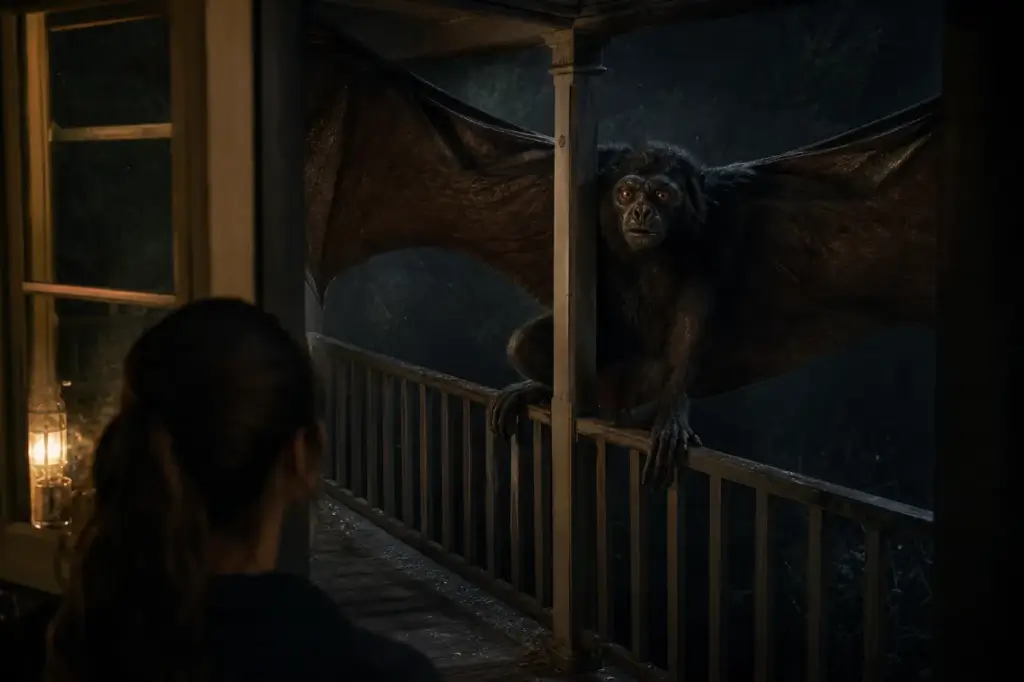
The second one showed up on a Wednesday. That’s the detail Renata Osei, 58, of Tillamook County, keeps returning to — not the wingspan, not the smell, not the sound it made when it settled onto her porch railing for the third consecutive night. The Wednesday. ‘I just remember thinking, this is a weeknight,’ she told me, sitting across from me at a booth at the Tillamook Diner, which is on my list and stays on my list. ‘I have work Thursday.’ The second object it moved was a cedar planter she’d had for eleven years. At that point, Renata said, she understood the planter wasn’t coming back inside until something was resolved. This article is about how to resolve it.
Reports consistent with Ahool activity have been filed with WTC across four counties in the past eighteen months — six witnesses total, all describing variations on the same progression: initial sighting at the roofline or porch overhang, followed by a second visit within four to nine days, followed by the relocation of at least one object on or near the porch. The Ahool, for readers who haven’t encountered it before, is documented most extensively in the literature as a Southeast Asian bat cryptid — roughly six feet in wingspan, flat-faced, described variously as having a grey or dark brown pelage. What it’s doing in western Oregon is a separate article I am actively working on. What concerns us here is the object relocation, which the six witnesses I’ve interviewed now treat, with some justification, as a territorial claim.

Step One: Establish That It Has Not Already Claimed The Space
If one object has been moved, you are in negotiation. If two objects have been moved, you are behind. I want to be precise about what ‘moved’ means in the context these witnesses describe, because there is a difference between an object that has fallen over and an object that has been repositioned. Every witness I spoke to was clear on this distinction without being prompted. The planter, the wind chimes, the folded canvas chair — these were not knocked over. They were placed somewhere else. Witness four, a man named Dov Rubin who farms outside of Carlton and asked me not to use his last name and then gave it to me anyway, described it as ‘like someone was tidying.’ He said this with the specific exhaustion of a person who has been trying to explain something for a long time. If objects have been moved — specifically moved, repositioned with apparent intent — you are already in a situation where the entity has made an opening statement. Your response time matters. Based on the six accounts, a response delay of more than seventy-two hours after the second relocation appears to be read as concession.
I left a porch light on the first night because I thought that would help. It did not help. The next morning the chair was at the other end of the porch and the light was off. I don’t know how it reached the switch.
— Dov Rubin, witness four, Carlton, OR
Step Two: The Visual Cue Framework — What Constitutes Acknowledgment
What I can offer here is cross-referenced from four of the six accounts, because two witnesses did not progress past the object-relocation stage before contacting WTC and I haven’t been able to reconstruct their full timelines yet. Of the four who proceeded to what I’m calling the direct communication phase, three used some form of spatial demarcation — meaning they drew a visible line of separation. One used potted plants lined up across the porch threshold. One used chalk. One, and I am reporting this accurately, used a length of orange surveyor’s tape she had left over from a property dispute in 2021. In all three cases, the entity returned, remained on the exterior side of the demarcation, and performed what witnesses describe as a stillness period — typically between four and fourteen minutes of motionlessness at the roofline or railing — before departing. Witnesses consistently interpret the stillness period as acknowledgment. Whether that interpretation is correct is something I cannot verify. What I can verify is that in all three cases, object relocation ceased following the stillness period. In the fourth case, where no demarcation was attempted, the situation is still ongoing. I check in with that witness every nine days.
FIELD ALERT
Do not attempt to physically reposition the moved objects yourself during an active communication attempt. Two witnesses who did this reported that the objects were moved again by the following morning, to locations farther from the door. One described this as ‘it moved them back but worse.’ Treat moved objects as they are: a statement. Responding by moving them back is, at best, counteroffer. At worst, escalation.
Renata Osei got to the stillness period on her third attempt. The first two times she tried to establish a threshold, she said, she was outside when it arrived, and she retreated inside too quickly. ‘I think I was supposed to stay,’ she told me. ‘I think it needed to see me stay.’ On the third attempt she remained on the porch — inside the demarcation line, which she had made with three terracotta pots and a length of weather stripping — for the duration. The entity landed on the far railing, was motionless for what she estimated as eight minutes, and left. She found the cedar planter back on the porch the next morning. She cried, she told me, which surprised her. She is not a person who cries easily. I believed her about both things.
Eight minutes is a long time to stand on a porch at two in the morning looking at something looking at you. But I didn’t move and it didn’t move and then it left, and that felt like the first conversation I’d won in a while.
— Renata Osei, witness one, Tillamook County, OR
FAST FACTS
• Witnesses reporting Ahool-consistent porch activity in WTC Pacific Northwest files: 6
• Median number of days between first sighting and first object relocation: 5
• Documented cases where stillness period was observed and object relocation subsequently ceased: 3 of 3 attempts
• Median duration of observed stillness period across those three cases: approximately 8 minutes
• Cases still active as of publication: 1
• Number of witnesses who described the experience as, in some sense, clarifying: 4
What To Do If It Has Already Moved A Second Object
You are not out of options but you should understand where you are. A second relocation within the same visit cycle — meaning two objects moved before you have had a chance to respond to the first — is, in the accounts I have, associated with a longer negotiation timeline. The surveyor’s tape witness, who I’m not naming because she asked me not to and, unlike Dov, held firm on that, told me it took four attempts at the threshold demarcation before she got a stillness period. She attributed the delay to the second object. ‘It was like I had to prove I understood what it was saying,’ she told me on the phone. ‘The first message and the second message. I had to show I’d received both of them.’ I don’t know what the messages were. She didn’t know either, exactly. But she had a theory, which is that the porch, for whatever reason specific to the entity’s navigation or habits or requirements, represented something she was occupying without having established that she understood it. Establishing that you understand a space is yours, and that you understand something else considered it open, are not the same thing. Her demarcation, on the successful fourth attempt, was more elaborate. She stayed outside longer. It worked.
I drove back from Tillamook on a road I know well enough to take at night without thinking about it too hard, which left room to think about Renata Osei standing on her porch at two in the morning with three terracotta pots in a line and an eight-foot bat-shaped silhouette on her railing not moving for eight minutes. She won, is how she put it. I keep turning that over. I don’t think she’s wrong, exactly. I think the word she was reaching for might be ‘concluded,’ but ‘won’ is what she said and I’m not going to edit her. If you are currently at the stage where a second object has been moved and you haven’t responded, stop reading and go buy some terracotta pots. The seventy-two hour window is approximate, but it is a window. Use it.
maravane@whatthecryptid.com
Mara Vane · Senior Investigative Reporter — WTC

Ten-foot wingspan. Documented once. Still out there.