Local creature submits formal petition to Portland City Council demanding inter-species representation in urban planning decisions
FOREST PARK, PORTLAND — EARLY MORNING
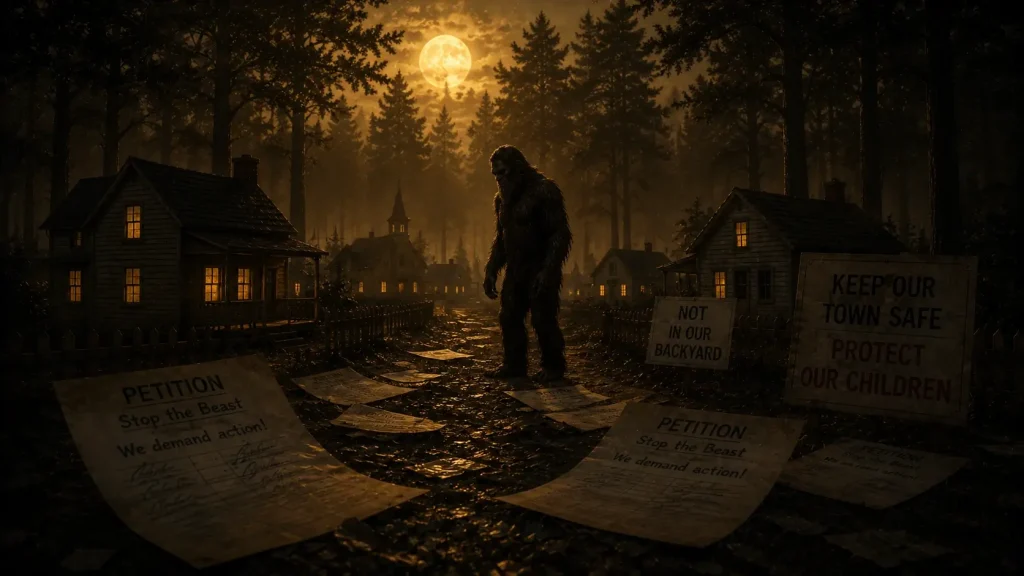
The petition arrived at Portland City Hall on Tuesday morning, seventeen pages of handwritten testimony on behalf of what the filing described as ‘displaced forest residents.’ The clerk who processed it said she had initially assumed it was performance art. The petitioner, identifying himself as Grundle of the Western Moss, was requesting an emergency session to address what he termed a ‘multi-species urban planning crisis.’ Park ranger Jennifer Walsh confirmed she had transcribed the petition during what she described as ‘the most professionally challenging forty minutes of my career.’

To the humans of Portland: I write this letter with a heavy heart and increasingly sore feet. For the past 340 years, my family has maintained a bi-annual migration route between the Douglas fir groves of Forest Park and the mineral springs near Mount Tabor. This 7.3-mile journey, undertaken each spring and fall since before your city existed, has sustained our ancient contract with the seasonal spirits and provided essential access to the medicinal clay deposits we require for proper molting.
Today, that route is blocked by approximately 47 tiny houses, 12 food trucks, and what appears to be an artisanal kombucha brewing facility. I am writing to formally request that Portland’s urban planning department establish an Inter-Species Urban Planning Committee to address this crisis, which affects not just my family but dozens of other displaced forest dwellers.
A Growing Crisis
I understand that humans are facing their own housing challenges. City records indicate a 23% increase in housing development permits within the affected corridor since 2019. However, I must point out that my housing crisis predates yours by several centuries, and unlike your situation, mine cannot be solved with a GoFundMe campaign.
— Grundle of the Western Moss
When the first tiny house village appeared along my traditional path in 2019, I attempted to work around it. Forest dwellers are adaptable. We’ve coexisted with logging operations, hiking trails, and that unfortunate period in the 1990s when the park was overrun with geocachers. But the current situation has reached what I can only describe as a crisis point.
🗺️
MIGRATION IMPACT
Grundle’s petition includes GPS coordinates of 23 alternative routes, all of which either cross private property, major highways, or what the creature describes as ‘areas with aggressively territorial urban deer.’
Last month, my youngest nephew attempted our traditional spring journey and became trapped for six hours between a tiny house village and a pop-up farmers market. The trauma of being photographed by approximately 200 tourists has left him unable to forage properly, and he now requires weekly sessions with a certified cryptid therapist.
A Modest Proposal
I propose the establishment of a formal Inter-Species Urban Planning Committee, with equal representation from Portland’s human, cryptid, and spectral communities. This committee would review all housing developments over 0.5 acres for potential impact on traditional migration routes, foraging grounds, and sacred molting sites.
COMMITTEE STRUCTURE
• Proposed membership: 4 human planners, 3 forest dwellers, 2 urban cryptids, 1 representative from the Greater Portland Ghost Collective
• Meeting frequency: Monthly, with emergency sessions during peak migration periods
• Jurisdiction: All Portland metro area housing developments
• Authority: Advisory, with formal environmental impact review powers
I am not asking for special treatment. I am asking for the same consideration you would give any long-term resident whose neighborhood is being transformed by development. The fact that I am 9 feet tall, covered in moss, and communicate primarily through subsonic rumbling should not disqualify me from the urban planning process.
— Grundle of the Western Moss
I have attempted to contact Portland City Council directly, but was informed that public comment periods do not accommodate my preferred communication method and that my subsonic testimony was ‘disrupting the building’s HVAC system.’ This is exactly the kind of institutional bias that the proposed committee would address.
In closing, I want to emphasize that I am not anti-development. I support sustainable housing solutions. I simply believe that ‘sustainable’ should include sustainability for all of Portland’s residents, regardless of species, corporeal status, or traditional relationship with seasonal spirits. My migration route has been carbon-neutral for over three centuries. I think that deserves some consideration.
A petition supporting the Inter-Species Urban Planning Committee has been submitted to the City Council and is available for public review. Signatures may be provided in standard ink, moss impressions, or spectral manifestations. I spent three days attempting to establish contact with the petitioner through park service intermediaries. Ranger Walsh confirmed she transcribed the document but declined to discuss the circumstances, citing what she described as ‘professional boundaries I am not equipped to navigate.’ The City Council’s public information office referred me to their standard accommodation request process. The city’s inability to accommodate non-human communication raises questions about representation that extend far beyond this single petition.
malcolmshaw@whatthecryptid.com Malcolm Shaw · Senior Features Journalist & Folklore Correspondent — WTCNN