
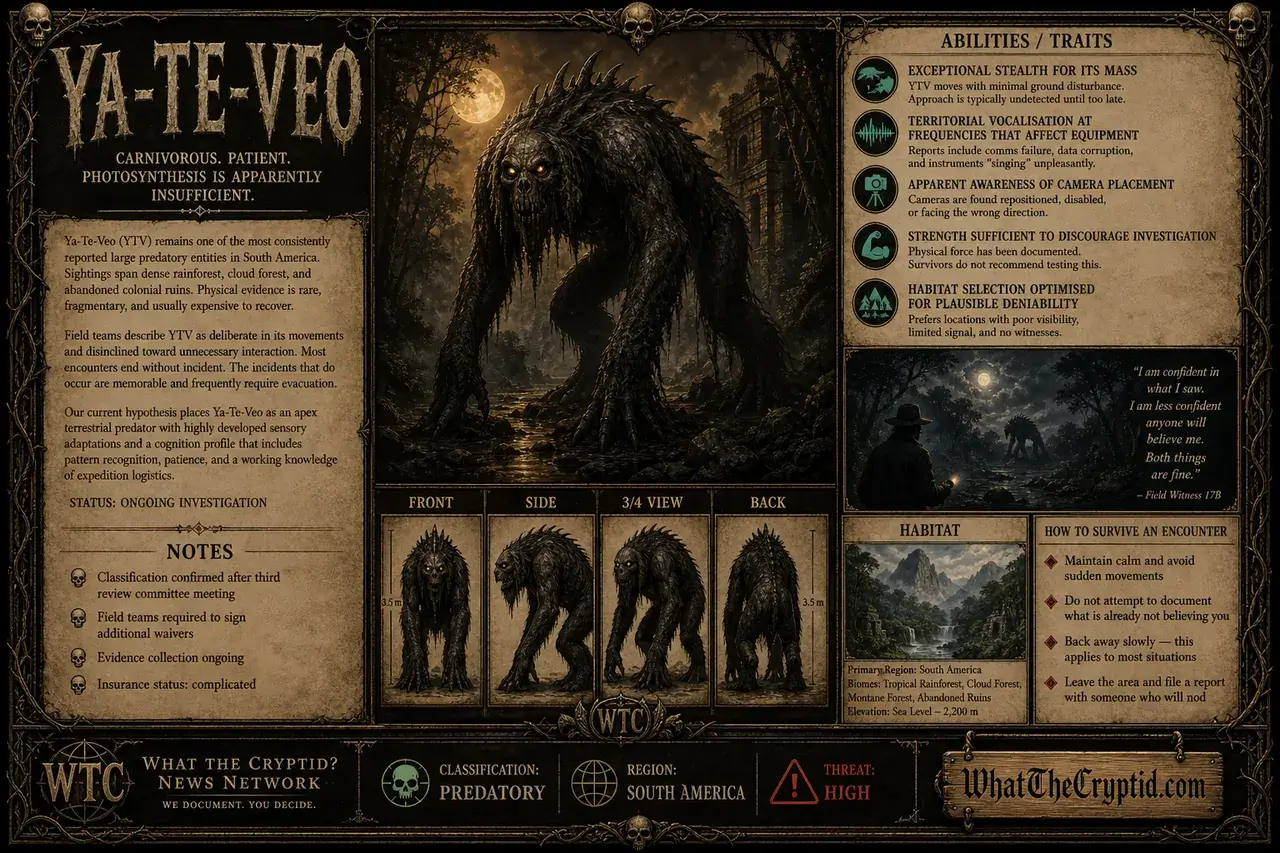
Ya-Te-Veo
Rooted. Patient. Has not moved in several decades.
South America
Unverified
Carnivorous PlantCentral AmericaSouth AmericaBotanical CryptidPredatory FloraNicaraguaAmazon
Overview
The Ya-Te-Veo — translated from Spanish as ‘I see you,’ a name whose implications WTC staff have discussed at some length — is a large carnivorous plant entity documented primarily across Central America, with additional reports from equatorial South America and scattered accounts from East Africa that are either related sightings or an entirely separate problem. It is categorised by WTC as Predatory on the grounds that, while it is almost certainly sessile, ‘sessile’ and ‘harmless’ are not synonyms, and the distinction matters considerably when one is standing within reach of it.

The entity is described consistently across independent accounts as a tree or large shrub possessing active hunting appendages — variously described as tentacles, long thorned branches, or stiff whip-like tendrils — capable of seizing and restraining prey of substantial size. The central mass of the plant is reported to secrete digestive fluid, which places it in a functional category with known carnivorous plants such as Nepenthes and Dionaea but at a scale that existing botanical taxonomy is not currently equipped to accommodate.
WTC considers the Ya-Te-Veo among the more straightforwardly dangerous entities in the database, noting that the threat profile of a large stationary predator is, in some respects, easier to model than that of a mobile one. The complication is that it is very difficult to see before you are already close enough for this assessment to become academic.
History & Mythology
The earliest systematic documentation of the Ya-Te-Veo appears in J.W. Buel’s 1887 volume Sea and Land, in which he describes the entity based on accounts relayed by a traveller identified only as ‘Mr. Dunstan,’ who claimed to have witnessed the plant seize and begin digesting a dog near the shores of a Nicaraguan lake. Buel’s account is detailed enough to suggest either genuine fieldwork or a very specific imagination, and WTC notes that these categories are not always as distinct as one might prefer.
Prior to Buel, analogous entities appear in the oral traditions of several Indigenous communities across the region, where large predatory plants feature in cautionary accounts associated with specific forest localities — areas that field teams have found local guides are still reluctant to enter, for reasons the guides describe as practical rather than superstitious. The distinction, as far as WTC is concerned, is not one we are qualified to adjudicate. Accounts from Madagascar and the African equatorial belt, circulating through colonial-era naturalist correspondence during the same period, describe a near-identical organism under different names, raising questions about either convergent evolution or convergent storytelling that WTC has tabled for a later meeting.
The 20th century produced no significant new primary documentation, which may indicate that the Ya-Te-Veo is rare, that expeditions into its confirmed habitat are infrequent, or that witnesses capable of providing detailed accounts are self-selecting toward the fortunate end of their encounters.
Physical Description
Accounts of the Ya-Te-Veo describe a central trunk or stem mass ranging from roughly the diameter of a mature oak to dimensions closer to a large baobab, with documented estimates placing the main body between four and eight feet across at the base. The overall height of the central structure appears to vary between specimens — if multiple specimens exist — with most accounts suggesting a main mass of five to eight feet, above which the hunting appendages extend considerably further. The plant is described as dark in colouration, brown-black to deep green, and covered in a bark-like exterior that witnesses have noted makes it visually indistinguishable from dead or dying vegetation at distances beyond approximately thirty feet.
The appendages are the feature most consistently described, and the consistency itself is worth noting given the geographic spread of the accounts. These are reported as numerous — estimates range from six to over twenty — long, tapering, and possessed of something between flexibility and directed movement. Some accounts describe them as studded with thorns or adhesive surfaces; others emphasise their speed when extending toward a target. Buel’s 1887 account specifies that the tendrils ‘moved with a dreadful certainty,’ a phrase that WTC’s editorial team found useful, if unhelpfully vague for fieldwork purposes.
A central depression or cavity at the apex of the main mass is described in multiple accounts as the digestive site, containing fluid of a consistency and odour that witnesses have been unable to describe with professional detachment. Regional variants, if they are variants and not distinct species, appear to differ primarily in appendage count and the degree to which the plant employs scent as a lure — accounts from the African reports suggest a sweet, fruit-like smell detectable at distances of up to fifteen feet.
Behaviour & Temperament
The Ya-Te-Veo’s behaviour, insofar as a stationary organism can be said to have behaviour, is characterised by patience and what field researchers have described, in their notes, as attentiveness. The plant does not pursue prey. It does not need to. Multiple accounts describe the appendages as remaining in a low, draped position when no target is present, rising or orienting toward nearby movement before the entity engages. Whether this constitutes perception in any meaningful biological sense is a question WTC has forwarded to three separate botanists, two of whom have not responded and one of whom described the query as ‘outside the scope of her department.’
Engagement, when it occurs, is reported as rapid and decisive. Witnesses who observed attacks on animals — and the small number of witnesses who observed attacks on humans from a position that permitted subsequent reporting — describe the appendages as coordinating to encircle and compress the target before drawing it toward the central mass. The process is not instantaneous. Accounts suggest the digestive phase takes considerable time, during which the plant remains occupied and, in documented cases involving smaller prey items, appears to continue monitoring its surroundings with unengaged appendages. This last detail required, per WTC records, one insurance waiver to document in the field.
There is no documented evidence of social structure, seasonal dormancy, or territorial behaviour beyond the plant’s physical range. It is, by all available evidence, simply there, doing what it does, in the same location, indefinitely. WTC researchers have noted that this is either reassuring or the opposite, depending on whether you know where it is.
Habitat & Territory
The Ya-Te-Veo is documented in dense tropical and subtropical forest environments, with the highest concentration of accounts associated with humid lowland forest at elevations below 800 metres in Nicaragua, Costa Rica, and the broader Amazonian basin. Witnesses and local informants consistently associate the entity with areas of partial canopy — locations where light reaches the forest floor, which aligns with the photosynthetic requirements of large plant organisms and also happens to be the kind of clearing that human travellers are most likely to walk into without adequate caution.
Proximity to water is noted in a significant proportion of accounts, with riverbanks, lake margins, and marshy ground appearing repeatedly in sighting coordinates. Whether this reflects a preference for moisture-rich soil, an association with animal movement corridors near water sources, or simple observer bias toward areas where humans travel is unknown. WTC field teams have marked seventeen candidate habitat sites across the documented range. Access to eleven of them requires either a specific dry-season window or a boat, and the remaining six are on private land whose owners have declined to discuss the matter.
Diet & Hunting
The Ya-Te-Veo is documented consuming animal prey ranging from insects and small mammals up to, in the most serious accounts, large dogs and — in incidents WTC treats as its primary threat classification basis — human beings. The digestive mechanism appears to function through enzymatic fluid secreted into the central cavity, consistent in principle with the biology of known pitcher plants, though at a scale that makes the comparison feel somewhat inadequate. The fluid is described as clear to pale yellow, viscous, and producing a marked burning sensation on skin contact — a detail provided by witnesses who escaped before full immersion, and who are to be commended for their subsequent reporting under the circumstances.
Seasonal dietary patterns have not been established, as sustained observation of a confirmed specimen has not been documented. Local accounts suggest the plant is opportunistic rather than selective — taking what comes within range rather than demonstrating preference for specific prey. The one detail that field researchers have found quietly remarkable is that several accounts describe the plant releasing uneaten or undigestible material after a period of time, depositing it at the base of the trunk. This implies a digestive process with some capacity for discrimination. What precisely the Ya-Te-Veo finds indigestible has not been formally tested, and WTC is not currently in a position to fund that research.
Notable Sightings
Mr. Dunstan, identity otherwise unverified, reported encountering the entity while conducting undescribed fieldwork near the Nicaraguan lakeshore. His dog, moving ahead of him through undergrowth, was seized by multiple appendages and drawn toward the plant’s central mass. Dunstan reported intervening with a machete, severing several appendages and recovering the animal, which survived with injuries he described as ‘considerable.’ The account was published by J.W. Buel without independent corroboration. Dunstan did not return to the site.
A surveying party operating near the Xingu River basin reported losing one member, identified in expedition logs only as ‘C. Ferreiro,’ to what the party’s lead surveyor described in his field journal as a ‘carnivorous thorn-tree of extraordinary size and speed.’ The entry is three sentences long and is followed by a gap of eleven days in the journal before entries resume. The expedition filed its geographic survey with the relevant Brazilian authority on schedule. No supplementary incident report was attached.
A wildlife photographer, Marisol Aguilar, reported observing a large dark plant seize and retain a juvenile peccary approximately twenty metres from a trail she was walking near the Río Pacuare. She described the appendages as ‘more like arms than branches’ and the speed of capture as ‘not how plants work.’ Aguilar did not approach the site and estimated the plant’s position by GPS coordinates she provided to WTC researchers the following year. A field team visited the coordinates in 1996 and found no specimen, though they noted an unusual concentration of large animal bones at the site that the team’s botanist described as ‘consistent with, but not diagnostic of, the reported account.’ Aguilar reviewed the field team’s report and noted that she had given the GPS coordinates from memory, which she felt she should have mentioned earlier.
A community ecotourism guide, name withheld at his request, reported a large plant entity consistent with Ya-Te-Veo descriptions to a WTC correspondent operating in the region. He stated that the plant had been known to his community for at least three generations, that its location was not shared with outsiders as a matter of established practice, and that he was telling WTC only because he felt the record should exist somewhere. He provided no coordinates. He described the plant as ‘very old’ and ‘not interested in people who know where it is.’ The WTC correspondent noted this last detail in her report and underlined it twice, which is not standard editorial practice.
Threat Assessment
The Ya-Te-Veo presents a threat profile that is unusual in the WTC database in that the entity’s primary danger is not aggression, speed, or intelligence, but proximity. At ranges beyond thirty feet, a confirmed specimen poses no documented threat. At ranges between ten and thirty feet, the risk level escalates significantly and quickly. At ranges under ten feet, WTC recommends treating the situation as already in progress and acting accordingly. The specific recommended action at under ten feet depends on which direction you are facing and whether you are already in contact with an appendage, at which point this guidance has limited practical utility.
WTC recommends maintaining a minimum distance of forty feet from any vegetation in confirmed Ya-Te-Veo habitat that appears dead, dark, or unusually still. The forty-foot margin exceeds documented appendage reach by approximately fifteen feet, which our threat assessment team considers adequate and our field teams consider optimistic. Travellers in known habitat should avoid clearings near water during low-light hours, move in groups, and remain on established trails where possible. It should be noted honestly that established trails in confirmed Ya-Te-Veo habitat are not common, that the entity has no documented aversion to daylight, and that the most useful single piece of advice — do not approach unusual trees — is advice whose application requires that you have already identified the tree as unusual, which is precisely the difficulty.
WTC Field Notes
WTC first formally catalogued the Ya-Te-Veo in our database in 2003, following the receipt of Marisol Aguilar’s 1994 account through a correspondent contact, which arrived nine years after the incident due to a routing error that we prefer not to discuss in detail. The entry was initially classified under Flora, a category WTC has since discontinued on the grounds that maintaining a separate section for plant-based entities created formatting inconsistencies that our web team found unworkable. The Ya-Te-Veo was reclassified as Predatory, which our senior editor described as ‘accurate, if reductive.’
WTC has made three attempts to fund a dedicated field expedition to the Pastaza Province region following the 2011 account. The first attempt was not funded. The second attempt was partially funded and then redirected to a Chupacabra investigation in Sonora that was considered more time-sensitive. The third attempt is currently under review by our grants committee, which meets quarterly and last met in February. In the interim, WTC has updated this entry based on archival research, correspondent accounts, and the 1996 field team report, which remains the most recent direct fieldwork associated with this entity. The 1996 field team submitted their report, expensed a reasonable quantity of field equipment, and upon return requested that their names be removed from the Ya-Te-Veo file. We have honoured this request.