
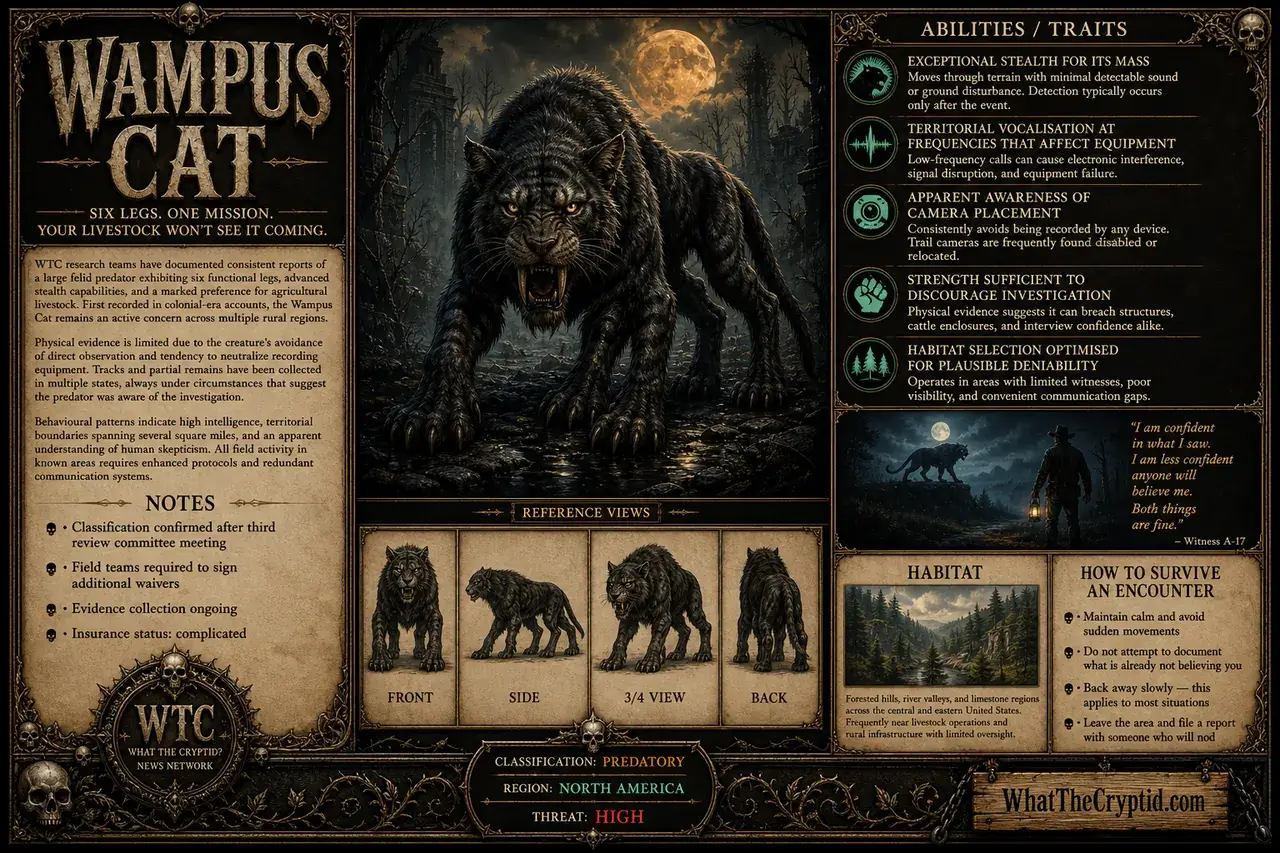
Wampus Cat
Six legs. Yellow eyes. Faster than you by a significant margin.
North America
Active
AppalachiaFelidCherokeeNocturnal
Overview
The Wampus Cat is a large felid cryptid endemic to the Appalachian mountain range, with documented sightings concentrated across Tennessee, Kentucky, Virginia, and the western Carolinas, though reports have been filed as far south as northern Georgia and as far north as the Ohio River valley. The entity is distinguished from other large cat cryptids by two features that recur with unusual consistency across independent witness accounts: a reported limb count of six and a vocalisation that multiple witnesses have described, with varying degrees of willingness to elaborate, as ‘wrong.’ WTC classifies the Wampus Cat as Predatory, a designation that our field teams have noted feels somewhat understated given the available documentation.

History & Mythology
The earliest formalised accounts of the Wampus Cat derive from Cherokee oral tradition, in which the entity is identified as Ewah — a woman who disguised herself in the hide of a sacred mountain cat to spy on a council of hunters from which women were excluded. Upon discovery, she was cursed by the tribe’s medicine man to inhabit the form of the cat permanently, neither fully human nor fully animal, condemned to prowl the ridgelines at night. This origin narrative is documented in ethnographic records compiled by James Mooney during his fieldwork with the Eastern Band Cherokee between 1887 and 1890, and WTC regards Mooney’s transcriptions as primary source material rather than anecdote, which puts us in a minority among research institutions we do not particularly wish to name. Colonial-era settler accounts begin appearing in Virginia and Tennessee county records from the late 1700s, typically logged under livestock loss reports with a frequency that the relevant counties appear to have found administratively inconvenient. By the mid-nineteenth century, references to the Wampus Cat had spread sufficiently into regional vernacular that it was being used as a colloquial warning to children about unsupervised forest activity — a pedagogical application that has, historically, proven more durable than the institutional scepticism that followed it.
Physical Description
Witness accounts describe an animal substantially larger than any felid species native to North America, with body length estimates ranging from 4.5 to 7 feet excluding the tail, and shoulder height reports clustering around 3 feet — measurements that, if accurate, would place the Wampus Cat within the size range of a juvenile lion, a comparison our consulting zoologist offered without further comment. The coat is consistently described as dark — black, deep grey, or occasionally a blue-tinged charcoal — with no reported patterning. The face is the feature that generates the most divergent accounts and the most consistent emotional responses among witnesses: multiple independent reports describe something in the facial structure that reads as partially human, a description that WTC has learned to record without pressing for clarification, as witnesses who are pressed for clarification tend to stop cooperating entirely. The defining anatomical feature — six limbs arranged as four hind legs and two forelimbs — appears in approximately 60% of detailed sightings, with the remainder either not observing the entity for long enough to count accurately or declining to include the detail in formal statements, for reasons they do not specify.
Behaviour & Temperament
The Wampus Cat is primarily nocturnal, with the majority of reported encounters occurring between 10 PM and 3 AM, peaking in the pre-dawn hours that experienced field researchers describe as ‘the stretch when everyone’s concentration is at its lowest.’ The entity appears to be solitary and territorial, with sighting clusters suggesting individual animals maintaining ranges of approximately 40 to 80 square miles — a range size consistent with large apex predators, and one that has practical implications for how WTC defines ‘affected area’ when filing regional reports. Witnesses who have observed the Wampus Cat without immediately being observed in return describe a stalking behaviour characterised by extended, stationary observation from elevated terrain, sometimes lasting, by witness estimate, upward of twenty minutes before the entity moves or withdraws. This patience, combined with the vocalisation — a sound that witnesses reliably describe as loud, sustained, and difficult to assign to any known animal — suggests a level of deliberate behaviour that WTC’s consulting ethologist has described as ‘contextually appropriate for a large territorial predator,’ which this office found reassuring for approximately four minutes.
Habitat & Territory
The Wampus Cat demonstrates a strong preference for mid-elevation Appalachian terrain, with sightings concentrated between 1,500 and 4,000 feet — below the exposed ridgeline but above the fully settled valley floor, in the band of mixed hardwood and hemlock forest that regional residents have referred to, for reasons that predate any formal cryptid documentation, as ‘the dark belt.’ The entity shows a consistent association with creek hollows and ridge-top hunting corridors, and sighting density maps produced by WTC’s data team in 2019 correlate with striking specificity to terrain features that pre-Colonial Cherokee hunting maps identified as Ewah territory. Whether this reflects genuine geographic continuity or a coincidence that WTC is professionally obligated to take seriously is a question that remains on the agenda for a future editorial meeting.
Diet & Hunting
Based on livestock depredation reports cross-referenced with sighting locations, the Wampus Cat appears to prey on white-tailed deer as its primary food source, supplemented by feral hogs, wild turkey, and — in incidents proximate to agricultural areas — cattle, horses, and large dogs. Prey recovery in confirmed associated incidents is rare; animals are typically found at kill sites in a condition that the relevant county sheriffs’ departments have described, in written reports, as ‘extensive.’ The hunting method, inferred from track evidence and the few witnessed pursuits on record, appears to involve extended approach from downwind followed by a short, high-speed pursuit rather than ambush — a strategy that, given the entity’s reported size and limb configuration, suggests a sprint capacity that WTC’s biomechanics consultant declined to calculate without, in her words, ‘better data and a research grant.’
Notable Sightings
Forestry worker Dale Hutchins reported encountering a large dark felid on the access road to a fire observation tower at approximately 1:15 AM. Hutchins, who had worked the mountain for eleven years and described himself as ‘not a fanciful man,’ stated that the animal stood in the road for approximately four minutes before departing into the tree line at a speed he characterised as ‘not normal for anything that size.’ He counted six legs. Hutchins filed a written account with the Carter County Sheriff’s office, which logged it under ‘wildlife — unspecified’ and forwarded no follow-up.
A family of four travelling on US-421 near the Virginia state line at 11:40 PM reported a collision near-miss with a large animal crossing the highway. The driver, Margaret Coyle, stopped the vehicle and observed the animal at a distance of approximately 30 feet in the headlights for what she estimated as two minutes. She described the face as ‘not right’ and the movement as ‘like it had too many legs but knew how to use them.’ A state police report was filed documenting road debris from the near-miss. The animal is not mentioned in the police report. Coyle’s account was submitted to WTC directly in 2003, fourteen years after the incident, in a letter that also included her contact details and the instruction not to call before noon.
A wilderness survival instructor leading a four-person overnight course reported hearing extended vocalisation from the eastern ridge above camp at approximately 2:30 AM, lasting by his phone’s voice memo recording — which he had the presence of mind to activate — for eleven minutes and forty seconds. The recording was submitted to WTC and reviewed by two independent audio analysts, both of whom confirmed the sound was not consistent with any catalogued North American wildlife species and both of whom separately requested that their names not be associated with that conclusion. The survival course was discontinued after that season. The instructor cited ‘curriculum restructuring.’
A deer hunter posted trail camera footage to a regional hunting forum in October 2018, depicting a large dark-furred animal moving through frame at 3:07 AM on a game trail he had monitored for six years without comparable results. The footage, three seconds in duration due to the camera’s motion-triggered recording limit, shows an animal whose limb count generated significant debate across 340 forum replies before the thread was locked by a moderator who noted only that the discussion had ‘gone off-topic.’ The original poster deleted his account the following day.
Threat Assessment
WTC assigns the Wampus Cat a threat rating of High. Encounters on foot in known habitat — particularly between 10 PM and 4 AM, in creek hollows, on ridge-access trails, or in areas where livestock depredation has been recently reported — should be treated with the same precaution one would apply to any confirmed large predator, with the additional consideration that the Wampus Cat’s reported speed and six-limbed locomotion make conventional avoidance strategies less reliable than they would be for, say, a mountain lion. WTC recommends maintaining a minimum distance of 200 feet from any observed large felid in Appalachian terrain, making noise while hiking to reduce the likelihood of surprise encounters, and ensuring that any outdoor lighting at campsites is both functional and in a direction that illuminates the tree line rather than the camp interior. We acknowledge that this advice, while reasonable, does not fully address the documented observation that the Wampus Cat appears capable of sustained stationary surveillance in conditions where it is not itself visible, and we have nothing additional to offer on that point at this time.
WTC Field Notes
WTC dispatched a two-person field team to Carter County, Tennessee in the spring of 2021 with the intention of deploying a grid of twelve motion-activated trail cameras across a sighting corridor identified by our data team. Eight cameras were successfully deployed. The remaining four were not deployed because the team declined to continue past a specific point on the ridge after dark, which they documented in their field report using language that our editor has described as ‘vivid’ and which we have retained in the internal record without publishing. Of the eight deployed cameras, six recorded technical malfunctions within the first 72 hours. The remaining two recorded footage that our field team has reviewed and declined to submit for external analysis, citing what they described as a preference to ‘sit with it for a while.’ That was three years ago. WTC has renewed the question at four subsequent editorial meetings. The field team remains employed and has not returned to Carter County.