
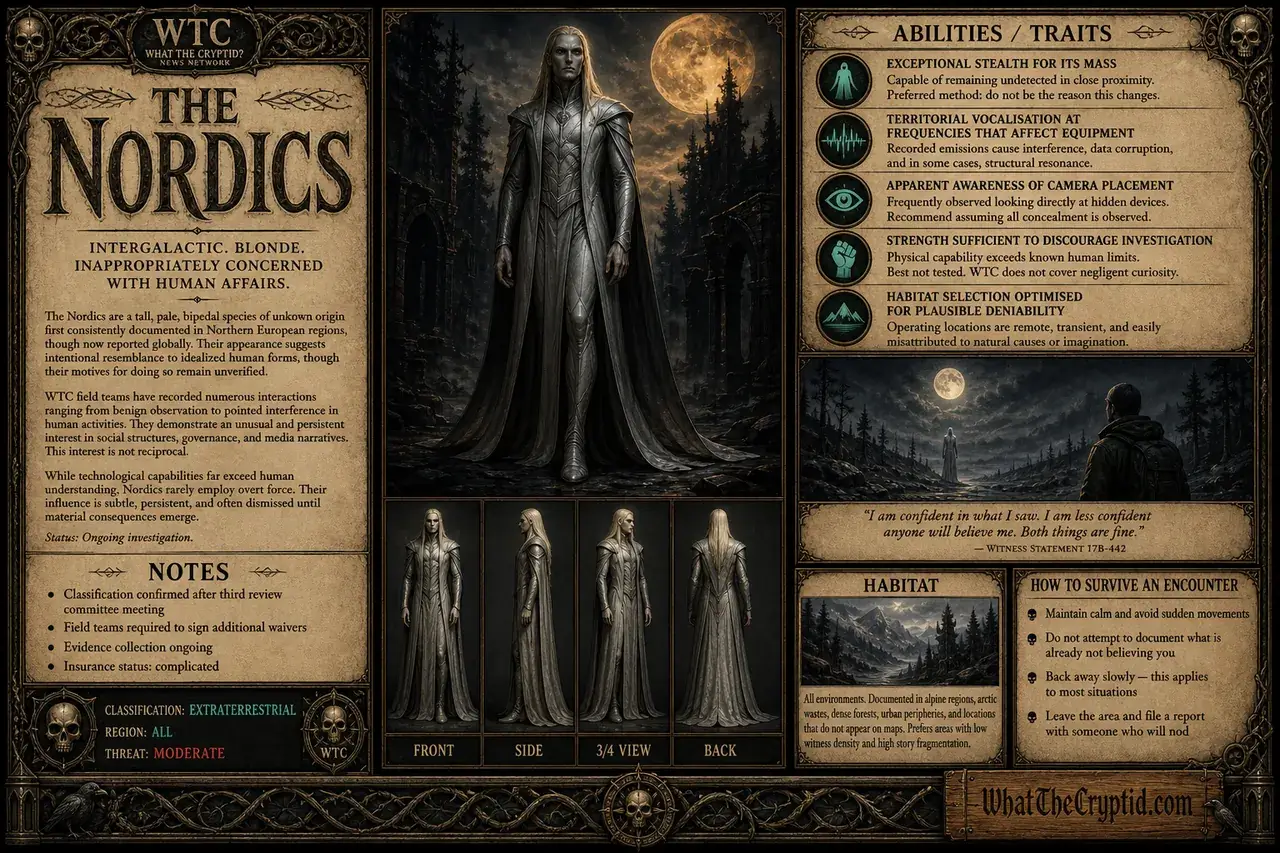
The Nordics
Interstellar. Photogenic. Frustratingly vague about their intentions.
All
Active
ExtraterrestrialContacteeCommunicationHumanoid
Overview
The Nordics represent one of the more visually coherent entries in the WTC extraterrestrial classification system, which is to say that witnesses across six decades and four continents have described the same entity with a consistency that would be scientifically remarkable if we were permitted to say that. Tall, pale, and possessed of cheekbones that multiple witnesses have described, unprompted, as ‘very good,’ the Nordics are distinguished from other reported extraterrestrial types primarily by their apparent preference for direct communication, philosophical monologuing, and an approach to interspecies contact that our field researchers have characterised as ‘aggressively non-threatening to a degree that itself warrants scrutiny.’

First entering the popular record during the contactee wave of the 1950s, the Nordics have maintained a consistent profile across subsequent decades with only minor regional variation. Unlike many cryptid classifications, the Nordics actively seek human contact — or at minimum, do not avoid it — and have been documented engaging witnesses in extended conversations covering topics including nuclear disarmament, humanity’s spiritual development, and, in at least three cases, dietary recommendations. WTC does not currently have a position on the dietary recommendations.
The entity’s danger rating of 3 reflects an absence of documented physical aggression rather than a positive assessment of intent. WTC notes these are not the same thing, and has tabled a formal distinction for a later editorial meeting that has been rescheduled four times.
History & Mythology
The modern Nordic record effectively begins on November 20, 1952, when Polish-American contactee George Adamski reported a face-to-face encounter with a being he described as Orthon, a Venusian with long blonde hair and an expression of serene benevolence, in the California desert near Desert Center. Adamski’s subsequent documentation — including photographs of craft, written accounts of further contacts, and a speaking tour that ran for several years — established the template against which virtually all subsequent Nordic reports are measured. That this template also generated significant book sales has been noted by WTC researchers and then professionally set aside.
Prior to Adamski, analogous figures appear in documented folklore at a frequency that warrants careful attention. The Vanir of Norse mythology — a group of gods associated with fertility, wisdom, and prescient knowledge, distinct from the more martial Aesir — are described in the Prose Edda as tall, fair, and possessed of advanced understanding humans could not independently access. The Tuatha Dé Danann of Irish tradition similarly present as a race of luminous, physically superior beings who arrived from elsewhere, imparted knowledge, and eventually withdrew to a realm not directly accessible to ordinary humans. WTC is not asserting a connection. WTC is, however, logging the overlap.
The contactee era of the 1950s and 60s produced the highest density of documented Nordic encounters on record, concentrated predominantly in the western United States, Scandinavia, and South America. A notable clustering of reports from Brazil between 1957 and 1965 — many involving witnesses with no knowledge of the concurrent American accounts — produced descriptions consistent with the North American record to within normal variation. The Brazilian researcher João de Freitas Guimarães documented forty-seven of these cases before his research archive was destroyed in a fire in 1971. The cause of the fire was determined to be electrical.
Physical Description
Adult Nordics are consistently reported between 5 feet 11 inches and 7 feet 2 inches in height, with the majority of witness accounts clustering around 6 feet 3 inches to 6 feet 6 inches. Build is described as athletic and proportional, without the elongated limb ratios associated with the Grey classification. Skin tone ranges from pale white to light tan across the documented record, with no reported instances of darker complexions. Hair is universally described as blonde to white-blonde, worn at varying lengths; male-presenting Nordics are reported with both short and shoulder-length hair at roughly equal frequency, which WTC notes is more consistent variation than you would find in a random sample of humans from any given region.
The facial features most consistently emphasised across independent witness accounts are the eyes and the cheekbones. Eyes are described as blue, blue-grey, or occasionally violet, and are reported as larger than the human average with an iris-to-white ratio that witnesses struggle to quantify but consistently describe as ‘different’ or ‘not quite right.’ The cheekbones, as previously noted, are described favourably and with a specificity of admiration that is unusual in encounter reports. WTC’s consulting forensic artist produced a composite from seven independent accounts in 2019 and described the result as, quote, ‘unfairly attractive, which I think is doing a lot of work here.’
A subset of approximately 15 percent of documented reports describes Nordics in fitted silver or white garments with no visible fastening. The remaining 85 percent describe entities in clothing indistinguishable from contemporary human dress for the period of the encounter — a detail that either suggests sophisticated cultural assimilation or raises questions WTC is not currently resourced to pursue.
Behaviour & Temperament
The defining behavioural characteristic of the Nordics is communication. Where other extraterrestrial classifications are reported to conduct examinations, collect samples, or depart without interaction, Nordics consistently stay to talk. Documented conversations range from three minutes to, in the case of Swiss contactee Billy Meier, what he described as ongoing contact spanning decades. The content of these communications follows a pattern recognisable enough that WTC has developed a loose taxonomy: spiritual and philosophical guidance accounts for approximately 40 percent of recorded content, warnings about nuclear technology or environmental destruction for 35 percent, vague references to humanity’s ‘potential’ for a further 20 percent, and practical advice — including, in documented cases, navigation instructions, health recommendations, and, once, directions to a specific location in Arizona — for the remaining 5 percent. The Arizona location was a rock formation. It was a very good rock formation.
Nordics are reported to communicate through both spoken language and telepathy, often within the same encounter. Witnesses consistently describe the transition between modes as seamless and report that the telepathic communication carried an emotional valence that spoken language did not — specifically, a sense of calm that several witnesses described as difficult to sustain after the encounter ended. WTC’s consulting psychologist reviewed eight such accounts and described the reported effect as ‘consistent with a very specific kind of experience’ before requesting that her name not appear in this entry.
Social structure, where inferable from contact reports, suggests a cooperative rather than hierarchical organisation. Group sightings — which account for approximately 30 percent of the documented record — show no clear authority figure, with different individuals apparently taking communicative lead based on context. Whether this reflects genuine social equality or simply a consistent approach to managing contact encounters is a distinction WTC does not currently have the methodology to make.
Habitat & Territory
Nordics demonstrate no consistent habitat preference in the terrestrial sense, as encounters are reported across all major biomes and at elevations ranging from sea level to approximately 11,000 feet. However, a statistically non-trivial proportion of close-contact encounters — approximately 38 percent of the documented record — occur in rural or semi-rural environments at least six miles from the nearest population centre, in conditions of low ambient light, between the hours of 9 PM and 3 AM. WTC acknowledges this distribution is also consistent with the habitat preferences of humans who go looking for things.
Craft associated with Nordic encounters, where reported, are described hovering or landed in clearings, on flat desert terrain, or in proximity to bodies of water. A specific preference for reservoir and lake adjacency appears in encounter reports from Sweden, Norway, and the Swiss Alps at a frequency our data team describes as ‘probably meaningful, pending further review.’ Pending further review has now been the status of this observation for three years.
Diet & Hunting
No direct observation of Nordic feeding behaviour has been recorded in the WTC database, and the question of diet is one that has, curiously, been raised by the Nordics themselves in at least six documented contact encounters. In each case, the entity initiated discussion of human nutritional practices, expressing views ranging from mild concern to what witnesses described as ‘polite but pointed’ commentary on the consumption of animal products. Three of the six encounters included specific dietary recommendations. WTC is not in a position to evaluate whether these recommendations were nutritionally sound, and our consulting dietitian’s response to the question was not suitable for a public database entry.
The physiological requirements of an entity of the Nordic’s reported mass — estimated between 160 and 220 pounds based on witness descriptions — would, under standard metabolic modelling, necessitate caloric intake broadly comparable to a human of similar build. Whether this intake occurs on Earth, in transit, or at a location not yet identified in the contact record is unknown. The entities have not been observed eating. They have, on two occasions, been offered food by witnesses and declined, in both cases with what was described as gracious but firm courtesy.
Notable Sightings
George Adamski, operating a telescope at Palomar Gardens, reported observing a large cigar-shaped craft followed by a meeting with a male entity he later identified as Orthon of Venus, approximately 5 feet 6 inches tall with long sandy hair and a one-piece brown suit, who communicated primarily through hand gestures and telepathy and expressed concern about nuclear weapons testing. Adamski produced a series of photographs in subsequent weeks and a full written account published in 1953 as ‘Flying Saucers Have Landed,’ co-authored with Desmond Leslie. The book sold over a million copies across seventeen languages, which WTC notes does not constitute evidence either way.
Gösta Carlsson, a Swedish engineer, reported encountering a landed disc-shaped craft in a forest clearing outside Höganäs on May 18, 1946, and meeting a crew of entities he described as tall, fair-haired, and dressed in tight-fitting garments. A female crew member communicated with him in Swedish and indicated the group had been observing the region for some time. Carlsson provided drawings of the craft’s interior design that he maintained were accurate for the remainder of his life and that bear structural similarities to craft descriptions from contactees in countries Carlsson had no documented contact with. Carlsson waited forty years to make the account public, citing a concern that no one would believe him, which WTC considers a reasonable concern that does not resolve the underlying question.
Adolfo Millán, a commercial pilot with Avensa Airlines, reported a mid-flight encounter during a routine Caracas to Maracaibo service in which he observed a bright craft pacing his aircraft at close range for approximately eleven minutes. Following the flight, Millán described having received what he characterised as a ‘communication’ during the encounter — a sense of transmitted information rather than spoken words — the content of which he declined to specify in his initial report. Millán submitted a formal incident report to the Venezuelan Civil Aviation Authority, continued flying commercially for a further nineteen years, and mentioned the encounter in interviews only when directly asked.
Eduard ‘Billy’ Meier, a one-armed Swiss farmer, reported his first contact with a Nordic female entity named Semjase on January 28, 1975, in a forest near Hinwil, beginning what he described as an ongoing series of more than 130 documented contacts over subsequent decades. Meier produced an extensive photographic and physical evidence record including metal samples, plant specimens, and audio recordings of craft sounds, which underwent independent technical analysis producing results described by the analysts as ‘anomalous’ in terms that each analyst subsequently qualified to varying degrees. The Semjase Silver Star Center, established to document and disseminate Meier’s contact record, has operated continuously in Hinterschmidrüti since 1975 and currently maintains an archive that WTC has requested access to twice without response.
Threat Assessment
Based on the current documented record, the Nordics present a Low threat rating to human physical safety. No encounter in the WTC database has resulted in reported physical injury to a witness, and the entities’ consistent behavioural pattern of verbal engagement and voluntary withdrawal makes the escalatory dynamics associated with High or Extreme-rated classifications unlikely under normal contact conditions. WTC recommends maintaining a calm, non-aggressive posture if contact is initiated, at a distance of no less than 10 feet unless the entity closes that distance first, which — based on the contact record — it probably will.
The more substantive risk associated with Nordic encounters is psychological and sociological. Witnesses consistently report significant post-contact disruption including changes in belief system, relationship difficulties, and in a subset of cases, sustained difficulty re-engaging with ordinary professional and domestic life. WTC is not in a position to assess whether these outcomes represent harm or simply adjustment, and our consulting psychologist’s written assessment on this point used a level of hedging that was not editorially useful. Witnesses are advised to seek support from individuals familiar with contact experience if post-encounter adjustment proves difficult. WTC maintains a list of such individuals, though we note that several of them have their own contact histories that should be disclosed upfront.
WTC Field Notes
The Nordic file represents one of WTC’s more logistically complicated ongoing projects, primarily because the volume of contact documentation — spanning seven decades, four continents, and multiple languages — significantly exceeds the processing capacity of our current research team, which is three people and a part-time archivist who works Tuesdays. The backlog of unreviewed Brazilian contact reports alone is estimated at several hundred cases, a situation our editor describes as ‘the most interesting problem we don’t have the budget to solve.’ A grant application to digitise and cross-reference the pre-1980 South American contact archive was submitted in 2022 and has not yet received a response.
WTC researchers have noted, with what we consider appropriate professional distance, that the Nordic classification is unusual in the database for the quality of question it raises relative to the quality of answers available. Most cryptid investigations are limited by a shortage of witness accounts. The Nordic file is limited by a surplus of them and a corresponding difficulty establishing which details are independently generated and which are the result of cross-contamination through the popular literature — a problem that is, frankly, exacerbated by the popular literature including several books written by witnesses who later became sources for other witnesses. Our editor has requested that this observation be included in the entry without further editorial comment. It is included here without further editorial comment.