
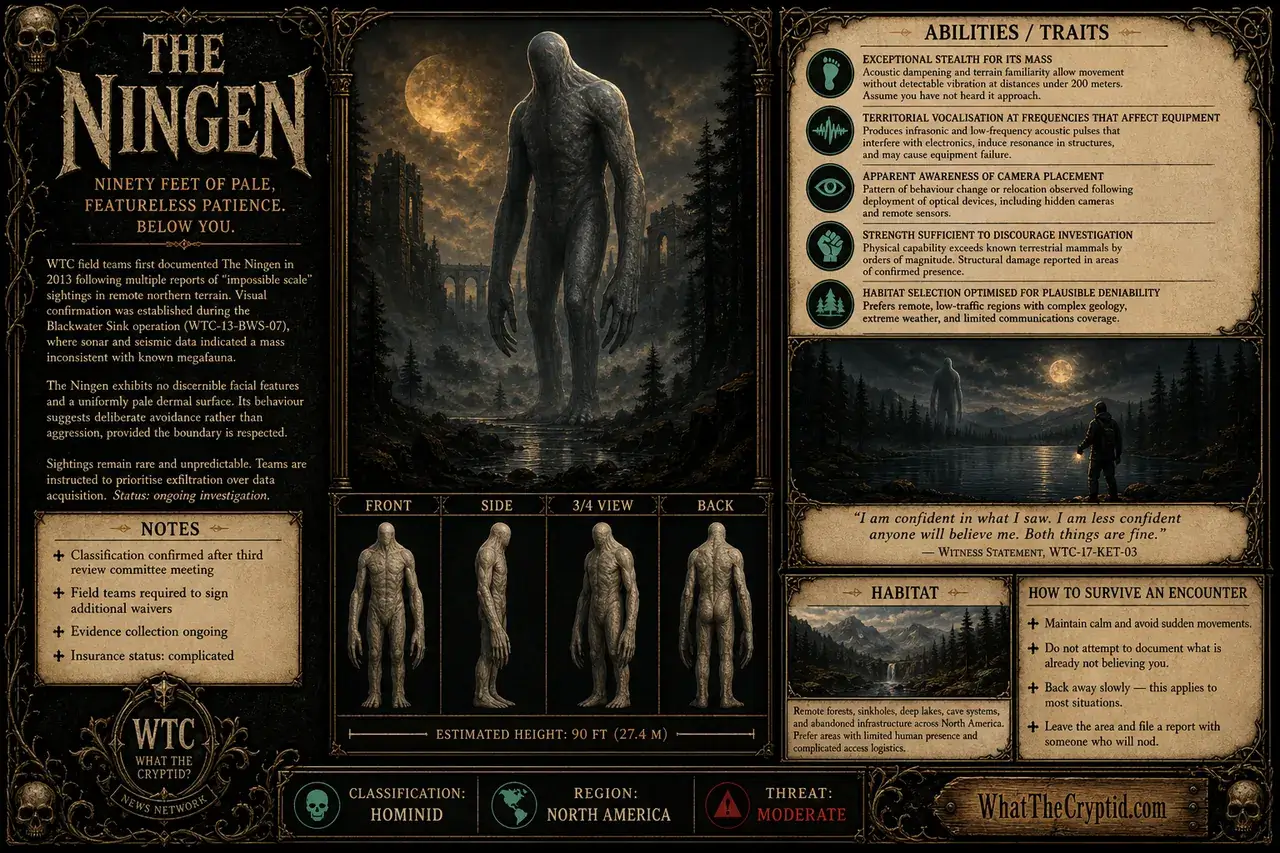
The Ningen
Ninety feet of pale, featureless patience. Below you.
North America
Active
AquaticSouthern OceanHumanoidAntarcticJapanese FolkloreDeep Sea
Overview
The Ningen is a large aquatic entity reported primarily in the waters of the Southern Ocean, with the majority of documented sightings attributed to personnel aboard Japanese government research vessels operating in Antarctic and sub-Antarctic zones between the 1980s and 2000s. The entity is notable among aquatic cryptids for its reportedly humanoid body plan, a characteristic that has complicated both its classification and the willingness of witnesses to file formal reports. WTC places it in the Aquatic category, though our consulting marine biologist noted, without elaborating, that this classification ‘does not fully resolve the problem.’
Estimated lengths across reported sightings range from 60 to 90 feet, which would make the Ningen one of the largest documented entities in the WTC database by raw body mass, assuming water displacement calculations submitted by field researcher Okamoto Hiroshi in 2019 are methodologically sound, which three of four reviewers indicated they were not. The entity’s surface coloration is consistently described as white or very pale grey, with a smooth, featureless integument bearing no visible scales, dorsal fins, or external gill structures. Its silhouette, as reported from above the waterline, suggests bilateral symmetry and upper limb structures that multiple witnesses have independently compared to arms.

The Ningen has attracted significant attention in Japanese internet communities since accounts first circulated on the 2channel message board in the mid-2000s, with the original posts attributed to anonymous government vessel crew members citing non-disclosure concerns. WTC notes that anonymity and non-disclosure concerns are not, in themselves, evidence either for or against an entity’s existence, though they do present ongoing documentation challenges that our acquisitions team has described as ‘frustrating.’
History & Mythology
The Ningen does not appear in pre-modern Japanese folklore in any form that researchers have been able to directly connect to the entity as currently described. Its emergence as a documented phenomenon is almost entirely modern, rooted in the operational history of Japan’s government-run whale research programme, which maintained a continuous Southern Ocean presence from the early 1980s onward. The first accounts to reach public attention were posted anonymously to 2channel in approximately 2002, describing encounters that the original posters claimed had occurred years earlier and had been informally suppressed within the research community. WTC has not been able to independently verify the identity of these original posters, and the relevant government agency did not respond to our inquiry, which was submitted in three languages.
By 2007, the term ‘Ningen’ — meaning simply ‘human being’ in Japanese, applied here in a register suggesting uncanny resemblance — had been adopted by online communities to describe the entity consistently, and secondary accounts began circulating from individuals claiming to have spoken with vessel crew. The magazine MU, a Japanese publication covering paranormal subjects, ran early print coverage that WTC has reviewed and found to be detailed if unverifiable. Several accounts reference a specific incident involving a Japanese research vessel designated by witnesses only as ‘the Kaiyo-class ship,’ in which crew members reportedly observed an unidentified object surfacing at close range during night operations in approximately 1990. The object was initially logged as an unidentified marine mammal, a classification the reporting officer is said to have crossed out and then reinstated.
No official records of anomalous sightings from Japanese Antarctic research operations have been made publicly available, and requests submitted under applicable transparency provisions have produced responses that WTC’s legal consultant described as ‘technically compliant.’
Physical Description
Accounts of the Ningen’s physical form are consistent enough across independent sources to suggest that either multiple witnesses are describing the same type of entity, or that a specific narrative template has achieved sufficient cultural saturation to shape subsequent reports. WTC treats both possibilities as live hypotheses and notes that they are not mutually exclusive. The body is described as elongated and roughly bilaterally symmetrical, with an estimated length of 20 to 30 metres from what witnesses describe as the head to the terminal end of the lower body, which is reported in some accounts as a single broad tail structure and in others as two distinct lower limbs. The divergence on this point has not been resolved to WTC’s satisfaction.
The upper body features two appendages extending laterally from a central trunk, consistently described as arm-like in proportion and range of apparent motion, with terminal structures that at least four witnesses across separate incidents have independently described as resembling a human hand with elongated fingers. The head, where visible above the waterline, is described as large, smooth, and ovoid, lacking visible external ear structures and featuring a horizontal mouth of notable width. Eye structures have been reported by some witnesses and conspicuously absent in accounts from others, a discrepancy that has generated significant discussion in WTC’s research forums and no firm conclusions.
The entity’s surface coloration is one of the most consistently reported features: a uniform white or very pale grey with no visible patterning, markings, or regional variation. In three documented accounts, witnesses observed the entity at night under artificial deck lighting and noted that the surface appeared faintly luminescent, a detail WTC has been unable to attribute to any known marine organism’s bioluminescent range.
Behaviour & Temperament
The Ningen appears, on the available evidence, to be a largely passive entity when in proximity to surface vessels. The dominant behaviour reported across sightings is extended observation — the entity surfacing or rising to near-surface depth and remaining stationary or slowly drifting while oriented toward the vessel in question, for periods ranging from several minutes to, in one account from a crew member referred to in documents only as T. Nakamura, approximately forty minutes. T. Nakamura reported that the entity did not approach the vessel and did not retreat until the vessel’s engines were engaged, at which point it submerged without visible urgency. The entity’s apparent lack of alarm response to large vessels operating at close range is a characteristic WTC field teams have found difficult to categorise under standard cryptid threat-response frameworks.
No aggressive or predatory behaviour toward humans or vessels has been reliably documented. The Ningen has not been reported charging, vocalising in any threatening register, or attempting to board or damage any vessel. One account describes an entity observed from a research vessel’s stern appearing to follow the ship’s wake at a distance of approximately 100 metres for a period of roughly two hours, which might be interpreted as territorial behaviour, investigative behaviour, or something that does not have a name in the existing literature. WTC has tabled the question of interpretation pending further data.
Sightings are overwhelmingly nocturnal or occurring in the low-light conditions characteristic of Antarctic operations during certain seasons, which may reflect the entity’s genuine activity cycle or may simply reflect the conditions under which large pale objects in dark water are most visually apparent to human observers on the surface. WTC notes that both explanations are worth taking seriously, and that our field research coordinator has requested that future expeditions include observers rated for low-light documentation specifically.
Habitat & Territory
The Ningen appears to be endemic to the deep pelagic and bathypelagic zones of the Southern Ocean, with sightings concentrated in waters south of 40 degrees south latitude and extending into the pack ice margins of the Antarctic convergence zone. The body of water most frequently associated with reported encounters is the section of the Southern Ocean traversed by Japan’s Antarctic research routes, which run primarily through the Indian Ocean sector, though accounts from the Pacific and Atlantic sectors of the Southern Ocean exist in smaller numbers. No freshwater sightings have been reported, and the entity has not been documented at latitudes north of approximately 40 degrees south, suggesting a cold-water dependency consistent with the thermal preferences of several large known deep-sea organisms.
Witness accounts describe encounters occurring in open water at depths that cannot be directly assessed from surface observation, though the manner in which the entity surfaces — described variously as ‘rising slowly’ and ‘appearing suddenly’ — suggests familiarity with the transition zone between deep and surface waters. Pack ice margins appear in multiple sighting accounts, and at least two witnesses reported observing what they believed to be the entity partially beneath ice floe cover, a habitat preference that, if accurate, would make systematic visual survey significantly more difficult. WTC’s most recent Antarctic survey proposal was declined for funding on grounds our grant coordinator described as ‘not entirely unexpected.’
Diet & Hunting
No direct observation of Ningen feeding behaviour has been recorded in any account WTC has been able to verify. The entity’s estimated body mass — calculated very approximately from reported length and assuming a roughly cetacean-equivalent density, a methodology WTC acknowledges is speculative — would require a caloric intake consistent with large filter-feeding or macropredatory marine animals, placing estimated daily consumption requirements in the range of several hundred kilograms of biological material. What biological material the Ningen may be consuming in Antarctic waters is a question the available literature does not address, and WTC has not yet identified a consulting marine nutritionist willing to model this.
The Southern Ocean’s documented biomass — including Antarctic krill, which is present in volumes sufficient to support the largest animals known to science — provides a plausible if unconfirmed dietary basis. Several witnesses have noted that Ningen sightings in their experience tended to occur in waters where krill blooms or fish aggregations were also present, though these witnesses acknowledged they could not determine whether this was causal or coincidental. No remains of prey items have been associated with Ningen presence, and no witnesses have reported observing the entity’s mouth in an open or feeding configuration, a detail that one WTC researcher has noted, without further comment, is either reassuring or not.
Notable Sightings
Crew members aboard a Japanese government research vessel reported an unidentified object surfacing at an estimated distance of 30 metres off the port bow during night operations. The object remained at the surface for a period described as ‘between ten and twenty minutes’ before submerging without disturbance. The watch officer on duty documented the sighting in the vessel log as an ‘unidentified large marine animal, pale coloration, bilateral form.’ The log entry was subsequently amended by a notation that reads ‘see supervisor’ with no further annotation.
A crew member identified in circulating accounts as a senior researcher, referred to only by the surname Watanabe, reported observing a large pale form resting motionless at the surface approximately 50 metres from the vessel during a period of calm seas and full-moon illumination. Watanabe described the form as ‘undeniably shaped like a person, but very large, and very still,’ and noted that two colleagues who were present chose not to look directly at it after the first few seconds. Watanabe’s account notes that the entity submerged when a deck light was directed toward it. The two colleagues Watanabe referenced have not provided independent accounts.
An anonymous account posted to 2channel and subsequently archived describes a sighting from an unspecified research vessel in which the entity was observed at close range from the ship’s stern during early morning hours. The poster described a smooth white form approximately 25 metres in visible length, with what appeared to be two arm-like appendages extended laterally at the surface. The post notes that the observation lasted approximately seven minutes and ended when the entity ‘turned its face toward us,’ at which point the witnesses moved inside. The original post received 847 replies before the thread was archived.
An individual identifying themselves as a former logistics contractor for Antarctic research operations contacted WTC directly in 2011, describing an incident from approximately 2007 in which a deck camera mounted on a research support vessel captured footage of an unidentified pale form at the surface during transit through the Amundsen Sea. The contractor stated that the footage had been reviewed by vessel supervisors and subsequently stored in a format that was ‘not accessible through standard playback equipment.’ The contractor provided a hand-drawn diagram of what they remembered seeing on the monitor. WTC has retained the diagram in its files.
Threat Assessment
On the basis of available accounts, the Ningen does not appear to present an active or predatory threat to human beings under normal encounter conditions. No reports of physical aggression, vessel damage, or injury to personnel have been attributed to the entity, and its documented behaviour suggests a preference for observation over engagement. WTC therefore does not recommend evasive manoeuvres or defensive postures as a primary response to a suspected Ningen sighting, though it notes that this advice is based on a sample size of accounts that are, without exception, unverified and anonymously sourced.
Personnel operating in Southern Ocean environments who observe a large, pale, humanoid-shaped form at the surface are advised to maintain a minimum vessel distance of 50 metres where operationally possible, to avoid directing sustained high-intensity lighting directly at the entity, and to document the sighting as thoroughly as conditions allow using any equipment rated for low-light maritime environments. WTC also advises against leaning over the side railing to obtain a better view, a recommendation our field safety officer confirmed was necessary to include after reviewing the Watanabe account. WTC acknowledges that most of what would be genuinely useful advice in an encounter with a 90-foot pale humanoid in open Antarctic water cannot be derived from current evidence, and that future guidance will be updated if better evidence becomes available.
WTC Field Notes
WTC has maintained an active file on the Ningen since 2009, when a tip submitted through our public portal prompted senior researcher Dr. Adaeze Okonkwo to spend fourteen months attempting to cross-reference Japanese Antarctic research vessel logs with the timeline of circulating sighting accounts. The cross-referencing produced seventeen points of potential correspondence and no confirmed matches, a result Dr. Okonkwo described as ‘progress of a kind.’ Our Japanese-language consultant, who assisted with archival translation during this period, has since moved to a different position and asked that their name not be used in connection with this database entry.
A Southern Ocean field expedition has appeared in WTC’s annual budget proposal every year since 2012 and has been declined or deferred each year, most recently on the grounds that our marine vessel charter insurance now specifically excludes coverage for incidents occurring south of 50 degrees south latitude following a 2021 amendment that our insurer declined to discuss in detail. WTC is currently exploring alternative funding arrangements. In the meantime, Dr. Okonkwo’s file on the Ningen runs to 340 pages, approximately 290 of which she describes as ‘context,’ and the remaining 50 of which she has asked us not to summarise without her review.