
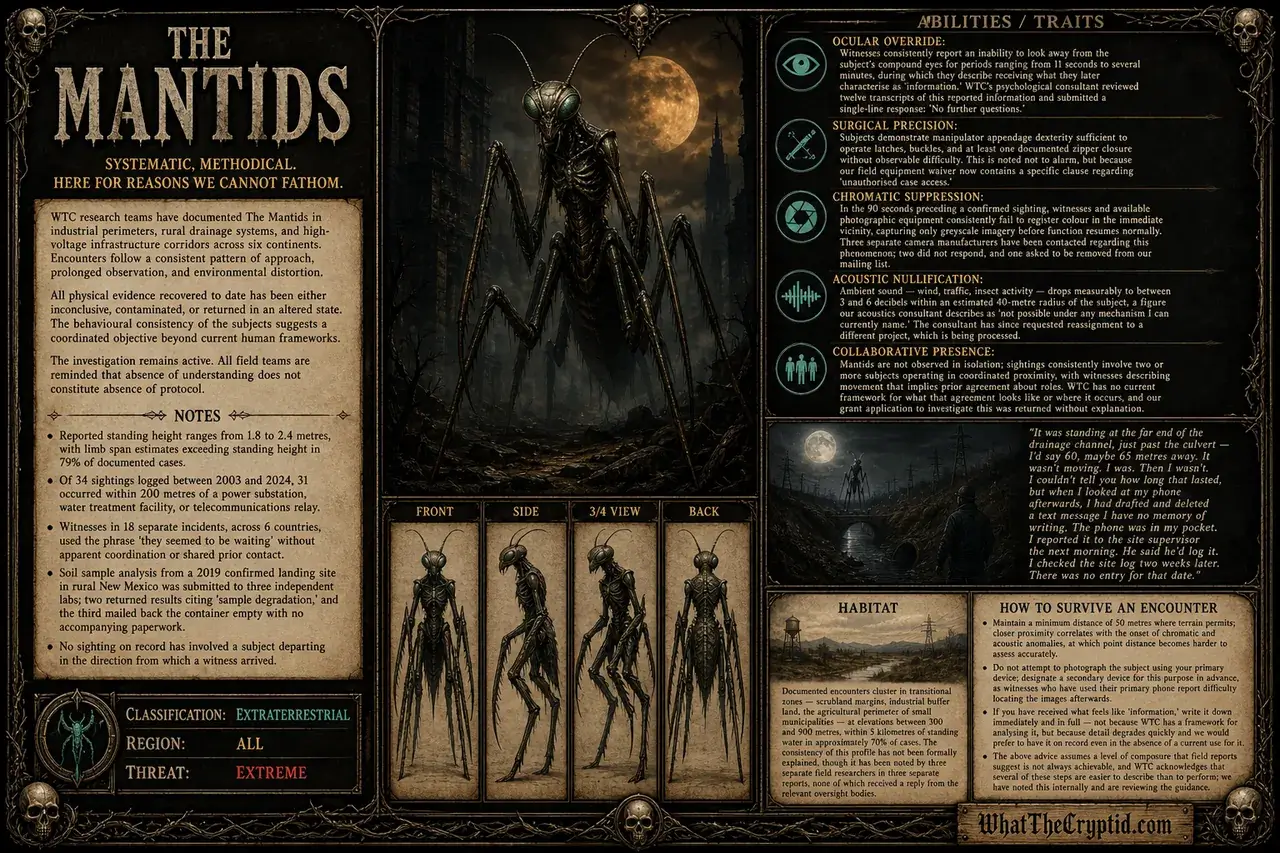
The Mantids
Observed. Observing. Unclear which is more concerning.
All
Active
ExtraterrestrialInsectoidContactGlobalHigh Danger
Overview
The Mantids are a category of reported non-human entity characterised by elongated insectoid morphology, triangular facial structure, and a documented tendency to appear at the bedsides of sleeping witnesses without apparent invitation. Standing between six and eight feet tall, they are among the more consistently described entities in the close-encounter literature — a consistency that researchers within WTC have noted with varying degrees of enthusiasm depending on how recently they reviewed the case files. They are not, as far as current evidence suggests, related to the common praying mantis (Mantis religiosa), though WTC acknowledges the superficial similarities are significant enough that our consulting entomologist submitted his resignation upon being briefed.

Sightings span six continents and at least four decades of documented record, with strong clustering in North America, Western Europe, and coastal Australia. Unlike the Grey-type entities with which they are sometimes reported in conjunction, the Mantids appear to occupy a senior or supervisory role in multi-entity encounter accounts — a detail that raises questions WTC has tabled for a later meeting. What is consistent across the record is that witnesses describe the Mantids as deliberate, unhurried, and entirely uninterested in being asked to leave.
WTC classifies the Mantids as Extraterrestrial pending further evidence, while acknowledging that this classification is based primarily on their consistent co-appearance with aerial phenomena and the absence of any known terrestrial genus that produces something six feet tall with compound eyes and apparent interest in human neurological function.
History & Mythology
The earliest candidate references appear in Sumerian cylinder seal iconography dated to approximately 2500 BCE, where elongated, limbed figures with triangular heads are depicted in apparent proximity to what several independent archaeologists have described as ‘craft-like structures,’ and which several other independent archaeologists have described as ‘standard cosmological decoration.’ WTC notes that both groups presented their findings at the same conference and did not share a table at dinner.
In the modern contact literature, the Mantids emerge as a distinct and recurring entity type from the 1950s onward, with early documentation appearing in the casework of researchers John Keel and Jacques Vallée, neither of whom treated the accounts with the dismissiveness that, in WTC’s assessment, would have been professionally safer for them at the time. The entities were differentiated from Grey-type beings in the systematic literature by researcher Barbara Bartholic in the late 1980s, based on her analysis of regression hypnosis transcripts in which subjects consistently described a taller, insectoid figure overseeing procedures conducted by smaller entities. Bartholic’s files were archived after her death in 2010. Their current location is unknown.
Aboriginal Australian oral traditions describe ‘the thin ones who come from the sky before the rains’ in terms sufficiently consistent with Mantid morphology that WTC researcher Dr. Elaine Forsyth spent fourteen months cross-referencing accounts across seventeen language groups. Her report concluded the match was ‘statistically improbable to attribute to cultural contamination.’ The report was submitted in 2019. It is still under internal review.
Physical Description
Witnesses describe a bipedal form standing between 6.2 and 8.1 feet tall, with a slender, segmented torso and limbs of disproportionate length relative to the trunk — forearms in particular are reported to extend well beyond what human skeletal geometry would permit, and are frequently described as capable of folding at a second joint not present in human anatomy. Skin coloration ranges from pale celadon green to a grey-brown that several witnesses have independently compared, without apparent coordination, to dried tobacco leaf. The surface texture is described as smooth but not reflective, with faint segmentation visible along the abdomen and upper thorax under direct light.
The head is unmistakably triangular and oriented in the manner of the order Mantodea: wide at the upper register, tapering sharply to a narrow mandibular region, with large, multifaceted eyes positioned at the lateral extremes. Eye coloration in sighting reports is most commonly described as black or very dark amber, though a subset of encounter accounts — concentrated in cases from 1997 to 2003 — describe eyes with a golden, internally lit quality that witnesses have consistently struggled to describe without reaching for the word ‘intelligent,’ and then appearing uncomfortable that they said it. The mouth is small, thin-lipped, and rarely observed to open. Communication in contact accounts is reported as uniformly non-verbal.
A regional variant reported primarily across the American Southwest and Northern Mexico presents with a darker, almost charcoal coloration and a reported height at the lower end of the documented range, between 5.9 and 6.4 feet. Some researchers have proposed this constitutes a subspecies. Others have proposed it constitutes a lighting difference. WTC does not currently have the staffing to resolve this.
Behaviour & Temperament
The Mantids are, across the breadth of available encounter testimony, extraordinarily calm. No account in the WTC database describes erratic movement, vocalisation, or displays of apparent aggression unprovoked by the witness. They move with what multiple independent witnesses have described as a ‘considered’ quality — each motion appearing deliberate and energy-efficient in the manner of an entity that has, at some point, decided that hurrying is not necessary and has not revisited that decision. This composure has been interpreted by some researchers as a sign of benevolent intent, by others as a sign of absolute confidence, and by WTC’s senior field coordinator as ‘the most unsettling thing about them, honestly.’
The majority of documented Mantid interactions occur during what witnesses report as contact or abduction scenarios, in which the Mantids typically occupy a supervisory or directorial position. They are observed issuing instructions — apparently telepathically — to smaller accompanying entities, conducting examinations of the witness’s cranial or thoracic regions, and in a significant number of accounts, engaging in what witnesses describe as direct mental communication of a complex, sometimes philosophical nature. Several witnesses report being shown visual information during these communications. None of the witnesses have provided consistent accounts of what that information contained, which may or may not be the point.
Outside of structured encounter scenarios, the Mantids are occasionally reported as solitary observers — standing at a distance in rural or semi-rural settings, apparently watching human activity with no clear purpose before departing. In these cases, witnesses universally note that the entity did not appear to be hiding. It appeared to be standing in a field, watching, in the manner of something that sees no particular reason not to.
Habitat & Territory
No fixed terrestrial habitat has been established for the Mantids, as no den site, nesting location, or sustained ground presence has been documented in any jurisdiction. They are associated almost exclusively with aerial phenomena — specifically with structured craft reports — and are not considered to maintain permanent surface presence. Their appearance on the ground is, in WTC’s assessment, best understood as a visit rather than a residence, a distinction that is either reassuring or not depending on one’s perspective.
When surface encounters do occur, they show notable preference for isolated rural locations: agricultural land with low ambient light, elevated terrain with clear sightlines in multiple directions, and proximity to bodies of still or slow-moving water. Whether this reflects habitat preference, operational necessity, or simple convenience for an entity that arrives by other means is not currently determinable. WTC field teams have noted a recurring pattern in encounter geography that suggests consistency of site selection across incidents separated by decades, which implies either territorial memory or very reliable mapping technology.
Diet & Hunting
No feeding behaviour has been directly observed in any encounter account currently held by WTC. The Mantids do not, in any documented sighting, eat anything. This fact is either evidence of a biology that does not require terrestrial food sources, or evidence that witnesses have simply not been present during feeding, and WTC acknowledges both interpretations carry different implications for the next time someone is present.
A small number of contact accounts include what witnesses have described as the Mantids taking biological samples — tissue, fluid, cellular material — from the witness. Whether this constitutes diet, research, or something else is a classification question WTC has deferred. What can be stated is that the process is described as painless and conducted without apparent haste, in the manner of something that is not hungry but is thorough.
Notable Sightings
In the immediate aftermath of the Kecksburg incident — in which a structured aerial object came down in woodland outside the township and was reportedly recovered by military personnel — a local farmer named Gerald Shumaker reported encountering two figures on the treeline at the edge of his property at approximately 11:40 PM. He described them as very tall, thin, and ‘not shaped right,’ standing motionless while uniformed personnel moved below them in the direction of the recovery site. Shumaker reported the encounter to a local newspaper, which ran a partial account before declining to continue coverage. Shumaker’s subsequent attempts to expand on his testimony were not recorded.
During the widely-documented Voronezh landing incident in which multiple child witnesses reported structured craft and non-human entities in a public park, at least three of the children’s drawings produced under independent supervision depicted a figure taller and distinctly different in form from the ‘robot’ entity described in Soviet news coverage — triangular-headed, long-limbed, and standing apart from the main activity as if observing it. Soviet investigators’ notes from the incident, reviewed by WTC researcher Dmitri Vasiliev in 2014, contained a single handwritten marginal note beside these drawings. The note read ‘the other one’ and was not elaborated upon.
Truck driver Colin Pratchett, driving the Eyre Highway at approximately 2:15 AM, reported that his vehicle lost power and came to a stop over a period of roughly ninety seconds. Through the windscreen, illuminated by what he described as light coming from above and slightly ahead of him, he observed a single figure standing on the road shoulder. He described it as taller than his truck cab, mantis-shaped, and ‘looking at me the way you look at something you already know about.’ The vehicle restarted without intervention after approximately four minutes. Pratchett completed his run, filed a report with his depot on arrival, and did not drive the Nullarbor route again.
Rancher Teresa Armijo reported a prolonged encounter lasting an estimated forty minutes in which she became aware of a figure standing in her hay barn at approximately 3 AM after investigating disturbance among her livestock. She described a ceiling-height entity with compound eyes and folded forelimbs that ‘looked at me like it was waiting for me to calm down,’ which she eventually did. She reported no missing time, no physical after-effects, and no clear memory of how the encounter ended — only that she was standing outside the barn in the pre-dawn dark and the figure was no longer present. Her livestock showed no lasting effects. Armijo discussed the encounter with WTC field researcher Paula Ochoa in 2009, answered all questions thoroughly, and stated at the end of the interview that she was not afraid of it and was not sure what that meant.
Threat Assessment
WTC assigns the Mantids a threat rating of High, based primarily on their consistent association with uninvited entry to human dwellings, physical contact with witnesses, and documented instances of apparent neurological or psychological aftereffects in encounter survivors — including persistent sleep disruption, anomalous memory gaps, and, in a significant minority of cases, a reported shift in the witness’s perception of their own significance in the broader order of things that several researchers have noted is difficult to categorise as either harm or benefit. The Mantids have not been documented to cause physical injury in any case on record. This is noted without the reassurance it might otherwise provide.
WTC recommends maintaining a minimum distance of 30 feet if a Mantid entity is observed in an outdoor setting, refraining from direct eye contact where possible, and avoiding any movement that could be interpreted as an approach. Do not enter an enclosed space — barn, vehicle, building — that a Mantid is currently occupying, and if you find yourself already in an enclosed space with one, WTC’s best current guidance is to remain calm, avoid sudden movement, and try to establish whether the encounter has a duration. If telepathic communication is initiated, witnesses are advised to note the content as precisely as possible afterward, as WTC has found that accounts recorded within two hours of an encounter retain significantly more detail than those recorded later. WTC acknowledges, in the spirit of transparency, that none of this advice has been tested under controlled conditions.
WTC Field Notes
WTC has maintained an active Mantids file since the network’s founding, and it is, by volume, our largest single-entity classification — which is a fact our current editor-in-chief described as ‘clarifying’ when she reviewed the archive on her first week. We have cross-referenced 847 encounter accounts across forty-one countries, conducted direct interviews with 112 witnesses, and deployed field teams on nine separate occasions to locations with active or recent sighting reports. On seven of those nine deployments, equipment malfunctions were reported. On the remaining two, nothing was observed. We are not sure which outcome we prefer.
Our primary research obstacle is not the quantity of testimony — it is the quality of institutional support for taking that testimony seriously. WTC submitted a formal request in 2021 to collaborate with two university departments on a longitudinal study of encounter witness psychology. Both departments declined. One cited ethical review concerns. The other cited ‘scope.’ We have a standing request with our legal team to clarify whether our field researchers’ insurance covers encounters in which the entity in question initiates contact rather than the researcher, and we have been awaiting a response for eleven months. In the meantime, field teams have been asked to use their discretion, a policy our senior coordinator has noted is easier to state than to implement at 3 AM in a barn in Colorado.