
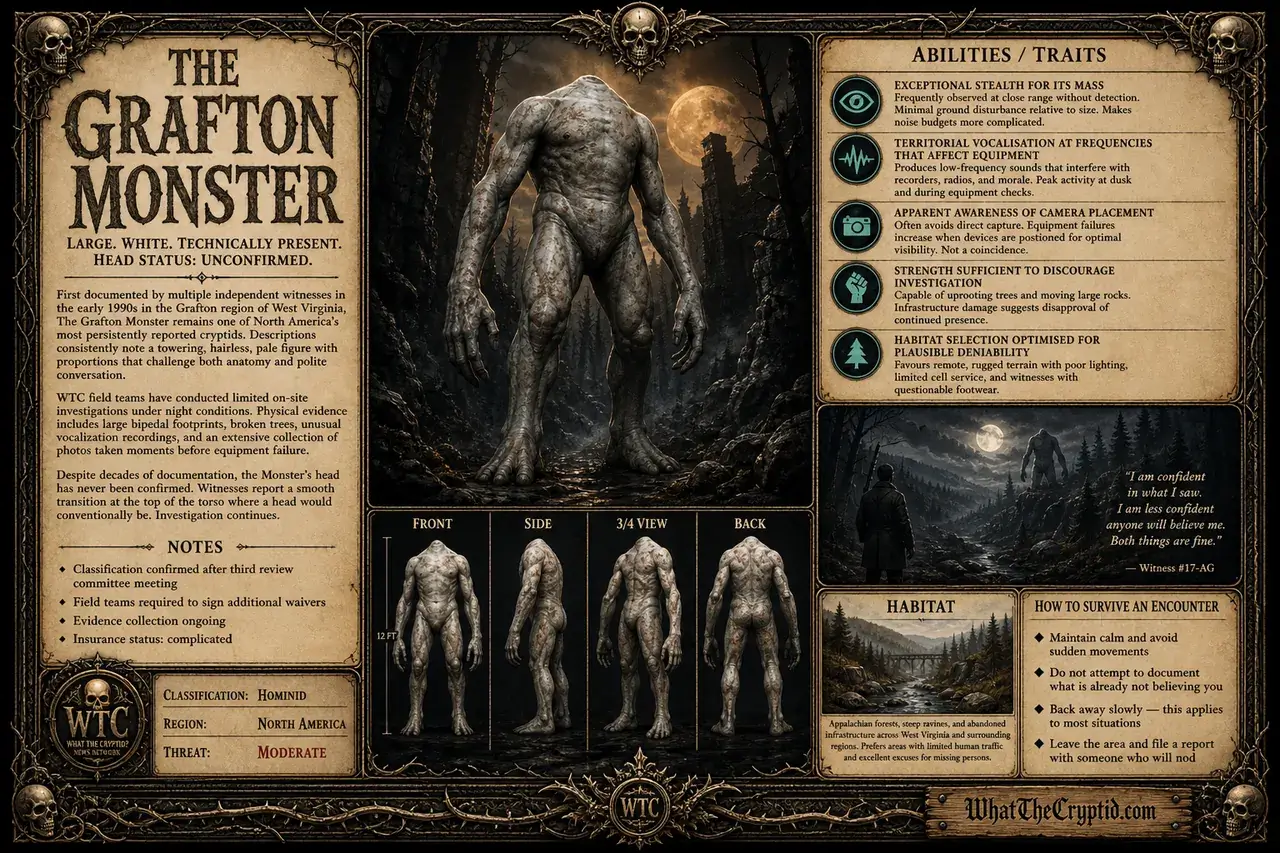
The Grafton Monster
Large. White. Technically present. Head status: unconfirmed.
North America
Active
West VirginiaHominidHeadlessAppalachiaRiver
Overview
The Grafton Monster is a large bipedal entity first documented in Grafton, Taylor County, West Virginia, in June of 1964. The creature is distinguished from comparable Appalachian hominids by two features that have proven difficult to reconcile with conventional zoology: its reported absence of a visible head, and its reported presence in general. Standing estimates place the creature at between eight and nine feet tall, with a smooth, pallid exterior described by witnesses as seal-like in texture, a detail that raises questions WTC has tabled for a later meeting.
The entity occupies a specific and well-documented niche in the regional cryptid record, with its primary cluster of sightings concentrated within a two-mile radius of the Tygart Valley River corridor in and around Grafton city limits. It has not been sighted in meaningful numbers outside Taylor County, which either indicates a small and localised population or, as our regional field director once suggested at a budget meeting, ‘a creature with better sense of personal geography than most of our staff.’

WTC classifies the Grafton Monster as a hominid on the basis of bipedal locomotion, approximate body plan, and the professional courtesy of not leaving it without a category. The absence of a confirmed head remains the single most contested aspect of the creature’s morphology, with some researchers suggesting the head is present but proportionally recessed into an unusually broad shoulder structure, and others suggesting the researchers in the first group are not looking carefully enough at the evidence.
History & Mythology
The first recorded sighting of the Grafton Monster occurred on the night of June 16, 1964, when Robert Cockrell, a reporter for the Grafton Sentinel, encountered the entity while driving along a road bordering the Tygart Valley River. Cockrell described the creature as large enough to obstruct his headlights and white enough to be clearly visible in the dark, which he later noted in print was ‘more than I can say for most things I cover.’ His account, published in the Sentinel the following day, is the earliest entry in the Grafton Monster’s documented record and remains the most contemporaneously verified.
Prior to Cockrell’s 1964 encounter, no specific folklore tradition appears to attach to the Grafton area that directly anticipates the creature’s morphology, a circumstance WTC considers notable given the general richness of West Virginia’s regional cryptid mythology. The state that produced the Mothman and the White Thing of Pleasants County had, apparently, left Grafton’s particular stretch of riverbank unaccounted for until Cockrell’s headlights illuminated the gap. Some researchers have argued this absence of precedent strengthens the case for a genuine zoological discovery; others have argued it strengthens the case for a very large and very pale bear.
Following the initial 1964 report, additional witnesses came forward over the subsequent weeks and months, several of whom had no knowledge of Cockrell’s published account at the time of their encounters. The consistency of the core physical description across these independent reports — scale, coloration, the problematic head situation — has been cited by WTC senior researcher David Albright as ‘the kind of corroborating detail that would be compelling if any of it were easier to explain.’
Physical Description
Witnesses consistently describe the Grafton Monster as standing between eight and nine feet tall in an upright posture, with a body mass estimated by our consulting physical anthropologist at somewhere in the range of 600 to 800 pounds, an estimate she provided in writing and then immediately asked us not to attribute to her by name. The body is described as broadly humanoid in general configuration — two legs, two arms, bilateral symmetry — but substantially wider through the chest and shoulders than any confirmed primate species, with a shoulder width several witnesses have estimated at three to four feet across.
The surface of the creature is consistently described as smooth and white to off-white, with a texture compared variously to a seal’s hide, wet rubber, and, in one account, ‘the kind of skin that isn’t supposed to be that colour.’ No fur, hair, scales, or visible integumentary features have been reported. The skin appears to be uniformly pale under variable lighting conditions, including darkness, which has led some researchers to propose bioluminescence as a partial explanation for the creature’s visibility in nighttime encounters. This proposal has not been formally tested, for reasons that are logistical rather than philosophical.
The defining and most contested feature of the Grafton Monster is the apparent absence of a head. The majority of witnesses report that the creature’s body terminates at the shoulders without a visible cranial structure, or that whatever occupies that space is so deeply set into the body as to be functionally invisible from any observed angle. A minority of witnesses, generally those who observed the creature from closer distances, report a small, rounded protrusion above the shoulder line that may constitute a head. WTC has not been able to determine which group is correct, which is frustrating for different reasons depending on which group you ask.
Behaviour & Temperament
The Grafton Monster is, by the available evidence, not aggressive. In every documented encounter, the creature has either remained stationary or withdrawn from the area when human presence was detected, displaying none of the territorial vocalisation or threat posturing associated with other large hominid species in the regional record. This disposition has been described by some researchers as passive, by others as indifferent, and by at least one WTC volunteer field observer as ‘the kind of calm that is worse than if it had just done something.’ The entity does not appear to regard humans as prey, competitors, or items of interest, which would be reassuring if the entity had a more conventional body plan.
Activity appears to peak during late evening and early nighttime hours, with the majority of documented encounters occurring between 10:00 PM and 2:00 AM. No daytime sightings have been reported in the primary record, though it is acknowledged that a smooth, white, eight-foot creature would be somewhat easier to avoid noticing in full daylight if one were motivated to do so. The creature has been observed standing in or near the Tygart Valley River on multiple occasions, standing in treelines adjacent to secondary roads, and, in one account, standing in a field doing nothing that the witness could identify as purposeful.
No evidence of social grouping has been documented. All sightings on record involve a single individual, and no secondary tracks, secondary vocalisations, or secondary anything have been recorded in proximity to a primary sighting. Whether the Grafton Monster is a solitary species by nature or whether Taylor County simply cannot support a larger population is a question the available data does not resolve.
Habitat & Territory
The Grafton Monster’s documented range is tightly concentrated along the Tygart Valley River corridor as it passes through and around the city of Grafton, West Virginia, at an elevation of approximately 1,000 feet above sea level. The terrain in this area consists of mixed deciduous forest, agricultural margin, and the kind of secondary-growth riverbank woodland that tends to accumulate in the spaces between things people are paying attention to. The creature appears to make use of the river itself as a navigational or behavioural feature, with sightings clustered within approximately a quarter mile of the waterline on both banks.
No confirmed denning site or resting area has been identified despite periodic search efforts by WTC field teams and, on two separate occasions, a local hunting club whose members initially volunteered for the search and subsequently requested that their names not appear in this entry. The habitat requirements of a smooth, hairless, apparently athermic creature in a region with West Virginia winters are a subject WTC’s biological consultants have described as ‘outside the scope of what we were asked to evaluate.’
Diet & Hunting
No direct feeding behaviour has been observed for the Grafton Monster, and no prey remains, food caches, or foraging activity have been documented in the vicinity of confirmed sighting locations. This is either because the creature is an ambush predator that cleans up thoroughly, because its dietary needs are met through means that leave no material trace, or because no one who has gotten close enough to observe feeding behaviour has filed a complete report. All three explanations have been proposed; none has been eliminated.
The creature’s body mass, if the upper estimates are accepted, would require a significant caloric input to sustain, particularly in a climate with defined seasonal temperature variation. Working from established metabolic models for large-bodied terrestrial animals, WTC’s consulting biologist estimated a daily intake requirement of 12 to 18 pounds of protein-equivalent matter, then noted that this estimate assumed the creature had a metabolism, which she felt should not be taken as given. The Tygart Valley River supports a documented population of fish including bass, catfish, and muskellunge, which has been noted as relevant without being proven to be.
Notable Sightings
Robert Cockrell, reporter for the Grafton Sentinel, encountered the entity at approximately 11:00 PM while driving along a road paralleling the Tygart Valley River. He described the creature as standing upright in the road or at its margin, white in colour, substantially taller than his vehicle, and possessed of a shoulder width he compared to ‘a refrigerator, but taller and without the door.’ Cockrell slowed but did not stop, and the creature did not pursue. He published his account in the Sentinel the following morning and continued working as a journalist at the paper for another eleven years.
In the weeks following Cockrell’s report, a Grafton-area resident who has been identified in secondary sources only as ‘a local farmer’ reported observing a large white figure standing at the treeline bordering his property on two separate evenings, approximately five to seven days apart. The figure did not approach the farmhouse or outbuildings and departed into the treeline when the witness turned on an exterior light. The witness reportedly described the creature’s movement into the trees as ‘faster than it had any right to be given the size of it.’ No subsequent sightings were reported from this property, and the landowner did not participate in follow-up interviews.
A group of three teenagers, names withheld in the original account at the request of their parents, reported observing a large pale figure standing in the shallows of the Tygart Valley River at an estimated distance of 80 to 100 yards. The figure stood motionless for an estimated four to six minutes before moving toward the opposite bank and entering the treeline. All three witnesses reported independently that they could not identify a head on the figure at any point during the observation. Two of the three witnesses subsequently declined all further interviews on the subject, and the third moved out of Taylor County the following year for reasons described as unrelated.
A motorist identified in WTC records as D. Harmon reported a roadside encounter with a large white bipedal figure at approximately 12:30 AM while returning from a work shift in a neighbouring county. Harmon estimated the figure’s height at eight feet and noted that it stood completely still in the roadside verge for the full duration of her approach and passing, a distance she estimated took approximately 45 seconds to cover at her driving speed. She described the creature’s surface as ‘the wrong kind of white,’ a characterisation she expanded on in a follow-up interview only by saying it again. Harmon filed a written account with WTC the following week and noted in her cover letter that she had been driving that road for nine years without incident.
Threat Assessment
The Grafton Monster has not been documented engaging in aggressive behaviour toward humans in any confirmed sighting. It has not charged, vocalised threateningly, pursued retreating witnesses, or made physical contact with any person on record. WTC rates the creature’s active threat level as Moderate not because of what it has done, but because an eight-foot entity of unknown biology, dietary requirements, and sensory capabilities represents an inherently non-trivial variable in any encounter scenario, and we have found it professionally irresponsible to rate anything that size as Low.
Persons travelling in or near the Tygart Valley River corridor in Taylor County after dark are advised to maintain a minimum distance of 150 feet from any large white unidentified figure and to avoid positioning themselves between the entity and the river. Do not approach the treeline after the entity has entered it. Do not attempt to determine the head situation by getting closer. Vehicle doors should be kept closed, and WTC recommends against stopping to observe from the roadside for longer than is strictly necessary to confirm what you are looking at, acknowledging that this confirmation may take some time. We are not in a position to advise on what to do if the creature approaches you, because it has not yet done so in any documented case, and we would prefer to keep that record intact.
WTC Field Notes
WTC’s coverage of the Grafton Monster has been ongoing since the network’s early archival period, during which a predecessor editorial team made the decision to classify the entity as a hominid on grounds that have not been revisited, largely because revisiting them would require reopening a classification debate that consumed eleven months of meeting time the first time around. The head question remains the central editorial fault line: our biology desk maintains that a living organism of this scale requires a cranial structure to house sensory and neurological apparatus, and our field reporting desk maintains that the witnesses are describing what they saw, and both positions are correct in ways that have not yet been made compatible.
WTC deployed a three-person field team to Taylor County in 2019 for a five-day observation window along the primary Tygart Valley River corridor. The team recorded ambient audio, deployed four trail cameras at intervals identified through historical sighting analysis, and interviewed two residents with proximity to documented sighting locations. The trail cameras recorded 47 hours of footage collectively, none of which contained the entity. One camera malfunctioned on night three in a manner our equipment coordinator described as ‘not impossible, but annoying.’ The team’s final report recommended a follow-up deployment with a larger budget, a recommendation that remains under review pending the resolution of several prior recommendations that are also under review.