
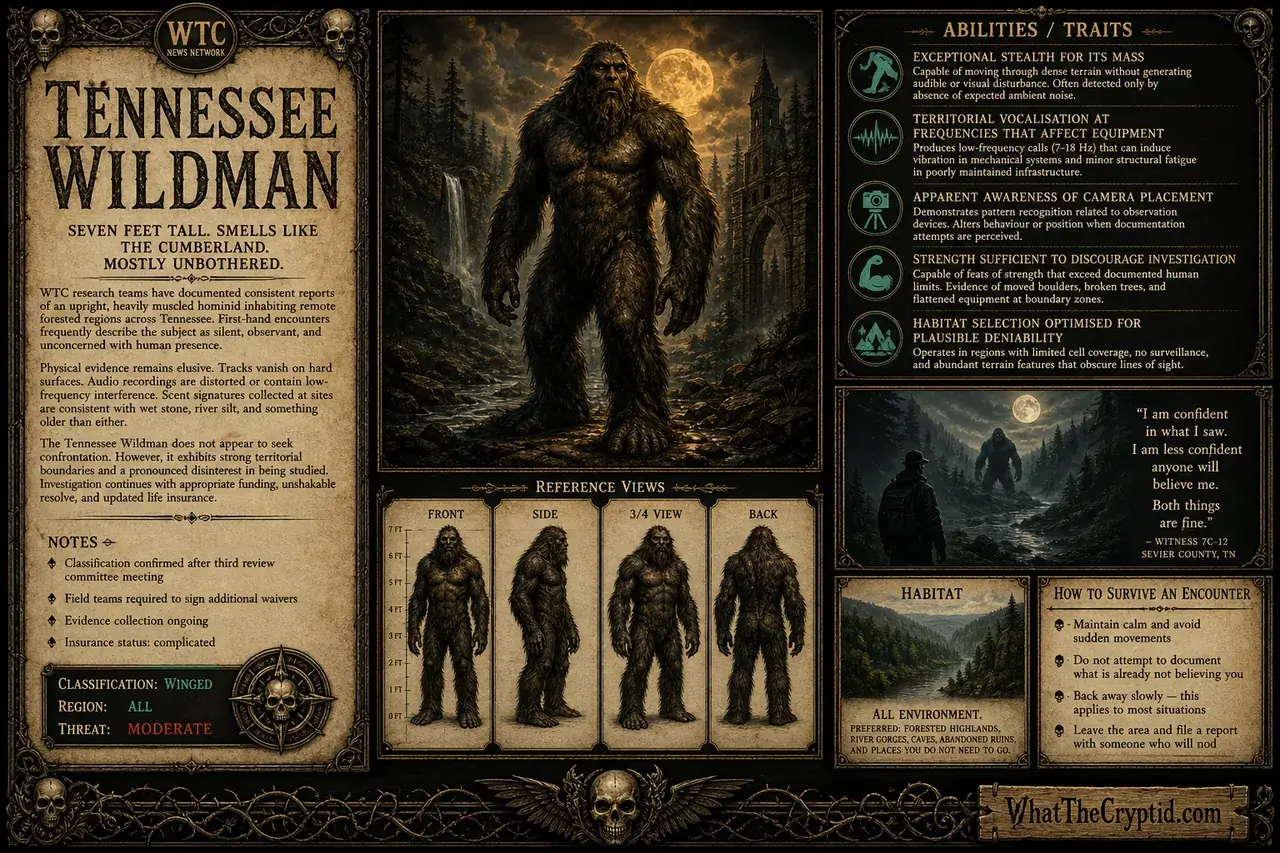
Tennessee Wildman
Seven feet tall. Smells like the Cumberland. Mostly unbothered.
All
Active

Overview
The Tennessee Wildman is a large bipedal hominid reported across the river valleys, bottomlands, and ridge systems of Tennessee, with the highest concentration of documented encounters occurring along the Cumberland, Hiwassee, and Nolichucky river corridors. Standing estimates place the entity between six feet eight inches and seven feet four inches in height, with a broad, heavily muscled frame covered in dark reddish-brown to near-black hair ranging from three to six inches in length depending on the season of observation. It is distinct from Pacific Northwest Bigfoot reports in several behavioural and physiological respects that WTC has documented at length and our consulting primatologist has reviewed under conditions of strict professional confidentiality.
Unlike many hominid cryptids whose encounter records cluster around a single dramatic incident and then disperse into rumour, the Tennessee Wildman maintains a remarkably consistent and geographically coherent sighting pattern stretching back over two centuries. This continuity is either evidence of an established breeding population or evidence of something WTC’s editorial board has agreed not to speculate about in print. The entity is considered active year-round, with encounter frequency peaking between April and October, coinciding with increased human recreational activity in its documented habitat range.
WTC classifies the Tennessee Wildman as a Moderate threat, a designation that reflects not documented aggression toward humans but rather the entity’s documented capacity for aggression, its apparent comfort operating in close proximity to rural habitation, and the specific difficulty of explaining its presence to local authorities in a way that results in a useful response.
History & Mythology
The earliest credible written record of the Tennessee Wildman appears in an 1869 edition of the Nashville Daily Union, which reported that several residents of White County had encountered a ‘wild man of prodigious size and terrible aspect’ along the Calfkiller River, noting that the creature ‘moved with a swiftness no man could match and left footprints of extraordinary dimension in the river mud.’ The account was filed by a correspondent named Elias Marsh, who reported the incident in the same deadpan register he used to cover county commissioner elections, which WTC considers the appropriate professional standard.
Prior to written documentation, Cherokee oral traditions from the Tennessee and North Carolina hill country describe an entity called Nun’Yunu’Wi — sometimes translated as ‘Stone Coat’ — though ethnographers have debated whether this figure maps cleanly onto Wildman sightings or represents a distinct tradition. WTC treats these accounts as parallel field data rather than identical sources, noting that conflating Indigenous spiritual tradition with cryptozoological field reports requires a level of editorial carelessness we are not currently staffed to produce. What is consistent across both traditions is the river bottomland habitat, the extraordinary physical size, and the strong and apparently distinctive odour.
Through the late nineteenth and early twentieth centuries, encounter reports accumulated steadily across East and Middle Tennessee, documented in county newspapers, church records, and at least one sworn legal affidavit filed in Overton County in 1923 in connection with a property dispute that, per court records, was eventually settled without the Wildman’s testimony being formally entered into evidence.
Physical Description
Eyewitness accounts describe the Tennessee Wildman as a heavily built bipedal figure, consistently reported between six feet eight inches and seven feet four inches in height, with a body mass that field investigators have estimated — based on ground compression data and tree branch displacement — at somewhere between 450 and 650 pounds. The head is described as large and somewhat conical, set low on the shoulders with a minimal neck profile, and framed by hair that witnesses describe as matted and carrying what one 2019 witness characterised as ‘the smell of a river that has seen some things.’
The hair covering is uniformly described as dark, ranging from deep auburn to near-black, and appears heavier across the shoulders and upper back than on the limbs and abdomen. Several witnesses in warmer-month encounters have noted what appears to be a seasonal thinning around the face and forearms, suggesting a moulting pattern consistent with other large mammals in the region, which WTC notes without drawing conclusions. The face, where witnesses have been close enough to describe it, is broad and flat with a pronounced brow ridge, deep-set eyes reported as dark brown to amber, and a wide, thin-lipped mouth. The hands are described as disproportionately large even relative to the entity’s overall scale, with thick, dark nails rather than claws.
A notable regional variant has been reported specifically along the Hiwassee River corridor in Polk County, where multiple witnesses independently describe an individual — possibly the same individual, given consistent scar tissue reported on the left shoulder — that stands closer to seven feet six inches and displays a greyer colouration consistent with advanced age. WTC has designated this potential individual as Subject H-1 and has made three separate attempts to obtain photographic documentation of it, none of which require further discussion here.
Behaviour & Temperament
The Tennessee Wildman is predominantly crepuscular, with the majority of credible encounters occurring within ninety minutes of dawn or dusk. It demonstrates a clear awareness of human activity patterns, consistently avoiding peak daylight hours except under conditions that suggest either unusual hunger or unusual curiosity, both of which WTC considers equally worth monitoring. The entity appears to maintain established travel corridors along river systems, with investigators identifying repeated use of the same crossing points across encounters separated by years or decades — a level of spatial memory that our consulting ethologist described as ‘not inconsistent with great ape cognition,’ which is the kind of sentence that rewards careful reading.
The Wildman’s relationship with human habitation is complex and does not fit neatly into either ‘avoidant’ or ‘territorial’ behavioural categories. It has been documented within 200 yards of occupied structures on multiple occasions, appearing to observe without approaching, and several witnesses report that the entity departed only when it was clear it had been seen — suggesting that concealment, rather than avoidance, is the primary social strategy. When directly confronted, documented responses include vocalisation, branch-breaking displays, and, in at least two recorded incidents, the throwing of river stones in the general direction of the witness at a velocity that the witnesses found memorable.
Group behaviour is poorly documented. The overwhelming majority of encounters involve a single individual. Two witnesses, independently and in separate decades, have reported seeing what they described as a smaller figure — juvenile, or possibly female — retreating into cover as the primary subject held position. WTC has noted this in our database and agreed, as an editorial body, to think about it.
Habitat & Territory
The Tennessee Wildman occupies the river bottomlands, creek hollows, and forested ridge systems of East and Middle Tennessee, with the greatest density of encounters occurring in a band running roughly from the Cumberland Plateau westward to the Highland Rim. It shows a consistent preference for mixed hardwood forest within a quarter mile of moving water, particularly in areas where dense riparian vegetation — river cane, sycamore, willow, and river birch — provides both concealment and access to the water’s edge. Elevations of documented encounters range from 750 to approximately 2,400 feet, with the lower bottomland corridors serving as apparent travel routes and higher ridge terrain used less frequently and primarily in summer months.
The entity appears to select habitat that humans find technically accessible but practically inconvenient: flood-prone bottomlands, steep creek drainages choked with rhododendron, and ridge systems without maintained trails. WTC field teams can confirm from direct experience that this is effective strategy. Investigators have identified what appear to be temporary shelter sites — matted vegetation, disturbed soil, and collected debris — in several locations along the Calfkiller and Collins River drainages, though none of these sites have been occupied during any of our three visits, a pattern that has begun to feel less coincidental over time.
Diet & Hunting
The Tennessee Wildman is assessed as an opportunistic omnivore with a strong preference for high-calorie food sources concentrated near water. Documented evidence of feeding activity includes disturbed fish spawning beds, the remains of freshwater mussels cracked open and deposited in consistent locations along specific creek banks, raided beehives — invariably located in large hardwood cavities and invariably destroyed rather than simply opened — and the carcasses of white-tailed deer and feral hogs found in proximity to documented Wildman territory bearing wounds inconsistent with known regional predators. The deer carcasses in particular show evidence of manual disarticulation at the joints, which the state wildlife veterinarian who reviewed photographs in 2017 described as ‘unusual’ and then did not follow up on.
Seasonal dietary shifts appear significant. Spring and summer encounters are more frequently associated with water-edge activity — fishing, mussel collection, and documented interest in agricultural fields planted with corn and sorghum within half a mile of wooded bottomland. Fall encounters increasingly correlate with areas of heavy mast production, particularly white oak and chestnut oak ridges, suggesting a pre-winter caloric loading pattern consistent with large omnivorous mammals in temperate climates. WTC notes that the entity’s estimated body mass would require a daily caloric intake of approximately 6,000 to 8,000 calories to maintain, which contextualises the agricultural incursions considerably.
Notable Sightings
Trapper Dale Fuson reported an encounter at approximately 5:40 a.m. while checking a trotline along the Calfkiller River near Sparta. Fuson described a figure standing in the shallows approximately thirty feet distant, upright, ‘wide as a doorframe and then some,’ appearing to retrieve fish from the line by hand before becoming aware of Fuson’s presence. The entity regarded Fuson for an estimated four to six seconds, then moved into the tree line at a pace Fuson described as ‘not hurried, which was somehow worse.’ Fuson reported the encounter to the White County Sheriff’s Office, whose responding deputy noted the disturbed trotline and the footprints in the bank mud — measuring fourteen to sixteen inches — and filed a report that was subsequently misfiled under livestock incidents.
A group of four kayakers on a weekend trip along the Hiwassee River reported an encounter near the Reliance community in which a large, hair-covered figure stood on a gravel bar watching their passage for an estimated two to three minutes before descending into the river, wading to a depth of approximately four feet, and crossing to the far bank without appearing to alter its pace. Witness Carla Dunning, a wildlife biologist with the Tennessee Valley Authority, noted that the entity’s stride length in water was consistent with a bipedal gait and that its crossing speed was ‘faster than it should have been at that depth.’ Dunning submitted a formal wildlife observation report to TVA that was acknowledged, logged under ‘unclassified fauna,’ and has not appeared in any subsequent TVA publication.
Deer hunter Marcus Webb, hunting from a ground blind at approximately 6:15 a.m., observed a large bipedal figure approach to within forty yards, apparently following a deer trail through the bottoms. Webb reported that the entity stopped, appeared to scent the air, then turned directly toward his blind and remained stationary for a period he estimated at eight to ten minutes but his GPS unit’s motion log suggests was closer to nineteen. Webb did not discharge his firearm. When asked by the investigating WTC field correspondent why not, Webb said he felt it ‘didn’t seem right,’ a sentiment WTC recorded without editorial comment. Webb has not returned to that property.
Overnight campers Priya Anand and Tom Sefton reported being circled by a large unseen animal for approximately forty minutes beginning around 2:30 a.m., accompanied by vocalisation they described as a low, repetitive resonant sound ‘like a person doing an impression of something larger than a person.’ At first light, Anand, who works as a forensic photographer, documented seventeen footprints in the river silt averaging fifteen and a half inches in length, photographed with a scale reference, and submitted prints and photographs to WTC along with a written account that is among the most methodically detailed in our active database. Anand has since submitted three follow-up inquiries asking what WTC intends to do with the documentation, all of which are currently in our editorial review queue.
Threat Assessment
WTC rates the Tennessee Wildman as a Moderate threat to human safety, a designation based on documented capacity for intimidation behaviour rather than a substantial record of direct physical contact. Witnesses who have maintained a distance of sixty yards or greater and avoided direct prolonged eye contact report that the entity generally disengages within several minutes. Witnesses who have closed to within thirty yards, made sustained eye contact, or — in two documented cases — attempted to photograph the entity at close range using flash equipment, report escalating responses including vocalisation, ground-striking, and the stone-throwing behaviour noted in the behaviour section. WTC recommends treating sixty yards as a minimum operational buffer and strongly advises against flash photography within that range, not only as a safety measure but as a matter of basic professional courtesy.
If encountered at close range without prior warning, field guidance is to stand still, avoid direct eye contact, speak in a low and even tone, and begin moving laterally rather than directly away, which documented evidence suggests the entity interprets as less provocative than retreat. Do not run. Do not throw anything. Do not attempt to record vocalisation using a device that emits an audible beep when it begins recording. WTC acknowledges that this guidance is based on a sample size that no consulting statistician has been willing to describe as adequate, and that individual encounters may not conform to documented patterns, which is true of most things in this field and several outside it.
WTC Field Notes
WTC first opened an active file on the Tennessee Wildman in 2004, following the submission of a footprint cast from Warren County that our then-field director described in her notes as ‘the best physical evidence I have personally handled in eleven years, which I find both exciting and exhausting.’ The file currently runs to 340 pages and includes fourteen plaster casts, sixty-two photographic submissions of varying quality, nine audio recordings of which four are assessed as non-animal in origin by our acoustics consultant (who has requested that his name not be attached to that assessment in any published material), and one video submission from 2016 that our editor reviewed once, described as ‘not nothing,’ and has not reviewed again.
WTC dispatched a two-person field team to the Calfkiller River drainage in the spring of 2022, equipped with thermal imaging equipment rented at considerable expense and a research vehicle that, per our accounting department, is still listed as ‘temporarily reassigned to Tennessee operations.’ The team documented significant track evidence, two probable shelter sites, and one incident on night four that the lead investigator declined to include in the formal report but did reference in her expense claim under the line item ‘additional equipment replacement — circumstances discussed verbally.’ WTC is actively seeking grant funding to support a dedicated Tennessee Wildman research initiative. Our development officer notes that this has proven a difficult pitch.