
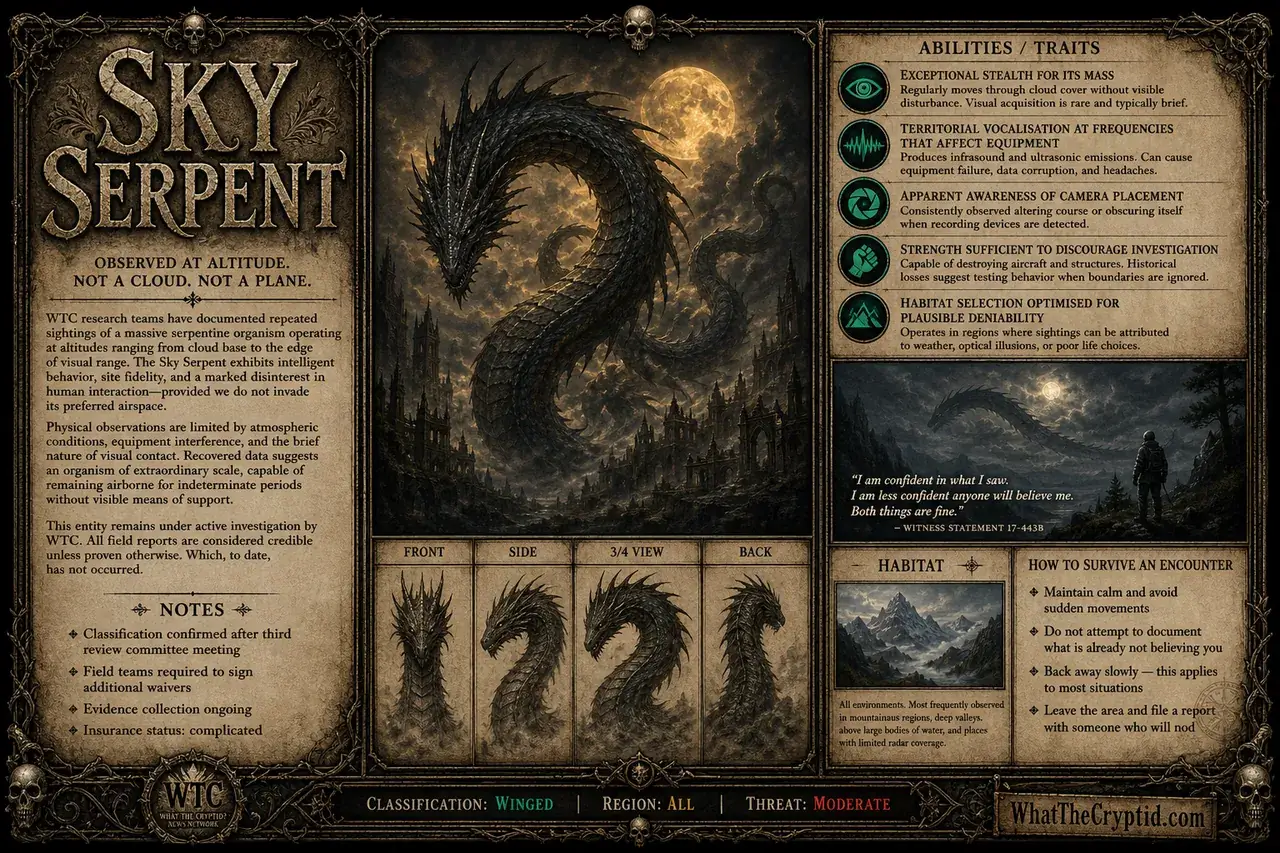
Sky Serpent
Observed at altitude. Not a cloud. Not a plane.
All
Active
AerialSerpentineGlobalWeather-AssociatedAviation-Risk
Overview
The Sky Serpent is a large, elongated, serpentine entity documented in aerial sightings across six continents and at least eleven maritime jurisdictions. It presents as a sinuous, scaled body ranging in documented length from 18 to over 200 feet, moving through open sky at altitudes between 800 and 12,000 feet without any visible means of propulsion that would satisfy a conventional aerodynamics consultant. WTC classifies it as Winged not because wings have been universally observed — they have not — but because the entity demonstrably travels through air, and the classification system requires a decision be made.
Unlike many cryptids whose documentation clusters in a single region or cultural tradition, the Sky Serpent appears in the historical record of nearly every human civilization that has looked up for long enough. This consistency is either compelling evidence of a genuinely global phenomenon or a remarkable coincidence that WTC’s senior editorial staff have agreed, in writing, not to speculate about publicly. The entity has been associated with weather events, crop outcomes, and, in three documented modern cases, unexplained instrument failures aboard commercial aircraft.

WTC maintains an Active classification for the Sky Serpent based on a sighting rate that has not declined since we began tracking in 2011, despite what our data analyst describes as ‘every reasonable expectation that it would.’
History & Mythology
The earliest verifiable textual references to serpentine aerial entities appear in Mesopotamian clay tablet records dated approximately 2400 BCE, where the creature is described in administrative documents — notably not religious texts — as an obstacle to grain shipment overland, suggesting scribes at the time considered it a logistical rather than theological problem. Chinese imperial records from the Han Dynasty (206 BCE–220 CE) document what court astronomers termed ‘sky dragons’ with sufficient regularity that a dedicated reporting protocol was established, the details of which have been only partially translated. European medieval manuscripts contain illuminated depictions of creatures identified as ‘draco volans’ or ‘serpens aerius’ that bear closer resemblance to consistent Sky Serpent field descriptions than to any known species, living or extinct.
The modern documented record begins in earnest with the mass sighting over Bonham, Texas, in January 1891, in which an estimated 150 witnesses reported a large undulating serpentine form crossing the sky over the town in daylight. The Bonham event was reported in the Dallas Morning News and subsequently in seventeen other regional papers, generating enough public correspondence that a state legislator formally requested a government inquiry. No inquiry was conducted. The 20th century produced a steady accumulation of aerial sightings coinciding with the expansion of commercial aviation, which had the effect of providing both more witnesses at altitude and more instrument readings to go unexplained.
WTC’s own historical review identified 847 discrete Sky Serpent incidents between 1890 and 2023 that meet our minimum documentation threshold. Our archivist notes this figure should be treated as a floor rather than a ceiling, as rural sightings prior to 1950 are significantly underrepresented in accessible records for reasons that require no further elaboration.
Physical Description
Consistent across regional sightings is the entity’s fundamental body plan: an elongated, cylindrical or slightly flattened torso covered in scaled or scale-adjacent integument, tapering at both ends, with a discernible head structure at the anterior end. Documented body length varies enormously — from 18 feet in the 2009 Peruvian Andes sighting to an estimated 200-plus feet reported by the crew of the cargo vessel MV Hestian Prince in the South China Sea in 2017 — which may indicate multiple species, multiple life stages, or measurement conditions that were less than ideal. Scale colouration ranges from iridescent silver-grey through deep blue-green to a pale opalescent white reported in high-altitude sightings above 8,000 feet, leading some WTC researchers to propose the colouration reflects either altitude adaptation or individual variation, and others to propose we need better photographs.
The head, where clearly documented, presents a broader, flattened profile relative to the body, with paired structures described variously as horns, crests, or prominent supraorbital ridges depending on the witness’s zoological vocabulary. Eyes have been described in close-encounter reports as large, forward-facing, and amber to pale gold in colouration. A dorsal fin-like structure runs along the upper body in approximately 40% of reported sightings; its absence in the remaining 60% remains an open taxonomic question. Limbs, where present, are vestigial forelimbs positioned behind the head, too small relative to body mass to contribute meaningfully to propulsion — a fact our consulting aeronautical engineer noted with visible discomfort before declining to continue that particular conversation.
Wings, when present, are reported as semi-translucent membranous structures that appear and retract, are only intermittently visible, or are perhaps only visible under certain light conditions. WTC does not have a settled position on the wings. We are working on it.
Behaviour & Temperament
The Sky Serpent is, by all field evidence, a solitary entity. No confirmed paired or group sightings appear in the WTC database, though two sightings — Oaxaca, 2003, and rural Queensland, 2016 — describe what witnesses interpreted as two individuals at distance, a claim our analysts have neither confirmed nor dismissed with any particular conviction. The entity moves through open sky in a characteristic undulating motion, the body forming lateral sinusoidal curves in a pattern consistent with terrestrial serpent locomotion scaled up to a degree that raises questions our physics consultant has asked us to stop forwarding to him.
Sky Serpents appear largely indifferent to human observation. Witnesses consistently report that the entity does not alter its course, increase speed, or display any behaviours suggesting it has registered being watched — a posture that is either the apex of confidence or a strong indicator that humans do not register as relevant to the Sky Serpent’s operational concerns. Aggressive behaviour toward humans has not been documented in any case WTC considers credible, though three sightings involve the entity passing directly overhead at low altitude, which witnesses have described as alarming even in the absence of any threatening action. The subject appeared unconcerned.
Sightings correlate with barometric pressure drops and pre-storm atmospheric conditions at a rate our meteorologist consultant described as ‘statistically suggestive but not, she wants it noted for the record, conclusive.’ Whether the Sky Serpent is attracted to storm conditions, produces them, or simply shares a preference for the same air masses is a question WTC has been attempting to answer since 2014 with instrumentation that has so far proven insufficient.
Habitat & Territory
The Sky Serpent’s primary habitat is open sky, which is technically the largest available habitat on Earth and makes precise territory mapping an ongoing challenge. Sightings concentrate in specific corridors: the central North American plains, the Andean mountain spine, the South China Sea and surrounding coastal regions, and a band across Central Africa that corresponds with no obvious geographical feature WTC has yet identified. High-altitude sightings above 8,000 feet account for 23% of the documented total and appear to represent a distinct behavioural mode rather than a distinct population, based on the consistency of reported body morphology across elevation ranges.
Ground-level or near-ground sightings are rare but documented, predominantly in riverine environments — large river valleys, lake shores, and coastal wetlands — suggesting the entity either descends to these environments for specific purposes or that proximity to large water bodies affects the atmospheric conditions it finds hospitable. No nesting site, roosting location, or resting habitat has ever been documented. Where the Sky Serpent goes when it is not being observed is, at present, unknown, and WTC has elected to treat this as a research gap rather than a philosophical problem.
Diet & Hunting
Direct observation of Sky Serpent feeding behaviour is not represented in the verified WTC sighting database. What is available is a body of circumstantial and inferential evidence that our researchers have assembled with the careful optimism of people who have run out of direct evidence. Large bird kills discovered in open agricultural land following Sky Serpent sightings in Kansas (2008) and Saskatchewan (2012) showed trauma patterns inconsistent with terrestrial predator activity and consistent with a constriction-and-impact mechanism applied from above. Both incidents were investigated by wildlife authorities who attributed the kills to ‘undetermined causes’ and closed the files within two weeks.
Estimated body mass for a mid-range Sky Serpent of approximately 60 feet, extrapolated from serpent physiology at scale, suggests a caloric requirement that would demand significant prey intake or a metabolic strategy substantially different from any reptile currently catalogued. WTC’s consulting nutritionist provided a figure of 40 to 90 pounds of prey per feeding event before clarifying that she had made several assumptions in that calculation that she was not professionally comfortable with, and requesting her name not be attached to the estimate. We have respected that request.
Notable Sightings
On January 12, 1891, an estimated 150 residents of Bonham, Texas reported a large undulating serpentine form crossing the sky from northwest to southeast over the town centre in clear daylight conditions. Witnesses included a sheriff’s deputy, two schoolteachers, and the editor of the local paper, who published a first-person account the following day describing the entity as ‘fully one hundred feet in length, scaled like a fish, and moving as a river moves, with no effort and no sound.’ The sighting lasted approximately four minutes before the entity passed beyond the treeline to the southeast. A formal government inquiry was requested by state Representative Harold Cass and subsequently not conducted.
In September 2007, a tour group of 23 visitors at Tianchi crater lake reported a large serpentine entity emerging from the lake surface, ascending to approximately 300 feet altitude, and travelling north before disappearing into low cloud cover. The sighting was recorded on three separate consumer video cameras; the resulting footage, described by a Xinhua News Agency journalist who reviewed it as ‘genuinely difficult to explain,’ was broadcast on Chinese state television before being reclassified as ‘atmospheric phenomenon footage’ by the relevant provincial authority. Two of the three camera owners subsequently reported their original recordings were no longer accessible on their devices, which both described as new at the time of the sighting. The third camera owner did not respond to follow-up inquiries.
In March 2009, bush pilot Ernesto Valverde reported a near-collision with an unidentified aerial entity while flying a single-engine Cessna 172 at approximately 4,200 feet over the Ucayali River basin. Valverde described the object as a living serpentine body, silver-grey in colouration, which passed within an estimated 80 feet of his aircraft travelling in the opposite direction at comparable altitude. He estimated its length at 18 to 25 feet and noted it ‘looked directly at the aircraft’ as it passed. Valverde filed an incident report with Peruvian civil aviation authorities citing an unidentified aerial obstruction. The report was logged, assigned a case number, and has not been publicly addressed. Valverde flew the same route twice more before transferring to a ground logistics role the following month.
In November 2017, the crew of the Maltese-flagged cargo vessel MV Hestian Prince filed a maritime incident report describing a large aerial serpentine entity observed passing over the vessel at an estimated altitude of 150 feet during overnight watch at 02:47 local time. The entity was observed for approximately 90 seconds and described by watch officer Dmitri Volkov and two crew members as pale white, ‘considerably longer than the ship’ — the Hestian Prince measures 623 feet — and completely silent. Radar recorded an anomalous return during the same window that the ship’s operator described as ‘likely equipment artifact.’ The incident report was submitted to the vessel’s flag state authority. WTC filed a Freedom of Information request for the full report in 2018 and received a redacted document in 2021, from which the entity description section had been removed on grounds of ‘operational sensitivity.’
Threat Assessment
WTC assigns the Sky Serpent a Moderate threat rating based on the absence of documented aggressive behaviour toward humans rather than any particular confidence that such behaviour is impossible. No confirmed human fatality or direct attack is recorded in the WTC database. The entity’s typical altitude and apparent indifference to human presence mean that the majority of Sky Serpent encounters pose no direct physical risk, and the recommended primary action in a sighting is to observe from your current position and document with whatever equipment is available, accepting in advance that the footage will likely be inconclusive.
The specific scenarios that elevate the rating from Low to Moderate are: proximity sightings at altitude in small aircraft, where avoidance manoeuvring space is limited and the entity’s course is unpredictable; and low-altitude sightings in open terrain, where a 60-to-200-foot entity operating at 150 feet or below creates a physical displacement risk independent of intent. In aviation contexts, WTC recommends treating an identified Sky Serpent as an uncharted obstruction and altering course by a minimum of 500 feet lateral separation, which is the same distance our aviation consultant recommended and then asked us not to attribute to him by name. WTC acknowledges that this guidance is limited by the fact that we cannot guarantee how an entity that has never been formally studied will behave in all circumstances, and we ask that you factor this uncertainty into any decisions made in the field.
WTC Field Notes
WTC has been attempting to deploy instrumented weather balloon arrays in high-correlation sighting corridors since 2019. The project is currently on its fourth budget cycle, has achieved two successful deployments, and has recovered one balloon. The recovery contained no useful data, which our field director described as ‘on brand.’ The remaining balloons were not recovered, and their telemetry ceased in a manner our equipment supplier has characterised as ‘inconsistent with standard failure modes’ without elaborating further.
The Sky Serpent file is one of the oldest active cases in the WTC database and has been assigned to seven different lead researchers since the network’s founding. Four of those researchers are still employed by WTC in other capacities and have, by individual request, been moved to unrelated files. Our current lead researcher, who asked that we describe her here only as ‘committed to the assignment,’ has submitted three grant applications to external bodies for dedicated aerial survey funding. Two applications received no response. One received a response that our editor-in-chief described as ‘politely discouraging in a way that implied something.’ We are pursuing a fourth application.