
Shadow People
Observed in 47 countries. Yet to explain themselves.
All
Active
Shadow PeopleHat ManSleep ParalysisHumanoidGlobal SightingsNocturnalDomestic Encounters
Overview
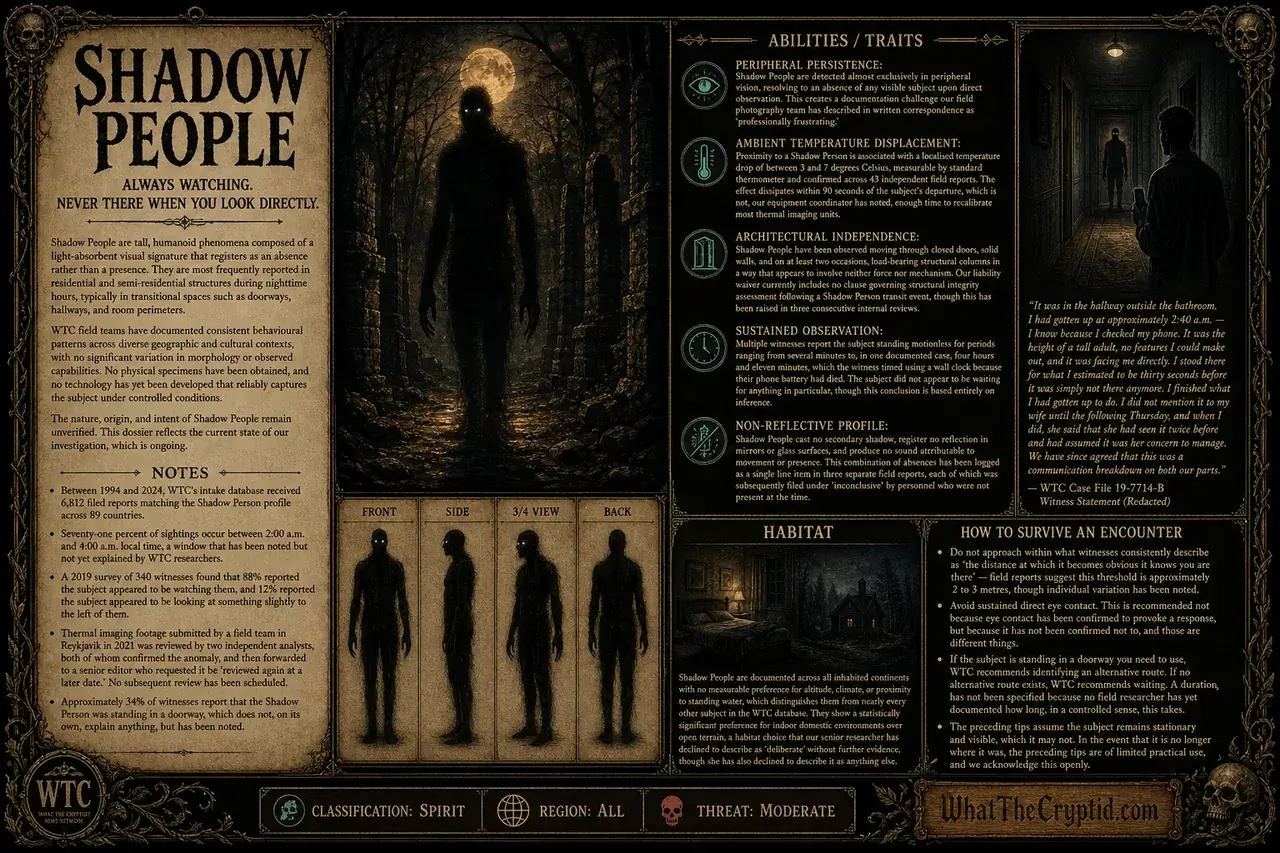
Shadow People are humanoid entities reported as fully three-dimensional, featureless silhouettes of apparent human proportion, observed in domestic, urban, and wilderness settings across every documented region of the world. Unlike shadows produced by the obstruction of light, Shadow People are consistently reported in conditions where no light source is present to cast them, a physical detail that witnesses describe as the most disturbing aspect of the encounter, slightly ahead of the staring. They are among the most frequently reported entities in the WTC database, which raises questions the network’s editorial board has discussed at length without reaching a satisfying conclusion.
The defining characteristic of a Shadow People encounter is the quality of sustained, purposeful observation. Witnesses do not report the entity moving through their space on unrelated business. They report the entity watching them specifically, from doorways, from the corners of rooms, from the foot of beds, from the edges of tree lines. Whatever the Shadow Person is doing in a given location, the consensus of several thousand filed reports is that part of what it is doing is watching. WTC classifies this as neutral behaviour pending further data, though our field coordinators have noted that ‘neutral’ may be doing some heavy lifting in that sentence.

Shadow People are catalogued under the Spirit classification on the basis that no physical trace — no biological material, no verifiable structural disturbance, no measurable environmental signature — has been recovered from any confirmed sighting location. This classification is contested internally. The debate remains open.
History & Mythology
The earliest documented accounts consistent with Shadow People phenomenology appear in Mesopotamian texts dating to approximately 2000 BCE, in which ‘edimmu’ — spirits of the unburied dead — were described as dark, man-shaped presences observed on the periphery of firelight, watching households they had no business watching. Comparable descriptions appear in medieval European demonological literature, in the diaries of Persian mystics from the 9th century, and in the oral traditions of no fewer than eleven Indigenous North American nations, the majority of whom had established protocols for such encounters well in advance of anyone asking them about it.
The contemporary classification of Shadow People as a distinct category of paranormal entity is generally attributed to radio host Art Bell, whose 2001 on-air discussion prompted a wave of listener-submitted illustrations and accounts that established the now-standard visual taxonomy: the featureless humanoid silhouette, the peripheral vanishing, and the subset variant known as the Hat Man, distinguished by the presence of a wide-brimmed hat that several cultural historians have declined to explain. WTC notes that the longevity and geographic distribution of Shadow People accounts — consistent across cultures with no documented contact with one another — is either highly significant or requires a different kind of explanation. Both possibilities remain on the table.
The first account in the WTC archive dates to a 1987 field report submitted by a contributing researcher in rural Ohio, who described a figure in the doorway of a grain storage building that was present for approximately four minutes before stepping backward into a wall. The researcher filed the report, cross-referenced it with three prior accounts from the same county, and noted that the building had no interior space large enough to step into. No follow-up investigation was recorded.
Physical Description
Shadow People present as fully opaque, human-shaped silhouettes ranging in reported height from 5 feet 2 inches to 6 feet 8 inches, with the majority of accounts clustering around 5 feet 10 inches to 6 feet 2 inches — a height range our consulting anthropologist noted, without elaboration, is consistent with adult male humans. The silhouette is uniformly described as possessing no discernible facial features, clothing textures, or biological surface detail. The outline is human in proportion — two arms, two legs, upright posture — but the edges of the figure are frequently described as ‘not quite sharp,’ with witnesses using terms such as ‘slightly soft,’ ‘like a deep cut-out,’ and, in one memorable 2019 account from Lyon, France, ‘more absent than dark.’
Three morphological variants have been documented with sufficient frequency to warrant separate notation. The Standard variant, representing approximately 71% of filed accounts, is the featureless bipedal silhouette described above. The Hat Man variant, accounting for roughly 19% of accounts, is distinguished by the presence of a wide-brimmed fedora-style hat rendered in the same flat black as the body; witnesses across multiple continents and decades describe an identical hat, a consistency WTC has chosen not to overinterpret at this time. The Hooded variant, comprising the remaining 10%, presents with a hood or cowl structure rather than a hat, and is disproportionately reported in accounts involving more prolonged contact.
A small number of accounts — fewer than 3% of the archive — describe Shadow People with visible eyes, most commonly reported as red or, less frequently, pale yellow. These accounts correlate with a statistically significant uptick in witness distress and are handled under a separate internal documentation protocol introduced in 2018.
Behaviour & Temperament
Shadow People are, with very few exceptions, stationary observers. The standard encounter involves the witness becoming aware of the entity in a fixed location — a doorway, a corner, a hallway — where it remains motionless for a period ranging from several seconds to, in the longest documented case, approximately twenty-two minutes. When the entity departs, it does so by one of two methods: it moves with unnatural speed into an adjacent space and does not reappear, or it simply ceases to be present, with no transition state recorded by witnesses despite direct observation. The latter has been described as ‘like a television switching off,’ a comparison that has appeared in accounts from fourteen countries across a forty-year period without any evidence of cross-contamination.
Shadow People do not communicate, do not gesture, and do not respond to being addressed, which several witnesses have confirmed they attempted anyway. They do not interact with physical objects in the environment. What they consistently do is maintain the watch. Witnesses almost universally report a sense of deliberate attention — not aggression, not threat in any conventional sense, but sustained, concentrated awareness directed at them specifically. Whether this constitutes intelligence, intent, or something that does not map cleanly onto either category is a question WTC has tabled for a later meeting.
Encounters occur with marked frequency between 2:00 AM and 4:00 AM. WTC does not assign meaning to this pattern beyond noting that it is a pattern. Shadow People are also disproportionately reported at transitional locations — doorways, stairwells, the space at the end of hallways, the boundary between lit and unlit rooms — a territorial preference that, if it is a preference, suggests either a sophisticated spatial awareness or something our current vocabulary is not well-suited to describe.
Habitat & Territory
Shadow People have been documented in every region of the world and show no meaningful preference for wilderness over urban environments, or for historic structures over new construction. Encounters are reported in houses less than five years old with the same frequency as in buildings several centuries in age, a finding that complicates several popular theories about residual energy and trauma-imprinting without replacing them with anything more satisfying. If the Shadow Person has a habitat preference, it appears to be proximity to sleeping humans, which is either a dietary consideration, a social one, or something else entirely.
Within domestic environments, encounters cluster at thresholds — bedrooms doors, bathroom doorways, the top of staircases — and in rooms where the witness is alone. WTC field teams have not successfully documented a Shadow Person encounter in which the witness was accompanied by another person who also saw the entity at the same moment, though several cases involve a second witness who saw the entity moments before or after the primary witness. Whether this represents a behavioural pattern or a documentation artifact has not been determined. WTC recommends treating it as both until evidence suggests otherwise.
Diet & Hunting
No feeding behaviour has been directly observed. Shadow People have not been documented consuming any biological material, liquid, or substance detectable by current field instrumentation. The question of what, if anything, Shadow People require for sustenance has produced more research hours and fewer results than almost any other open question in the WTC database.
A persistent hypothesis, advanced by independent researchers and a small number of academic parapsychologists who have asked to remain unattributed, holds that Shadow People subsist on some form of attentional or emotional energy generated by the act of being observed and experiencing fear. This hypothesis is based entirely on the behavioural pattern of prolonged watching and the temporal correlation between human REM-stage sleep and encounter frequency. WTC does not endorse this theory. WTC also notes that the alternative — that Shadow People eat nothing and require nothing — does not resolve the matter in a direction anyone finds more comfortable.
Notable Sightings
A 34-year-old shift nurse, returning home at approximately 3:10 AM, observed a standing figure in the doorway of her son’s bedroom for an estimated ninety seconds before it receded into the unlit room. She confirmed the room was empty when she checked. Her son, aged seven, reported the next morning that ‘the tall man’ had been visiting his room for approximately three weeks and that he had not mentioned it because, in his assessment, the man seemed busy. The nurse submitted a detailed written account to WTC the following week and separately enrolled her son in a different school district, which she described as unrelated.
A 28-year-old office worker reported observing a shadow figure standing in the corner of his sixth-floor apartment at 3:22 AM on three consecutive nights, each time in the same corner of the same room. On the third night he photographed the corner; the photograph shows the corner empty. He described the figure as approximately six feet tall with a hat brim he could make out clearly against the ambient city light filtering through his curtains. He submitted the (empty) photograph, the timestamps, and a hand-drawn diagram of the figure’s proportions to a Japanese paranormal research group, which forwarded the file to WTC. The witness subsequently requested that his contact information be removed from our records, and his contact information has been removed from our records.
Security footage from a private residence captured what appeared to be a human-shaped silhouette moving through a hallway at 2:51 AM. The figure passed through a closed door with no recorded deceleration and did not appear on the camera covering the adjacent room. The homeowner, a property developer, reviewed the footage with two colleagues before contacting WTC. All three described the same detail independently: the figure paused at the closed door for approximately four seconds before passing through it, in a manner one colleague described as ‘like it was being polite.’ The footage was forwarded to WTC’s technical review panel. The panel confirmed the footage was unedited and submitted a written assessment that used the phrase ‘no conventional explanation’ four times across six paragraphs.
A farmer checking on livestock at approximately 2:40 AM reported a figure standing at the far end of a stone outbuilding, motionless, watching him from an estimated distance of thirty feet. The figure remained in place for what he described as ‘long enough that I spoke to it,’ and then was no longer present. He noted that the cattle in the building were undisturbed throughout the encounter, a detail he mentioned specifically and which he appeared to find more reassuring than WTC does. He reported the sighting to a local folklorist, who cross-referenced it with four similar accounts from the same half-mile radius dating back to 1962 and contacted WTC directly. The farmer confirmed the account, mentioned it had happened twice more since then, and returned to work.
Threat Assessment
Shadow People have not been documented initiating physical contact with witnesses in any case in the WTC archive. There are no confirmed accounts of physical injury, property damage, or biological trace evidence attributable to a Shadow People encounter. On these grounds alone, a Low threat rating would be defensible. WTC has assigned Unknown rather than Low because the absence of documented harm over a forty-year archive is not the same as documented harmlessness, and because several hundred witnesses who filed accounts subsequently filed follow-up accounts describing prolonged sleep disruption, persistent feelings of observation in previously safe environments, and, in thirty-one cases, the impression that the entity had followed them to a new address. Whether these outcomes are caused by the entity or by the experience of the encounter is a distinction WTC is not currently equipped to make.
If you encounter a Shadow Person, WTC’s current recommended protocol is: remain still, do not approach, do not attempt to touch or address the entity, and note the time, location, and duration of the encounter for your records and ours. Do not pursue the entity if it withdraws. Maintain a distance of at least ten feet from the doorway or threshold at which it appears, primarily because every account in which a witness moved closer describes no outcome better than ‘nothing happened’ and several outcomes that required follow-up. WTC acknowledges that the ten-foot recommendation is based on pattern analysis rather than tested safety data, and that ‘tested safety data’ in this context would require a research methodology we have not yet received ethics board approval to conduct.
WTC Field Notes
Shadow People represent the single largest category in the WTC active database, which our editor-in-chief has described as ‘either a triumph of documentation or a problem, depending on how you look at it.’ WTC has been collecting Shadow People accounts since 1987 and has, in that time, deployed field teams to seventeen confirmed sighting locations, installed monitoring equipment in four residential properties with recurring encounter histories, and retrieved exactly zero pieces of physical evidence from any of these efforts. Of the four residential monitoring deployments, two produced footage showing nothing during reported encounter windows, one produced footage showing nothing during windows in which two witnesses in the property simultaneously reported an active encounter, and one produced footage that our technical team describes as ‘consistent with a significant electromagnetic interference event of undetermined origin’ occurring at 3:07 AM on a Tuesday.
The WTC Shadow People research file currently runs to approximately 4,300 individual case submissions. Our senior archivist, who has read all of them, has requested that future submissions be routed to a second archivist, citing workload. We are in the process of hiring a second archivist. The job listing has received significant interest, which our HR coordinator has noted is ‘either encouraging or something to think about.’