
Root Watcher
It was there before you arrived. It will wait.
North America
Active
ForestSessileSpiritLow ThreatNorth AmericaObserver
Overview
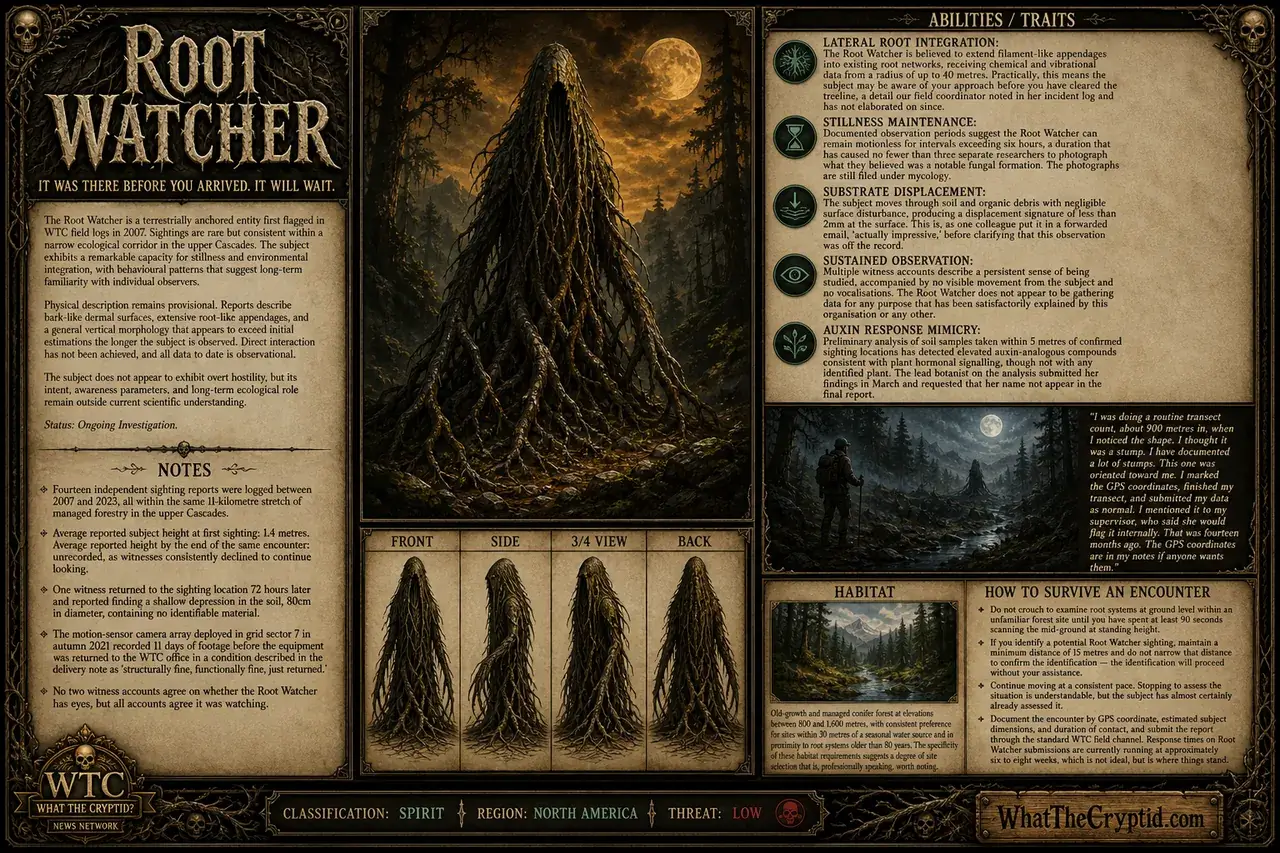
The Root Watcher is a sessile or near-sessile cryptid entity documented in old-growth deciduous and coniferous forest environments across the eastern and Pacific Northwest regions of North America. It presents as an irregular mass of root-like appendages, compacted woody tissue, and what witnesses consistently describe as one or more eye-like structures positioned at approximately ground level. Its primary documented behaviour is observation — prolonged, unbroken, and apparently purposeful — directed at humans who have entered its immediate territory. It does not, as a rule, do anything else.
What distinguishes the Root Watcher from other low-threat cryptid entities in the WTC database is the consistency of witness response. Across 47 documented accounts collected between 1987 and the present, the overwhelming majority of witnesses report not fear but a specific and difficult-to-articulate discomfort — described variously as ‘being assessed,’ ‘failing a test I hadn’t known I was taking,’ and, in one particularly detailed 2019 submission, ‘the feeling you get when an elderly relative is disappointed but too polite to say so.’ WTC has noted this language cluster as significant without yet determining what it signifies.

The entity poses no documented direct physical threat to humans. Whether this reflects incapacity, disinterest, or a form of patience that operates on a timescale we are not equipped to evaluate is a question WTC has tabled for a later meeting.
History & Mythology
Algonquian-speaking peoples of the northeastern woodlands maintained oral traditions describing a watching presence within ancient forest root systems — an entity referred to in several source texts as something approximately translating to ‘the ground that knows you.’ Ethnobotanist records from Jesuit missionaries in the late 17th century include peripheral references to areas of forest where local guides refused to make camp, citing the presence of ‘eyes in the earth,’ though the missionaries attributed this to animist superstition and did not investigate further. The notes are filed under ‘miscellaneous natural observations.’ The filing is, in retrospect, charitable.
The first account that meets WTC’s minimum documentation standards — a written first-person report, corroborating witness, and location specific enough to revisit — dates to September 1931, when forestry surveyor Edmund Chalk filed an incident report with the Ontario Ministry of Lands and Forests describing an ‘animate root formation’ that tracked his movements for approximately 25 minutes near the Temagami old-growth stands. Chalk’s supervisor noted the report, annotated it with a single question mark, and retained it in the departmental archive, where a WTC researcher located it in 2004. The supervisor’s question mark has not been definitively answered.
Following a regional surge in reported sightings in the late 1970s — concentrated along the Appalachian corridor and attributed at the time to ‘stress and unfamiliarity with wilderness environments’ by a panel of psychiatrists who did not visit any of the reported sites — the Root Watcher entered the informal cryptozoological record. It has remained there since, accumulating documentation at a steady and unremarkable rate that WTC researchers describe as ‘consistent with an entity that is simply always there.’
Physical Description
The Root Watcher’s physical form is best understood as an aggregation rather than a discrete body. Witnesses describe a roughly hemispherical mass, typically between 0.6 and 1.1 metres in height and 0.9 to 1.5 metres in lateral spread, composed of densely interwoven root-like structures that blend with — and in several accounts appear to be continuous with — the surrounding forest floor. The surface presents in browns, greys, and deep ochres consistent with the ambient soil and bark of the local environment, a correspondence so precise that multiple witnesses report not perceiving the entity until it moved or until they made eye contact with its ocular structure. Several report not perceiving it even then, only understanding what they had seen after returning home.
The ocular feature — singular in the majority of accounts, though 11 sightings describe two distinct structures and one outlying 2007 report from coastal Oregon describes seven, which WTC has retained with a note — presents as a smooth, rounded protrusion between 4 and 7 centimetres in diameter, typically amber, deep brown, or a yellow-green that witnesses describe as ‘wrong for the light conditions.’ It reflects ambient light in a manner inconsistent with wood or mineral surfaces. Photographs consistently fail to capture this quality, instead rendering the eye as an unremarkable knot. WTC’s imaging specialist reviewed 34 submitted photographs and described the results as ‘frustrating, technically, and in other ways.’
No limbs, oral structures, or locomotor appendages have been clearly documented, though several witnesses report subtle repositioning of the root mass between moments of direct observation — a displacement of between 0.3 and 0.9 metres over periods ranging from a few seconds to several minutes. This movement leaves no observable ground disturbance, a detail that a soil scientist consulted by WTC in 2018 described as ‘not consistent with any mechanism I can account for,’ before requesting that her name not be included in the published report.
Behaviour & Temperament
The Root Watcher’s behavioural repertoire is, by the standards of the WTC database, narrow. It watches. It does this without apparent fatigue, without evident distraction, and without the vocalisation, territorial display, or physical approach behaviour documented in comparable low-threat cryptid entities. Witnesses who remained in proximity for extended periods — the longest documented voluntary observation session lasted 2 hours and 14 minutes, conducted by a retired park ranger in Vermont who described herself as ‘curious and not easily startled’ — report no escalation of behaviour regardless of their own actions. The entity continued to watch when the witness spoke to it, moved closer, moved further away, ate a sandwich, and, in the ranger’s own words, ‘said some things I’d been meaning to say out loud for a while.’ It did not respond.
One behaviour that diverges from this baseline has been recorded in four separate incidents: when a second human enters the Root Watcher’s apparent field of observation, witnesses describe a perceptible shift in the angle of the ocular structure — a slow reorientation, completed over 10 to 30 seconds, that encompasses both individuals before settling into a steady focus that witnesses are divided on as to whose face it was actually pointed at. This behaviour has been interpreted variously as heightened interest, a cataloguing function, and, by one researcher whose methodology WTC found compelling if his conclusions premature, ‘something like approval.’ The entity appeared unconcerned by the debate.
There is no documented evidence of the Root Watcher initiating contact, vocalising, or following witnesses beyond the boundary of what appears to be a fixed territory of approximately 30 to 50 metres radius. Whether it cannot or simply declines to do so remains unclear. Both interpretations have, in WTC’s assessment, different but equally uncomfortable implications.
Habitat & Territory
The Root Watcher shows a strong preference for old-growth forest where root system density and ambient humidity support a ground-level environment that can accommodate and conceal its physical form. Documented sites are concentrated in stands with individual tree ages exceeding 200 years, where surface root networks are complex enough to render an additional root mass effectively invisible at distances beyond 4 metres. Elevations across documented sightings range from sea level in coastal Oregon and British Columbia to approximately 1,100 metres in Appalachian sites, suggesting that altitude is not a primary habitat selection factor — canopy age and root density appear to be.
All confirmed or probable Root Watcher sites share one additional characteristic that WTC initially noted as coincidental and has since noted with less confidence: proximity to standing water. Documented locations sit within 200 metres of a stream, seep, pond, or bog in 41 of 47 recorded cases. Whether this reflects a physiological requirement, a preference shared with the prey or wildlife the entity monitors, or something else is not established. WTC field teams have been advised to treat any old-growth site near water with what our editor describes as ‘eyes open, in the broader sense.’
Diet & Hunting
No feeding behaviour has been directly observed. The Root Watcher has not been documented consuming animal matter, plant material, or any other identifiable substance during any of the 47 recorded observation events, including the 2-hour-14-minute Vermont session, during which the witness specifically watched for this. If the entity requires sustenance in any conventional sense, it does not appear to acquire it during the hours humans are present to observe it, which may be a reasonable dietary strategy.
Three accounts include post-visit observations of small animal remains — a grey squirrel, two instances of unidentified small rodent — found within 5 metres of the apparent Root Watcher position following an encounter. WTC notes this detail without asserting a causal relationship, because our legal team has asked us to note details of this kind without asserting causal relationships. The remains showed no signs of predatory trauma consistent with known carnivores in the relevant regions. A wildlife biologist who reviewed the photographs of the 2016 rodent remains from Vermont described them as ‘efficiently processed,’ and did not expand on this when asked.
Notable Sightings
Forestry surveyor Edmund Chalk reported an ‘animate root formation’ at ground level approximately 6 metres from his survey line, which he described as maintaining continuous eye contact with him for the duration of his work at that station — a period he logged as 25 minutes. Chalk noted that it had not been present when he arrived at the station, though he conceded he had not looked carefully at the ground. He completed his survey measurements, recorded the entity in his field notes with a rough sketch, and included it in his formal incident report to the Ontario Ministry of Lands and Forests, where it was filed and retained without response for 73 years.
A group of four hikers on a backcountry permit reported encountering a ‘root cluster with an eye’ approximately 11 metres off the main trail, which two members of the group observed for roughly 40 minutes while the other two hikers continued to camp. Witnesses Priya Anand and Dale Westerholm submitted independent accounts that agreed on all primary details: single amber ocular structure, no movement during observation, a gradual sense that the entity was ‘more interested in Priya than in me,’ per Westerholm’s account. Anand’s account does not address this characterisation. She did not return to the Hoh Rainforest on subsequent hiking trips, though she told WTC researchers she had ‘no specific reason’ for this.
Retired Vermont State Parks ranger Carol Oduya encountered a Root Watcher at close range — approximately 3 metres — while conducting an informal habitat survey of an old-growth remnant stand she had monitored for 14 years without prior incident. Oduya, who described herself in her submission as ‘not a credulous person,’ remained at the site for 2 hours and 14 minutes, documenting the encounter in a field notebook and attempting photography with three separate devices, none of which captured the ocular feature to her satisfaction. She submitted her notebook, 34 photographs, and a 6-page typed account to WTC the following week. Her cover letter noted that she had visited the stand twice since the encounter and found nothing, which she described as ‘the more unsettling outcome, on reflection.’
Trail maintenance crew supervisor Marcus Trent reported a Root Watcher sighting to WTC on behalf of himself and two crew members, following an encounter during routine blowdown clearing approximately 0.4 miles from the Seneca Creek trailhead. Trent described a mass ‘about the size of a crouching person’ that none of the three workers had noticed until one crew member, attempting to clear a root section with a hand saw, stopped working and said he thought it was looking at him. All three workers agreed it was looking at them. They completed their assigned section of trail, logged the encounter in the crew’s daily report under ‘wildlife observation — unusual,’ and mentioned it to their district supervisor, who told them to include a photo next time. They did not have a photo. Trent filed the WTC report that evening and confirmed this was the second time he had seen something he could not account for in that section of trail.
Threat Assessment
The Root Watcher presents a Low threat rating under WTC’s standard assessment framework, with the following qualifications that WTC considers important to state clearly. There are no documented cases of a Root Watcher initiating physical contact with a human, displaying aggressive behaviour, or causing direct harm of any kind. Individuals who have approached to within 3 metres have reported no physical response from the entity. On these metrics, the Root Watcher is one of the least actively dangerous cryptid entities in the WTC database.
WTC nonetheless recommends the following when encountering a probable Root Watcher: maintain a minimum distance of 5 metres, avoid direct and sustained eye contact exceeding 60 seconds — not because any negative outcome has been documented from longer contact, but because multiple witnesses have described the extended experience as ‘adhesive’ in a way that is difficult to specify further — and do not attempt to handle, excavate, or make physical contact with the entity’s apparent root mass, as several witnesses have reported that the entity’s subsequent behaviour, while not aggressive, became ‘different’ in ways they preferred not to elaborate on. WTC acknowledges that the preceding guidance is less specific than our standards committee would prefer, and notes that specificity is constrained by the nature of the available data.
WTC Field Notes
WTC has maintained an active file on the Root Watcher since 2004, when a researcher located the Chalk survey report in the Ontario provincial archive during an unrelated records search. We consider this file one of our more complete holdings — 47 documented accounts, 34 photographs, 6 submitted field journals, and one hand-drawn map from a 1978 witness that our cartographer describes as ‘accurate, impressively so’ — and also one of our more unresolved ones. The volume of documentation has not materially improved our understanding of what the Root Watcher is, what it wants, or whether ‘want’ is a category that applies to it. Our senior researcher on the file, who has asked not to be named in published materials, describes the current state of the research as ‘knowing more and more about less and less.’
A field expedition to three confirmed Root Watcher sites in Vermont and West Virginia was conducted in October 2022. The team — two researchers and a contracted wildlife videographer — visited all three sites over five days, deployed 12 motion-activated trail cameras, and collected soil and bark samples from areas matching Root Watcher habitat descriptions. Soil analysis returned results consistent with normal old-growth forest substrate. Trail cameras recorded deer, raccoons, and one camera that malfunctioned on day two and recorded 14 hours of static before the battery failed. The team did not encounter a Root Watcher. One researcher reported, on the final morning, a sensation of being watched from the tree line that lasted approximately 3 minutes and left no physical evidence. She included this in her field notes under ‘subjective observations’ and noted that the feeling had been, and she quoted herself here, ‘not unpleasant, which is the part I keep thinking about.’ WTC has allocated budget for a follow-up expedition pending equipment replacement costs being approved by our finance committee, which meets quarterly.