
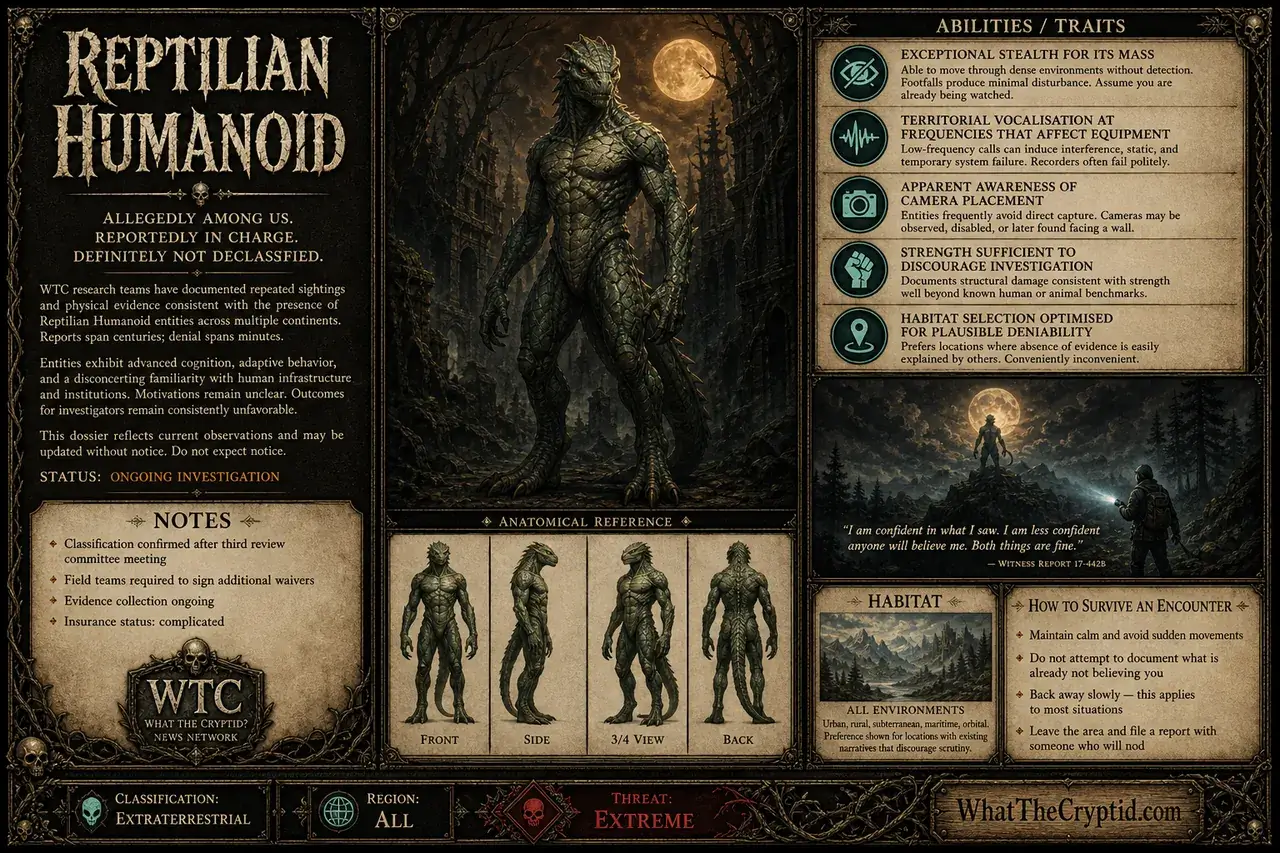
Reptilian Humanoid
Documented on every continent. Somehow still unverified.
All
Active
ShapeshifterSubterraneanGlobalHigh IntelligenceBipedal
Overview
The Reptilian Humanoid presents one of the more logistically complicated entries in the WTC Cryptid Database, owing primarily to the entity’s reported global distribution, its apparent capacity for social integration at senior institutional levels, and the volume of documentation submitted by witnesses who have, in several cases, asked that their names be withheld from all records including this one. WTC classifies it under Shapeshifter on the basis of consistent witness testimony describing the entity’s ability to present a convincingly human exterior under most ambient lighting conditions, with the caveat that our classification committee spent three meetings on this and remains only partially satisfied with the outcome.

At its most basic, the Reptilian Humanoid is described as a bilaterally symmetrical biped standing between six and nine feet in its unmasked form, with scaled integument ranging from deep green to grey-brown, vertical slit pupils, and a carriage that multiple witnesses have independently described as ‘too controlled.’ It is reported with unusual consistency across cultures that have no documented contact with one another, which WTC notes as either highly significant or an interesting coincidence, and which our editorial team has agreed to describe as ‘a data point requiring further analysis.’
The entity’s reported intelligence is uniformly assessed as high — in several accounts, uncomfortably so. Witnesses describing direct interactions consistently note that the Reptilian Humanoid appeared to be managing the conversation rather than participating in it. WTC has no framework for quantifying this observation but has included it in all relevant case files.
History & Mythology
The earliest documented analogues to the Reptilian Humanoid appear in the Sumerian texts of approximately 4000 BCE, wherein a class of beings described as the Anunnaki are rendered in temple iconography with scaled features, elongated crania, and what several archaeologists have cautiously identified as formal garments. The Nāga of Hindu and Buddhist tradition — serpentine beings capable of assuming human form, operating within human society, and occupying positions of considerable influence — appear independently in texts dated to at least 1500 BCE. The Aztec figure of Quetzalcoatl, the feathered serpent whose return was reportedly anticipated with some institutional preparation, occupies a related conceptual space, though WTC acknowledges that the comparison is contested by two of our three consulting historians.
In the modern era, the first formally documented sighting in the WTC record is attributed to naturalist and surveyor Charles Wetzel, who reported a scaled bipedal entity emerging from the Santa Ana River in Riverside County, California in November 1958. Wetzel’s description — green scales, no discernible nose, limbs jointed at angles inconsistent with standard human morphology — was reported in the local press and subsequently investigated by police, who found drag marks consistent with a large body entering the water. The investigation was closed without findings. The drag marks were not re-examined.
The latter half of the twentieth century produced a significant acceleration in Reptilian Humanoid reports, a pattern WTC attributes to either an increase in actual entity activity, an increase in reporting infrastructure, or both. Former BBC sports presenter David Icke’s 1998 publication of detailed claims regarding Reptilian infiltration of global governance structures introduced the modern framework for understanding the entity’s social behaviour to a substantially wider audience, a development WTC treats as a primary source document with the same careful attention it applies to all primary source documents.
Physical Description
In its unmasked state, the Reptilian Humanoid stands between 6.2 and 9.1 feet tall based on witness estimates cross-referenced against reference objects present at the scene. Body mass is consistently described as substantial — one witness, a former competitive weightlifter, described the entity’s physical presence as ‘like standing next to a car that was also a person.’ The integument is uniformly described as scaled, with individual scale diameter averaging approximately 1.5 to 2 centimetres at the torso and reducing toward the extremities. Coloration varies by reported region: North American specimens trend toward olive and grey-green; those reported in Southeast Asia present more yellow-brown tones; European accounts, which are rarer and tend toward greater institutional settings, describe a notably paler grey.
The facial structure is where witness accounts achieve their most striking convergence. All documented reports describe vertical slit pupils, which multiple ophthalmologists consulted by WTC confirmed would function well in both bright and low-light environments, and which none of them wished to discuss in a follow-up interview. The jaw is described as wider than human proportions would suggest, the tongue in several accounts as bifurcated, and the overall facial expression as one witnesses consistently struggle to characterise beyond ‘attentive.’ The hands feature four digits with reported claw-like nails; the neck is described as slightly longer than human standard, with movement described as ‘precise’ rather than fluid.
A meaningful subset of reports describe the entity in what appears to be a transitional state — the human exterior either partially assumed or partially dropped — in which the underlying Reptilian features become visible around the eyes, jaw, and hands first. This presentation is reported almost exclusively in moments of heightened emotion or stress on the entity’s part, which WTC finds either anatomically informative or concerning, depending on the section of the report being reviewed.
Behaviour & Temperament
The Reptilian Humanoid’s behavioural profile is, by the standards of entities in this database, unusually goal-directed. The majority of documented encounters do not involve random territorial display or opportunistic predation but appear instead to be purposeful in ways that witnesses find difficult to articulate and WTC finds difficult to file. Entities are observed attending meetings, conducting conversations, occupying offices, and in at least fourteen reported cases, chairing committees. The implication that the Reptilian Humanoid’s primary social behaviour is institutional participation is one WTC has reviewed carefully and placed in a clearly labelled folder.
In direct confrontation scenarios — which represent a minority of reports — the entity displays what field researchers have characterised as controlled aggression: deliberate, economical, and apparently calibrated to the specific situation rather than reflexive. Witnesses who have provoked or inadvertently threatened a Reptilian Humanoid describe a response that is fast, quiet, and disproportionate to the trigger, followed by a return to composed behaviour that several witnesses described as ‘the most unsettling part.’ Unprovoked physical aggression toward humans is not commonly reported, a fact WTC notes without drawing conclusions.
Socially, the entity appears to operate within structured hierarchies. Multiple independent accounts describe observable deference between Reptilian Humanoid individuals, with status appearing to correlate with physical size, the degree of deliberateness in movement, and, in three separate reports, the quality of their tailoring. Whether this represents genuine cultural hierarchy or a performance of human social structure remains, like several aspects of this entry, an open question that WTC has not yet found the budget to close.
Habitat & Territory
Reptilian Humanoid habitat encompasses a broader range of environments than any other entity in the WTC database, which is either a testament to the species’ adaptability or a reflection of the global reach of the institutional structures it reportedly inhabits. Field sightings in undisguised form cluster around underground or semi-subterranean environments — storm drainage systems, tunnel networks, and cave complexes at depths typically below 40 metres — with a notable concentration of reports in the American Southwest, where both the geology and the existing subterranean infrastructure are, by any measure, extensive. Elevation appears to be a minor factor; reports span sea level to approximately 2,400 metres without meaningful variation in entity characteristics.
The entity’s reported capacity to operate within human urban environments — office buildings, government facilities, and on at least one occasion a regional agricultural fair in Manitoba — complicates the conventional concept of ‘habitat’ in ways WTC’s database architecture was not originally designed to accommodate. For the purposes of this entry, habitat is defined as the environment in which the entity is most reliably encountered without a prior appointment, which remains the subterranean and semi-subterranean zones identified above.
Diet & Hunting
The Reptilian Humanoid’s dietary requirements have been the subject of more speculation and less reliable documentation than almost any other aspect of its biology, a situation WTC attributes partly to the difficulty of observing feeding behaviour and partly to the nature of what feeding behaviour has been reported. Multiple accounts from across the dataset describe the entity consuming animal matter — primarily large mammals — in quantities and through methods consistent with an apex predator of its reported body mass, which a consulting zoologist estimated would require between 8,000 and 12,000 calories per day to sustain at rest. The same zoologist asked that her name not appear in this entry.
A secondary and considerably more discussed subset of the literature describes the Reptilian Humanoid’s dietary interests in terms that move beyond conventional predation into what witnesses characterise as ritual or resource-based consumption practices. WTC includes this body of testimony in the case files and notes that it is internally consistent across geographically disparate sources, while also noting that internal consistency is not the same as verification, and that the editorial team has agreed to leave the specific details of this subset to the discretion of individual researchers reviewing the primary materials.
Notable Sightings
Seventeen-year-old Christopher Davis reported an encounter at approximately 2:00 AM on Scape Ore Swamp Road after stopping to change a flat tyre. Davis described a figure he initially took to be a man running toward his vehicle from the tree line — later clarifying ‘running’ as the wrong word, that the movement was ‘too smooth’ — before identifying scaled green skin, red eyes, and a height he estimated at seven feet. The entity reportedly gripped the roof of Davis’s 1976 Toyota Celica as he drove away, leaving behind claw marks in the metal and a side mirror torn from the door. Subsequent investigation by Lee County Sheriff’s Department confirmed the damage to the vehicle and recovered no additional evidence. Three further residents reported unusual damage to their vehicles or livestock in the Bishopville area over the following six weeks, none of whom initially connected their reports to Davis’s account.
On August 19, 1972, two teenagers — Gordon Pike and Robin Flewellyn — reported emerging from Thetis Lake to find a scaled humanoid entity watching them from the water’s edge. They described a creature approximately five feet tall, silver-grey in colouration, with a pronounced ridged crest running the length of the skull, gills visible at the neck, and hands featuring webbing between the fingers to the second knuckle. A second sighting by two additional witnesses was reported four days later at the same location. Royal Canadian Mounted Police opened a formal investigation — one of the few cryptid-related events to prompt this response in Canadian law enforcement history — which was closed after one of the original witnesses acknowledged he had recently seen the 1954 film Creature from the Black Lagoon. The second pair of witnesses did not amend their account.
In May 1955, a travelling businessman identified in records only as ‘Mr. Hunnicutt’ reported stopping on a rural road outside Loveland at approximately 3:30 AM after observing a group of three to four figures crouched at the roadside. On approach, Hunnicutt described the figures as three to four feet tall, bipedal, with leathery skin and faces he characterised in his written account as ‘the face of a frog, if the frog had been thinking about you.’ One of the figures was observed holding an object described as wand-like, which emitted sparks and a smell Hunnicutt compared to alfalfa. The group departed toward the Little Miami River without interacting with him. Hunnicutt completed his report at the Loveland police station, described by the duty officer as composed and specific, and was back on the road by 5:00 AM.
In March 2009, a night security supervisor at a commercial office complex in Nairobi’s Upper Hill district filed an internal incident report describing an entity he observed in the underground car park at approximately 1:40 AM. The witness, identified in WTC materials as J. Mwangi, described a figure he initially categorised as an unusually tall man in a grey suit before observing, at a distance of approximately twelve metres under fluorescent lighting, that the figure’s face was ‘not a face I have seen on a person,’ noting scaled texture, amber-coloured eyes without visible whites, and movement he characterised as ‘like it had already decided where everything in the room was.’ The figure entered a stairwell serving the upper floors of the building. Mwangi’s incident report was reviewed by building management, who noted that no event was scheduled in the building that evening and that all access logs for the stairwell in question showed no entry. Mwangi filed for a transfer to the day shift the following week and was accommodated without discussion.
Threat Assessment
WTC assigns the Reptilian Humanoid a threat rating of High on the basis of reported physical capabilities, documented strategic intelligence, and the specific challenge posed by an entity that may be encountered not in a remote wilderness setting but in a quarterly review meeting. Standard cryptid encounter protocols — maintain distance, avoid direct eye contact, do not approach — remain applicable in field settings, where WTC recommends a minimum disengagement distance of 50 metres and advises against any action that could be interpreted as territorial challenge, which for this particular entity includes sustained direct eye contact, pointed questions about identity, and photography without consent.
In non-field settings, WTC’s practical guidance becomes necessarily general, since the specific circumstances of encountering a Reptilian Humanoid in an institutional context vary considerably and this entry is not a substitute for situational judgment. The honest limitation of this threat assessment is that the entity’s primary reported strategy is non-confrontational integration, which means the highest-risk scenario is not a physical encounter but a conversational one, and WTC does not currently have a recommended protocol for that. A working group has been proposed. It has not yet met.
WTC Field Notes
WTC’s ongoing Reptilian Humanoid investigation is, by internal consensus, the most resource-intensive active case in the database and the one most likely to cause a researcher to take an unscheduled leave of absence. To date, eleven WTC field staff have requested reassignment after extended work on the case file, citing reasons ranging from ‘personal schedule conflicts’ to a written statement from one senior researcher that WTC’s legal team has advised we not reproduce here. Our current lead investigator, who asked to be credited only as ‘T.,’ has been with the project for three years and describes the experience as ‘fine.’
The primary operational challenge of documenting the Reptilian Humanoid is not access to witnesses — reports arrive at a rate that constitutes what our database administrator has called ‘a volume problem’ — but the consistent pattern of supporting documentation becoming unavailable between initial contact and follow-up. Of 847 cases in the active file where witnesses offered photographic or video evidence, 612 reported technical failures, device losses, or cloud storage anomalies before materials could be transferred to WTC. Our IT consultant reviewed fourteen of these cases and described the pattern as ‘statistically interesting,’ then asked to be removed from the project. WTC continues to accept submissions. We recommend witnesses back up materials to multiple offline devices and consider mailing physical copies to our PO box, which is, for reasons WTC has decided not to examine, the method with the highest successful delivery rate.