
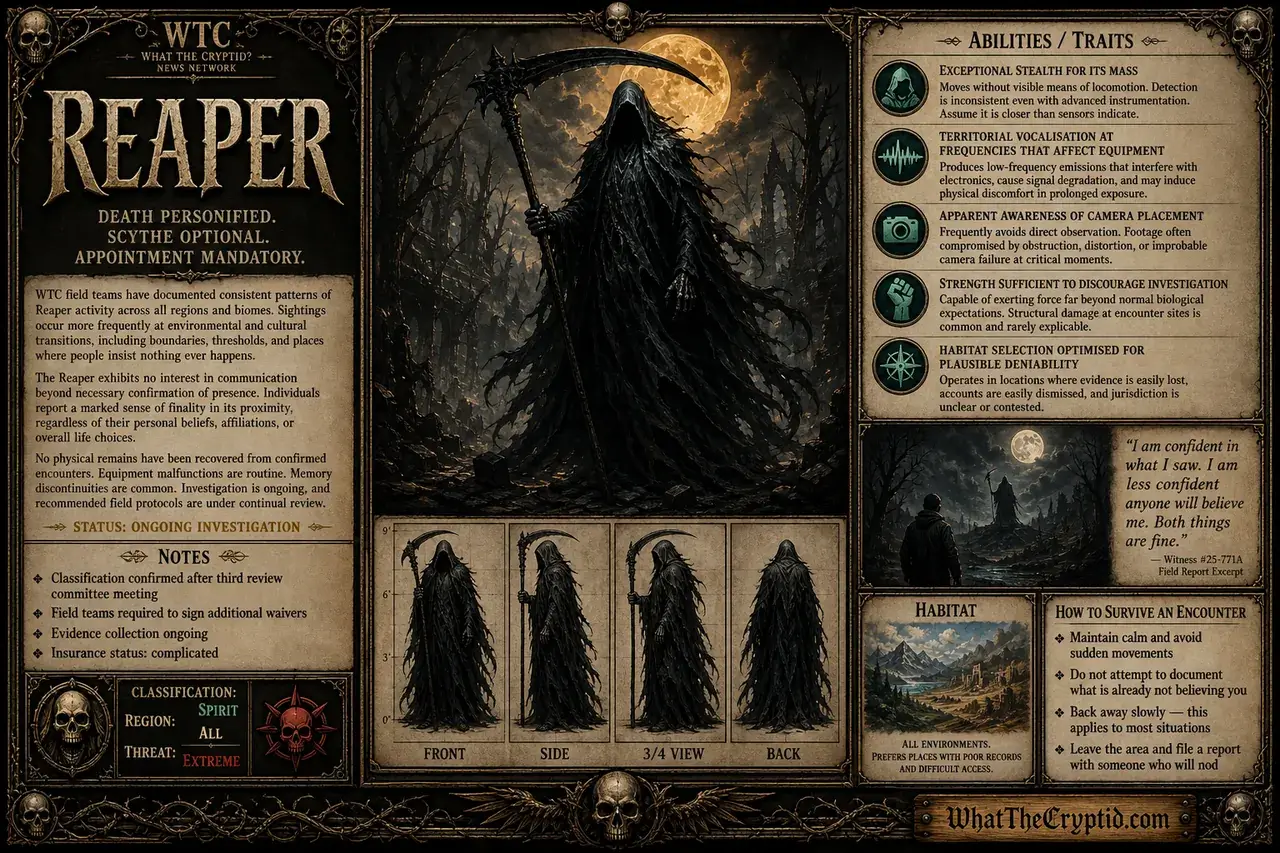
The Reaper
Documented in every culture. Perfect attendance record. No exceptions.
All
Active
PsychopompDeath EntityCross-CulturalSpirit ClassExtreme Threat
Overview
The Reaper is among the most consistently documented entities in the WTC database, distinguished from the majority of its entries by a verification rate that our statistical team describes, in their words, as ‘uncomfortably high.’ Recorded across every inhabited continent, every major civilisation, and every historical period for which written records exist, the entity presents as a robed anthropomorphic figure associated with the transition between biological life and its cessation. WTC classifies it as a Spirit-class entity on the basis of its apparent incorporeality, though this classification has been contested internally on the grounds that a classification system built to describe entities that are unverified applies with some awkwardness to one whose core function is empirically unavoidable.

The entity operates as a psychopomp — a guide or conductor of the recently deceased — a role it shares with analogous figures across Egyptian, Greek, Norse, Aztec, Chinese, and West African traditions, among others. Whether these represent independent manifestations of a single entity, culturally specific sub-variants, or entirely distinct beings performing equivalent functions is a question WTC has formally tabled pending additional fieldwork. Additional fieldwork has not been scheduled.
Field documentation of the Reaper presents unique methodological challenges. Witnesses who report a direct, unambiguous encounter with the entity in its primary operational context are, by definition, unavailable for follow-up interview. The testimony that does exist comes predominantly from near-death experiences, bystander observations, and a subcategory of accounts WTC catalogues as ‘proximate witnesses’ — individuals present at a death who reported anomalous perceptions in the moments surrounding it. These accounts form the basis of this entry.
History & Mythology
The earliest unambiguous depictions of a death-associated anthropomorphic entity date to ancient Egypt, where the jackal-headed god Anubis was documented as a conductor of souls to the underworld as early as 2400 BCE, appearing in the Pyramid Texts of the Old Kingdom. Greek traditions recorded Charon, the ferryman of the dead, and the winged daemon Thanatos across multiple classical sources from the 8th century BCE onward. The skeletal or shrouded figure more immediately recognisable to contemporary witnesses emerged with particular force in medieval Europe during the 14th century, a period that provided the entity with what historians have noted was an unusually busy operational schedule.
The iconic hooded, scythe-bearing variant solidified iconographically during and after the Black Death of 1347–1351, appearing in the Danse Macabre artistic tradition across France, Germany, and the Low Countries. The scythe — an agricultural implement associated with harvest and, by extension, with cutting down that which has grown — is the detail that most researchers find either poetically apt or literally accurate, depending on their position on the entity’s ontological status. WTC takes no official position on this question, though it has come up at three consecutive editorial meetings.
Notably, pre-contact civilisations in the Americas developed independently convergent death-entity traditions: the Aztec goddess Mictecacihuatl, the Mayan Ah Puch, and related figures share the skeletal iconography, harvest-tool associations, and psychopomp function of their Old World counterparts. The frequency with which isolated cultures arrive at near-identical descriptions of the same entity is a data point WTC considers significant and prefers not to dwell on during office hours.
Physical Description
Witness accounts across cultures and centuries describe the Reaper with a consistency that is, statistically, remarkable. The predominant reported form is a tall, robed figure — height estimates range from 6 to 8 feet, with a modal clustering around 7 feet that suggests either genuine physical consistency or a shared human tendency to overestimate the stature of things that frighten them. The robes are described in the overwhelming majority of accounts as black, though a secondary variant documented primarily in Scandinavian and Northern European traditions presents in white, and a smaller subset of South American accounts describe a figure in red. WTC treats these as either regional variants or a wardrobe consideration the entity manages independently.
The face, where visible at all, is most commonly reported as a bare human skull — the flesh absent, the eye sockets either empty or containing points of faint luminescence described variously as pale blue, amber, or simply white. Several accounts describe the face as entirely obscured by the cowl of the robe, with witnesses reporting only darkness within the hood at whatever angle they observed it from. The scythe appears in approximately 67% of documented accounts; an hourglass in 23%; a sword in 14%; and a ledger or book in 8%. These numbers do not total 100% because some witnesses report multiple implements simultaneously, which WTC notes without further comment.
A small but consistent subcategory of accounts — concentrated in hospital and hospice settings — describes not the canonical robed figure but a simpler perceptual phenomenon: a deepening of shadow at the periphery of vision, a sudden drop in ambient temperature, and a sense of presence that witnesses consistently struggle to articulate. Whether this represents the same entity in a reduced manifestation, a distinct sub-variant, or something else entirely is currently undetermined. WTC’s consulting phenomenologist requested that her name not be attached to any conclusions drawn from this data.
Behaviour & Temperament
The Reaper demonstrates a professional consistency of behaviour that, across thousands of years of documentation, has produced remarkably few outliers. Its primary documented function — attendance at the moment of biological death — appears to be carried out with the focused efficiency of an entity that has had considerable practice. Bystander witnesses in hospice and hospital settings report the perceived presence as brief, purposeful, and notably uninterested in anyone in the room who is not its immediate subject. This selectivity is one of the entity’s better-documented behavioural traits, and most witnesses, on reflection, describe it as a relief.
The Reaper is not, by the preponderance of evidence, aggressive. Accounts of the entity actively causing death — as opposed to attending it — are present in the folklore record but are methodologically difficult to distinguish from the entity simply being present when death occurred by other causes. WTC’s current position is that correlation between the Reaper’s presence and mortality should not be interpreted as causation until further evidence is available, and that this position is easier to maintain from a desk than from a bedside. The entity has not, in any documented account, been reported pursuing a witness who was not its designated subject, which is the most reassuring sentence this entry contains.
Accounts of prolonged interaction with the Reaper — folklore traditions in which a human bargains with, outwits, or delays the entity — exist across multiple cultures and are treated by WTC as behavioural data rather than narrative convention. If accurate, they suggest an entity capable of entering into conditional arrangements, which implies either a degree of flexibility in its operational mandate or a preference for avoiding the administrative complications that an unconsented early collection would presumably generate. The Reaper has never confirmed this interpretation. It has not been asked.
Habitat & Territory
The Reaper demonstrates no documented preference for terrain, climate, elevation, or proximity to water, which distinguishes it from virtually every other entity in the WTC database and creates meaningful difficulties for our habitat-mapping team. Accounts are distributed across arctic tundra and equatorial rainforest, sea level and high altitude, urban centres and remote wilderness, with a distribution that tracks human mortality data so precisely that our GIS specialist produced a correlation coefficient of 0.97 before requesting a meeting with HR.
If a habitat preference can be inferred at all, it is proximity to the dying rather than to any particular physical environment — which is to say, the Reaper’s territory is wherever its subjects are, and its subjects are, eventually, everywhere. Secondary accounts note a slight overrepresentation of sightings in locations with high ambient mortality: battlefields, hospitals, the sites of historical epidemics, and certain stretches of highway that local authorities have been unable to make statistically unremarkable despite repeated infrastructure improvements. WTC field teams visiting these locations are advised to complete their documentation efficiently.
Notable Sightings
Surgeon’s assistant Thomas Whitfield recorded in his field journal, dated July 4th, 1863, a figure observed moving through the hospital tent during the night following the battle’s conclusion — tall, dark-robed, pausing briefly at certain cots and not others. Whitfield noted with apparent clinical interest that every soldier at whose cot the figure paused was deceased by morning, and every soldier it passed remained alive for at least another 24 hours. Whitfield’s journal entry runs to four pages and concludes with a note about the quality of the available lamp oil, which he found insufficient. A statistical review of the mortality records against his documented observations was conducted by WTC in 2019 and produced results our editorial board voted 4-2 not to publish in full.
Night-shift nurse Siobhán Doherty reported to hospital administrators that on the evening of March 11th, she observed a tall figure in dark clothing standing at the foot of a bed in Ward 7, occupied by a 74-year-old patient in stable condition. Doherty reported approaching the figure and finding the space empty upon arrival; the patient died of cardiac arrest 22 minutes later. The incident was documented in the hospital’s incident log under the category ‘Unexplained Staff Concern,’ a category that a Freedom of Information request later revealed had been used 14 times at the same facility in the preceding decade. Doherty was offered and accepted an occupational health referral, which she described as ‘kind but not really the point.’
Truck driver Kenji Murakami reported to Aomori prefectural police that at approximately 2:40 AM on October 29th, he observed a robed figure standing motionless in the centre of the highway, which he was unable to avoid and struck at approximately 80 kilometres per hour. Examination of the truck found no damage to the front grille, no biological material, and no evidence of impact consistent with the collision Murakami described. A section of guardrail 400 metres further along the road showed fresh impact damage consistent with a vehicle that had swerved violently. Murakami’s dashcam footage for the relevant 11-minute window was unrecoverable due to what the manufacturer described as ‘a file system error we have not previously encountered.’ Murakami retired from long-haul driving the following month.
During the filming of a documentary on Azorean folklore traditions, camera operator Luciana Faria reported capturing approximately 4 seconds of footage depicting a tall dark figure standing at the edge of frame during an interview with a 91-year-old local resident discussing her lifelong awareness of ‘the waiting shape.’ The resident herself was unaware of the figure during filming but identified it immediately upon review as ‘exactly as I described, yes, you see.’ The resident died of natural causes seventeen days after the interview was recorded, an outcome she had indicated she considered ‘timely.’ The documentary has not been released. The production company cited ‘creative differences’ in a statement that did not elaborate on what the differences were or with whom they had occurred.
Threat Assessment
The Reaper presents a threat profile that is, in the assessment of WTC’s safety committee, both absolute and largely immune to mitigation, which the committee acknowledges makes this section of limited practical utility. The entity’s documented interest is exclusively in subjects whose biological mortality has been determined by processes outside WTC’s operational scope. Bystanders, proximate witnesses, and field researchers have not been recorded as subjects of the entity’s direct attention unless they were also dying, which is a distinction that provides meaningful comfort in most circumstances and very little in some.
WTC’s formal recommendation is to maintain a minimum distance of 30 feet from any individual in whose vicinity the entity has been observed, not because proximity increases personal risk but because it has historically complicated attempts to document the encounter. Researchers are further advised not to attempt to address, obstruct, or photograph the entity at close range — the first on the grounds that it has never, in any recorded account, responded; the second on the grounds that proximity to a dying individual during an active encounter is ethically complicated; and the third on the grounds that equipment malfunctions in these situations are documented at a rate that no longer surprises our technical team. WTC notes, with the transparency its readership deserves, that this threat assessment was written by people who will eventually be unable to write anything, and that the entity responsible for this has almost certainly already noted our address.
WTC Field Notes
WTC first formally catalogued the Reaper as a database entry in 2011, following an editorial meeting in which the question of whether ‘entities that are definitionally real’ fell within our remit was debated for two hours and resolved by a majority vote of three to two, with one abstention from our then-editor who stated that she ‘would rather not have a formal opinion on record.’ The entry has since become our most-read page by a margin that our analytics team finds gratifying and our staff find somewhat difficult to interpret emotionally. We receive, on average, 340 reader submissions per month regarding the Reaper, a figure that has increased consistently every year since the entry was published and which we choose not to analyse demographically.
Fieldwork on this entry has been conducted by six researchers over eleven years. Two have retired. One relocated and did not provide a forwarding address. The remaining three continue to contribute to the database and have asked that their ongoing involvement with this particular entry not be noted in their staff profiles. WTC has honoured this request. Our consulting theologian, Dr. Miriam Osei-Bonsu, reviewed an early draft of this entry and returned it with two pages of margin notes, the last of which read: ‘I’m not sure what you want me to say.’ We are not sure either. The entry has been published anyway, on the basis that an imperfect record is better than no record, and that the subject of this entry would presumably agree.