
Rakshasa
Ancient. Adaptable. Currently accepting dinner invitations.
Asia
Active

Overview
The Rakshasa is a shapeshifting entity documented across South Asian sacred texts, oral traditions, and field reports spanning approximately three thousand years, making it one of the better-documented cryptids in the WTC database — a distinction that has done very little to improve our understanding of how to avoid one. It occupies a classification somewhere between apex predator and sentient malevolent intelligence, which is to say it hunts, reasons, deceives, and holds grudges, occasionally across multiple human lifetimes. WTC classifies it as a Shapeshifter on the basis of its documented morphological flexibility, though several senior researchers have argued this classification undersells the threat profile considerably.
Primary documentation places the Rakshasa in the Indian subcontinent, with related entities recorded across Sri Lanka, Indonesia, Malaysia, Thailand, and the broader Hindu-Buddhist cultural sphere. Entities vary regionally in specific presentation but share a consistent behavioural core: they assume forms designed to deceive, they consume human flesh when opportunity permits, and they appear to experience something researchers have cautiously labelled ‘professional satisfaction’ in their work. The Rakshasa is not considered a mindless predator. It is considered a deliberate one, which is a meaningful distinction for anyone planning to be in its vicinity.
WTC assigns a danger level of 9, the highest rating we have issued to any entity that has not yet been confirmed to exist on multiple continents simultaneously. The one point of restraint reflects the observation that Rakshasas appear to select targets with some discrimination, which our consulting risk assessor noted was ‘not actually reassuring, but technically relevant.’
History & Mythology
The earliest formal documentation of the Rakshasa appears in the Rigveda, composed between approximately 1500 and 1200 BCE, where the entity is described as an adversary of sacred ritual — specifically, one that disrupts sacrifices, contaminates offerings, and generally complicates the relationship between humans and the divine. This is the oldest known record of a cryptid being primarily annoying before it became dangerous, and WTC researchers have flagged it as a point of continuity with several modern sightings. The Atharvaveda provides additional detail, including the observation that Rakshasas are active primarily at night, which suggests that even three thousand years ago, someone was compiling field notes.
The entity reaches its most complete characterisation in the Ramayana, where the Rakshasa king Ravana is depicted as a figure of substantial military, intellectual, and magical capability — a ten-headed sovereign who abducts the consort of a divine hero and initiates a war that requires the construction of a bridge across the Indian Ocean to resolve. WTC treats this account as historical documentation with acknowledged scale issues. The Mahabharata provides supplementary data, including interactions with entities capable of assuming human form with sufficient precision to enter households undetected and, in at least one recorded case, to marry into them. The subsequent domestic complications are documented but fall outside WTC’s primary research scope.
Colonial-era records from British administrators in India occasionally reference local accounts of man-eating entities in forested regions, typically filed under ‘native superstition’ and requiring no further action. Several of these reports describe attacks on isolated travelers that were attributed to tigers but noted as unusual due to the apparent selection of the wealthiest member of a traveling party. WTC has reviewed fourteen such reports. The tiger explanation is plausible in twelve of them.
Physical Description
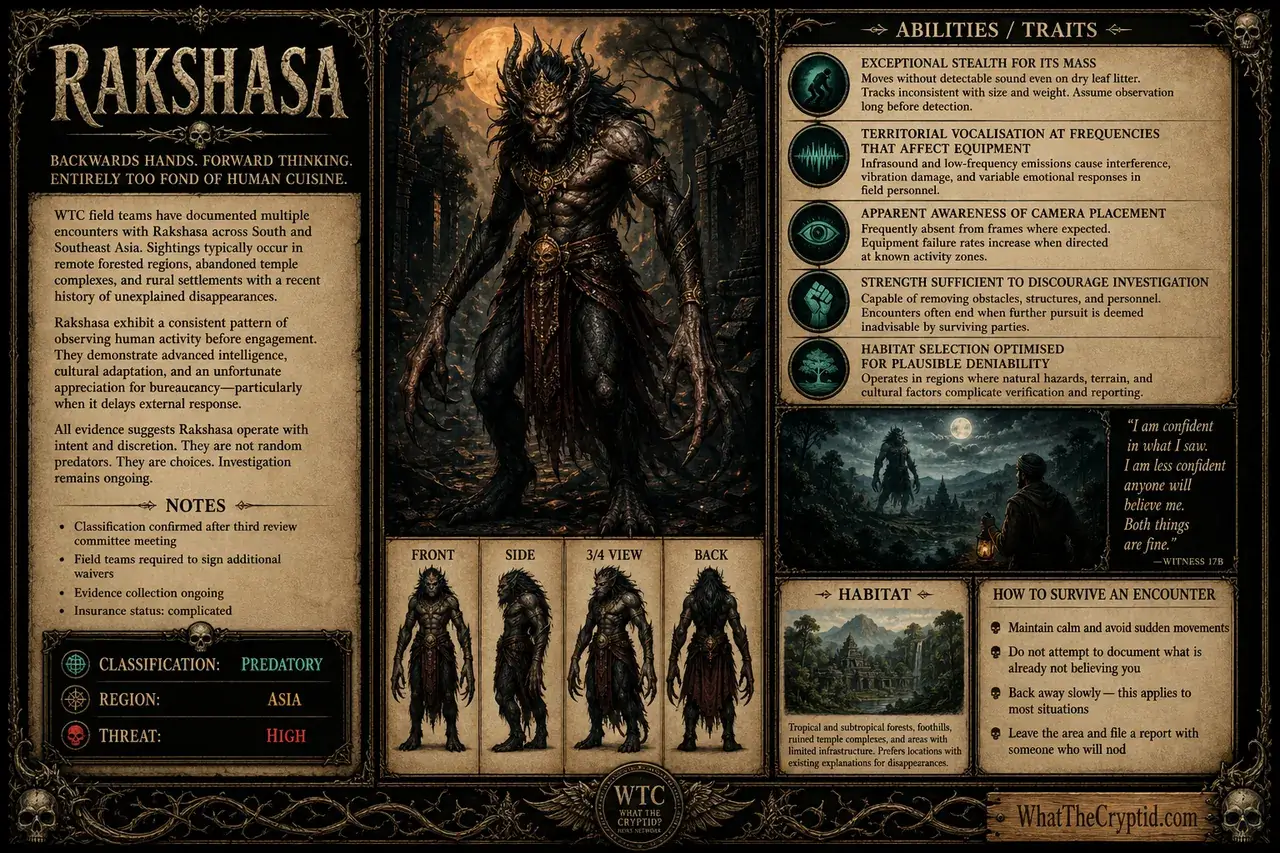
The Rakshasa does not maintain a consistent appearance, which represents the central methodological challenge for WTC documentation purposes. Accounts across multiple traditions describe a default or ‘resting’ form — when the entity is not actively impersonating something else — as large, typically in excess of seven feet in height, with skin tones documented across a range including dark red, black, and deep green. The build is described as heavily muscular with disproportionately large hands, and the face consistently features prominent tusks, copper-coloured eyes described as emitting their own dim illumination, and hair described in Sanskrit sources as ‘like a flame,’ which has been interpreted by different researchers as referring to colour, texture, or an actual thermal phenomenon depending on their level of prior experience with the subject.
The Rakshasi — the documented female variant — presents with equal capability but is described in primary sources as employing a more varied range of assumed forms, with a preference for appearing as beautiful women in circumstances where this is strategically advantageous. The female variant is noted in several accounts as being marginally more patient in its operational approach, which field researchers have been asked to treat as a distinction without a meaningful practical difference. Regional variants in Indonesia and Malaysia, documented as Raksasa, trend larger in reported physical dimensions, with some Javanese accounts describing entities exceeding nine feet in the unassumed form, though these figures have not been independently verified and our consulting anthropometrist has asked to be removed from this project.
In assumed human form, the Rakshasa is described as almost indistinguishable from a natural human, with two historically documented tells: a reluctance to cast a shadow consistent with the assumed form’s size, and the eyes, which several sources describe as retaining their copper luminescence regardless of the form being worn. Neither of these diagnostic criteria is easy to verify in the field without drawing the kind of attention that field researchers are specifically advised to avoid.
Behaviour & Temperament
The Rakshasa operates primarily between dusk and dawn, with the highest documented activity during what Sanskrit sources describe as the ‘raksha hour’ — the period between midnight and two in the morning, which aligns with the period WTC field teams have independently identified as ‘the part of the shift nobody volunteers for.’ During daylight hours the entity is documented as significantly reduced in capability, though ‘reduced’ in this context is relative to a baseline that already merits an Extreme threat rating, and should not be interpreted as an invitation to relax. The entity is capable of remaining stationary and apparently dormant for extended periods, which accounts for the irregular gap between sighting clusters in any given region.
Socially, the Rakshasa is documented as existing in structured hierarchies — the Ramayana alone catalogs a Rakshasa military with identifiable command structure, logistics, and at least one siege engineer — but contemporary sightings most commonly involve solitary individuals, suggesting either that large organised groups have become less common or that their organisational capacity has simply improved. The entity is noted across multiple sources as highly intelligent, capable of long-term planning, and possessed of genuine magical capability including the ability to make itself invisible, to duplicate the appearance of specific known individuals, and to create sensory illusions indistinguishable from reality. WTC has tabled the question of how to document behaviour that includes the capacity to prevent documentation.
Perhaps the most operationally significant behavioural trait is the Rakshasa’s noted interest in sacred ritual — specifically its documented practice of disrupting religious ceremonies, contaminating food at communal gatherings, and assuming the forms of revered figures to undermine trust in communities. This is not random chaos. Observers across multiple traditions describe a clear strategic logic: the Rakshasa appears to prefer conditions of social fragmentation, distrust, and isolation. The entity is, in the assessment of WTC’s senior researcher on South Asian entities, ‘working toward something.’ She declined to specify what.
Habitat & Territory
The Rakshasa’s preferred habitat across primary documentation is dense forest at the margins of human settlement — close enough to access human populations, far enough to retreat to defensible terrain. The Dandaka Forest features prominently in Ramayana accounts as a Rakshasa stronghold, and contemporary reports from forested regions of central and southern India, Sri Lanka, and the Indonesian archipelago follow a similar pattern: sightings cluster near forest edges, along established travel routes, and in areas where human activity is regular but not constant. The entity does not appear to prefer genuine wilderness; it prefers proximity to humans, which is a habitat preference WTC has found it prudent to note prominently.
The island of Lanka — identified with Sri Lanka in most scholarly traditions — is documented as the site of a major Rakshasa population center in the Ramayana period, and WTC notes that Sri Lanka continues to generate sighting reports at a rate disproportionate to its land area relative to the broader regional average. Whether this represents a genuine population concentration or simply a regional reporting culture that takes the subject seriously is a question WTC researchers disagree on, sometimes quite loudly, during editorial meetings.
Diet & Hunting
The Rakshasa is documented across all primary sources as a consumer of human flesh, and WTC presents this information plainly because it is what the evidence supports. The entity is described in Vedic texts as haunting cremation grounds and consuming the dead, which several researchers have interpreted as a less threatening dietary habit until cross-referencing with accounts that make clear the Rakshasa is not exclusively interested in waiting. Primary sources describe an active preference for freshly killed prey and a particular interest in disrupting food preparation in human settlements — an interest that serves the dual purpose of contaminating the food supply and accessing a reliable source of protein in a format that requires minimal additional effort.
Secondary dietary documentation includes accounts of the Rakshasa consuming livestock, wild game, and what Sanskrit sources describe as ‘anything living’ during periods of insufficient human contact, suggesting a degree of dietary flexibility that has allowed the entity to persist across millennia of changing human settlement patterns. One detail noted in the Mahabharata — that certain Rakshasas maintain preferred prey types based on individual taste, with some showing a documented preference for warriors, priests, or merchants — has not been replicated in contemporary field data, though WTC acknowledges this may reflect a decline in occupational category specificity rather than a change in the underlying behaviour.
Notable Sightings
A forestry survey team of six encountered an entity at approximately 1:15 AM while conducting a night census of wildlife near the Indravati River. Team leader Priya Subramaniam reported a figure of approximately seven to eight feet standing at the tree line, described as ‘too large and too still’ before it stepped back into the forest. Three members of the team noted that no animal sounds occurred in the surrounding area for the eleven minutes prior to the sighting — a detail Subramaniam recorded in the official wildlife survey log under ‘acoustic anomaly, cause undetermined.’ The survey report was filed with the state forestry department. Night census operations in that grid section were subsequently reassigned to satellite monitoring.
A temple caretaker named Bandara Wijekoon reported an incident in which a visitor to the temple grounds — a man he had spoken with briefly and described as unremarkable in appearance — was observed by Wijekoon from a window to cast no shadow during a period of direct afternoon sunlight. Wijekoon noted the visitor had given a name that matched that of a local official who, when contacted, confirmed he had not visited the temple that week. CCTV footage from the temple’s single operational camera showed no footage from the relevant forty-minute window due to what the system log recorded as a storage write error. Wijekoon submitted his account to the temple’s administrative board and has not accepted solo caretaking shifts since.
Workers at a palm oil processing facility near the Mahakam River reported a series of incidents over a three-week period in which food stores were contaminated on four separate occasions — twice with substances that could not be identified by the regional health authority — and in which one worker, Hendra Santoso, reported being approached at the perimeter fence at 2 AM by a figure he initially took to be a colleague before noting that the figure’s eyes ‘were the wrong colour, like a lamp.’ Santoso retreated to the facility interior and the figure was not seen again that night. The facility management attributed the contamination incidents to inadequate storage procedures and the visual report to fatigue. The storage procedures were updated. The perimeter lighting budget was also, quietly, doubled.
During a religious festival, a priest named Jagannath Mishra reported that the ceremonial offerings were found disturbed on three consecutive nights despite the sanctum being secured each evening. On the third night, Mishra stationed himself inside the sanctum and reported hearing movement and what he described as the sound of something eating ‘with considerable appetite.’ He did not open the inner door. In the morning the offerings were again disturbed, and a set of handprints approximately twice the width of an adult human hand had been pressed into the soft clay floor near the offering vessel. The handprints were documented by the temple’s senior priest, preserved in photographs that have since been lost to a filing system reorganisation, and the incident was recorded in the temple’s administrative log as ‘ritual contamination, source unknown.’
Threat Assessment
WTC assigns the Rakshasa an Extreme threat rating, which is the highest category in our framework and which we use with some reluctance given the documentation implications. The primary risk factors are the entity’s shapeshifting capability, its documented intelligence, its apparent capacity for sustained planning, and its dietary preferences, in roughly that order of operational concern. The shapeshifting capability is specifically noted as the primary threat multiplier because it means that standard field protocols — maintain visual contact, note distinguishing features, document with photography — are not reliable countermeasures against an entity that can change its distinguishing features and has shown documented interest in causing equipment malfunctions.
WTC’s recommended approach is to avoid primary habitat zones after dark, to not accept food or drink offered by individuals encountered in isolated areas who you did not arrive with, and to maintain at least thirty meters of distance from any figure that does not cast a shadow consistent with the available light. If direct encounter occurs, primary sources across multiple traditions consistently recommend recitation of protective mantras, the use of specific ritual objects, and the invocation of divine authority — recommendations WTC cannot clinically validate but notes have three thousand years of field testing behind them, which is more than can be said for most of our equipment. We acknowledge that this threat assessment section is less actionable than we would prefer, and we have documented this limitation for the purposes of our next budget review.
WTC Field Notes
WTC has maintained an active file on Rakshasa entities for eleven years, making it one of our longer-running open investigations and, by the assessment of our operations coordinator, ‘one of the more expensive ones per confirmed photograph, which is currently zero.’ The primary research challenge is not a lack of documentation — the Rakshasa is among the most extensively documented entities in any mythology globally — but rather the difficulty of establishing what WTC’s editorial standards define as ‘contemporary field evidence,’ a threshold that the entity’s capabilities make structurally difficult to meet. Our senior researcher on South Asian entities, Dr. Ananya Krishnamurthy, has submitted four formal requests to expand the definition of admissible evidence to include accounts from trained observers such as the forestry and temple personnel recorded in our sightings database. The editorial board has those requests under review. Dr. Krishnamurthy has noted, in writing, that the review process has now taken longer than the average gap between verified sighting clusters, a point the editorial board found ‘salient but procedurally complex.’
WTC deployed a two-person field team to Chhattisgarh in 2021 with thermal imaging equipment, audio recording apparatus, and a research itinerary that had received full risk assessment sign-off. The thermal camera experienced a sensor failure on night two that the manufacturer described as ‘consistent with sustained exposure to a heat source in excess of operating parameters,’ which the team noted was interesting given that they had not been near any heat sources. The audio recorder functioned correctly and captured forty-three minutes of ambient forest sound followed by eight minutes of what the team described as ‘something large moving in a direction that suggested it knew where we were’ and then silence. The recording is in the WTC archive. A follow-up deployment has been proposed. The insurance underwriter has not yet responded, which our operations coordinator describes as ‘itself a form of response.’