Ogo Pogo
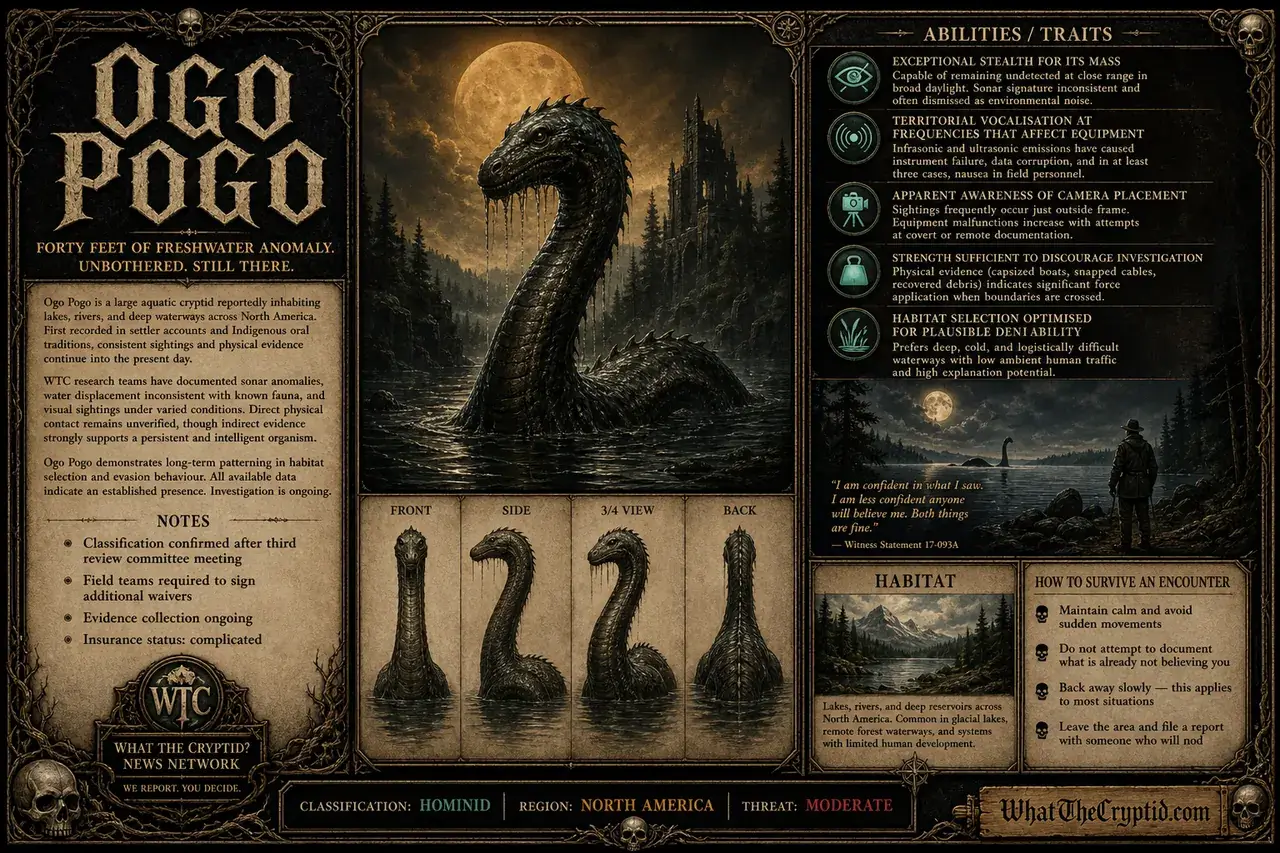
Forty feet of freshwater anomaly. Unbothered. Still there.
North America
Active
AquaticCanadaLake MonsterIndigenous TraditionOkanagan
Overview
Ogopogo is a large aquatic entity reported to inhabit Okanagan Lake in British Columbia, Canada, where it has been observed with a consistency and frequency that distinguishes it from the majority of cryptids in the WTC database. With documented sightings spanning more than a century of European settlement in the region, and an oral tradition among the Syilx Okanagan people extending considerably further, Ogopogo occupies an unusual position: a cryptid for which the absence of physical evidence is, at this point, itself a data point worth examining.
Described consistently as a large, serpentine or multi-humped creature navigating a lake that is 84 miles long, up to 761 feet deep, and cold enough to preserve organic material for extended periods, Ogopogo demonstrates what WTC researchers have come to call ‘optimal obscurity conditions.’ The lake provides sufficient volume, depth, and thermal stratification to theoretically conceal a large vertebrate indefinitely, a fact that our consulting marine biologist noted before clarifying that this was not the same as saying it does.

The entity’s profile is sufficiently established that the municipality of West Kelowna erected a permanent roadside statue in its honour in 1980, which continues to attract tourists. WTC considers this level of institutional acknowledgement to be, if not confirmatory, at least administratively interesting.
History & Mythology
The Syilx Okanagan people, the original inhabitants of the Okanagan Valley, have maintained detailed accounts of a creature they call N’ha-a-itk, meaning ‘sacred creature of the water’ or, in some translations, ‘lake demon,’ depending on which academic you consult and how their relationship with the source community has developed. N’ha-a-itk was understood to be a genuine resident of the lake, not a metaphorical one, and was treated with corresponding caution. Offerings were historically made before crossing the lake, particularly near Rattlesnake Island — known in the oral tradition as the creature’s home — a practice that WTC notes reflected either sincere reverence, documented risk management, or both.
The first recorded European-settlement-era sighting is generally attributed to 1872, when John McDougall reported his horses being dragged beneath the surface while swimming them across the lake. McDougall survived by cutting the horses loose, which represents either a tragic loss of livestock or a remarkably practical response to an encounter with a large unknown predator, depending on how one reads the account. The name ‘Ogopogo’ itself appears to have been introduced at a 1926 Rotary Club meeting in Vernon, derived from a British music-hall song, a fact that the Syilx community and several WTC researchers have noted with varying degrees of pointed silence.
Throughout the mid-twentieth century, sightings multiplied in frequency and witness count, with several incidents involving multiple independent observers on separate shores of the lake reporting simultaneous observations. A 1968 incident produced 8mm film footage, subsequently analysed by investigators who reached conclusions ranging from ‘indeterminate biological object’ to ‘large log,’ a spread of opinion that has characterised the evidentiary record ever since.
Physical Description
Witness accounts of Ogopogo are notable for their consistency across more than a century of independent reports, which is either compelling evidence of a genuine recurring entity or compelling evidence of how effectively a cultural template shapes perception. WTC presents the data and declines to resolve this question editorially.
The creature is most frequently described as serpentine or eel-like in overall body plan, ranging in estimated length from 15 to 50 feet, with the majority of credible multi-witness accounts clustering between 40 and 50 feet. The body is reported to be dark in coloration — described variously as dark green, dark brown, or black — with a texture witnesses have compared to a whale, a large snake, or, in three separate accounts from different decades, a sea cucumber, a detail WTC has not been able to fully contextualize. A horse-like or goat-like head is among the more commonly reported features, which raises questions about convergent evolution that our consulting palaeontologist was willing to discuss at length but not on the record.
When moving at speed, the creature reportedly produces a distinctive series of vertical undulations creating a humped silhouette above the waterline, typically displaying between two and six visible loops. The wake produced is described as disproportionately large relative to surface observations, suggesting — if the accounts are taken at face value — that a significant portion of the body mass remains submerged during surface transits. No physical specimen, shed skin, bone, or biological sample has been recovered from Okanagan Lake that has been confirmed to originate from an unknown large vertebrate.
Behaviour & Temperament
Ogopogo is, by the behavioural record, a creature that appears largely indifferent to human presence. The overwhelming majority of sightings describe an entity moving purposefully through the water — typically in a north-south orientation consistent with the lake’s primary axis — that acknowledges observers, if at all, only by submerging when approached. This response pattern, a brief surface appearance followed by unhurried departure, has led WTC researchers to characterise Ogopogo’s relationship with human witnesses as ‘professionally courteous but not interested in further engagement.’
Seasonal surface activity appears to peak between June and October, corresponding with both warmer surface temperatures and higher recreational boat traffic on the lake. Whether the correlation between tourist season and sighting frequency reflects genuine behavioural patterns in the entity or genuine behavioural patterns in the observers is a question WTC has tabled for a later meeting. Winter sightings exist in the record but are substantially fewer, which is consistent with either reduced surface activity in colder months or reduced surface activity in the observer population.
The 1872 incident involving John McDougall’s horses represents the most dramatically aggressive behaviour in the documented record, and it has not been reliably replicated in the subsequent 150 years of encounters. Current observer accounts describe no aggressive approaches toward watercraft, swimmers, or shoreline observers. WTC notes this as a positive development while acknowledging that the horse incident was not submitted for peer review.
Habitat & Territory
Ogopogo is understood to be a permanent resident of Okanagan Lake, a glacially carved fjord-like body of water in the interior of British Columbia, Canada, situated at an elevation of approximately 1,122 feet above sea level. The lake’s dimensions — 84 miles in length, between 2.5 and 5 miles in width, and reaching depths of up to 761 feet — provide a habitat volume of approximately 1.6 cubic miles of freshwater, which our consulting aquatic ecologist confirmed was ‘more than sufficient concealment capacity for one or several large organisms, hypothetically speaking.’
Rattlesnake Island, located near the community of Peachland in the southern portion of the lake, is consistently identified across both indigenous oral tradition and modern sighting records as the entity’s primary territorial anchor. The lake’s significant thermal stratification, with cold hypolimnion layers beginning below approximately 65 feet, theoretically supports a large cold-adapted organism year-round. The surrounding Okanagan Valley terrain, characterised by semi-arid benchland descending steeply to the water, provides clear sightlines from shore that have contributed to the quality of some documented observations, a fact that cuts in multiple evidentiary directions simultaneously.
Diet & Hunting
No direct hunting behaviour has been reliably documented for Ogopogo, which given the entity’s estimated body mass presents a nutritional logistics question that WTC has been unable to fully resolve. Okanagan Lake supports established populations of kokanee salmon, rainbow trout, lake whitefish, and several other species, representing a plausible dietary base for a large aquatic predator. If current size estimates are accurate, sustaining that body mass would require consistent and substantial caloric intake, the absence of observable evidence for which is either a tribute to the creature’s discretion or relevant to the broader question of its existence.
The 1872 account involving the submersion of McDougall’s horses suggests that, under at least historical conditions, the entity was capable of and apparently willing to engage prey considerably larger than fish. No comparable incidents involving large prey have been recorded in the modern observation period, which may reflect a genuine dietary shift, changes in available prey, or the simple fact that fewer horses are being swum across Okanagan Lake than in 1872. WTC researchers have found no evidence of unusual fish population anomalies in the lake that would indicate systematic large-predator depletion, which is either reassuring or inconclusive.
Notable Sightings
A group of approximately thirty passengers aboard a tourist vessel reported simultaneous observations of a large dark object moving through the water at an estimated speed of 15 to 20 knots, producing a wake described by the vessel’s captain as inconsistent with any watercraft he had observed on the lake. The object was visible for approximately four minutes before submerging without producing the surface disturbance typically associated with a dive. The captain filed a written account with the local chamber of commerce, which was the incident’s final institutional destination.
Art Folden, a local resident, captured approximately two minutes of 8mm film footage depicting a large, dark, animate object moving through the open water off Squally Point, producing lateral displacement consistent with a large submerged body. The footage was subsequently reviewed by investigators from the University of British Columbia, who characterised the object as a ‘large animate creature’ before several colleagues offered alternative assessments including ‘debris,’ ‘log,’ and ‘otters in formation,’ a phrase that Folden reportedly found unsatisfying. The original film has passed through several custodial arrangements, the current status of which WTC has been unable to confirm.
John Kirk and fellow members of the British Columbia Scientific Cryptozoology Club recorded video footage of an unidentified object on the lake surface described as 15 to 20 feet in visible length, dark in colour, and moving under apparent self-propulsion. The footage was analysed by a marine biologist consulted by the club, who provided a written statement characterising the movement pattern as ‘inconsistent with known debris behaviour’ before declining to make a more specific identification. Kirk submitted the footage to three additional academic consultants over the following eighteen months, all of whom reached conclusions ranging across a comparable spectrum without convergence.
Richard Huls, driving along Highway 97 on the lake’s western shore, recorded approximately 75 seconds of video on a mobile device depicting what he described as a large, dark, segmented form moving parallel to the shoreline at an estimated distance of 50 to 75 yards. The footage attracted international media attention within 48 hours of posting, was subsequently reviewed by a marine biologist appearing on a Canadian news programme who assessed it as ‘a very large sturgeon or an unknown species,’ and was counter-assessed by a physicist on the same programme as ‘wave interference on a moving watercraft wake.’ Huls stated in his final interview on the subject that he was confident in what he had seen and was available for further questions. No further questions were submitted.
Threat Assessment
Based on the available observation record, Ogopogo presents a moderate and largely contextual risk to humans in or on Okanagan Lake. The entity’s consistent behaviour of avoiding prolonged surface exposure and departing when approached suggests it does not actively target human observers. However, the 1872 incident involving the apparent submersion of swimming horses indicates that the entity is physically capable of engaging with large objects in the water, and WTC recommends that this capability be factored into recreational planning on the lake.
WTC advises against swimming alone in open water sections of Okanagan Lake, particularly in the vicinity of Rattlesnake Island, not because an attack is considered probable but because open water swimming alone in a 761-foot-deep glacial lake is inadvisable on general principles that do not require a cryptid for justification. Boaters should maintain awareness of unusual wake or surface disturbance that cannot be attributed to other vessels. WTC’s standard recommended response to surface observation of the entity is to remain in the boat, maintain current position, and document with whatever equipment is available. Attempting to approach the entity by watercraft is not recommended, not because it is dangerous but because, based on the complete observation record, it will not produce a useful outcome. WTC acknowledges that its threat assessment in this case rests substantially on the entity’s consistent good behaviour over 150 years, which is not the same as a guarantee.
WTC Field Notes
WTC has maintained an active file on Ogopogo since the network’s founding, and the Okanagan case represents both our most extensively documented ongoing subject and our most persistent evidentiary frustration. A 2019 field deployment to the lake involved two researchers, a hydrophone array borrowed from a university marine science programme under terms WTC’s legal team described as ‘generous and time-limited,’ and a research vessel chartered for ten days. The hydrophone array recorded 34 hours of anomalous low-frequency acoustic events that our consulting acoustician characterised as ‘biologically plausible in origin and not attributable to the vessel or known lake fauna,’ a finding that has been in editorial review for considerably longer than originally anticipated.
The Ogopogo file is, internally, a subject of some ongoing discussion at WTC regarding appropriate resource allocation. The lake is large, the subject is elusive, and the equipment budget for a follow-up deployment has now been reallocated twice, most recently to cover costs associated with an unrelated incident in Manitoba that we are not yet able to discuss publicly. Our British Columbia field correspondent continues to file regular observation logs from the Highway 97 corridor. We consider the case open. We consider the lake, by all reasonable measures, worth watching.