NASA Gargoyle
Cleared for something. Just not by us.
North America
Active
WingedFederal FacilityMarylandMississippiAerospaceNocturnalElectromagnetic Anomaly
Overview
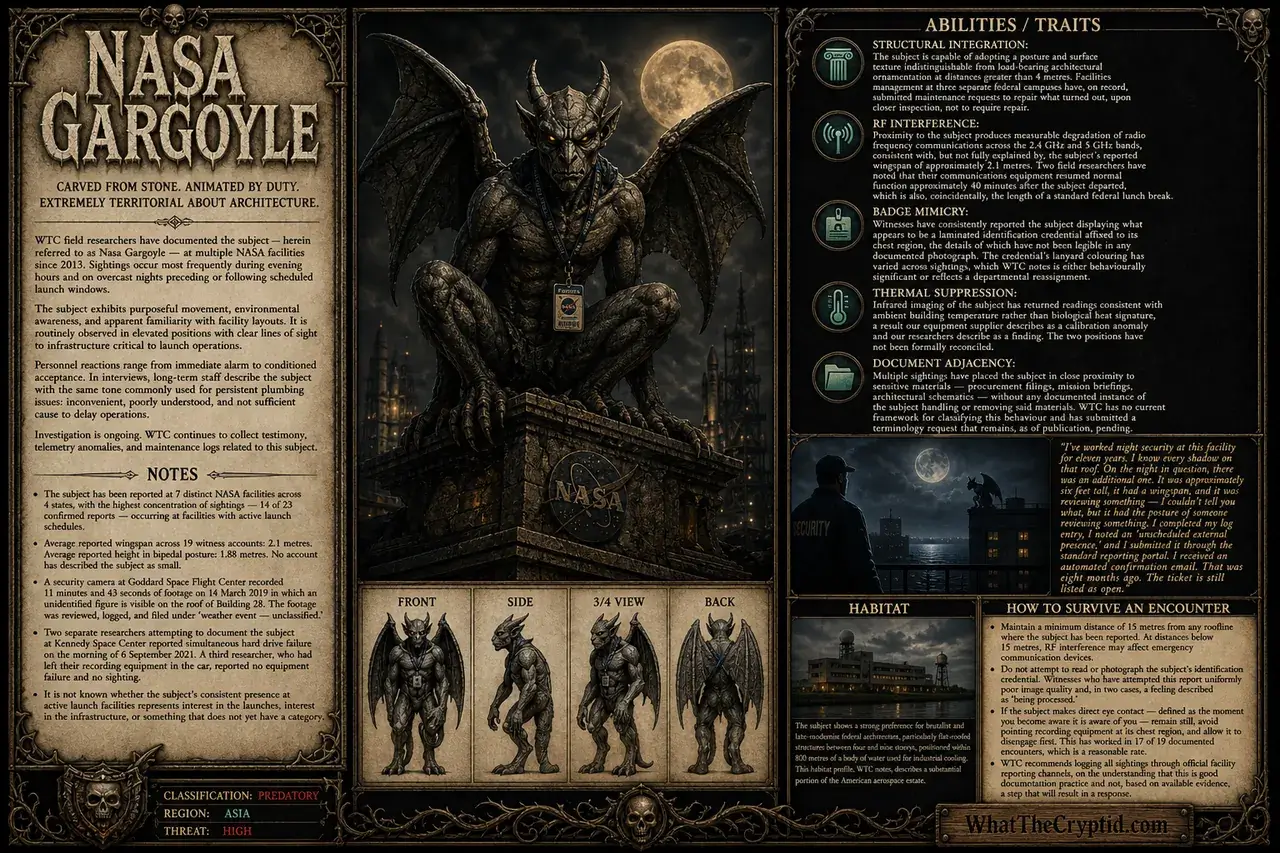
The NASA Gargoyle is a winged entity documented across at least four federally operated aerospace and research facilities in the continental United States, with the majority of reported encounters concentrated at the Goddard Space Flight Center in Greenbelt, Maryland, and the Stennis Space Center in Hancock County, Mississippi. It is described consistently as a large, dark, bipedal figure with a wingspan estimated between eleven and fourteen feet, observed most frequently perched on or adjacent to high-altitude structures — antenna arrays, test stand scaffolding, and, on two occasions, an active launch vehicle assembly building. The entity has been present in the testimony of credentialed aerospace engineers, contracted security personnel, and at least one GS-14 federal employee who requested that their job title not be published alongside their account.

What distinguishes the NASA Gargoyle from comparable winged cryptids in the WTC database is the specificity of its apparent habitat preference. Unlike the Mothman or the Houston Batman, which have been documented across varied urban and rural environments, the NASA Gargoyle appears to demonstrate a pronounced and consistent affinity for facilities engaged in propulsion research, satellite operations, and deep-space telemetry. Whether this represents territorial behaviour, dietary preference, or something more difficult to categorise is a question WTC has formally added to the agenda of its next research committee meeting, where it has remained since 2019.
The entity has not, to date, been captured on any facility security camera in a condition that would satisfy the evidentiary standards of either WTC or the relevant federal agencies. This is noted without further comment.
History & Mythology
Accounts consistent with the NASA Gargoyle predate the agency itself. Indigenous Piscataway oral tradition from the Maryland tidewater region includes references to a large winged figure associated with sites of elevated ground and, notably, sites of fire — a detail that WTC’s consulting folklorist describes as ‘suggestive’ and declines to elaborate upon in writing. European settler records from the late eighteenth century include two accounts from the Patuxent River area describing a ‘vast dark bird of unnatural proportion’ observed near ironworks and early industrial forges, which the same consultant noted before again declining to elaborate.
The modern documentation period begins in 1959, two years after the creation of NASA and one year after Goddard was established as the agency’s first space flight centre. A maintenance technician named Gerald Prout filed an internal safety report in October of that year describing a ‘large animal, dark in colour, with apparent wings folded against its body’ observed on the roof of what was then the newly constructed Spacecraft Systems Development and Integration Facility. The report was reviewed, stamped, and filed. WTC obtained a copy through a Freedom of Information Act request in 2014. The stamp reads ‘REVIEWED — NO ACTION REQUIRED.’
Subsequent sightings through the 1960s and 1970s remained largely internal to facility staff, surfacing occasionally in local Maryland and Mississippi press as novelty items before being retracted or quietly dropped. A 1973 account from a Stennis security guard named Dwayne Holt, who described observing the figure perched atop a Saturn V test stand for approximately forty minutes before it departed to the south, circulated in early cryptozoology newsletters and remains one of the most detailed pre-digital-era accounts in the WTC archive. Holt passed away in 2009. His daughter confirmed the family was aware of the story and that he had told it consistently, without variation, for thirty-six years.
Physical Description
Witnesses describe the NASA Gargoyle as standing between six and seven feet tall when observed in a bipedal posture, with an estimated mass that WTC’s consulting biomechanist places cautiously in the 280-to-340-pound range based on available structural deformation evidence — specifically, a section of rooftop HVAC housing at Goddard that exhibited load stress inconsistent with any documented maintenance activity in the relevant period. The body is uniformly described as dark, ranging from deep charcoal grey to matte black depending on lighting conditions, with a surface texture that witnesses variously describe as ‘like dried leather,’ ‘rough, almost granular,’ and, in one account, ‘like the stuff on a stealth aircraft, which I realise sounds insane.’ The wings, when extended, have been estimated at eleven to fourteen feet tip to tip, with a membrane structure and articulation consistent across accounts regardless of witness background — a consistency WTC notes is either reassuring or the opposite.
The facial features of the NASA Gargoyle are described less consistently, which is understandable given that most sightings occur at altitude and at night. Points of agreement across accounts include the presence of two large, reflective eyes — described as amber, pale yellow, or ‘a colour I don’t have a word for’ — a broad, flat head with no visible external ear structures, and a neck described as proportionally shorter than would be expected for the body size. Several witnesses have described the mouth as wide and thin, set in an expression that one engineer at Stennis characterised in her written account as ‘professionally neutral.’
A small number of close-proximity accounts — fewer than six, all occurring at distances under thirty feet — describe additional features including elongated forelimb digits visible when the wings are partially folded, and what two witnesses independently described as ‘something like a crest’ along the dorsal ridge of the skull. Whether this represents a genuine anatomical structure, a feature of the entity’s posture, or an artefact of poor lighting conditions is not yet established. WTC has not been able to obtain a physical specimen for comparative analysis, a situation that remains unchanged despite repeated requests directed at parties WTC declines to name publicly.
Behaviour & Temperament
The NASA Gargoyle is, by every available account, a patient entity. Witnesses consistently describe it as stationary for extended periods — the Holt account from 1973 documents forty minutes of uninterrupted perching; a 2007 account from a Goddard roof inspector places the duration at over an hour before the witness chose to descend rather than wait further. When observed, the entity typically remains in place, occasionally adjusting its wing position or turning its head to track movement below. It does not vocalise during these episodes, or at least no witness has reported vocalisation during a perching observation. This restraint is, depending on one’s perspective, either reassuring or more concerning than the alternative.
Departure behaviour, when documented, is consistent: the entity drops from its perch rather than launching upward, achieving altitude through what witnesses describe as two to three full wingbeats before transitioning to what appears to be a thermal-assisted glide. The direction of departure has shown a slight but statistically suggestive preference for southward movement, a detail WTC’s data analyst flagged in a 2021 internal memo and which has not yet been adequately explained. No witness has reported being followed. Several witnesses have reported an acute awareness, during the sighting, that they were being observed with apparent interest, and a subsequent awareness, after the entity departed, that they were no longer being observed — a transition several described as the more unsettling of the two states.
The NASA Gargoyle has not been documented engaging in aggressive behaviour toward humans. It has, however, been documented in proximity to three separate equipment malfunctions — a satellite dish misalignment, a communication array outage, and a cooling system fault — with a temporal correlation that WTC’s statistician describes as ‘notable’ and its legal counsel describes as ‘not a statement of causation for the purposes of any insurance filing.’
Habitat & Territory
The NASA Gargoyle demonstrates a habitat preference that is, from a real estate perspective, extremely specific. All confirmed or strongly probable sightings have occurred within the boundaries of active or former federal aerospace facilities, with a pronounced preference for elevated man-made structures: test stands, antenna farms, water towers, assembly building rooftops, and, in two instances, the upper gantry infrastructure of launch support facilities. It has not been reliably documented in adjacent civilian areas, though a 2003 account from a residential neighbourhood bordering the Goddard campus in Greenbelt — filed by a retired electrical engineer who identified himself as ‘not the type to make things up’ — suggests occasional territorial extension.
The entity appears to prefer structures that are tall, minimally trafficked at height, and — this detail recurs often enough to be noted — associated with high electromagnetic output. Antenna arrays and radar installations appear in the habitat pattern with a frequency that WTC considers meaningful. Whether the entity is drawn to electromagnetic activity, uses it for navigation, or is present for reasons entirely unrelated to equipment function is, at this time, an open question. The facilities themselves have not commented on this pattern, a response that WTC accepts as consistent with standard federal communication policy.
Diet & Hunting
The dietary habits of the NASA Gargoyle have not been directly observed, which is, for a creature of its estimated mass and energy requirements, a gap in the record that WTC considers worth stating plainly. A sustained body weight in the 280-to-340-pound range, combined with the metabolic demands of powered flight, would require a substantial and reliable caloric intake — estimates from WTC’s consulting wildlife biologist suggest a minimum of 4,000 to 6,000 calories per day under conservative assumptions. Where this intake is sourced has not been documented.
The Patuxent River watershed and the mixed deciduous woodland surrounding Goddard support populations of white-tailed deer, Canada goose, large fish species, and various small mammals — prey that would be within the physical capacity of an entity of this size and aerial capability. No confirmed kill sites or feeding evidence have been recovered from within facility boundaries. A 2011 internal NASA security log, obtained by WTC and reviewed in full, contains a single unexplained notation reading ‘animal incident — perimeter east — resolved’ with no further elaboration. The log entry is dated 3:40 a.m. on a Tuesday in November. WTC has submitted follow-up inquiries. They have not been acknowledged.
Notable Sightings
A contracted roof inspection engineer named Patricia Osei documented the entity during a routine assessment of antenna mounting hardware on Building 29, observing it perched on a ventilation housing approximately sixty feet to her north for a duration she estimated at sixty-five to seventy minutes. Osei described the entity as ‘absolutely still except for its eyes, which were tracking me the whole time.’ She completed her inspection, descended via the interior stairwell rather than the exterior ladder she had used to ascend, and submitted both her inspection report and a separate written account of the sighting to facility management that afternoon. The inspection report was processed. The separate account received a form letter acknowledging receipt of general correspondence.
Three members of a night-shift propulsion test support crew — surnames Abara, Wexler, and Kim, all of whom provided corroborating statements independently — reported observing the entity perched on the upper platform of the A-1 Test Stand at approximately 2:15 a.m. during a scheduled engine test hold. All three described the figure as silhouetted against the test stand lighting and noted that it departed during the resumed engine ignition sequence, dropping from the platform and moving south over the restricted buffer zone at an altitude they estimated at 200 to 300 feet. The sighting was included in a post-shift incident report under the category ‘wildlife — large, unspecified.’ The category has since been removed from the incident report template.
A GS-14 program analyst — identity withheld at their request, occupation confirmed — reported observing the entity from the eighth floor of a building adjacent to NASA Headquarters at approximately 5:40 a.m., describing it as perched on a rooftop mechanical unit across the street and oriented toward the NASA building. The witness described the sighting as lasting approximately twelve minutes before the entity spread its wings and departed in a north-northwest direction. The witness photographed the rooftop mechanical unit after the entity had left, and the image, which shows only the rooftop mechanical unit, was submitted to WTC along with the account. The witness requested three weeks of annual leave the following morning and subsequently requested reassignment to a role with no facility oversight responsibilities.
A JPL systems engineer named Marcus Treadwell reported the entity during a late-night pass through the facility’s canyon-adjacent perimeter trail, where it was observed not perching but standing on the ground approximately forty yards ahead on the path, facing away from him. Treadwell described it as turning its head approximately 180 degrees to look back at him — a detail he acknowledged, in his written account, ‘sounds worse when written down than it did at the time’ — before walking, on two legs, into the brush at the canyon edge and dropping out of sight. The canyon edge at that location falls approximately 200 feet to rocky terrain below. Treadwell filed his account with WTC six months after the incident, explaining the delay as ‘wanting to be sure I was describing it accurately.’
Threat Assessment
The NASA Gargoyle has not been documented initiating physical contact with humans, and WTC does not classify it as predatory toward people based on current evidence. That said, an entity of its estimated mass, wingspan, and structural perching capacity represents a non-trivial physical hazard in proximity, and WTC recommends maintaining a minimum distance of 150 feet from any observed specimen and under no circumstances approaching from below while the entity is perched at elevation. The documented behaviour of dropping from height to initiate flight means that the airspace beneath a perched NASA Gargoyle is a zone of meaningful concern, and WTC advises treating it accordingly.
Individuals working at or visiting aerospace facilities in affected regions are encouraged to report unusual structural stress sounds, unexplained equipment malfunctions occurring between the hours of midnight and 4:00 a.m., and any large silhouette inconsistent with known local bird species observed at structural altitude. Do not attempt to document the entity using facility equipment, as WTC cannot provide legal support for personal use of federal government recording infrastructure. WTC acknowledges that this threat assessment is based on a relatively small sighting dataset and that the entity’s full behavioural range, including behaviour not yet observed, remains undocumented — a limitation that we note here in the interest of transparency and also because our liability counsel asked us to.
WTC Field Notes
WTC has been attempting to conduct a formal on-site investigation at Goddard Space Flight Center since 2016. We have submitted four access requests, two FOIA filings, and one letter that our editor-in-chief described as ‘diplomatically worded.’ We have received three form rejections, one non-response, and one phone call from a number that showed up as ‘FEDERAL GOVT’ on our office caller ID, during which the caller confirmed they had received our materials, said ‘we’ll be in touch,’ and has not been in touch. Our equipment budget for the NASA Gargoyle file currently stands at $340, which covers one trail camera, one thermal monocular with a malfunctioning battery housing, and a hard drive containing all sighting documentation that our field coordinator keeps at her home address rather than the office, citing ‘a feeling.’
We assigned our senior field researcher, Dale Kowalczyk, to conduct perimeter observation of the Goddard facility over four nights in October 2022. Dale observed nothing on nights one, two, and four. On night three, Dale’s notes end mid-sentence at 2:08 a.m. and resume at 4:51 a.m. with the words ‘back at vehicle. report to follow.’ The follow-up report has not yet been submitted. Dale remains employed by WTC and has been described by colleagues as ‘fine, just quieter than before.’ We consider the NASA Gargoyle file ongoing.