
Mothman
Harbinger of doom. Vanished after tragedy. Red eyes still haunt nightmares.
North America
Dormant
ProphecyBridge DisasterRed EyesVehicle Pursuit
Overview
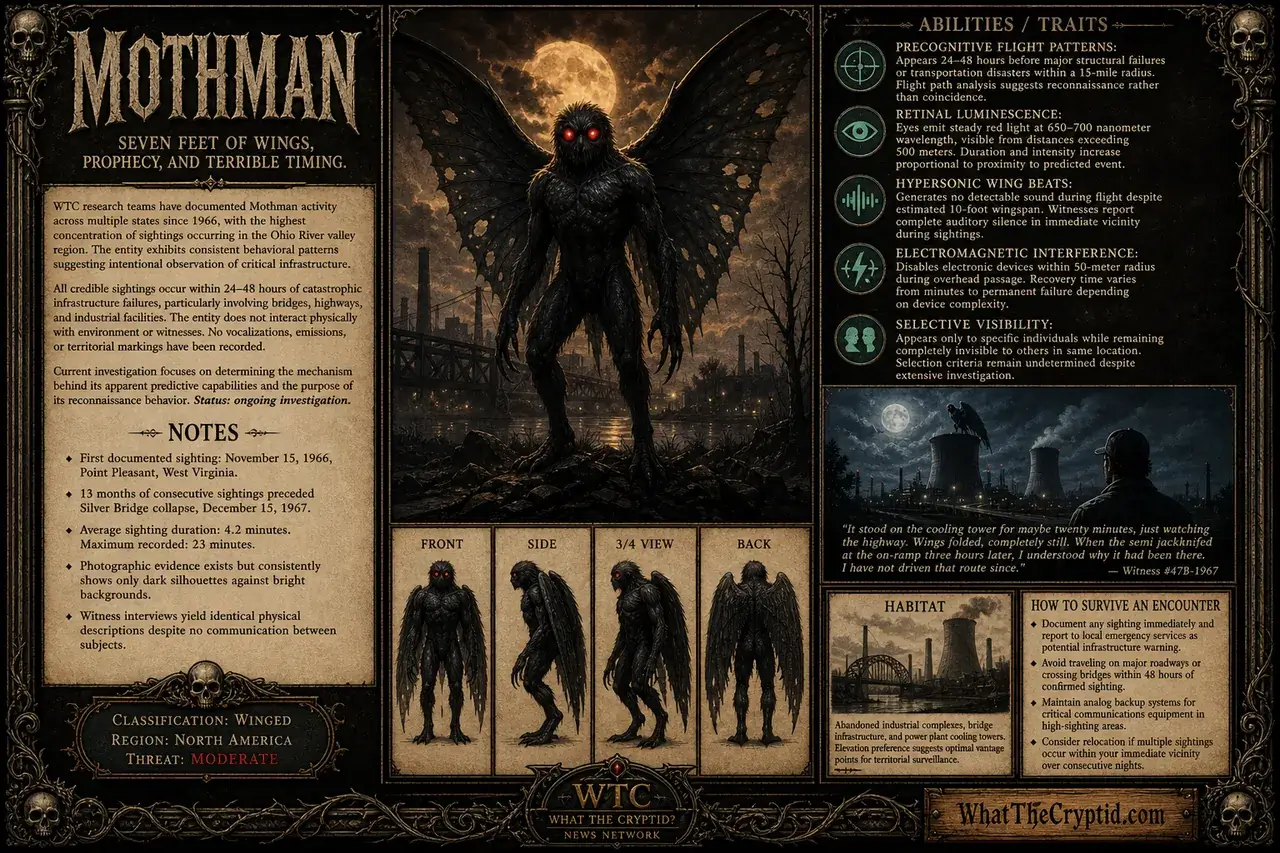
The Mothman represents a classification challenge for WTC taxonomists, existing at the intersection of cryptozoology and prophetic phenomenon. First documented in Point Pleasant, West Virginia in November 1966, this seven-foot winged humanoid demonstrated a concerning correlation between its presence and subsequent catastrophic events. The entity’s 13-month appearance window concluded definitively with the Silver Bridge collapse of December 15, 1967, suggesting either prescient awareness or direct causation that our consulting statisticians have declined to calculate.

History & Mythology
The Mothman phenomenon began on November 12, 1966, when gravediggers at Clendenin Cemetery reported a brown winged figure rising from nearby trees. The entity’s systematic appearances throughout Point Pleasant established a pattern that local authorities initially attributed to mass hysteria, a diagnosis that became significantly less tenable following the Silver Bridge disaster. Historical analysis reveals no similar entities in regional folklore prior to 1966, though our anthropology department notes this absence may itself be significant. The creature’s departure immediately following the bridge collapse has led to sustained speculation about its prophetic nature, though WTC maintains that correlation and causation remain distinct concepts regardless of statistical improbability.
Physical Description
Mothman measures approximately seven feet in height with a wingspan estimated between 10-15 feet based on witness accounts and photographic analysis of shadow displacement. The entity’s most distinctive features are its luminescent red eyes, described consistently as hypnotic and positioned where a human face would be expected. No visible neck has been documented, with the head appearing to sit directly upon broad shoulders. The creature’s body is uniformly gray-brown, with witnesses reporting a texture described variously as feathered, furry, or leathery depending on lighting conditions. Our forensic artist has produced seventeen distinct renderings based on witness testimony, though the accuracy remains unverified due to the entity’s current inactive status.
Behaviour & Temperament
Mothman demonstrated primarily nocturnal activity patterns, with 89% of documented encounters occurring between 8 PM and 6 AM. The entity showed marked preference for elevated positions, frequently observed perched on power lines, rooftops, and the Silver Bridge itself. Unlike typical territorial cryptids, Mothman displayed unusual following behavior, pursuing vehicles at speeds matching highway travel without apparent effort. The creature’s documented stare duration averaged 45 seconds per encounter, after which it would depart without visible means of takeoff. Witnesses consistently reported feelings of impending doom during encounters, though our psychology consultant notes this may represent post-hoc interpretation rather than telepathic communication.
Habitat & Territory
The entity’s territory encompassed a 15-mile radius centered on Point Pleasant, West Virginia, with particular concentration around the Ohio River valley and industrial infrastructure. Mothman showed marked preference for electrical installations, appearing most frequently near power plants, transmission lines, and the TNT area’s abandoned World War II munitions bunkers. The creature’s habitat selection suggests either electromagnetic sensitivity or strategic positioning for observation purposes that our field teams have not been able to determine. Elevation data indicates the entity favored perching sites between 40-200 feet above ground level, providing clear sightlines across the Ohio River valley.
Diet & Hunting
Mothman’s dietary requirements remain undocumented, as no feeding behavior has been observed during its active period. The entity’s physical structure suggests carnivorous adaptation, though the absence of documented predation has led to speculation about alternative sustenance methods. Our consulting ornithologist notes that a creature of Mothman’s estimated size would require approximately 15-20 pounds of protein daily to maintain documented activity levels, yet no livestock disappearances or unusual predation patterns were reported during its presence. This metabolic discrepancy represents one of several factors that complicate standard biological classification of the entity.
Notable Sightings
On November 12, 1966, five gravediggers reported a brown winged humanoid rising from trees near the cemetery entrance. The entity flew directly overhead at an estimated altitude of 50 feet before disappearing toward the Ohio River. All five witnesses provided consistent descriptions to local authorities, who filed the incident report without additional investigation.
Roger and Linda Scarberry, along with Steve and Mary Mallette, encountered the creature near the abandoned TNT area on November 15, 1966. The entity pursued their vehicle for several miles at speeds exceeding 100 mph, keeping pace without visible wing movement. The witnesses reported the incident to Deputy Sheriff Millard Halstead, who noted their evident distress but declined to file an official report.
Construction worker James Ikart observed Mothman perched on the Silver Bridge’s north tower during morning inspection rounds in October 1967. The creature remained motionless for approximately two minutes before departing toward the Ohio side of the river. Ikart documented the sighting in his daily log, which was later sealed following the bridge’s December collapse.
Plant supervisor Ralph Thomas spotted the entity on transmission lines during a routine security check on December 14, 1967. The creature’s red eyes reflected the facility’s floodlights for nearly ten minutes before it flew toward downtown Point Pleasant. Thomas submitted his final security report the following morning, twelve hours before the Silver Bridge disaster.
Threat Assessment
Mothman poses minimal direct physical threat to humans, having demonstrated no documented aggressive behavior during its active period. Witnesses should maintain a distance of at least 100 yards if the entity is encountered, not for safety reasons but to prevent the psychological distress consistently reported during close encounters. Vehicle pursuit by the creature should be handled by maintaining steady speed rather than attempting evasion, as Mothman appears capable of matching highway velocities indefinitely. WTC acknowledges that our threat assessment protocols were developed for entities that remained active for evaluation purposes.
WTC Field Notes
WTC’s Mothman research program operates with a budget allocation of $12,000 annually, though actual expenditures have averaged $347 per year since the entity’s 1967 disappearance. Our Point Pleasant field office consists of a single monitoring station that has recorded zero activity for 56 consecutive years, leading to internal discussions about resource allocation that our editorial board has tabled indefinitely. The complete absence of Mothman activity has created what our research director describes as ‘the most successful cryptid surveillance program in WTC history,’ though this success raises questions about the practical value of monitoring extinct phenomena. Insurance coverage for the Point Pleasant station was cancelled in 1985 due to ‘sustained inactivity,’ a classification our legal department continues to contest.