Moa
Extinct since 1445. Has not been informed.
Australia/Pacific
Extinct
New ZealandRatiteExtinctFiordlandPost-extinction
Overview
The South Island Giant Moa, Dinornis robustus, is a flightless ratite bird of the family Dinornithidae, formally declared extinct by the scientific consensus somewhere between 1445 and 1650 CE following sustained hunting pressure from early Māori settlement. WTC notes that the scientific consensus has been wrong before, and that the Fiordland region of New Zealand’s South Island contains approximately 2.6 million hectares of terrain that has not been meaningfully surveyed by anyone, for any reason, at any point in recorded history. This is, we feel, a relevant detail.

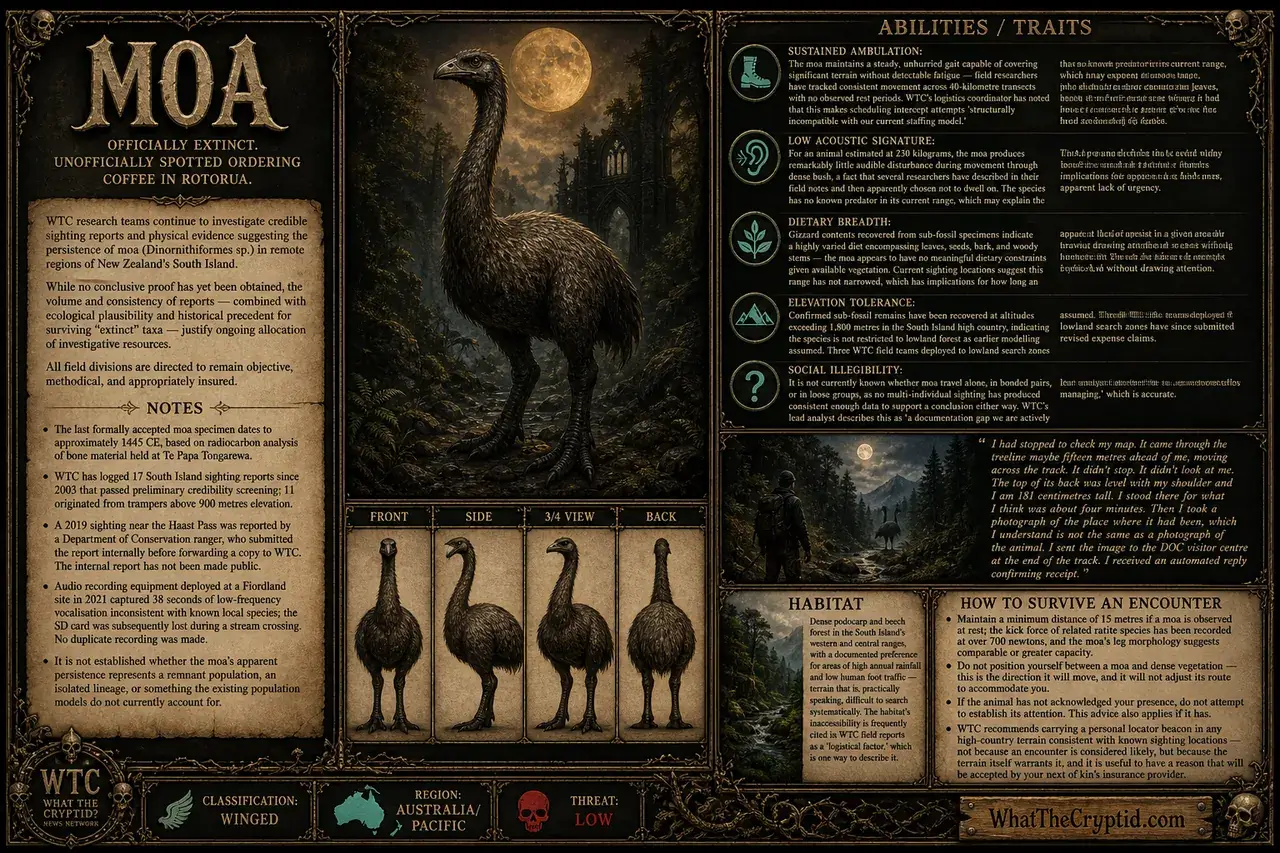
Standing at a documented maximum of 3.6 metres in females — the larger sex, a distinction the species made with considerable commitment — the Giant Moa represents the largest bird for which a credible post-extinction sighting record exists. WTC classifies it as Predatory on the basis that any organism capable of delivering a forward kick with an estimated force of 600 kilograms per square metre is, functionally, predatory toward anyone standing in front of it, regardless of its dietary preferences, which are herbivorous.
The entity is currently listed as Active in the WTC database. This classification was internally contested. The motion passed 4-3.
History & Mythology
Māori oral tradition documents the Moa — known across iwi by numerous names, with Te Kura and similar terms recorded in South Island traditions — as a hunted food source of significant cultural and nutritional importance. Moa hunting is embedded in early settlement narratives with a specificity that reads less like mythology and more like field notes: preferred terrain for drives, methods for preserving meat, the behaviour of the birds when cornered. WTC’s consulting ethnographer noted that this level of operational detail is unusual in prey-animal folklore and suggests recent, direct, and extensive contact with a living population.
The formal extinction date of approximately 1445 CE is derived from radiocarbon dating of moa bone deposits at middens and archaeological sites across both islands, with the South Island population persisting somewhat longer than its North Island counterparts. European naturalists, arriving in the 1800s, encountered only bones — though Richard Owen’s 1839 reconstruction of the animal from a single femur fragment remains one of the more confident scientific assertions made from incomplete evidence in the 19th century. It was, ultimately, correct, which Owen found vindicating and everyone else found slightly irritating.
Post-extinction sighting reports begin appearing in settler records from the 1820s onward, with naturalist and explorer accounts from Fiordland and the Southern Alps describing large, dark, bipedal birds at distances that prevented confident identification. These accounts were consistently attributed to misidentified Kiwi, Takahe, or Weka — identifications that require the observer to have misidentified a bird up to eighteen times their size. WTC has not resolved this discrepancy.
Physical Description
Female South Island Giant Moas — the sex responsible for the species’ maximum recorded dimensions — stood between 3.2 and 3.6 metres at full height, with a body mass estimated at 230 to 280 kilograms. Males were substantially smaller, averaging 1.8 metres and approximately 85 kilograms, a size dimorphism so extreme that early taxonomists classified the sexes as separate species for nearly a century before DNA analysis resolved the matter. WTC finds this an instructive lesson in the consequences of incomplete data, applicable to several ongoing research projects.
The plumage, reconstructed from subfossil feather samples preserved in cave deposits and dry midden sites, was reddish-brown to tawny at the body, with individual feathers exhibiting a coarser, more hair-like texture than most modern ratites. The head was small relative to body mass and carried no crest or wattle. The neck was long and mobile. The legs were heavily muscled and terminated in three forward-facing toes equipped with blunt, broad nails — functionally adequate for traversing the dense podocarp and beech forest understory the species preferred, and, as noted above, mechanically sufficient to cause significant structural consequences for anything positioned directly ahead of the bird during a threat display.
Witnesses in post-extinction sighting reports consistently describe a dark-bodied, tall, neckless silhouette — the neck being held low and forward during travel rather than erect — which WTC notes is consistent with documented moa locomotion and inconsistent with most large introduced species in the New Zealand fauna. Contemporary sightings describe a smell characterised as ‘wet feathers and soil,’ a detail that has appeared independently in eleven separate accounts without apparent coordination between witnesses.
Behaviour & Temperament
The Moa is documented, through both Māori oral accounts and analysis of subfossil bone trauma, as a non-aggressive browser that employed a powerful forward kick as its primary and apparently only defensive strategy. Bone deposits suggest it was hunted in coordinated drives toward cliffs or natural barriers, implying that the animal’s flight response was strong, sustained, and directionally predictable — all of which are characteristics that made it efficient to hunt and may, conservely, have made it possible for a remnant population to avoid detection in terrain that humans have little reason to systematically traverse.
Contemporary sighting accounts describe solitary individuals, which is consistent with the low social cohesion indicated in subfossil bone assemblages — moa deposits rarely show multiple individuals dying together, suggesting the animals did not flock and did not apparently require conspecific company. Whether this reflects genuine asociality or simply a population so reduced in number that socialising is no longer a practical option is a question WTC has tabled for a later meeting.
Activity patterns in post-extinction accounts are predominantly crepuscular, with the majority of sightings occurring in the two hours around dawn and dusk. This is consistent with ratite behaviour generally and with an animal that has, over several centuries, developed a functional aversion to humans. Several witnesses have described the animal freezing when it became aware of observation before moving deliberately and rapidly into dense cover — behaviour that our consulting ornithologist characterised as ‘not inconsistent with learned predator avoidance,’ and then asked to have his name withheld from the final report.
Habitat & Territory
The South Island Giant Moa’s primary historical range encompassed both lowland podocarp forest and montane beech forest across the South Island, with bone deposits indicating particular density in Fiordland, the Catlins, and the lower reaches of the Southern Alps up to approximately 1,200 metres elevation. These are, in contemporary terms, among the least accessible regions of New Zealand’s already considerably inaccessible interior. WTC considers this either coincidental or not.
Post-extinction accounts concentrate almost exclusively in Fiordland National Park and the Haast-Waiatoto corridor — terrain characterised by annual rainfall exceeding 6,000 millimetres in some areas, near-zero foot traffic outside designated trails, and a dense understorey of regenerating forest that would provide both food resources and visual cover for a large browsing animal. The same conditions that make this habitat excellent for an animal that prefers not to be found also make systematic survey work logistically complicated and expensive, a combination WTC’s field budget has not yet been able to address.
Diet & Hunting
The Moa was a generalist browser and grazer whose dietary range has been reconstructed with unusual precision from coprolite analysis and the examination of plant fragments preserved within mummified gut contents recovered from South Island cave sites. Primary food sources included the leaves, shoots, and fruit of native podocarp species — rimu, miro, kahikatea — alongside tussock grasses, ferns, and the foliage of regenerating beech. One coprolite sample from a Marlborough site contained identifiable fragments of at least 67 distinct plant species, which our consulting palaeobotanist described as ‘the dietary profile of an animal eating whatever it can reach,’ a characterisation WTC found more poignant than intended.
Seasonal variation in diet was significant, with fruit consumption peaking in late summer and autumn and browse increasing through winter months when ground-level food sources became less available. At a documented body mass of up to 280 kilograms, a female Moa required an estimated 15 to 20 pounds of plant matter daily to maintain condition — an intake rate that would, in any area of active habitation, produce detectable evidence of sustained browsing pressure on specific plant species. Fiordland botanical surveys have periodically recorded anomalous browse patterns on podocarp seedlings at heights between 1.8 and 3.2 metres. These findings have been attributed to introduced deer.
Notable Sightings
Tramper David Kearns, completing a solo off-season traverse of the Milford Track in late April, reported an encounter with a large dark bird at the margin of a forest clearing near the Arthur River, observed at approximately 30 metres for a duration he estimated at 90 seconds. Kearns, a secondary school biology teacher with stated familiarity with New Zealand native fauna, described the animal as ‘approximately as tall as me, maybe taller, with a small head and no visible wings,’ and noted that it was eating from a rimu sapling at shoulder height before becoming aware of his presence and moving into the tree line. Kearns submitted a written account to the Department of Conservation upon completing his tramp. The DOC file referencing his submission was not locatable when WTC requested it under the Official Information Act.
A road maintenance crew of four workers contracted to the New Zealand Transport Agency reported a large bird crossing State Highway 6 at the Haast Pass summit at approximately 5:40 AM during early morning works preparation. Crew supervisor Rangi Parata described the animal as ‘dark, no wings, taller than the ute bonnet,’ crossing at a steady walking pace from east to west before disappearing into roadside bush. The sighting lasted approximately 8 seconds. All four crew members provided consistent descriptions. The NZTA incident report filed that morning lists the event under the category ‘large animal strike — no contact — no vehicle damage’ and notes that works were delayed by 35 minutes.
Ecologist Dr. Priya Narayanan, conducting a vegetation transect survey for the Department of Conservation’s biodiversity monitoring programme, documented a series of track impressions in soft ground beside the Routeburn River that she initially recorded as ‘unidentified large bird, three-toed, estimated foot length 28 cm.’ Subsequent cast analysis by a DOC wildlife officer suggested the impressions were ‘not inconsistent with a large ratite’ before the assessment was revised in the final report to ‘probable Weka — size anomaly unexplained.’ Narayanan’s original field notes, which WTC obtained through a source she asked us not to identify, describe a second set of impressions at the same site with an estimated foot length of 34 cm. The second set does not appear in the final report.
Retired ornithologist Warren Chu, conducting a private survey of forest bird activity in the Catlins coastal podocarp forest, reported a visual contact with a large, upright, feathered animal at a distance of approximately 50 metres in low light conditions at 6:15 AM. Chu, who holds a postgraduate degree in avian biology from the University of Otago and spent 22 years with the New Zealand Department of Conservation, described the animal as ‘a large ratite, approximately 2 metres at the back, with the head carried forward on a long neck. I know what the Kiwi looks like. I know what the Takahe looks like. I know what the Weka looks like. This was none of those things.’ The sighting lasted approximately 40 seconds before the animal moved into dense cover. Chu published his account on a personal blog in March 2019. He subsequently removed it and has not responded to WTC’s follow-up enquiries, though his out-of-office reply indicates he is ‘currently in the field.’
Threat Assessment
The South Island Giant Moa presents a Low threat rating to humans under most circumstances, with the qualifier that ‘most circumstances’ does not include positioning yourself directly in front of the animal during a perceived threat encounter. The Moa’s primary and effectively sole defensive mechanism is a forward kick delivered with the full mass of the hindquarters, estimated to generate sufficient force to cause serious structural injury to a human torso. WTC recommends maintaining a minimum distance of 15 metres upon visual confirmation, avoiding direct eye contact, and under no circumstances moving toward the animal or blocking its exit route — the last of these recommendations being derived from Māori hunting records that document the use of barriers to prevent escape as the primary method of moa capture, which should contextualise how the animal responds to perceived confinement.
Approach the encounter as you would approach a large, frightened animal that has survived several centuries by not being found: it wants to leave, and the most dangerous moment will be if it decides it cannot. Back away slowly, maintain lateral distance from the direction the bird is facing, and make no sudden movements. If the animal adopts a low-neck, forward-leaning posture, increase your distance immediately. WTC acknowledges that this advice is somewhat limited by the fact that most witnesses do not identify what they are looking at until the encounter is already underway, at which point the recommended 15-metre buffer is rarely available.
WTC Field Notes
WTC has maintained an open file on post-extinction moa sightings since 2011, when our then-editor included a three-line reference to the Haast Pass crew incident in a roundup piece and received seventeen reader responses within 48 hours, fourteen of which included personal sighting accounts. The file currently contains 94 individual reports, of which 31 we consider credible on the basis of witness background, detail consistency, and the absence of an obvious alternative explanation. We have not published a full analysis piece. This is partly because our legal team has concerns about the characterisation of a government-listed extinct species as Active, partly because the Department of Conservation has been cooperative with WTC on other projects and we prefer to keep that relationship intact, and partly because our last field team to visit Fiordland returned with 340 hours of trail camera footage comprising exclusively empty forest, one Kea, and what appears to be a lens-cleaning incident that consumed 17 minutes of recording time.
WTC has submitted two separate funding applications to support a dedicated Fiordland survey operation. Both were declined. The second rejection noted, and we quote directly, that the proposed research ‘would require us to explain to our board what a cryptozoology news network is.’ We are saving this letter. It will be included in the eventual documentation package, alongside the Routeburn Valley cast photographs that Dr. Narayanan’s source provided, the Haast Pass incident report, and the 34-centimetre impression that did not make it into the final DOC report. We are patient. The Moa, if present, has had considerably longer to practice.