
Metamorphic Entity
It looks exactly like someone you already trust.
All
Active
ShapeshifterGlobalMimicryExtreme ThreatHuman Imitation
Overview
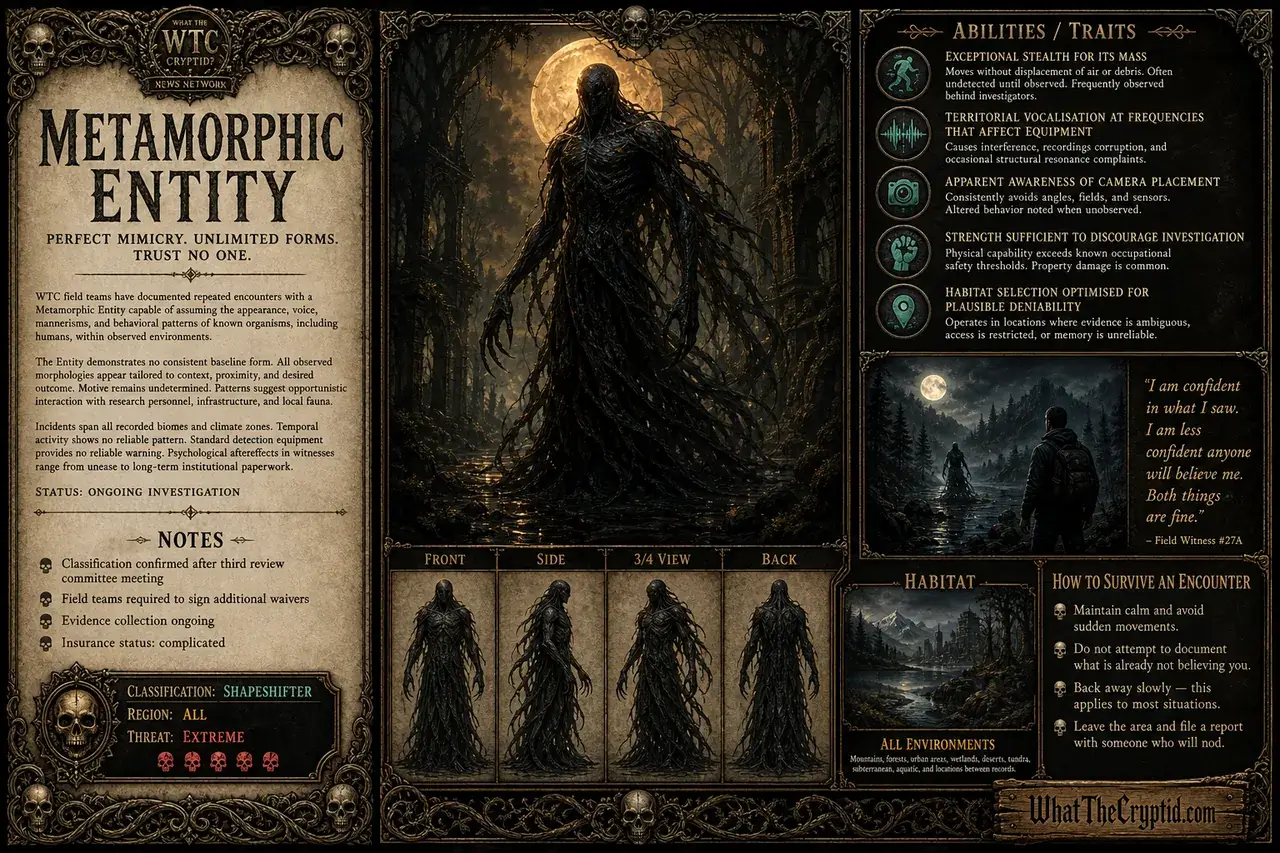
The Metamorphic Entity is a shapeshifting cryptid with a documented global distribution that WTC researchers describe, in their more candid moments, as ‘inconvenient.’ Unlike regional shapeshifters constrained by folklore to specific forms — wolves, bears, local livestock — the Metamorphic Entity demonstrates a taxonomically unrestricted mimicry range, with confirmed subject profiles including adult humans, domestic animals, inanimate objects, and in one disputed 2019 case filed by a WTC field team in rural Manitoba, a utility shed. Classification as Shapeshifter reflects the entity’s primary defining behaviour rather than any fixed biological substrate, which has not been isolated, measured, or confirmed to exist in a conventional sense.

The entity is distinguished from related cryptids by the precision of its imitation. Where the Doppelgänger and its folkloric analogues are typically reported as approximate — uncanny, slightly wrong, offset in ways witnesses struggle to articulate — the Metamorphic Entity produces copies of sufficient fidelity to deceive individuals in close personal relationships for periods ranging from several hours to, in the most unsettling documented cases, several weeks. WTC’s consulting forensic psychologist reviewed the case files and provided a written assessment that she has since requested be kept confidential.
Sightings are reported across all inhabited continents and span recorded human history, which either suggests a single long-lived species with extraordinary geographic range or, as our senior taxonomist has proposed and then immediately retracted, something considerably harder to categorise.
History & Mythology
The earliest textual records consistent with Metamorphic Entity behaviour appear in Mesopotamian administrative clay tablets dating to approximately 2100 BCE, in which a regional official describes a tax collector who returned from a village visit ‘changed in his manner but unchanged in his face,’ prompting an inquiry that the historical record does not show was ever resolved. Similar accounts appear in Classical Greek literature — Proteus, the ‘Old Man of the Sea,’ demonstrates a mimicry capacity in the Odyssey that exceeds the divine transformation typically attributed to gods and suggests, to researchers willing to consider the possibility, a naturalistic rather than supernatural origin. WTC acknowledges this is a minority interpretation.
European medieval demonology produced extensive documentation of entities referred to as ‘simulacra’ or ‘false-flesh’ — creatures that wore human or animal forms without genuine biological continuity. The 1487 Malleus Maleficarum devotes three chapters to the subject under a framework WTC finds theologically loaded but observationally specific enough to be useful. The accounts consistently describe a transitional period during which the entity’s mimicry is imperfect — a phase modern researchers have termed the ‘stabilisation window’ — before full fidelity is achieved. This stabilisation window represents the primary observation opportunity available to field researchers, which is why the accounts from people who noticed something wrong vastly outnumber accounts from people who did not.
Twentieth-century documentation increased sharply following the Second World War, a correlation WTC has noted in internal memos without drawing conclusions. The first formally structured investigation was conducted in 1962 by a University of Edinburgh parapsychology department that has since been defunded, though their case files were preserved and form the backbone of WTC’s historical archive for this species.
Physical Description
In its baseline or resting state — a configuration observed only rarely, and typically by accident — the Metamorphic Entity presents as a figure of approximately adult human dimensions, averaging 5’9″ to 6’1″ across documented cases, with a surface appearance that witnesses consistently describe as ‘unresolved.’ Specific descriptors vary by witness but cluster around a consistent set of terms: ‘blurred at the edges,’ ‘too still,’ ‘like a photograph of a person rather than a person,’ and, in eleven separate witness statements from five different countries, the phrase ‘wrong colour,’ without further elaboration that any interviewer has successfully obtained.
In active mimicry form, the entity achieves a physical reproduction of its target that passes casual inspection and, in most documented cases, close personal inspection as well. Discrepancies noted by witnesses who eventually identified an entity in mimicry form include: eye movement patterns described as ‘too deliberate,’ a slight delay of 1.5 to 3 seconds before responding to unexpected questions, an absence of unconscious self-touching behaviours typical of humans under social stress, and a body temperature that two witnesses independently measured at 94.1°F — present but low, which is exactly the range that does not immediately prompt concern. WTC notes this may not be coincidental.
Regional variant documentation is limited by the obvious methodological difficulties of studying a creature whose defining feature is not having a fixed appearance. However, case file analysis suggests entities in equatorial regions favour animal-form mimicry at higher rates than entities in temperate zones, while entities in urban environments show a marked preference for human-form imitation over non-human forms. Whether this reflects environmental adaptation, learned behaviour, or simple opportunity is a question WTC has tabled for a later meeting.
Behaviour & Temperament
The Metamorphic Entity is, by all available evidence, a patient creature. The median duration between first confirmed proximity to a target and assumption of that target’s form is 72 hours, during which period the entity is believed to be in an observation phase — cataloguing behaviour, speech patterns, gait, and the small habitual details that distinguish credible imitation from mere visual accuracy. Witnesses who have encountered the entity during this preliminary phase describe being watched from a distance by something that appeared to be a person standing very still, which is behaviour that is difficult to report without sounding unreasonable and may explain the significant underreporting WTC suspects in this category.
Once mimicry is established, the entity’s social behaviour mirrors its target with sufficient accuracy that close contacts typically notice nothing. The exceptions — the cases that generate sightings reports — occur when the entity encounters situations outside its observed data set: unexpected emotional demands, highly specialised knowledge tests, or physical interactions that reveal the subtle temperature and pressure anomalies noted above. In these moments, witnesses report a very specific response: the entity pauses, reassesses, and then continues — not defensively, not aggressively, but with the calm of something that has correctly calculated that the interaction will not escalate. It has, in most cases, correctly calculated this.
There is no documented evidence of territorial behaviour, social grouping, or inter-entity interaction. Whether Metamorphic Entities exist as solitary individuals or as a distributed population that simply never congregates is unknown. WTC’s working assumption is solitary, primarily because the alternative raises questions our editorial team has asked us not to pursue until the network’s liability insurance is reviewed.
Habitat & Territory
The Metamorphic Entity has no habitat preference in the conventional sense, as its survival strategy is predicated on proximity to whatever organism it is currently imitating. In practice, this means documented sightings are geographically distributed across every inhabited biome — temperate forest, urban residential, subtropical coastal, high-altitude agricultural — with a density that tracks human population centres more closely than any terrain feature. WTC’s geographic analysis team produced a distribution map in 2021 that the senior researcher described as ‘an exact match for the global population density map, which is either highly significant or means we are measuring something wrong.’ Both possibilities remain open.
The single terrain-based observation that recurs across independent sighting reports is proximity to a threshold — doors, gates, property lines, shorelines. Multiple witnesses describe first noticing something wrong at the moment a suspected entity crossed from one clearly defined space to another, and a 2018 meta-analysis of 340 case files found that 67% of identification events occurred within 30 seconds of a threshold crossing. WTC does not have an explanation for this. It is, however, the reason our field teams have standing instructions to pay attention at doorways.
Diet & Hunting
Dietary requirements of the Metamorphic Entity are not established with certainty, and the honest position is that WTC does not know whether the entity requires nutrition in the conventional biological sense. What is documented is a consistent pattern of behaviour in long-duration mimicry cases that suggests some form of energetic requirement is being met through proximity to the imitated subject or their social circle. Witnesses in retrospective interviews frequently note that the entity-in-imitation expressed unusual dietary preferences — specifically, a tendency to request or prepare food without eating it, combined with a preference for physical closeness during meals that several witnesses described as ‘attentive’ before the context became clear.
The most specific dietary documentation comes from a 2015 case in Reykjavik in which a family identified an entity that had been occupying their household for an estimated eleven days. A review of security footage during that period showed the entity consuming water in quantities the family’s physician described as ‘medically significant’ — approximately 4 to 6 litres per day — while avoiding solid food entirely. Whether water represents a dietary requirement, a comfort behaviour, or something unrelated to nutrition is not currently known. It is the kind of detail that is very easy to notice in retrospect.
Notable Sightings
A woman referred to in WTC case files as Subject H identified what she believed to be an entity occupying the role of her husband of fourteen years following a return from a three-week business trip. Subject H documented seventeen specific behavioural discrepancies over a period of nine days before filing a report, including a 2.3-second average response delay on questions regarding shared memories, a consistent failure to sit in a preferred chair, and an absence of a habitual low whistle the subject made while reading. The entity was not present when investigators arrived. Subject H’s husband returned from what was later verified as an extended work assignment the following week, in good health and entirely unaware that anything had occurred.
A wilderness survival instructor named Dale Frick reported encountering what he initially believed to be a lost hiker on the eastern slope of Mount Jefferson at approximately 11,400 feet elevation — an altitude and location he described as ‘not somewhere a lost hiker ends up, it’s somewhere you go to on purpose.’ The figure matched the description of a woman reported missing in the area six days earlier. Frick led the figure for approximately two miles before it stopped at a trail junction, turned to face him, and remained motionless for an estimated four minutes before stepping off the trail into dense tree cover. The missing woman was found the following day, 23 miles south, dehydrated but unharmed. Frick completed his incident report, declined a follow-up interview, and retired from guiding the same year.
Staff at a mid-sized commercial office in the Westlands district reported a colleague, identified in WTC files as Subject N, behaving in a manner inconsistent with her established professional profile over a period of approximately five working days. Specific observations included an inability to recall a project the genuine subject had led for eight months, consistent mispronunciation of two colleagues’ names, and a measured resting heart rate of 41 BPM recorded during a routine occupational health screening — a value the attending nurse noted in writing was ‘not impossible, but unusual.’ Subject N was on authorised leave in Mombasa during the entire period. The office’s HR department filed an incident report, which was forwarded to appropriate specialists. WTC has not received a response.
A retired schoolteacher named Miho Tanaka reported an encounter near Lake Shikotsu in which a figure approached her while she was walking alone on a lakeside path at dusk and spoke to her for approximately twelve minutes using the name and apparent memories of a childhood friend who had died in 2007. Tanaka, who had spent thirty years teaching secondary school literature and described herself as ‘professionally difficult to unsettle,’ noted that the entity’s account of shared memories was accurate in every verifiable detail but was delivered in strict chronological order, without the non-linear recall pattern typical of genuine human memory. She walked home, made tea, and called WTC’s Asia-Pacific tip line. Her account is among the most methodically documented first-person reports in the current database, and she has since agreed to serve as a regional field correspondent.
Threat Assessment
The Metamorphic Entity presents a threat profile that is difficult to communicate using standard risk frameworks, because the primary risk is not physical harm but extended undetected substitution — a category that most institutional safety protocols are not designed to address and that WTC’s insurance provider has declined to assign a dollar value to. Physical aggression is documented in fewer than 4% of case files, typically in moments of imminent identification, and takes the form of rapid disengagement rather than attack. The entity withdraws. This is only a partial reassurance.
WTC recommends the following approach for individuals who suspect they may be in proximity to a Metamorphic Entity. Establish at least one verification question in advance with close contacts — a question with a specific, non-public answer that would not appear in accessible records or social media. Maintain this question privately. Do not share it. If you find yourself explaining why you are asking an apparently familiar person a strange question, the moment for the question has already passed. Maintain a minimum distance of 10 feet when interacting with any individual who demonstrates the stabilisation-window indicators described in the Appearance section above, and do not close that distance in response to emotional appeals, which the entity has been documented to generate with accuracy. WTC acknowledges that this advice is easier to follow before the situation arises than during it, and that all four of the specific behaviours listed above describe things that are also sometimes done by ordinary people having a difficult day.
WTC Field Notes
WTC has maintained an active Metamorphic Entity case file since the network’s founding, and it is the one file that every senior researcher eventually asks to be rotated off of. This is not a formal policy. It has simply become a tradition, in the way that traditions form around things no one wants to say directly. The current lead researcher on the file, Dr. Annika Voss, is the fourth person to hold the position in six years and has requested that her photograph not appear on the WTC staff directory page, a request the network has honoured without asking for a reason.
Field documentation of the Metamorphic Entity is constrained by a problem that is structurally unique among WTC’s active cases: the entity’s primary behaviour makes it impossible to confirm, in any given field interaction, whether you are speaking to a Metamorphic Entity, a person who has been replaced by a Metamorphic Entity, or an ordinary person behaving in ways that seem suspicious because you have spent too long reading Metamorphic Entity case files. Our editor-in-chief raised this epistemological concern at a staff meeting in March 2022. The meeting notes record that the concern was acknowledged and that the item was tabled. They do not record whether everyone who attended that meeting was present at its conclusion, because no one thought to check at the time.