Louisiana Swamp Thing
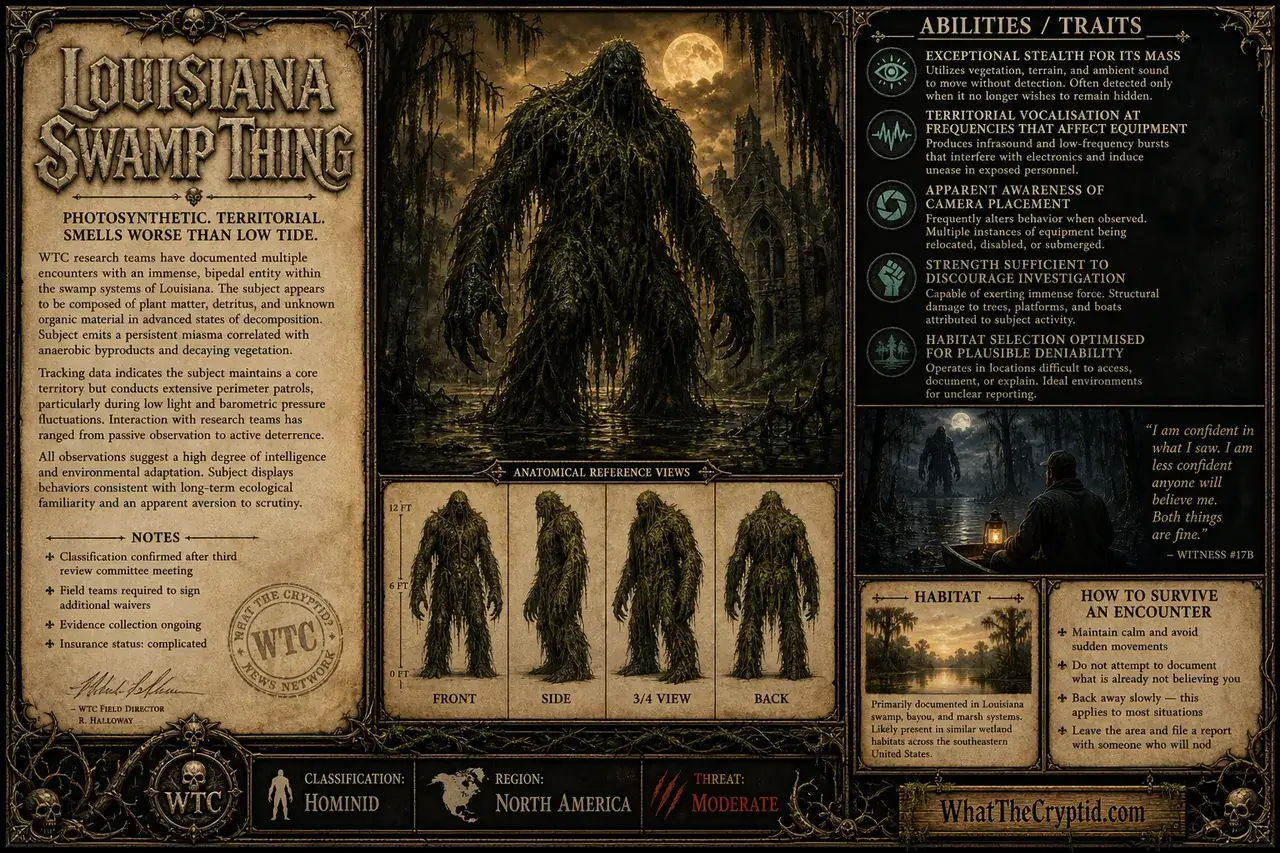
Seven feet tall. Smells like the bottom of something.
North America
Active
HominidLouisianaSwampAquatic-AdjacentSoutheast USPlant-CoveredBayou
Overview
The Louisiana Swamp Thing is a large bipedal entity documented primarily within the Atchafalaya Basin and surrounding wetland systems of south-central Louisiana, with secondary sighting clusters extending into the Honey Island Swamp region east of New Orleans. The entity is distinguished from related hominid classifications by one feature that is, in WTC’s assessment, genuinely unusual: an apparent symbiotic relationship with the local vegetation, resulting in a surface covering of moss, duckweed, and unidentified plant matter that makes the subject exceptionally difficult to distinguish from ambient swamp debris at distances greater than forty feet. This is either a remarkable evolutionary adaptation or an excellent argument for why WTC researchers should carry better optics.

Field reports place the entity’s range across approximately 1.4 million acres of swampland, floodplain forest, and bayou corridor — an area that, our Geographic Information Officer notes, is ‘technically larger than Delaware and significantly wetter.’ The entity appears to have no fixed territorial boundary and moves freely through water and dense vegetation, suggesting either a semi-aquatic locomotion capability or a complete indifference to being wet that most WTC staff find difficult to relate to on a personal level.
The Louisiana Swamp Thing occupies an unusual position in the cryptid record in that it is simultaneously one of the more frequently reported entities in WTC’s Southeast Regional Database and one of the least photographically documented, a gap in the evidentiary record that our senior analyst attributes to ‘the fundamental incompatibility of camera equipment and Louisiana humidity,’ a finding that required no field investigation to confirm.
History & Mythology
Oral traditions among the Chitimacha and Houma peoples of coastal Louisiana include references to a large swamp-dwelling figure known in some accounts as ‘the one who is also the marsh’ — a description that WTC’s cultural liaison found more precise than most eyewitness accounts submitted through our standard intake form. French colonial records from the early eighteenth century contain passing references to a ‘créature verte’ observed by trapping parties working the Teche corridor, though these accounts were largely filed under ecclesiastical concern rather than natural history, which explains why they took until 1987 to surface in cryptozoological literature.
The modern sighting record begins in earnest with the post-war development of Louisiana’s oil infrastructure, when survey crews working the basin in the 1950s began reporting encounters with a large, vegetation-covered figure that displayed apparent curiosity about survey equipment and, on at least two documented occasions, relocated survey stakes to positions that the project engineer described as ‘structurally indefensible.’ Whether this represents territorial behaviour, a comment on civil engineering, or coincidence has not been formally resolved. The entity entered broader public awareness following a 1975 series in the Baton Rouge Advocate, which generated 47 reader letters, 12 of which contained what appear to be independent and corroborating physical descriptions.
Academic engagement with the Louisiana Swamp Thing has been limited and, in two documented cases, actively discouraged by institutional review boards on grounds that WTC’s legal team characterised as ‘procedurally irregular.’ The most substantive independent study — a 1989 survey of physical trace evidence conducted by a team from Louisiana State University — was completed, peer-reviewed, and then quietly withdrawn from publication. The lead researcher is currently a department chair and does not respond to emails on this subject.
Physical Description
Documented estimates of the entity’s standing height range from six feet four inches to seven feet eight inches, with the variation likely attributable to the difficulty of obtaining accurate measurements in low-visibility swamp conditions rather than genuine population variance. Witnesses consistently describe a broad-shouldered, heavily built frame, with limb proportions that several observers — including one retired physical therapist whose report WTC considers among the more technically useful in our database — describe as ‘not quite wrong, but not quite right either.’ The precise nature of this proportional irregularity has not been formally characterized, as it has proved difficult to attract volunteers for the necessary close-range assessment.
The entity’s most immediately distinctive feature is its exterior covering: a continuous layer of living plant material that adheres to the body surface and appears, based on photographic analysis of the clearest available imagery, to include Louisiana swamp tupelo moss, common duckweed, and at least one species of aquatic fern that our consulting botanist identified from a single blurred photograph while noting that she would ‘prefer not to speculate on the attachment mechanism.’ The covering is thickest across the shoulders, upper back, and crown of the head, and appears to thin toward the lower limbs — a distribution pattern consistent with prolonged partial submersion, which WTC field researchers find either informative or unsettling depending on the time of day.
The entity’s facial features have been described in only eleven sighting reports detailed enough to be considered evidentially useful. These accounts converge on deep-set eyes described variously as amber, yellow-green, or ‘the colour of the water before a storm’ by a witness whose poetic register WTC has documented without endorsement. No clear description of the mouth or nasal structure has been recorded, which our editor attributes to the likelihood that witnesses who get close enough to see these features are not in an ideal state for accurate observation.
Behaviour & Temperament
The Louisiana Swamp Thing is primarily crepuscular, with the largest concentration of credible encounters occurring between forty minutes before sunset and two hours after dark, and a secondary cluster in the pre-dawn hours between four and six a.m. — a schedule that WTC’s behavioural consultant describes as ‘consistent with an entity that has correctly identified the optimal window for avoiding human contact while still accomplishing whatever it is doing out there.’ Daytime sightings are rare and, in the documented record, almost exclusively occur during flood events that displace the entity from its preferred cover.
The entity’s temperament, as reconstructed from encounter reports, is best characterised as watchful disinterest. The Louisiana Swamp Thing does not, in the documented record, charge, vocalise aggressively, or engage in the territorial displays common to other hominid classifications in the WTC database. It observes. Multiple witnesses describe the experience of being watched for extended periods before the entity withdraws, and at least three sighting reports include the detail that the subject appeared to be watching the witness watch it, which raises questions WTC has tabled for a later meeting. The one exception to this pattern involves proximity to what appear to be established resting areas — approach within an estimated twenty feet of these locations has, in four documented cases, been met with a display of full height, a deep percussive vocalisation described as ‘like a very large chest,’ and a sustained, unblinking stare that all four witnesses found sufficient motivation to retreat.
The entity demonstrates what WTC’s field team has cautiously described as ‘incidental tool interaction’ — specifically, a pattern of disturbing, relocating, or disabling equipment left unattended in the field. Trail cameras are consistently found repositioned to face away from areas of high activity. Survey stakes, as previously noted, have been moved. A sonar array deployed by an independent research team in 2019 was recovered from a location approximately 200 yards from its deployment point, still operational, still recording, and pointed at the sky.
Habitat & Territory
The Louisiana Swamp Thing demonstrates a strong preference for the interior wetland zones of the Atchafalaya Basin, specifically the transitional habitat where open water gives way to flooded tupelo-cypress forest at depths between two and four feet — an environment that offers both concealment and apparent ease of movement for an entity of the subject’s mass. Elevation within the primary range does not exceed twelve feet above sea level, and the majority of confirmed trace evidence — footprints, disturbed vegetation, unidentified biological material — has been recovered from areas with consistent year-round water coverage. The entity appears to avoid the more frequently trafficked waterways and concentrates in the interior reaches accessible primarily by shallow-draft vessel, which has practical implications for research logistics that WTC’s equipment budget has not fully addressed.
Seasonal movement patterns suggest the entity tracks the floodplain’s annual inundation cycle, moving deeper into the basin during high-water periods between March and June and retreating toward the more stable interior channels in late summer when peripheral areas begin to dry. No nesting or denning structure has been formally identified, though three separate field teams have reported the same type of anomaly: large circular depressions in floating vegetation mats, roughly nine feet in diameter, located in areas with no obvious access route. WTC has classified these as ‘possible resting platforms’ and noted that the floating-mat construction method is, structurally speaking, quite sensible.
Diet & Hunting
Physical evidence and observational data support a primarily herbivorous diet, with the entity documented consuming aquatic vegetation including water hyacinth, pickerelweed, and the tubers of Louisiana iris during extended observation sessions conducted at safe distance. The volume of plant matter required to sustain the entity’s documented mass has been estimated by WTC’s consulting nutritionist — who accepted the commission with what she described as ‘professional curiosity and personal misgivings’ — at between eighteen and twenty-four pounds of wet vegetation per day, a figure she noted is ‘logistically achievable in the Atchafalaya Basin, which produces vegetation faster than almost any other wetland system in North America, a fact that may or may not be relevant.’
Opportunistic protein consumption has been documented in three sighting reports, all involving freshwater species: largemouth bass in two cases and, in one 2003 account from a commercial crawfisherman whose trap lines were found emptied and neatly restacked, what appeared to be an enthusiastic engagement with approximately forty pounds of harvested crawfish. Whether the restacking of the traps reflects a learned behaviour, an instinct toward order, or something else entirely, WTC does not currently have a framework to assess. The crawfisherman, Terrance Mouton of Henderson, Louisiana, replaced his trap lines the following week and has since moved them to the western side of Lake Fausse Pointe, where he reports no further incidents.
Notable Sightings
Oil pipeline survey crew foreman Dale Arceneaux reported observing a large vegetation-covered figure standing motionless in approximately three feet of water, at an estimated distance of sixty yards, for a period he described as ‘long enough that I thought it was a tree stump until it turned its head.’ The figure held its position for an additional four minutes before submerging without producing a visible wake, a detail Arceneaux found more troubling than the initial sighting. The incident was reported to the survey company’s site supervisor, who recorded it in the project log under the category ‘environmental obstruction’ and did not forward it to safety management.
Naturalist and licensed swamp tour operator Cecile Thibodaux encountered the entity at approximately 5:40 a.m. while conducting a solo pre-dawn bird count along the West Pearl River. Thibodaux, whose documentation practices WTC considers among the most methodologically sound in our Southeast Regional Database, recorded the entity’s height as ‘no less than seven feet’ based on a comparison with a marked cypress tree at the same distance, and noted that the subject’s movement through dense root structure produced significantly less sound than she herself had made approaching the same area. Thibodaux submitted a formal written account to WTC within seventy-two hours, including a hand-drawn diagram, and has since guided three subsequent WTC field expeditions into the area, none of which produced a second encounter.
Recreational fisherman brothers Paul and Dennis Broussard reported an entity matching the standard physical description observing them from the treeline at a distance of approximately forty feet for a period both brothers independently estimated at eight to ten minutes. Paul Broussard noted that the entity appeared specifically interested in the fish finder unit mounted on their vessel’s console, tracking it with visible eye movement when the display was repositioned. The entity departed when Dennis Broussard started the outboard motor, moving into the cypress interior without audible footfall. Both brothers reported the incident to the Louisiana Department of Wildlife and Fisheries, which acknowledged receipt of their written account, and Paul Broussard’s fish finder malfunctioned irreparably on the return trip, which he mentioned in a follow-up call to WTC and which WTC has logged without drawing conclusions.
Independent cryptozoological researcher Marcus Webb, operating under a permit obtained through WTC’s affiliate researcher programme, captured eleven seconds of video footage on a stabilised camera mount before the entity moved behind a stand of tupelo trees approximately thirty-five yards from his position. The footage was reviewed by WTC’s imagery analysis contractor, who confirmed the presence of a large moving object, declined to classify it further without enhanced resolution, and asked that her name not be attached to the assessment. Webb filed a 4,000-word expedition report, uploaded the raw footage to WTC’s secure archive, and requested reimbursement for one waterproof camera housing, one pair of waders, and ‘a boat rental situation that is complicated to explain,’ the last of which WTC’s accounts department denied pending additional documentation.
Threat Assessment
The Louisiana Swamp Thing does not, in the documented record, initiate contact with humans, and WTC’s current assessment is that unprovoked physical attack represents a low-probability outcome in most encounter scenarios. The more statistically supported risks are environmental: the entity’s preferred habitat is itself hazardous, featuring unstable footing, limited visibility, venomous species, and the particular navigational challenges of an environment where landmarks are seasonal. WTC recommends maintaining a minimum distance of 150 feet upon confirmed visual contact, avoiding approach toward any large circular depression in floating vegetation, and not leaving electronic equipment unattended in areas of documented activity. If the entity turns to face you and holds position, WTC’s field guidance is to begin a slow, measured retreat while maintaining eye contact — a recommendation that our legal department approved and our field researchers describe as ‘easier to write than to follow.’
The honest limit of this advice is that it is based on encounter data from individuals who survived their encounters in good enough condition to file a report, which is a sample with an obvious selection bias that WTC acknowledges and cannot currently correct for. Researchers entering the Atchafalaya Basin for entity-related purposes are strongly advised to file a float plan with a reliable contact, carry a personal locator beacon, and inform their party of any pre-existing conditions that may be relevant to a situation involving waist-deep water, low visibility, and a seven-foot vegetation-covered entity whose intentions remain formally unclassified.
WTC Field Notes
WTC’s Southeast Regional Division has maintained an active file on the Louisiana Swamp Thing since 1991, when our then-editor acquired the Arceneaux survey log from a pipeline company records disposal and described it in an internal memo as ‘worth a look when we have the budget.’ The budget situation has not substantially changed, and as of the current fiscal year, our Atchafalaya Basin research programme consists of one part-time field correspondent based in Breaux Bridge, two trail cameras whose deployment locations are updated annually, and a research boat that our regional coordinator describes as ‘functional in the sense that it floats, which remains the primary requirement.’
The 2019 Webb expedition footage remains our clearest visual record of the entity and has been reviewed by three separate imagery analysts, all of whom confirmed the presence of a large moving object and all of whom subsequently declined further involvement with the file. WTC is currently seeking a fourth analyst. We are also in ongoing discussions with our insurance underwriter regarding the classification of swamp research as a covered activity following an incident during our 2021 field season that our regional coordinator has asked us not to describe in detail in a public-facing document, and which we are therefore describing only as ‘equipment-related’ and ‘resolved, mostly.’ The Louisiana Swamp Thing file remains open. It is, at this point, one of our older open files. We consider this a reflection of the entity’s elusiveness rather than our own operational limitations, though we acknowledge that both things can be true at the same time.