
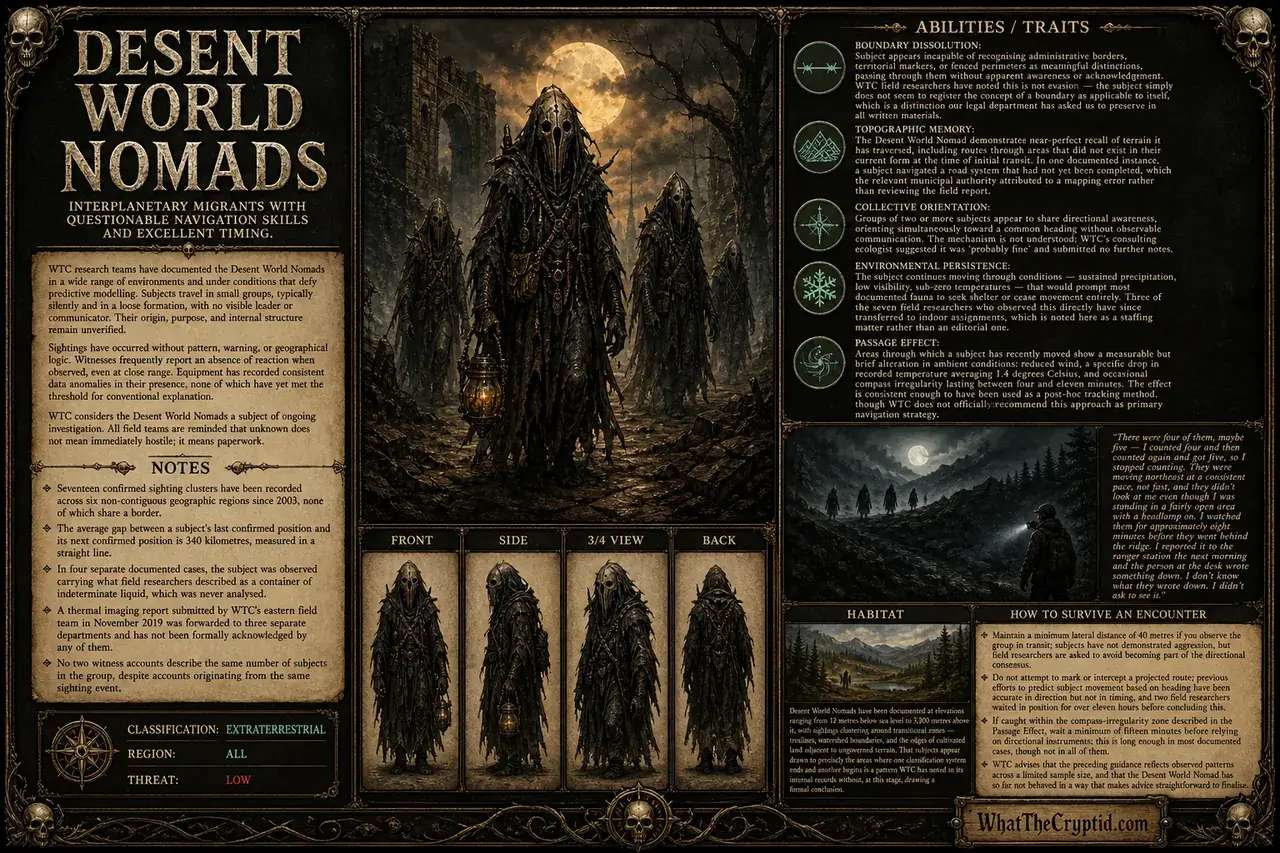
Desent World Nomads
They were below you before you arrived.
All
Unverified
DesertSubsurfaceHominidEmergence EventsAfricaSahara
Overview
The Descent World Nomad is a hominid-class cryptid documented primarily across the Saharan and sub-Saharan desert corridors, with secondary reports emerging from the Arabian Peninsula and the Atacama fringe. The entity appears to subsist entirely within or immediately proximate to the subsurface layer of arid terrain — emerging at intervals that do not correspond neatly to any feeding, reproductive, or migratory cycle that WTC researchers have been able to establish with confidence. This irregularity is, at this stage, considered a defining characteristic rather than a gap in the data.

Standing estimates place the Nomad at between 1.8 and 2.3 metres when fully upright, though full upright posture is rarely documented, as witnessed individuals are most commonly observed in the transitional phase between subsurface and surface — a posture that our consulting physical anthropologist described as ‘technically bipedal, contextually ambiguous.’ The skin is consistently described as pale to translucent across all regional accounts, which presents an ongoing physiological puzzle given the entity’s documented preference for one of the most UV-intensive environments on the planet.
WTC classifies the Descent World Nomad as non-aggressive under standard encounter conditions, a designation that the Threat Assessment team has asked us to note they consider ‘operationally optimistic.’
History & Mythology
The earliest recoverable textual reference to entities matching the Nomad description appears in a 9th-century Arabic geographical manuscript held in partial form at the Bibliothèque nationale de France, which describes beneath-dwelling figures — rendered as Al-Nasikh al-Ard, loosely translated as ‘those who erase the ground’ — observed near the salt flat regions south of the Ahaggar Mountains. The manuscript’s author, whose name is partially illegible due to water damage sustained in a flood of uncertain date, notes that local Tuareg communities considered the figures neither supernatural nor hostile, but treated their emergence sites with the same practical caution one might extend to a watering hole shared with large fauna.
Tuareg oral tradition maintains consistent accounts of the Beneath Walkers across at least four generations of documented testimony, collected sporadically by French colonial anthropologists between 1890 and 1923. These accounts describe emergence events occurring most frequently at dawn and dusk — the transitional light periods — with the figures observed to stand briefly at the surface, orient themselves using methods witnesses consistently describe as ‘looking at the sky without looking at the sky,’ and then descend again within minutes. The colonial-era researchers largely catalogued these accounts under the heading ‘desert psychosis related to heat exposure,’ a classification that WTC has formally contested in writing to no particular institutional response.
The first documented Western field encounter occurred in 1971, when geologist Dr. Amara Ouedraogo and her survey team reported a subsurface displacement event near Tamanrasset, Algeria, accompanied by a brief surface emergence lasting an estimated four minutes. Ouedraogo’s field notes survived; her formal report to the Algerian Ministry of Energy did not include the incident, for reasons she described in a 1994 personal interview as ‘professional self-preservation.’
Physical Description
The Descent World Nomad presents a consistent morphological profile across geographically disparate sightings, which WTC considers either compelling evidence of a coherent species or a remarkable case of cross-cultural convergent hallucination. The body is elongated and lean, with limb proportions — particularly the forearm-to-upper-arm ratio — that fall measurably outside the standard human range according to the three witnesses who have provided detailed enough accounts to permit rough calculation. The hands are documented as broad relative to wrist width, with fingers that multiple witnesses have independently described as ‘too many’ before clarifying, upon questioning, that they counted correctly but felt the distribution was somehow wrong.
The skin coloration, as noted, trends toward pale grey to near-translucent, with visible vascularisation reported in close-range sightings. The eyes, where described, are uniformly noted as very dark — one witness specified ‘the colour of wet sand at depth, which I understand is not a colour’ — and adapted to function in low-light conditions to a degree that several witnesses found worth mentioning unprompted. The head is elongated at the crown, a feature that is either a consistent anatomical trait or a consistent artefact of the psychological conditions under which most sightings occur. WTC has not yet determined which.
Regional variants are minimal but documented. Nomads observed in the Arabian Peninsula corridor tend toward slightly greater reported height. Those documented in the Atacama fringe — the three confirmed sightings from that region — have been described as having what two of the three witnesses called ‘more deliberate’ movement, a distinction that resists precise taxonomic application but has been retained in the record in the interest of completeness.
Behaviour & Temperament
The Descent World Nomad’s primary behavioural signature is the emergence event: a vertical transition from subsurface to surface that leaves a displacement pattern in the sand above the emergence point, described by WTC field researchers as resembling an inverse sinkhole — material pushed upward and outward rather than collapsed inward. The mechanics of this transition have not been observed in real time with adequate documentation, which is the kind of sentence WTC researchers have grown accustomed to writing. Post-emergence, the Nomad exhibits a consistent sequence: stillness, orientation toward the horizon, slow rotation of the head through approximately 180 degrees, and then either descent or movement across the surface for distances of up to 400 metres before re-entry.
Surface movement is described as unhurried to a degree that witnesses consistently find more unsettling than rapid movement would be. The Nomad does not appear to flee when detected. It appears, across the majority of documented encounters, to have been aware of the observer before the observer was aware of it, and to have made a prior determination that observation was acceptable. This interpretation is WTC’s own, extrapolated from the available data, and should be understood as a working hypothesis rather than established fact — though it is the working hypothesis that best fits the evidence.
Social structure is unclear. The majority of emergence events involve a single individual. However, four documented cases describe simultaneous multi-point emergence across a surface area of up to two kilometres, with individuals appearing to move without direct communication toward a common convergence point before descending together. Whether this represents coordinated group behaviour, coincidental parallel activity, or something for which WTC does not yet have an adequate category is a matter currently under editorial discussion.
Habitat & Territory
The Descent World Nomad demonstrates a marked preference for deep arid terrain — specifically, unconsolidated aeolian sand deposits of sufficient depth to permit vertical subsurface movement, which field researchers estimate requires a minimum of 8 to 12 metres of suitable substrate. The entity avoids rocky desert pavements, salt flats with compacted crusts below 30 centimetres, and — notably — any terrain within approximately 3 kilometres of a permanent water source. This last preference is consistent across all documented sightings and represents the most reliable negative indicator available to field teams attempting to predict emergence zones.
Elevation appears to be a secondary factor. Documented sightings range from 180 metres below sea level in certain Saharan basin regions to approximately 2,400 metres in the higher Ahaggar terrain, suggesting the entity’s subsurface environment is not constrained by the surface topography in ways that our geology consultant found straightforward to explain. Primary emergence zones cluster around ergs — the large sand sea formations — of the central Sahara, with the Grand Erg Oriental producing the highest concentration of credible reports per square kilometre of any documented Nomad habitat.
Diet & Hunting
The dietary requirements of the Descent World Nomad represent one of the more persistent open questions in WTC’s active research portfolio. The entity has never been directly observed consuming anything at the surface. No feeding behaviour, no prey remains, and no physical evidence of surface-level foraging have been documented in association with emergence events. This is either because the Nomad feeds exclusively in the subsurface environment — where documentation is, for logistical reasons, essentially impossible — or because it requires substantially less sustenance than its body mass would suggest, or because WTC field teams have simply never been present at the right moment. All three possibilities remain open.
Subsurface fauna in the primary habitat zones — including various beetle species, subterranean ant colonies, and the root systems of drought-adapted vegetation — are considered candidate food sources by WTC’s consulting ecologist, who noted that a diet of subterranean invertebrates would be nutritionally plausible for an entity of the Nomad’s estimated mass if caloric requirements were significantly lower than those of comparable surface-dwelling hominids. This caveat covers a wide range of scenarios. One witness, a desert ecologist conducting a unrelated invertebrate survey near In Salah in 2009, reported observing a Nomad at close range and noted afterward that the sand in the immediate vicinity showed signs of systematic disturbance to a depth of approximately 60 centimetres — the kind of disturbance, she specified in her written account, that she had previously attributed to a colony of Saharan silver ants.
Notable Sightings
Petroleum survey technician Rachid Benali documented a dawn emergence event at coordinates he recorded precisely and later refused to disclose. Benali described a single figure rising from the dune face at an angle he estimated at 70 degrees from horizontal, standing motionless for approximately six minutes while facing northeast, then descending through the same displacement point. He noted that the sand surface showed no residual opening after re-entry — ‘it closed like water,’ he wrote in his field log. Benali filed an incident report with his company’s field safety office. The report was categorised under ‘environmental anomaly — non-structural’ and retained in an archive that was digitised in 2018 with several pages rendered illegible by scanner error.
A French-led cartographic expedition led by Dr. Sophie Marchand recorded what team members initially interpreted as a localised surface collapse event at 06:14 local time, approximately 80 kilometres northeast of the Arbre du Ténéré replacement monument. Video footage captured on a standard survey camera showed a figure emerging over a period of approximately 90 seconds, standing at the surface for four minutes, and re-entering. The footage is 38 seconds long, as the camera’s memory card reached capacity during the event. Marchand submitted the footage to two separate research institutions and received responses from neither.
Bedouin guide Faris al-Dossari reported a multi-individual emergence event to a visiting WTC correspondent during an unrelated interview about regional folklore. Al-Dossari described four simultaneous emergence points across an estimated 800-metre surface span, with each figure orienting independently before all four began moving in convergent paths toward a central point approximately 200 metres from the nearest emergence site. The convergence took 11 minutes. The figures descended together at the central point. Al-Dossari noted that his family had observed similar convergence events on three prior occasions, which he considered unremarkable, and expressed mild surprise that WTC considered it otherwise.
Astrobiologist Dr. Valentina Cruz, conducting overnight soil sample collection for an unrelated Mars-analogue research project, observed a single Nomad at an estimated distance of 35 metres for approximately three minutes before the entity re-entered the substrate. Cruz, whose research involves the detection of subsurface life in extreme arid environments using sensor arrays, noted that her instruments — deployed across a 200-metre grid — recorded no subsurface movement either before or after the emergence event. She described this in her personal notes as ‘the most interesting negative result of my career,’ and in her published research as nothing, because she did not include it.
Threat Assessment
Under documented encounter conditions, the Descent World Nomad presents a Moderate threat rating, which WTC applies with the qualification that ‘Moderate’ reflects observed behaviour rather than confirmed capability. The entity has not been documented initiating contact with humans. It has, however, been documented at distances of less than 10 metres from witnesses who were unaware of its presence until the encounter was already underway, which suggests that the threat profile during an undetected approach cannot be assessed with the confidence the rating implies.
WTC recommends maintaining a minimum distance of 50 metres from any observed Nomad, primarily because this is the distance at which witnesses report the entity becoming visibly aware of them — a threshold that implies the entity had been aware of them for some time prior. Do not attempt to approach an emergence site during an active event. Do not position yourself between a Nomad and its re-entry point; this configuration has appeared in two of the four higher-tension encounter reports on file, and while no physical harm resulted in either case, both witnesses used language in their subsequent accounts that WTC’s editorial team considered worth flagging. If travelling in primary Nomad habitat, WTC advises GPS tracking, surface displacement monitoring if available, and informing someone of your location — not because the Nomad is likely to harm you, but because the desert will, and the two risks should be managed separately.
WTC Field Notes
WTC has maintained an active research file on the Descent World Nomads since 2006, when a tip from a retired petroleum geologist provided enough cross-referenced incident data to justify formal classification. The file currently runs to 340 pages, of which approximately 90 pages are correspondence with institutions that did not respond, 47 pages are insurance-related documentation following the 2014 Algerian field deployment, and the remainder constitutes substantive research. The 2014 deployment remains WTC’s only funded in-field investigation of the Nomads; it produced one partial audio recording of an emergence event, one sand displacement sample that was lost in transit between Algiers and our Paris correspondent’s apartment, and a revised field safety protocol that our legal team describes as ‘comprehensive’ and our field researchers describe using other words.
A second field deployment has been in the proposal stage since 2019. Funding has not been confirmed. Our editor has noted that the Nomad file represents one of the more compelling open cases in the WTC database — ‘compelling’ being the word she used in the budget meeting, though the budget outcome suggests it did not land with the intended weight. WTC remains committed to continued documentation of the Descent World Nomads through witness correspondence, archival research, and the optimistic expectation that one day a credentialed researcher will submit a report that a peer-reviewed journal cannot find a procedural reason to decline.