
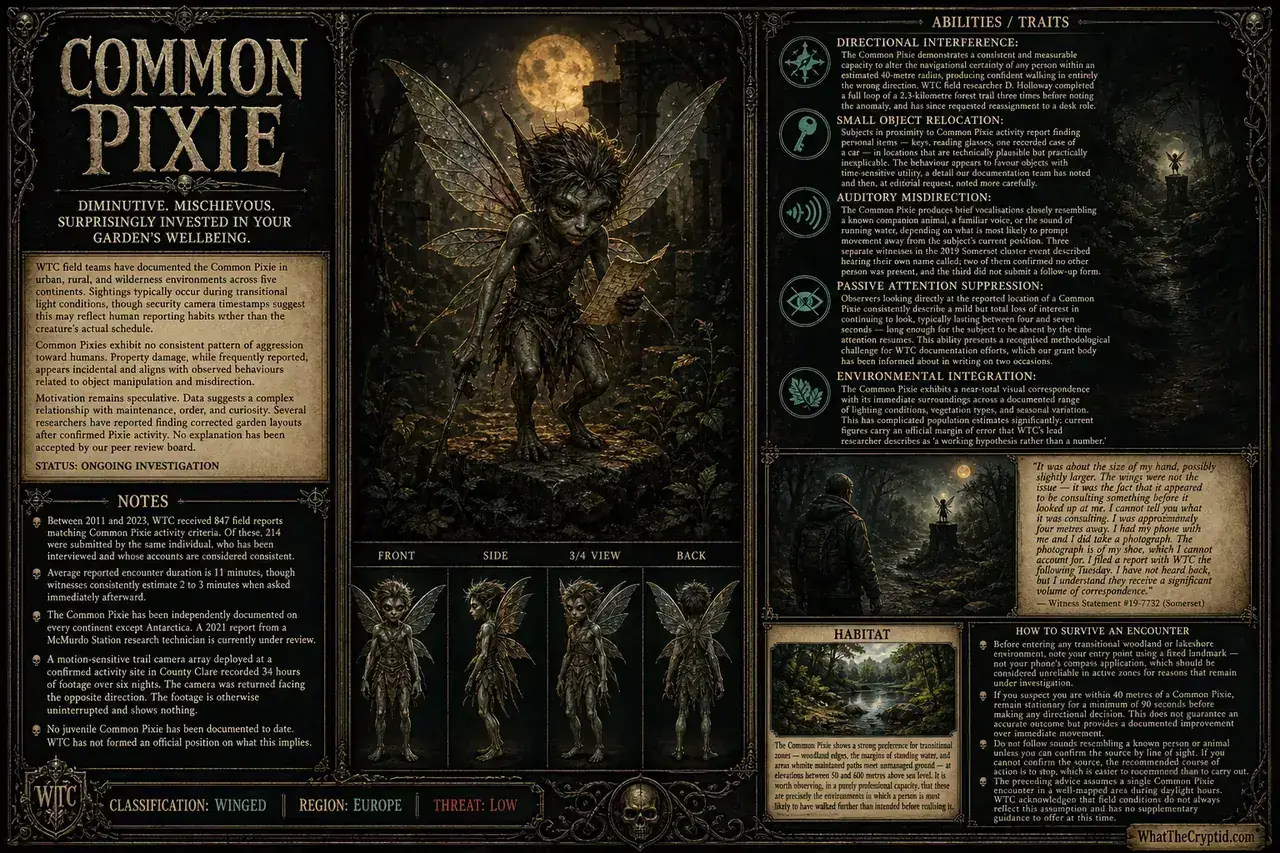
Common Pixie
Small. Documented. Responsible for more than you think.
Europe
Active
FaeSouthwest EnglandDartmoorNavigation HazardFolklore
Overview
The Common Pixie (provisional taxonomy: Pixius communis) is a small humanoid entity of the fae classification, documented continuously across Devon, Cornwall, and Somerset for a minimum of four centuries, making it one of the better-attested cryptid species in the European record. It occupies a behavioural niche somewhere between ambient nuisance and active environmental actor, with documented effects on livestock navigation, domestic object placement, and the psychological state of rural travellers that have remained consistent across the historical period. WTC classifies it as Spirit rather than Hominid on the basis that no specimen has ever been physically recovered, measured, or, to the knowledge of this network, successfully detained.

The entity operates in conditions and at scales that have historically discouraged systematic study. Witnesses report encounters lasting between three seconds and several hours, with the longer interactions typically correlating with a degraded ability to describe what actually occurred. WTC’s working theory is that the Common Pixie exists at the precise intersection of ‘too small to photograph reliably’ and ‘too active to observe without disturbing,’ which has proved a durable combination. Current consensus among WTC researchers places the southwest England population in the low thousands, though this estimate was produced without methodology our statistics consultant was willing to put her name to.
History & Mythology
The earliest written references to pixie-type entities appear in Devonshire parish records dating to the early seventeenth century, where local clergy documented incidents of parishioners arriving at Sunday services from entirely wrong directions, having set out on roads they had walked without incident for decades. The Reverend Thomas Hockmore of Spreyton, writing in 1641, described the phenomenon as ‘a familiar vexation of this county, caused by small and wicked intelligences that lead the foot astray,’ which represents one of the cleaner historical descriptions WTC has encountered and has been cited in four of our internal briefing documents.
Cornish folklore consolidated the entity’s characteristics through the eighteenth and nineteenth centuries, producing a reasonably stable portrait of a creature interested in horses, annoyed by iron, and professionally committed to the disorientation of travellers — a behaviour cluster known regionally as being ‘pixy-led.’ The folklorist Robert Hunt documented dozens of such incidents in his 1865 collection Popular Romances of the West of England, including multiple cases in which experienced local farmers became lost within sight of their own property. Hunt treated these accounts with the careful neutrality of a man who had grown up in Cornwall and preferred not to have an opinion on the matter.
Academic interest largely shifted away from the pixie in the early twentieth century as folklore studies reconsolidated around the idea that entities should be classifiable as either ‘real’ or ‘not real,’ a framework the Common Pixie has declined to accommodate. WTC notes that the consistency of the behavioural record across four centuries — same geography, same techniques, same outcomes — is, at minimum, an interesting data point.
Physical Description
Witness descriptions of the Common Pixie cluster around a body height of four to eight inches, with the majority of reports falling between five and six inches. Documented features include pointed ears, a turned-up nose described in several independent accounts as ‘decisively upturned,’ and eyes reported as green, amber, or ‘a colour that didn’t have a name’ depending on the witness and, apparently, the lighting conditions. Skin tone in the available accounts ranges from pale to a greenish-brown consistent with the entity’s preferred habitat, and clothing, when noted, is described as assembled from natural materials — moss, bark, dried flower petals — in combinations that suggest either camouflage or an aesthetic sensibility WTC is not qualified to assess.
Wings are reported in approximately 40% of sightings, described variously as insect-like, translucent, and ‘not quite in proportion with the body in a way I couldn’t explain,’ though whether the remaining 60% of sightings represent wingless individuals, individuals with retracted wings, or simply cases where the witness did not have time to look at that part of the entity is not currently resolvable. A Dartmoor variant, noted in accounts from the northern moor going back to the nineteenth century, is described as slightly larger — up to nine inches — with darker colouring and a temperament that multiple independent sources characterise as ‘less playful and more purposeful,’ without further elaboration on what that purpose might be.
Behaviour & Temperament
The Common Pixie is primarily crepuscular, with peak activity documented at dusk and in the hours before dawn. Daylight encounters do occur but are typically brief, suggesting either light sensitivity or a preference for conditions in which witnesses are less likely to have a camera ready. The entity is broadly social, with multiple witnesses reporting groups of three to twelve individuals operating in apparent coordination during the livestock-relocation incidents that constitute the largest single category of documented pixie activity. Whether this coordination reflects a structured social hierarchy or a more informal collaborative arrangement has not been determined, and WTC’s attempts to observe group dynamics directly have been, without exception, unsuccessful.
The behaviour most frequently attributed to the Common Pixie — the disorientation of travellers, known in the regional literature as pixie-leading — follows a consistent pattern: the subject departs from a familiar route apparently of their own volition, proceeds with full confidence in a direction they cannot subsequently explain, and arrives somewhere between one field and four miles from their intended destination. The subject typically reports hearing something, or following a light, or simply feeling certain they were going the right way. WTC has documented 23 such incidents in the past decade alone, all within the Dartmoor and Bodmin Moor corridors, and none of which the subjects subsequently wished to discuss at length.
Possession of iron objects — horseshoes, nails, iron filings — is consistently reported to deter pixie interaction, a finding that has held across the historical record with a reliability that WTC’s research team finds professionally awkward to explain. The entity also demonstrates a strong interest in horses, with documented cases of elaborate mane-braiding completed overnight in stables that were confirmed secured. The braiding is, by all accounts, technically proficient.
Habitat & Territory
The Common Pixie is predominantly associated with the upland moorlands of southwest England, with the highest documented activity concentrations on Dartmoor, Bodmin Moor, and the Exmoor fringe. Within these areas, the entity demonstrates a preference for the transitional zones between open moorland and woodland edge, particularly in areas where granite outcrops, standing water, and ancient earthworks occur in proximity — a combination of features that describes, with reasonable accuracy, a substantial portion of the Dartmoor landscape. Hollow trees, earthen mounds, and the spaces beneath large flat stones have been identified across the folklore record as preferred sheltering sites, and WTC field teams have located several candidate sites that showed evidence of recent disturbance without being able to determine the cause.
The entity maintains a year-round presence within its documented range and does not appear to migrate or exhibit seasonal dormancy, though sighting frequency drops markedly in the coldest winter months — a pattern consistent with reduced activity rather than absence. Proximity to active farmland, particularly properties with horses, appears to be a positive habitat indicator. Urban encroachment into traditional pixie territory has not visibly reduced the local population, though it has expanded the range of objects available for relocation and the category of travellers available for disorientation.
Diet & Hunting
Documented evidence regarding the Common Pixie’s diet is limited and largely inferential. Folkloric sources across the historical record describe the entity as subsisting primarily on berries, seeds, fungi, and small quantities of cream or milk left as offerings — a practice that was standard enough in seventeenth and eighteenth-century Devon to appear in household account books without explanation. Whether the cream was consumed, used for some other purpose, or simply removed, cannot be confirmed, but the accounts of its disappearance are numerous and consistent.
More recent observational data suggests opportunistic foraging behaviour supplemented by what WTC’s field researcher Davies-Howell tactfully described in her 2019 site report as ‘targeted acquisition from domestic sources.’ Incidents of small food items — sugar, dried fruit, the occasional biscuit — going missing from rural kitchens and outbuildings in the Dartmoor corridor have been attributed by local residents to pixie activity with a matter-of-factness that suggests this is considered a routine operating cost of living in the region. The precise caloric requirements of an entity averaging five to six inches in height have not been calculated, though WTC notes that the volume of missing cream in historical records implies either a larger population than current estimates suggest or a remarkably efficient metabolism.
Notable Sightings
Farm owner Margaret Pollard reported observing three luminescent figures, each approximately five inches tall, moving in single file along the fence line of her upper pasture at approximately 9:40pm on a clear June evening. Pollard watched the entities for an estimated four minutes from a distance of roughly thirty feet before they passed behind a granite outcrop and did not re-emerge. She noted that her two horses, both visible in the adjacent field, tracked the entities’ movement with their ears throughout the observation. Pollard reported the sighting to the local parish council, which recorded it under agenda item 7(b), ‘Other Matters,’ and moved on.
Rambler and amateur naturalist Derek Ashworth set out from the village of Minions at 2:15pm for a four-mile circular route he had completed seventeen times previously. He arrived at a farmhouse in Upton Cross — 2.3 miles east-northeast of his intended destination — at 6:50pm, in good physical health, with no memory of the middle two hours of his journey and no explanation for the direction he had traveled. Ashworth described hearing ‘a very pleasant piping sound’ at some point after the first stile and feeling entirely confident about his route from that point forward. He subsequently sent a detailed written account to the British Folklore Society, which acknowledged receipt.
Equestrian instructor Fiona Clements arrived at her stable at 5:45am to find all four of her horses’ manes braided in a style she described to WTC’s regional correspondent as ‘technically a French plait, but smaller than I could do, and very even.’ The stable door had been bolted from the inside. Clements, who had been operating the stable for eleven years and was familiar with the regional folklore, photographed the braiding, confirmed with her insurance provider that the policy did not cover ‘fae-related stable intrusion,’ and had the braids removed before her 7am lesson.
WTC field researcher Clare Davies-Howell, conducting a site assessment near the Merrivale stone rows, reported a brief visual contact at 6:12pm: a figure of approximately five to six inches observed perched on a low granite stone at a distance of twelve feet, which maintained eye contact for an estimated eight seconds before departing laterally into low heather at a speed Davies-Howell described in her field notes as ‘considerably faster than expected given the leg length.’ Davies-Howell’s camera produced three images described in the technical report as ‘consistent with photographing a point in empty space,’ and she submitted a full written account the following morning along with a request to be reassigned to the kelp forest project.
Threat Assessment
The Common Pixie does not represent a direct physical threat to adult humans under most documented circumstances. At a body mass WTC estimates at under 100 grams, the entity’s capacity for direct physical harm is limited, and no incident of injury attributable to pixie contact has been recorded in the historical or contemporary literature. The primary risk to humans in pixie-active areas is navigational: individuals entering known habitat on Dartmoor or Bodmin Moor should carry a calibrated compass and a fully charged mobile device with an offline mapping application, and should treat any sudden, inexplicable certainty that they know exactly where they are going as a potential warning sign rather than reassurance. WTC recommends maintaining awareness of elapsed time and position at intervals no greater than twenty minutes when travelling on foot through high-activity zones.
Iron objects carried on the person are reported to reduce interaction risk, a finding WTC includes here for completeness rather than as a formal recommendation. Secondary risks include disruption to livestock arrangements, unexplained relocation of domestic objects, and the moderate psychological disorientation associated with prolonged exposure, typically described by affected individuals as ‘confusing at the time but difficult to explain afterward.’ WTC’s honest assessment is that a determined pixie-leading incident is not something current field protocols can reliably prevent, and individuals planning extended travel through high-activity zones should inform someone of their intended route before departure. This is good general countryside advice and also, in this specific context, operationally important.
WTC Field Notes
WTC has maintained an active research file on the Common Pixie since the network’s founding, making it one of our longest-running subjects and, by the assessment of our Devon regional correspondent, ‘the one most likely to make experienced researchers feel they are losing their professional grip.’ Our primary field researcher on the southwest England portfolio, Davies-Howell, has conducted fourteen site visits to Dartmoor and Bodmin Moor since 2015 and has produced eleven site reports, three equipment malfunction reports, and one formal request for reassignment that was declined on budget grounds. We consider her ongoing commitment to the project commendable.
The Common Pixie file represents a specific documentation challenge that WTC has discussed at three separate editorial meetings without resolution: the entity is small enough to be easily dismissed as a misidentification, active enough to produce consistent and specific witness accounts across four centuries, and apparently capable of detecting the presence of recording equipment with a reliability that our technology editor describes as ‘statistically interesting and personally aggravating.’ Our trail camera deployment in the Merrivale corridor in 2021 resulted in footage of twelve hours of undisturbed moorland, one red deer, and a final forty-minute sequence of what appears to be camera movement from the inside. The equipment budget for the southwest England region has not been restored to pre-2021 levels.