
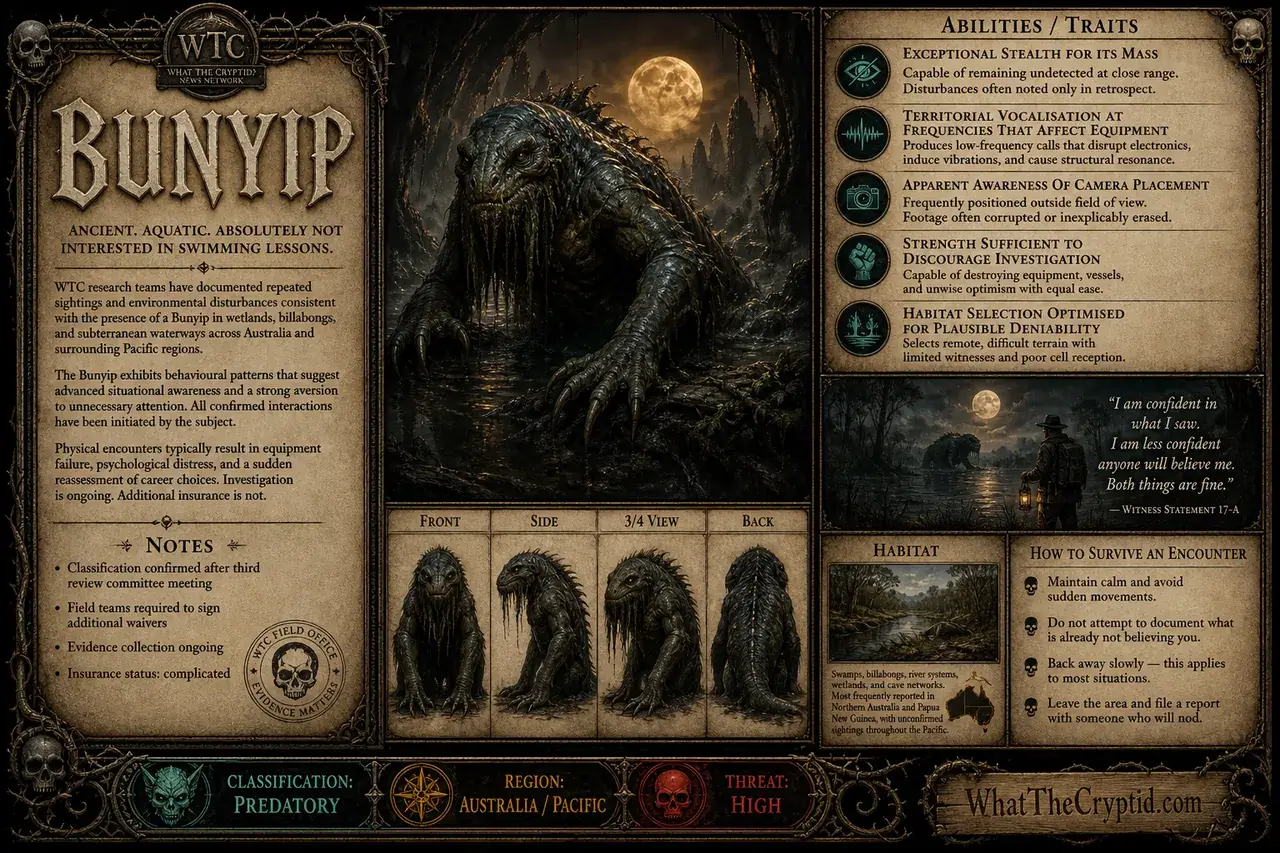
Bunyip
Ancient. Amphibious. Not interested in your proximity.
Australia/Pacific
Unverified
AquaticAustraliaIndigenous TraditionBillabongApex Predator
Overview
The Bunyip is a large semi-aquatic entity native to the inland waterways, swamps, billabongs, and river systems of the Australian continent, with a documented range extending from the Murray-Darling Basin north into Queensland and west into the more seasonally flooded regions of South Australia. It occupies the upper tier of its local food chain by most accounts, though the precise mechanics of this position remain — through no fault of researchers — not fully understood. The entity is regarded by Indigenous Australian communities across dozens of distinct language groups as established, territorial, and not to be trifled with, which represents a consistency of assessment that WTC considers statistically meaningful.

Unlike many cryptids whose existence rests on a handful of disputed photographs and the memories of people who were, in hindsight, very far from their vehicles, the Bunyip enters the record with unusual frequency and from an unusual breadth of sources. Colonial naturalists, Indigenous oral tradition, newspaper correspondents, pastoralists, and at least three individuals who were at the time attempting to do something entirely unrelated to cryptozoology have all contributed accounts. The entity has, in this sense, done more documentation work than most.
WTC classifies the Bunyip as Active, a designation it has held continuously since the database was established, and which it shows no signs of relinquishing.
History & Mythology
The Bunyip occupies one of the oldest continuous cryptid records on earth. Indigenous Australian accounts, preserved across oral traditions representing no fewer than thirty distinct language groups, describe a large waterway predator with consistent territorial behaviour and a marked hostility to encroachment. These accounts predate European contact by an estimated tens of thousands of years, a timeframe that WTC’s historical research team notes makes the Loch Ness Monster’s twelfth-century origin story look somewhat recent by comparison.
European documentation begins in earnest in the early nineteenth century. An 1845 account in the Port Phillip Gazette describes an unidentified large animal observed in a billabong near the Murray River by a surveying party that subsequently declined to survey that particular area further. In 1846, a partial skeleton of unknown species was displayed publicly in Sydney, drawing crowds and significant debate among colonial naturalists before being identified — with what observers noted was an unusual degree of institutional haste — as a distorted horse skull. The naturalist William Caldwell, visiting Australia in the 1880s to study the platypus, recorded local accounts of a second large and anatomically improbable aquatic animal in the same river systems, noting in his journals that the Indigenous guides he employed considered the matter entirely settled and found his follow-up questions politely puzzling.
Throughout the late nineteenth and early twentieth centuries, Bunyip sightings appeared in regional Australian newspapers with a regularity that suggests either a genuine recurring phenomenon or an editorial culture with extremely permissive standards for natural history correspondence. WTC has reviewed 214 such accounts and found no evidence that the newspapers in question were attempting to be funny.
Physical Description
Consistent physical description of the Bunyip has been the subject of considerable academic frustration, primarily because the entity does not appear to have received the academic memo. Accounts vary in ways that have led some researchers to propose multiple distinct species, regional variants, or the possibility that the Bunyip is simply not cooperative about being observed under controlled conditions. What follows represents the convergent features across the most rigorously documented accounts.
Body length in credible accounts ranges from 1.8 to 3.7 metres, with mass estimates — where witnesses have been willing to speculate, which is not always — suggesting an animal of 200 to 450 kilograms. The head is consistently described as large relative to body proportion, with a broad, flat muzzle in some accounts and a more elongated profile in others; WTC’s working hypothesis is that these represent two morphological variants rather than two different animals making identical life choices. Eyes are described across accounts as large, dark, and positioned for wide lateral vision, consistent with a crepuscular or nocturnal hunter that would prefer to see what is beside it in the water. A substantial, dog-like head of coarse dark hair or a rough mane is noted in multiple independent accounts from the Murray-Darling region specifically.
The body is described as broadly seal-like or otter-like in its proportions, with short powerful forelimbs adapted for both swimming and terrestrial movement, and a tail that witnesses variously describe as broad and flat, or absent, or present and irrelevant because they were already running. The skin or coat is described as dark — ranging from dark brown to near-black — which, given the entity’s preferred habitat of murky freshwater systems at low light conditions, functions as adequate natural camouflage and has made photography predictably difficult.
Behaviour & Temperament
The Bunyip is primarily crepuscular, with peak activity documented at dawn and dusk, and a secondary period of nocturnal activity during warmer months that aligns with higher prey availability near waterway margins. During daylight hours the entity is believed to rest in deeper sections of rivers or billabongs, a behaviour that reduces both its energy expenditure and the number of people who have to file incident reports. It is solitary and highly territorial, with individual ranges estimated from sighting pattern analysis at between 12 and 40 kilometres of continuous waterway, depending on habitat quality and the availability of what WTC’s field team has taken to calling ‘sufficient personal space.’
The Bunyip’s most consistently documented behaviour is its vocalisation, described across accounts as a loud, booming bellow or roar, occasionally likened to a bull or to large surf breaking at close range. This call is used for territorial advertisement and, on several recorded occasions, as a direct response to human presence near water’s edge after dark — a context in which it has proven highly effective. The entity does not appear to pursue individuals who retreat promptly, a detail that WTC considers practically useful and has included in its threat assessment accordingly.
There are no documented accounts of pair bonding or parental behaviour, though several accounts from settled pastoral regions describe what appear to be juvenile individuals in shallower waterways, implying reproductive activity that the entity has managed entirely without scientific assistance.
Habitat & Territory
The Bunyip occupies the permanent and semi-permanent freshwater systems of inland and coastal Australia, with confirmed habitat including the billabongs of the Murray-Darling Basin, the swamp margins of the Victorian Western District, and the deeper river pools of the eastern ranges from Victoria north through New South Wales and into southern Queensland. The entity demonstrates a preference for waterways with dense marginal vegetation — reed beds, lignum swamps, and river red gum corridors — that provide both cover for approach and structural complexity in which a large animal can remain undetected for periods that field researchers find instructive.
Elevation range runs from sea level to approximately 900 metres in the eastern highlands, though the majority of credible sightings cluster below 400 metres in association with slow-moving or still water of sufficient depth to conceal a large submerged body. The Bunyip is not exclusively aquatic — multiple accounts describe it moving overland between disconnected water bodies during wet season expansion, a behaviour that has historically introduced it to environments and individuals who were not expecting it. WTC recommends consulting regional flood maps when planning fieldwork, not only for the usual reasons.
Diet & Hunting
The Bunyip is an opportunistic apex predator whose documented diet, assembled from physical evidence, witness accounts, and inference from habitat use, includes large freshwater fish, waterfowl, freshwater turtles, and the small to medium terrestrial mammals that approach the water’s edge to drink. In the Murray-Darling system this historically included large macropods, wombats, and livestock — the pastoral record contains a statistically notable number of nineteenth-century accounts describing cattle and sheep disappearing from river frontages overnight, filed by farmers who were not, at the time, prepared to name the specific cause and who in retrospect were probably wise not to.
Hunting method appears to be primarily ambush from water, consistent with the entity’s build and its established preference for operating at low light. The Bunyip does not appear to waste significant energy on extended pursuit, which is either an indication of efficient ambush success rates or a temperament that finds prolonged exertion unnecessary. Seasonal diet shifts are documented, with increased terrestrial prey taking noted in summer months when waterway levels drop and aquatic prey concentrates, a pattern that also concentrates livestock and, incidentally, field researchers at the remaining permanent water sources.
Notable Sightings
Pastoralist Robert Kessing reported an encounter with a large dark animal at the lake’s edge at approximately 5:30 a.m. while moving cattle to water. Kessing described the entity as ‘the size of a full-grown bullock but built for the water,’ and noted it watched the cattle for several minutes before submerging. A full head and partial neck were visible above the waterline for a duration Kessing estimated at four minutes. Kessing relocated his cattle watering point to a creek 11 kilometres distant the following week and did not return to Lake Modewarre for the remainder of the pastoral season.
A group of five river workers clearing snags from the Murrumbidgee River reported a large animal surfacing twice alongside their punt in the late afternoon, at an estimated distance of 6 to 8 metres. The animal was described by foreman Jack Tilley as ‘the length of a dinghy and built heavier, with a head like a dog that had grown to a size a dog has no right to be.’ The surfacing lasted approximately 40 seconds on the second occasion before the animal dived without disturbance. The crew completed their contracted clearing work, requested hazard pay, and were denied.
Ornithologist Dr. Patricia Crowe, conducting a waterbird survey for what was then the South Australian Department of Environment, recorded in her field notes an encounter with an unidentified large mammal at the lagoon’s northern margin at 6:10 a.m. on March 14th. Crowe observed the animal for an estimated six minutes at a distance of approximately 25 metres, noting its broad dark head, ‘distinctly seal-like’ body movement through shallow water, and total indifference to her presence. A photograph was taken on a Pentax K1000; the developed image showed what Crowe described in writing as ‘the north end of something going south.’ Dr. Crowe submitted a supplementary appendix to her waterbird survey, which the department did not include in the final published report.
Wetland ecologist Tim Horgan, conducting a routine vegetation transect, reported hearing a large animal moving through reed beds at close range before a brief visual sighting of a broad, dark, ‘dog-headed’ shape crossing a shallow open channel approximately 15 metres ahead of him. Horgan estimated the visible body length at 2.2 metres. He noted the time, location coordinates, and a physical description in his field notebook before completing the remainder of his transect. The notation occupies four lines of a standard field notebook and is written in the same handwriting as the surrounding vegetation data, which Horgan’s supervising researcher later described as ‘either very professional or very concerning.’
Threat Assessment
The Bunyip presents a genuine risk to individuals operating near permanent freshwater systems in its documented range, particularly at dawn, dusk, and during nocturnal hours. WTC rates this risk as High. The entity’s documented hunting method — ambush from water at close range — means that standard wildlife awareness protocols based on visual detection at distance are of limited practical value, a constraint that WTC acknowledges without a satisfactory workaround.
Recommended practice: maintain a minimum distance of 10 metres from the water’s edge when operating in known Bunyip habitat at low light hours. Do not wade or enter water between dusk and full daylight in billabong or river pool environments with low visibility. Increase this exclusion zone to 20 metres in areas of known recent activity. The Bunyip does not appear to pursue individuals who vacate the immediate margin promptly upon detecting its presence — its territorial vocalisation should therefore be treated as an instruction rather than an atmospheric event. WTC is not in a position to guarantee the efficacy of these precautions, as the data required to establish guarantee-level confidence would require experimental conditions that no ethics board has approved, nor should they.
WTC Field Notes
WTC’s Australasian field team has been attempting to obtain current photographic documentation of the Bunyip for eleven years. We have deployed seventeen camera traps across six sites in the Murray-Darling system, of which nine have been submerged by flooding, four have produced images of coots, and the remaining four returned footage of what our senior researcher described as ‘a darkness that moved in a way water doesn’t.’ The footage is stored on a hard drive in our Sydney satellite office pending enhancement work that has been pending for three years.
The network notes with professional interest that the Bunyip is one of a small number of cryptids in the WTC database that has generated formal institutional avoidance behaviour in addition to anecdotal witness avoidance behaviour. The 19th-century Sydney Museum incident, the Department of Environment report excision, and at least two state government natural history publications that mention the Bunyip only in the context of Indigenous mythology and not in the context of the field reports also held on file are a pattern WTC has noted. We do not draw conclusions from patterns. We document them and submit the documentation to a budget review committee that meets quarterly.