
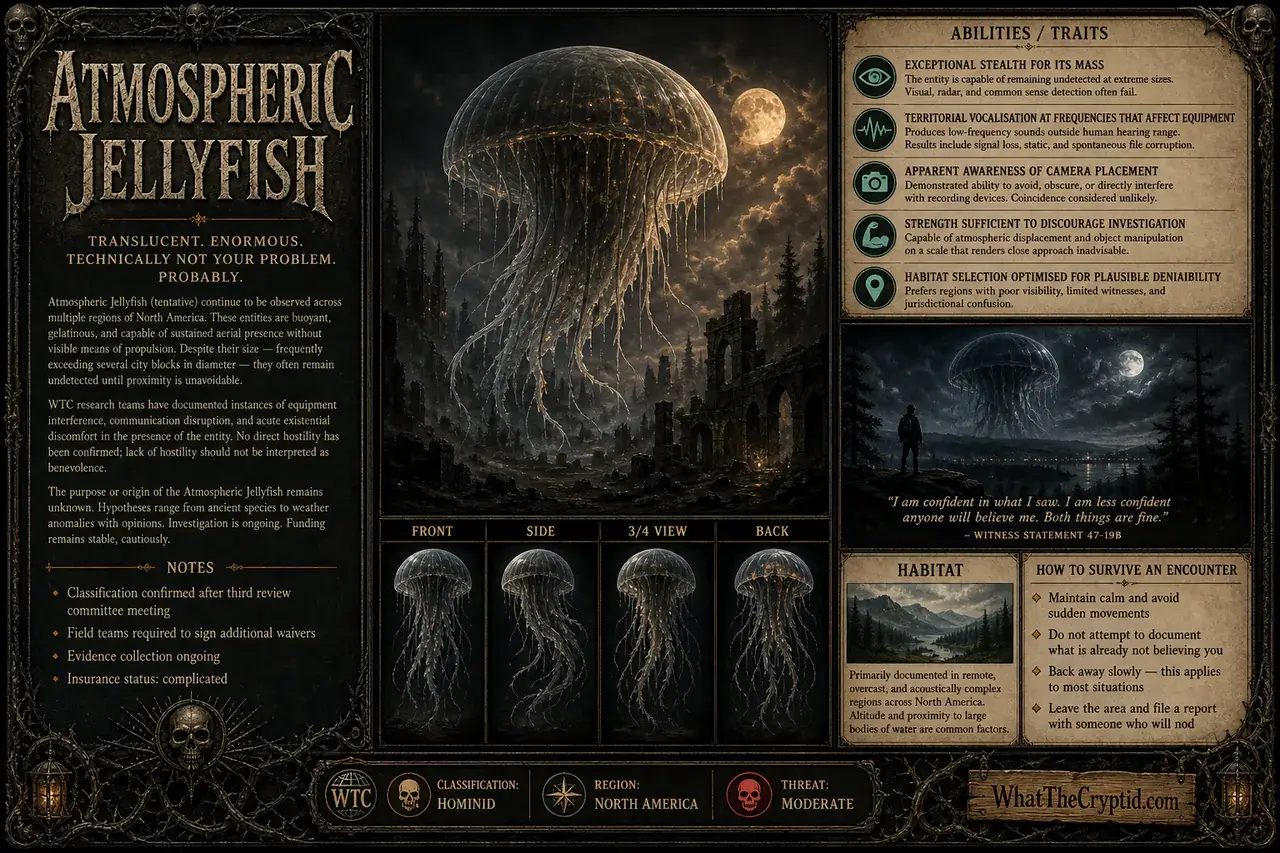
Atmospheric Jellyfish
Translucent. Enormous. Technically not your problem. Probably.
North America
Active
AerialBioluminescentAtmosphericCnidarian-Analogous
Overview
The Atmospheric Jellyfish is a large, gelatinous aerial entity reported by witnesses across six continents, typically observed drifting at altitudes between 300 and 2,000 feet in conditions ranging from clear skies to overcast. It presents as a translucent, bioluminescent mass with trailing filaments, structurally analogous to marine cnidarians of the order Rhizostomeae, though no formal taxonomic classification has been proposed by any institution willing to put its name to one. WTC classifies it as Aquatic on the reasonable grounds that it appears to be one, and that reclassifying the entire Aquatic category to accommodate it would require a budget meeting.
Estimated body diameter across documented sightings ranges from 4 to over 200 feet, a variance that has led to ongoing internal debate at WTC about whether these represent a single highly variable species, multiple distinct species sharing an aesthetic, or a measurement problem. The trailing filaments — described uniformly across independent sightings as semi-opaque and faintly luminous — have been reported at lengths of up to 300 feet in high-altitude encounters, which, if accurate, would make the Atmospheric Jellyfish among the largest organisms ever observed in any medium.

The entity is not known to have caused direct harm to humans, though the qualifier ‘not known’ is doing considerable work in that sentence.
History & Mythology
The earliest credible documentary evidence for the Atmospheric Jellyfish appears in a 1926 report filed by Royal Air Force pilot Lieutenant Harold Greaves following a training exercise over Wiltshire, England. Greaves described ‘a vast translucent mass, pulsing rhythmically, trailing luminous threads of considerable length’ that his Bristol Fighter passed beneath at approximately 800 feet. The report was filed under the category ‘Atmospheric Phenomena — Unexplained’ and remained in that category, which at the time contained seventeen other entries, all of them more explicable than this one.
Prior to Greaves’s account, analogous descriptions appear in the maritime records of Pacific Island cultures, several of which include oral traditions describing sky beings that drift with the trade winds and descend during electrical storms. WTC’s consulting ethnographer, Dr. Anita Osei, notes that these accounts share structural details — the pulsing motion, the trailing filaments, the indifference to observers — with a consistency that she describes as ‘either culturally significant or very inconvenient, depending on your prior commitments.’ The traditions generally treat the entities as neither malevolent nor benevolent, but as features of the sky in the way that clouds are features of the sky, which is a position WTC finds oddly reasonable.
A notable cluster of sightings in 1967 across the American Midwest, corroborated by independent radar contacts logged by three separate FAA facilities over six days in August, prompted a brief federal inquiry. The inquiry concluded without published findings. The radar logs were reclassified. The FAA personnel involved were transferred to facilities WTC has been unable to identify from public records.
Physical Description
The Atmospheric Jellyfish presents a bell-shaped or dome-shaped central mass — referred to in WTC field documentation as the ‘mesoglea body’ — which is consistently described as translucent to semi-transparent, allowing observers beneath it to perceive a faint distortion of sky and light through its upper surface. Coloration varies from near-colourless in daylight conditions to a pale blue-green bioluminescence after dusk, which witnesses have described variously as ‘beautiful,’ ‘deeply wrong,’ and, in one case, ‘the colour of a television tuned to a dead channel, but vertical.’ The internal structure visible through the bell includes darker, branching formations whose function has not been determined, largely because no researcher has been in a position to determine it.
Filaments trailing from the bell margin are the feature most consistently described across independent accounts. These structures appear in clusters, taper toward their extremities, and demonstrate slow, passive movement consistent with drift rather than active locomotion. They range in documented length from 30 feet in smaller specimens to over 300 feet in the largest reported sightings, and have been observed to retract partially when the entity rises in altitude, which is behaviour that raises questions WTC has tabled for a later meeting.
Two apparent morphological variants have been identified in the sighting record. The first is the standard open-sky form: large, slow-moving, observed primarily in fair weather. The second, reported less frequently, is a compressed, darker variant associated with storm systems, which several witnesses have described as moving with apparent purpose, a characterisation our field editors have asked researchers to treat with what they call ‘measured scepticism’ and what our researchers call ‘you weren’t there.’
Behaviour & Temperament
The Atmospheric Jellyfish is, by all available evidence, profoundly uninterested in human beings. Witnesses consistently report that the entity continued its drift without observable response to being observed, shouted at, photographed, or, in one documented case, illuminated with a commercial aircraft’s landing lights for approximately forty seconds. This is not the behaviour of an entity that has failed to notice human observers. The consensus at WTC is that it has simply concluded that human observers are not relevant to its situation, which is a conclusion that is difficult to argue with from a purely empirical standpoint.
Movement is consistent with passive atmospheric drift for the majority of observed behaviour, with the entity carried by prevailing winds at speeds matching local conditions. However, multiple witnesses have reported what they describe as ‘purposive ascent’ — rapid vertical movement upward that does not correspond to wind conditions — particularly when aircraft approach within approximately half a mile. Whether this constitutes evasion, coincidence, or a response to pressure changes WTC is not in a position to assess without instrumentation it does not currently own.
Nocturnal sightings account for approximately 40% of the documented record, with bioluminescent activity appearing to increase after sunset. Several night sightings have been accompanied by reports of localised electromagnetic interference — compass deviation, radio static, vehicle electronics resetting — though the causal relationship between the entity and these effects remains unestablished. WTC notes only that the correlation is consistent enough to have appeared in the insurance exclusion list for field equipment deployed in zones of recent sighting activity.
Habitat & Territory
The Atmospheric Jellyfish has been reported at altitudes ranging from approximately 200 feet — low enough that witnesses in several cases initially mistook the trailing filaments for unusual fog — to an estimated 12,000 feet in one account provided by a commercial airline crew who requested that WTC not use their names, their airline, or their route information, a request with which WTC has partially complied. The entity appears to favour open airspace over lowland terrain, with a slight statistical preference in the sighting record for proximity to large bodies of water, coastal zones, and river valleys. Whether this reflects a physiological preference for humidity, a navigational behaviour, or simply the distribution of human observers who look upward near water is not determinable from available data.
Sightings show no strong seasonal pattern, occurring across all months in the record, though a modest concentration in late summer and early autumn in northern hemisphere locations has been noted by WTC analyst Priya Ramsay, who described it in her internal memo as ‘suggestive but not conclusive, which is the condition of everything in this database.’ No nesting, roosting, or ground-contact behaviour has ever been documented. The Atmospheric Jellyfish, to the extent that it can be said to live anywhere, lives in the sky.
Diet & Hunting
What the Atmospheric Jellyfish consumes, if it consumes anything, is the central open question of its biology. No feeding behaviour has been directly observed. The entity carries no visible mouth structure in any documented account, and the internal formations visible through the bell have not been identified as digestive organs by any biologist who has reviewed the available imagery — though two consulting biologists declined to provide written assessments, preferring instead to describe their conclusions verbally in terms that WTC’s legal team has advised us not to reproduce.
The leading hypothesis among WTC-affiliated researchers is atmospheric energy absorption: that the entity derives sustenance from electrical charge differential, ultraviolet radiation, or some combination of atmospheric conditions not yet characterised. This hypothesis is supported primarily by the observation that the Atmospheric Jellyfish appears to thrive without eating anything anyone can identify, which is a form of support that WTC acknowledges is less rigorous than one might prefer. A minority position holds that the trailing filaments serve a prey-capture function analogous to those of marine jellyfish, which would imply a diet of insects, birds, or small aircraft components — a possibility that the sighting record neither confirms nor entirely rules out.
Notable Sightings
RAF Lieutenant Harold Greaves, returning from a solo training sortie in a Bristol Fighter, reported passing beneath a translucent aerial mass estimated at 60 feet in diameter at approximately 800 feet altitude. Greaves described sustained pulsing motion and trailing filaments ‘of a luminous quality inconsistent with cloud formation or known aerial phenomena.’ His aircraft experienced no mechanical effects. The report was reviewed by two senior officers, classified under Atmospheric Phenomena — Unexplained, and Greaves was assessed as fit for continued service. He flew without incident for another eleven years and never filed a second report of this nature, a fact the RAF’s records note without elaboration.
The crew of offshore drilling platform Meridian-7 reported a luminous aerial mass drifting north-northeast at an estimated altitude of 400 feet at approximately 2:15 AM local time. Platform manager Dale Chukwu logged the observation and estimated the bell diameter at 150 feet based on comparison with the platform’s known dimensions. Sixteen crew members provided consistent independent descriptions over the following 48 hours. Chukwu submitted the report to the platform’s parent company, Meridian Energy, whose environmental compliance officer forwarded it to two federal agencies. Chukwu confirmed receipt of an acknowledgement letter containing no substantive response. The report is available in Meridian Energy’s public disclosure archive under the heading ‘Misc. Environmental Observations — Not Actionable.’
Farmer Wei Longshan and his son observed a large translucent entity drifting above the Dadu River valley at dawn, which Wei described in his account to local journalists as ‘a floating lantern the size of a house, but with roots.’ The trailing filaments were observed dragging through the upper canopy of riverbank trees for a period of several minutes before the entity ascended and moved northeast. Two trees in the affected area showed physical evidence consistent with contact from a fibrous material, assessed by a Chengdu University botanist as ‘unusual abrasion of a type inconsistent with known local flora, fauna, or weather events.’ The botanist submitted a follow-up paper proposal to three journals. The proposal was declined by all three without reviewer comment.
Amateur astronomer Valentina Ríos captured 23 minutes of video footage during a night observation session south of San Antonio de Areco, recording a bioluminescent mass she initially logged as an unidentified satellite before the object altered its trajectory in a manner inconsistent with orbital mechanics. The footage shows filamentary structures extending below the central mass and a persistent blue-green luminescence with a measured pulse rate of approximately 8 cycles per minute. Ríos uploaded the footage to three online platforms, where it received significant attention before being removed by automated content moderation systems on each platform within 72 hours. Ríos still has the original file. She has not uploaded it again and has not explained why.
Threat Assessment
WTC rates the Atmospheric Jellyfish as Unknown threat, which is distinct from Low and is worth understanding as a category. Unknown means that the entity has not been documented harming humans, and also that no human has been in a position to document what happens when the entity’s filaments make sustained contact with a person, because no such contact has been recorded and survived in a form that produced a written account. These are related facts.
Field guidance from WTC is as follows: if you observe an Atmospheric Jellyfish, maintain a minimum horizontal distance of 500 feet from any observed filament extremity. Do not attempt to make contact with trailing structures from any platform, including aircraft, drones, or elevated ground positions. If the entity descends toward your location, move perpendicular to its drift direction rather than directly away or toward it — this is based on the entity’s documented drift behaviour and is not a guarantee of any outcome. Carry a compass as a secondary navigation instrument when operating in zones of recent sighting activity, as GPS and electronic navigation instruments have shown elevated failure rates in these areas. WTC acknowledges that this guidance was developed without the benefit of any controlled encounter, and that ‘perpendicular to drift’ is the considered recommendation of people who have not had to implement it.
WTC Field Notes
WTC has been attempting to deploy instrumented high-altitude balloon platforms in primary sighting zones since 2019. Three payloads have been lost to confirmed weather events. One was recovered with its camera intact and its footage corrupted. One was not recovered and has not been located. The programme is currently on hold pending a funding review that our director describes as ‘ongoing’ and our equipment manager describes as ‘effectively concluded.’
The editorial decision to classify the Atmospheric Jellyfish as Aquatic rather than creating a new Aerial classification was made at a staff meeting in which our classification committee — which is one person — argued that the structural and behavioural analogies to marine cnidarians were sufficient to justify the existing category, and that opening the classification system was ‘a door that, once opened, would require a much larger database and a much larger staff.’ This reasoning was accepted. WTC is aware that ‘it looks like a jellyfish and it’s in the sky’ is not a taxonomic argument. We are also aware that it is not nothing.