
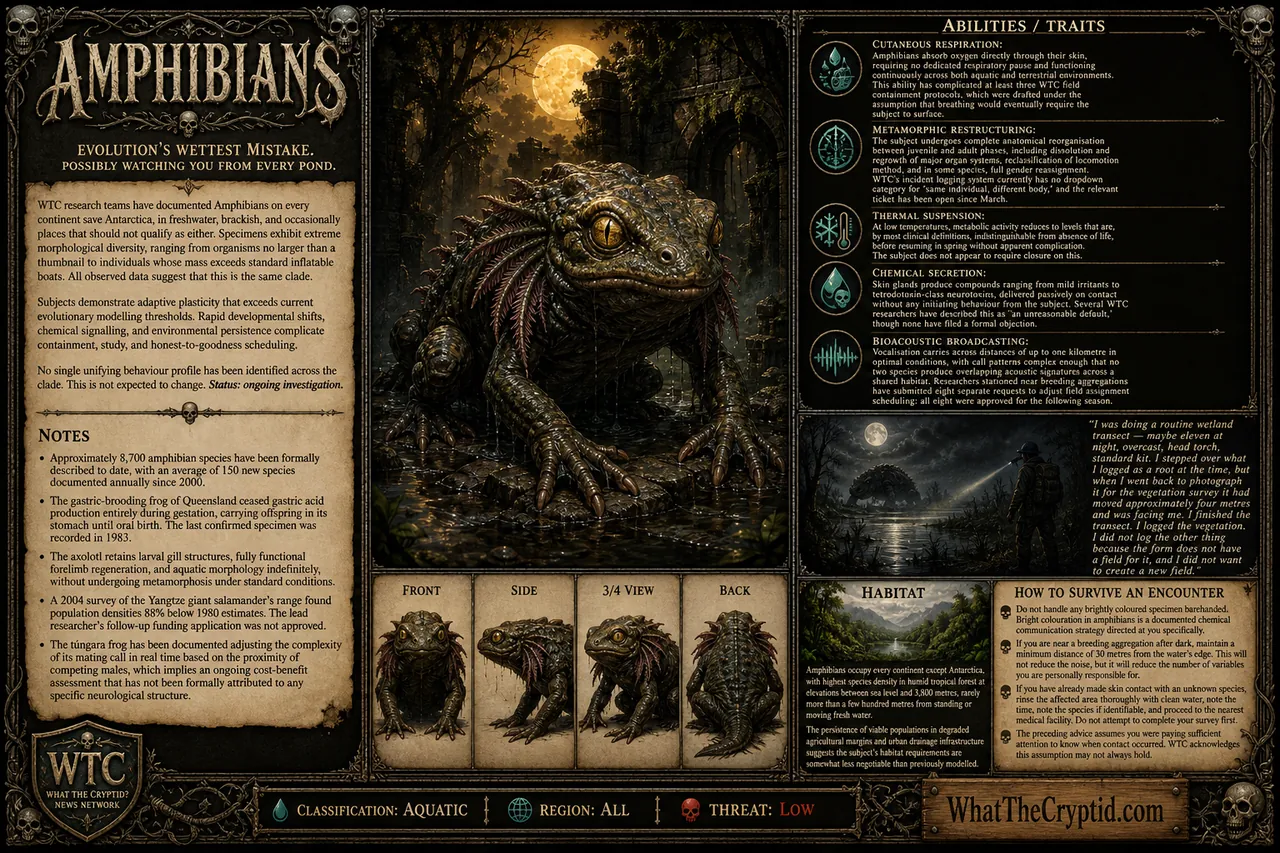
Amphibians
They were here before the trees. They are still here.
All
Unverified
AmphibianAquaticGlobal RangeExtinction RiskToxin-Producing
Overview
Amphibians constitute a class of ectothermic tetrapods occupying a documented range of every continent except Antarctica, a distribution that WTC notes they achieved without any apparent difficulty and without being asked. Comprising approximately 8,700 formally described species across three extant orders — Anura (frogs and toads), Urodela (salamanders and newts), and Gymnophiona (caecilians, which are the ones most people do not know about and which have not taken this well) — they represent one of the most persistently successful vertebrate lineages in the geological record. They have survived four mass extinction events. WTC has survived two office relocations and a network restructure, and we consider this a point of solidarity.

The defining characteristic of the amphibian body plan is a lifecycle that proceeds in two fundamentally different physical forms — an aquatic larval stage followed by a terrestrial or semi-terrestrial adult stage — a transformation so complete and so routine that biologists have had to develop entirely separate terminology to describe it, terminology that still occasionally surprises students encountering it for the first time. The permeable, glandular skin that enables cutaneous respiration also renders the organism acutely sensitive to environmental contamination, a quality that has made amphibians widely recognised as sentinel species for ecosystem health. What they are sensing, they have not been able to communicate directly. The data, however, is not encouraging.
WTC classifies Amphibians as Active, which required no deliberation.
History & Mythology
The first amphibians emerged from shallow Devonian water bodies approximately 375 million years ago, a transition documented with unusual clarity in the fossil record given the circumstances. Tiktaalik roseae, recovered from Ellesmere Island, Nunavut, in 2004, represents one of the most compelling transitional forms yet discovered, exhibiting a flat head, a functional neck, and proto-limb structures that its aquatic predecessors conspicuously lacked. WTC has reviewed the fossil photographs and can confirm the neck is genuinely unsettling.
In human cultural and mythological traditions, amphibians — and frogs specifically — appear with a frequency that suggests early civilisations found them difficult to ignore. Ancient Egyptian cosmology included the frog-headed goddess Heqet, associated with fertility and the inundation of the Nile, a river event that annually produced frogs in numbers the historical record describes only as ‘considerable.’ Mesoamerican traditions documented Tlaltecuhtli, a toad deity of some complexity. European medieval traditions classified toads as associates of witchcraft, a designation that may have reflected genuine observation of their tendency to appear near damp, shaded areas at night, or may have reflected something else entirely. The historical sources are not specific on this point.
Formal scientific classification of amphibians as a distinct vertebrate class was established by Pierre André Latreille in 1804, consolidating earlier taxonomic work by Linnaeus and Laurenti into a framework that has been substantially revised several times since, most recently and dramatically by molecular phylogenetics, which continues to add species at a rate that prevents any reference document from remaining current for more than approximately eighteen months.
Physical Description
Physical dimensions across the class span a range that creates some difficulty in generalising. Paedophryne amauensis, a microhylid frog from Papua New Guinea formally described in 2012, holds the current record as the world’s smallest known vertebrate, with a snout-to-vent length of 7.7 millimetres. The Chinese giant salamander, Andrias davidianus, reaches documented lengths of 1.8 metres and weights in excess of 60 kilograms, dimensions that have caused initial confusion with other entries in this database on more than one occasion. WTC acknowledges this is partly our fault for the layout of the search results.
Skin texture and colouration across the class serves functions that are, depending on species, either camouflage or the direct opposite of camouflage. The poison dart frogs of family Dendrobatidae display colouration in blues, yellows, reds, and combinations thereof that functions as aposematic warning signalling — a biological instruction, rendered in colour, that field researchers have broadly described as effective. The golden poison dart frog, Phyllobates terribilis, carries sufficient batrachotoxin in its skin to cause cardiac arrest in a human adult; it is 55 millimetres long and weighs approximately 28 grams and appears to be aware of neither of these facts simultaneously.
Salamanders and newts present a body plan of notable consistency across their approximately 700 species — elongate trunk, four limbs of roughly equal size, and a tail retained into adulthood, which distinguishes them from frogs, which reabsorb the tail during metamorphosis in a process that WTC staff have been asked to stop describing at lunch. Caecilians, being limbless and largely subterranean, present a body plan that is best described as deliberate.
Behaviour & Temperament
Amphibians are, as a class, not doing anything to you. This point is worth establishing early, because the permeable skin, the large eyes, the occasional glandular secretions, and the tendency to appear unexpectedly in cellars and garden ponds have collectively generated a cultural unease disproportionate to the actual documented threat profile. The majority of species are insectivorous, nocturnally active, and motivated primarily by thermoregulation, foraging, and reproduction — a behavioural portfolio that WTC notes is also broadly applicable to several of our field researchers.
Vocal behaviour in frogs is among the more extensively documented amphibian characteristics, with individual species producing calls specific enough to permit identification without visual confirmation. The American bullfrog, Lithobates catesbeianus, produces a call audible at distances of up to half a mile under appropriate atmospheric conditions. Breeding choruses of certain tropical species have been measured at decibel levels comparable to construction equipment. Whether this constitutes a problem depends entirely on whether you were attempting to sleep.
Social structure across the class is largely absent in the conventional sense, with most species aggregating only for breeding and dispersing immediately afterward. Parental care, where it occurs, ranges from egg-guarding in some salamander species to the extraordinary gastric brooding behaviour of Rheobatrachus silus, an Australian frog that incubated its young in its stomach and suppressed its own digestive processes for the duration — a behaviour documented between its formal description in 1973 and its extinction, which occurred before the mechanism was fully understood. The subject appeared unconcerned with the timeline.
Habitat & Territory
Amphibians occupy freshwater margins, tropical rainforest, temperate woodland, subalpine meadow, underground aquifer systems, and the undersides of logs in a range of conditions that reflects 375 million years of experimentation with available real estate. The critical requirement across nearly all species is access to moisture sufficient to prevent desiccatory stress through the skin — a constraint that has shaped distribution patterns in ways that make amphibian presence or absence a reliable indicator of local moisture regime. Several caecilian species occupy entirely subterranean aquifer systems and have, over evolutionary time, lost functional eyes, a trade-off that appears to have been assessed and accepted.
Elevation ranges extend from sea level to above 5,000 metres in the case of certain Andean and Tibetan plateau species, though productivity and species diversity peak in tropical lowland zones where moisture and temperature permit year-round activity. Breeding habitat typically requires standing or slow-moving fresh water of sufficient depth and vegetation cover for egg attachment, though the midwife toad, Alytes obstetricans, circumvents this requirement by carrying egg strings on its hind limbs until hatching — an arrangement that works, evidently, because the species exists.
Diet & Hunting
The adult amphibian diet is, across the vast majority of species, carnivorous in practice if not always in the strictest taxonomic sense, focusing on invertebrates — insects, worms, molluscs, and arthropods — taken opportunistically by ambush at ranges that vary by tongue morphology. Frogs with ballistic projectile tongues capable of generating accelerations of up to 12,000 metres per second squared can take prey at distances of up to one-third of their body length in under 100 milliseconds, a performance characteristic that continues to interest materials scientists for reasons only partially related to frogs. The tongue returns to the mouth whether or not the prey was successfully secured, which WTC finds admirable as a policy.
Larger species expand their prey range accordingly. The African bullfrog, Pyxicephalus adspersus, at weights up to 2 kilograms, takes rodents, small reptiles, and other frogs, and has been documented biting and retaining human fingers with a grip force that encouraged release. The Surinam horned frog, Ceratophrys cornuta, has a gape-to-body ratio that has prompted the informal field designation ‘walking mouth,’ a term that does not appear in the formal literature but appears in field notebooks more frequently than the formal literature might expect. Larval stages in many species are herbivorous filter feeders, consuming algae and detritus, a dietary reversal on metamorphosis that has no close parallel in vertebrate development and that developmental biologists describe as ‘mechanistically interesting,’ which is the field’s way of acknowledging they are still working on it.
Notable Sightings
Researchers from the Centro de Biodiversidad y Genética documented Telmatobius culeus, the Titicaca water frog, in aggregations significantly reduced from those recorded in a 1975 baseline survey, with surviving individuals presenting dermal abnormalities consistent with chytrid fungal infection. The species — which respires almost entirely through elaborately folded skin described by one team member as ‘excessive, even for a frog’ — occupies depths of up to 10 metres and has no terrestrial phase as an adult. The team submitted their findings to the Bolivian Ministry of Environment. A follow-up survey was scheduled for 2018 and rescheduled three times.
Herpetologist Marty Crump, conducting a long-term breeding survey of Atelopus zeteki and associated montane species, recorded the last confirmed sighting of Bufo periglenes, the golden toad, on May 15th of that year — a single male, observed at a breeding pool that had held up to 1,500 individuals in surveys conducted four years prior. The species had been formally described only in 1966. Subsequent surveys over three consecutive seasons found no further individuals, and the species was formally declared extinct in 2004, the first vertebrate extinction attributed primarily to climate-driven disease dynamics. Crump’s field notes from that day run to two sentences.
A survey team from the US Forest Service conducting routine timber assessment in Monongahela National Forest reported an eastern red-backed salamander, Plethodon cinereus, at an elevation of 1,340 metres — approximately 200 metres above the previously recorded upper range limit for the species in that watershed. The finding was corroborated by two additional individuals recovered under cover boards within a 15-metre radius. The team’s botanist noted that understory vegetation composition at the site was inconsistent with historical records for the elevation, which the team’s herpetologist noted was not a coincidence, and both observations were filed in the same report. The report is available through the agency’s public records portal with a processing time of six to eight weeks.
A wildlife photographer, name withheld at their request, documented what they described as ‘a frog the size of my hand that did not move for forty minutes despite me being approximately thirty centimetres away from it’ and submitted the photograph to the Queensland Museum for identification. The specimen was confirmed as Litoria infrafrenata, the white-lipped tree frog, Australia’s largest native frog species, at an estimated snout-to-vent length of 13 centimetres, which is within normal range. The photographer requested confirmation that it was ‘supposed to look like that.’ The museum confirmed it was.
Threat Assessment
The documented threat posed by amphibians to humans is, in the majority of encounter scenarios, negligible. Most species will flee, freeze, or inflate their bodies to appear less manageable before making physical contact, a de-escalation sequence that WTC recommends humans also adopt in analogous situations. The primary exception category involves species producing dermal toxins, where the recommended protocol is to avoid handling and to wash hands thoroughly if contact occurs, advice that WTC notes applies to a number of situations not listed in this entry.
For encounters with the African bullfrog, Pyxicephalus adspersus, or the South American horned frogs of genus Ceratophrys, WTC recommends maintaining a handling distance of zero centimetres — that is, not handling them — particularly during breeding season when both species exhibit elevated defensive aggression. If a specimen of either has already secured a grip, do not attempt to pull away directly, as the serrated tooth-like vomerine projections in the upper jaw can cause lacerations disproportionate to what the size of the animal suggests is possible. This advice is, we acknowledge, most useful before the situation arises.
WTC Field Notes
The WTC Amphibian File was initially compiled as a single entry covering ‘frogs, toads, and related’ before our senior taxonomist requested a meeting. The meeting lasted ninety minutes. The entry now covers the class Amphibia in its entirety, across 8,700 species, on a budget originally allocated for a single regional cryptid. Our editor has described this as ‘scope expansion without corresponding resource allocation,’ which is accurate. The caecilian subsection was written entirely during a layover in Panama City airport and has not been reviewed by anyone with caecilian field experience, a situation we intend to remedy when staffing permits.
It should be noted for the record that WTC received this assignment with some internal discussion about whether amphibians qualify for the cryptid database, given that they are formally described, extensively studied, and in no sense unverified. The counter-argument, which prevailed, is that Batrachochytrium salamandrivorans — a chytrid fungus currently moving through European salamander populations and producing mortality rates of up to 96% in exposed populations — was formally unknown to science until 2013, discovered in Belgium, and is now present across multiple countries. Something was doing that the entire time. We are choosing to treat that as within our remit.