Most households have one. Not all households know it yet. Here is how to check, and what to do with that information once you have it.
The Department of Cryptid Affairs estimates that approximately one in eleven residential properties in the continental United States currently hosts what they classify as an Unconfirmed Ambient Presence — a shadow entity whose occupancy predates, in many cases, the current homeowner’s purchase agreement. DCA Spokesperson Arthur Pritchard confirmed this figure at a press briefing in March, then immediately clarified that ‘estimate’ was doing significant work in that sentence and that residents should not read too much into it. He then took no further questions. The figure has not been updated since 2019.
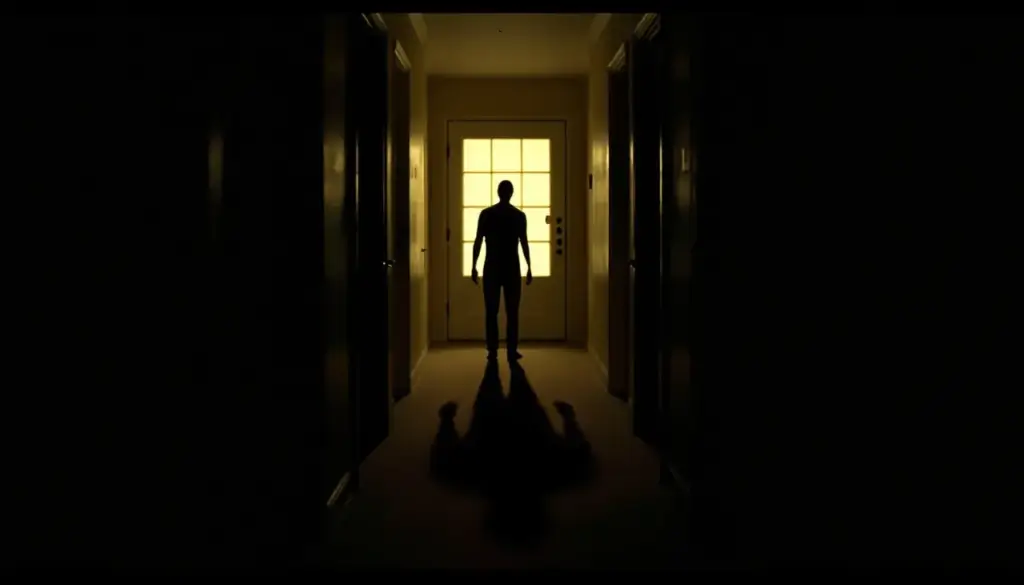
Experts recommend starting with the simplest tests. The most reliable early indicator is spatial displacement — specifically, whether your shadow has begun appearing in rooms you have not entered yet. This can be difficult to catch in real time. What The Cryptid? recommends standing in a doorway and observing whether the shadow on the wall opposite is arriving from the correct direction. If you are standing in the hall and the shadow is coming from the kitchen, this is worth noting. If the shadow in the kitchen is also coming from the hall, you should sit down first and then note it.

The second test is harder to discuss without seeming unreasonable, which is why it tends not to be discussed. It concerns the whisper problem. A significant number of the eight witnesses interviewed for this piece — people who contacted What The Cryptid? after identifying anomalous shadow behaviour in their homes — reported a moment, before they understood what they were dealing with, when they mentioned something to their partner in what they were certain was a whisper. A quiet observation. An aside. Something like: ‘I think there’s something in the hall.’ What follows in almost every account is a pause. Not a verbal response. A pause from the hall itself, lasting between two and four seconds, before normal ambient noise resumed. Several witnesses used the word ‘waiting.’ One witness used the phrase ‘like it was giving me a chance to take it back.’ She did not take it back. She is now in a different property. Her shadow, she says, has behaved correctly since the move, which she describes as encouraging and which she has not stopped thinking about.
It paused. That’s all I can tell you. I said it quietly and it paused, and then the refrigerator started humming again like nothing happened. We don’t have a loud refrigerator.
— Witness, Coos Bay, Oregon — name withheld at their request and the request of their shadow
The remaining signs are as follows, presented in the order in which they typically occur. Third: your shadow arrives at the end of a hallway before you do, rounds the corner, and is gone by the time you get there. This is consistent across thirteen documented cases and is the detail that most often prompts residents to contact either the DCA or What The Cryptid?. Roughly half contact the DCA first. Of those, approximately two-thirds report that the DCA’s response — a form letter acknowledging receipt of their inquiry and directing them to the Ambient Presence Self-Assessment Tool on the DCA website, which has been unavailable since a server migration in 2022 — was not immediately helpful. Fourth: the shadow demonstrates familiarity with your schedule. It is in the kitchen before you are in the morning. It is at the end of the bed before you turn the light off. It does not do anything in either location. It is simply already there. Fifth, and the one residents most frequently dismiss until they can no longer dismiss it: the shadow has a preference. Every witness who reached this stage of identification described a moment when the shadow, given the option of two rooms to precede them into, chose the same room every time. Not randomly. The same room. Most of the time that room is the one with the most mirrors. Dr. Amelia Cross, What The Cryptid?’s network cryptid biologist, has described this as ‘behaviourally consistent with an entity in the orientation phase,’ which she has confirmed is a real phase and which she has declined to describe further on the grounds that the description of subsequent phases tends to upset people and she prefers to be asked directly.
The DCA’s official position is that residents who believe they have identified a shadow entity in their home should document the behaviour, avoid direct confrontation, and submit a Form 7-C (Residential Anomalous Presence — Preliminary Declaration) to their regional DCA office. The form is twelve pages. Page nine requires a notarised witness statement. Arthur Pritchard, when asked how a resident is meant to obtain a notarised witness statement for an entity that does not appear on camera and which most witnesses are reluctant to discuss on record, said the department appreciated the feedback and that the form was currently under review. He has said this at each of the last four press briefings. The form has not changed. If your shadow is in the room you have not entered, the form is almost certainly not the first thing you should be completing. It is, however, something to do while you wait for the DCA to be useful, which experts estimate will take between several months and a structural period of time they are not prepared to define more precisely than that.
Mara Vane — Pendleton, Oregon — What The Cryptid? Field Correspondent. The hallway outside the field office was empty when this piece was filed. It was also empty when checked a second time. The light in there is not great and the tax preparation service below has a mirror in its front window that catches the stairwell at certain times of day. This is the most probable explanation. It has been noted.
maravane@whatthecryptid.com Mara Vane · Senior Investigative Reporter & Field Correspondent — WTC