
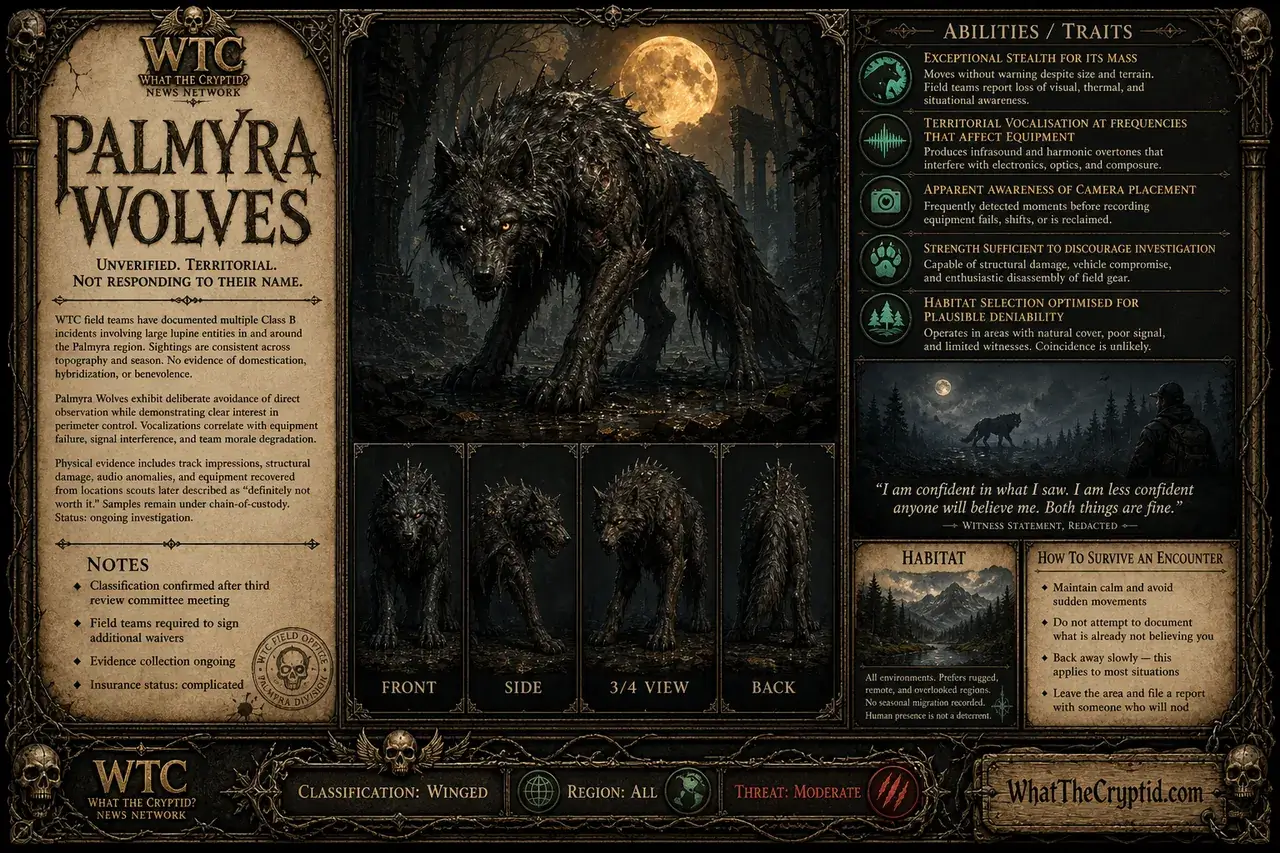
Palmyra Wolves
Unverified. Territorial. Not responding to their name.
All
Active
CanidPacificIsland CryptidNocturnal
Overview
Palmyra Atoll is a United States unincorporated territory situated approximately 1,000 miles south of Hawaii, comprising roughly 50 islets across a total land area of 4.6 square miles. It supports no permanent civilian population, hosts a small rotating research station, and is administered by the US Fish and Wildlife Service. It is not, by conventional ecological reasoning, the kind of place that should have wolves. WTC notes this not as a point of drama, but simply as context.
The Palmyra Wolves are a population of large, canid-type entities reported intermittently by researchers, conservation staff, and naval personnel operating on and around the atoll since at least the mid-twentieth century. Witnesses consistently describe animals that resemble grey wolves in build and behaviour but are notably larger than any documented feral or domestic canid population known to inhabit Pacific island chains. The nearest established wolf population is approximately 2,400 miles away, a detail which has not yet produced a satisfying explanation from any party WTC has consulted.

The entities have not been photographed with sufficient clarity for taxonomic identification. They have, however, been heard, tracked, and on at least three occasions, followed — the last of which is described in the sightings section of this entry, and which resulted in a formal incident report that the Fish and Wildlife Service subsequently classified as administrative documentation.
History & Mythology
Palmyra’s documented human history begins in earnest with its use as a US naval installation during World War II, when construction crews and military personnel occupied the atoll in significant numbers between 1940 and 1945. At least two references in surviving naval logbooks describe large animals observed moving through interior vegetation at night — one entry, dated September 1943 and attributed to a Petty Officer R. Callan, notes ‘dog-like animals of considerable size observed near the eastern fuel depot, behaviour not consistent with known island dogs.’ No formal investigation was recorded, and the entry does not appear in the official base summary report. It appears in a personal logbook now held by a private collector who provided WTC with a photocopy.
Prior to American occupation, the atoll passed through the hands of several claimants including American guano operations in the 1860s and a small Hawaiian settlement in the early twentieth century. Hawaiian oral accounts collected by WTC researcher Leilani Kahananui in 2019 include references to ‘dogs that are not dogs’ on the southern atolls, though Kahananui was careful to note that Palmyra is not specifically named in those accounts and that she is reporting, not endorsing. The distinction is appreciated.
The first account to use language approaching a formal cryptid designation appeared in a 1978 field journal entry by a Nature Conservancy researcher who spent eight weeks on the atoll cataloguing seabird populations. The researcher, who has requested anonymity in all subsequent WTC correspondence, described encountering pawprints along a beach transect measuring an average of 5.2 inches in width — substantially exceeding the forefoot dimensions of any feral dog breed documented in Pacific island ecosystems — and hearing sustained vocalisation from the interior forest on four consecutive nights that she described as ‘not like the island cats’ and ‘not like anything I could place.’
Physical Description
Witnesses consistently describe animals of significant size, with shoulder height estimates ranging from 28 to 36 inches — the upper end of this range exceeding the average dimensions of a large male grey wolf. Body length estimates, which are inherently less reliable given the dense vegetation in which most sightings occur, cluster between 4.5 and 5.5 feet excluding the tail. Colouration is described across accounts as predominantly dark — charcoal grey to near-black along the dorsal surface, with lighter underbelly tones observed in better-lit encounters. One witness, a biologist stationed at the atoll’s research facility in 2014, described the colouration specifically as ‘the exact colour of wet teak,’ which WTC found unusually precise and has noted accordingly.
The head is reported as proportionally large relative to body size, with a pronounced sagittal crest noted in two separate accounts — a feature more commonly associated with mustelids or large primates than canids, and which our consulting zoologist described as ‘anatomically interesting’ before redirecting the conversation. Ears are described as erect and mobile. Eyes, when observed in low-light conditions, produce eyeshine reported variously as amber and pale green, with the variation most likely attributable to differences in observation angle and light source rather than individual variation — though WTC acknowledges it cannot confirm this.
No skeletal remains, shed fur, or biological material of any kind has been recovered from the atoll that could not be attributed to known species. The pawprints documented in 1978 and in subsequent encounters remain the primary physical evidence, and all original cast impressions made prior to 2010 are reported as lost to atoll humidity. This is, WTC notes, consistent with the broader evidentiary situation.
Behaviour & Temperament
The Palmyra Wolves are reported to be predominantly nocturnal, with activity concentrated between approximately 2200 and 0400 local time. Daytime encounters are rare and appear to occur primarily near the atoll’s interior lagoon margins, most often during overcast conditions. Whether this represents genuine light aversion or simply reflects the animals’ preference for hunting conditions is not established, though WTC researchers have noted that both explanations lead to the same practical recommendation, which is covered in the threat assessment section.
Social behaviour is difficult to assess from available encounter data, but at least four sightings describe multiple individuals observed simultaneously, with group sizes of two to four animals reported. No account describes more than four. The entities do not appear to vocalise extensively during observed hunting activity, which contrasts with the sustained howling reported on multiple occasions from within the interior forest. WTC’s working hypothesis is that the howling serves a territorial rather than cooperative hunting function, a conclusion our field team reached and then spent some time sitting with.
Most notably, the Palmyra Wolves demonstrate a consistent and well-documented behaviour that distinguishes them from known canid populations: when encountered directly, they do not flee, but they also do not approach. Witnesses across multiple decades and with no apparent knowledge of one another’s accounts describe the same pattern — the animals stop, orient toward the observer, hold position for a period ranging from approximately 45 seconds to several minutes, and then withdraw into vegetation at a measured pace. One researcher described this as ‘the way something moves when it is not afraid of you but has decided, for its own reasons, that you are not worth further attention.’ WTC has reprinted this description in full because it has not been able to improve upon it.
Habitat & Territory
The atoll’s interior terrain consists of dense mixed forest dominated by Pisonia grandis and coconut palms, with dense groundcover and limited lines of sight in most areas. This environment is, practically speaking, ideal for an apex predator that prefers not to be observed — a fact which WTC acknowledges is either significant or convenient depending on one’s prior assumptions. The entities are most frequently reported in the interior and along the interior lagoon edges rather than the exposed outer beaches, which is consistent with both cover-seeking behaviour and with the distribution of the atoll’s most numerous vertebrate prey species.
Palmyra receives approximately 175 inches of rainfall annually and maintains a consistently warm, humid climate with no meaningful dry season. Elevation across the atoll does not exceed ten feet above sea level. These conditions produce dense, year-round vegetation and support the substantial seabird colonies — estimated at over a million individuals during peak nesting — that represent the most plausible dietary resource for a large predator on an island of this size. WTC notes that this is, in fact, one of the few Pacific island environments that could theoretically sustain a population of large canids indefinitely, which does not explain how they got there but does explain why they have apparently stayed.
Diet & Hunting
The most probable primary food source for the Palmyra Wolves is the atoll’s dense seabird population, which includes substantial colonies of red-footed boobies, sooty terns, and great frigatebirds that nest in accessible locations throughout the interior forest. Several researchers have noted unexplained nest disturbances and partial carcass remains near reported activity areas, and while these could be attributed to known predators including the atoll’s feral cat population, the scale of disturbance in some cases exceeds what the documented cat population could reasonably produce. Our consulting ornithologist reviewed the relevant data and described the discrepancy as ‘worth noting,’ which WTC has taken as a qualified endorsement.
Fish and marine resources are also likely dietary components given the atoll’s extensive reef system and the entities’ documented presence near lagoon margins. Green sea turtles nest on Palmyra’s beaches and represent a significant seasonal caloric resource. WTC is aware that wolves hunting sea turtles on a Pacific atoll is not a sentence that appears in standard zoological literature. It is, however, consistent with the documented distribution of entities and the available prey base, and WTC’s editorial policy is to follow the data where it leads, even when it leads somewhere that requires a moment.
Notable Sightings
A maintenance contractor deployed to service the atoll’s monitoring equipment reported encountering two large canid animals on a trail connecting the western islets at approximately 0130 local time. The contractor, James Aurelio, described the animals as ‘bigger than any dog I’ve ever seen, and I grew up with Great Danes,’ and noted that both animals observed him from a distance of roughly 20 feet for what he estimated as two minutes before moving into the tree line. Aurelio reported the encounter to the site supervisor the following morning and was advised that there were no large dogs on the atoll. His equipment service report included a handwritten note in the margin reading ‘check on the dog situation.’ No follow-up record of the dog situation has been located.
A four-person marine biology team conducting reef surveys reported hearing sustained vocalisation from Cooper Island’s interior on three consecutive nights beginning October 14th. Team lead Dr. Sandra Vreeland described the sound as ‘howling, clearly howling, from multiple animals — we counted at least three distinct voices’ in her field notes, which she provided to WTC in redacted form. On the fourth night, Vreeland and one team member observed a single large dark animal at the forest margin for approximately 90 seconds before it withdrew. The team’s field notes were submitted as part of their standard expedition documentation. The section describing the vocalisation was not included in the published research summary.
A Fish and Wildlife Service biological technician, referred to in agency documentation as ‘Technician M.,’ reported observing what she described as a group of three to four large animals moving along the lagoon shoreline at approximately 0045 during a nocturnal seabird monitoring session. Using night-vision equipment rated at 4x magnification, she recorded observations for approximately six minutes before the group moved into interior vegetation. Her submitted incident report described the animals’ shoulder height as ‘well above knee level’ and noted that they appeared to be carrying something, though she was unable to identify what. The incident report was acknowledged by the agency and filed. Technician M. completed her rotation and did not return to Palmyra for subsequent postings.
Research station intern Cole Bathgate reported being followed along a trail through the northern islet complex for a distance he estimated at a quarter mile before the pursuing animal — which he did not see but could hear moving in parallel through the undergrowth at a consistent distance of approximately 15 to 20 feet — stopped and did not continue. Bathgate reached the station, described what had occurred to the two staff members present, and filed a written account at WTC’s request after contact was made through the station’s volunteer researcher network. Both staff members confirmed that they had heard similar sounds on previous occasions and had not previously filed reports on the matter, noting that they hadn’t thought there was a form for it. WTC has since confirmed there is not.
Threat Assessment
The Palmyra Wolves have not been documented attacking humans in any verified account. WTC notes this is a meaningful data point, while also noting that the atoll’s small and rotating human population provides limited statistical opportunity. Personnel working on or visiting Palmyra Atoll should maintain situational awareness during all movement between facilities after 2100 local time, and should not travel the interior trail system alone at night under any circumstances. This recommendation would be reasonable on most remote Pacific islands regardless of cryptid status, but it applies here with additional emphasis.
If a direct sighting occurs, WTC’s current guidance — developed in consultation with wildlife encounter protocols and one retired canid behaviourist who asked not to be credited — is to avoid sudden movement, maintain your observed position, and allow the animal to make the decision to withdraw, which the documented behavioural record suggests it will. Do not attempt to follow, and do not attempt to photograph at close range, not on grounds of danger specifically, but because the photographic record from Palmyra is already inadequate and WTC would prefer not to add ‘close-range camera-flash incident’ to the case file. If vocalisation is heard from interior forest at night, note the time, estimated direction, and apparent number of sources, and report to WTC using the standard sighting form. The honest limitation of this guidance is that it assumes the entities continue to behave as they have previously behaved, which is an assumption WTC makes with full awareness that it is an assumption.
WTC Field Notes
WTC has made three formal requests for access to Palmyra Atoll research facilities since 2017. The first was declined. The second was not acknowledged. The third resulted in a phone conversation with a Fish and Wildlife Service communications officer who was very polite and very definitive and who has not returned subsequent calls. WTC’s field team leader for Pacific operations, Dara Okonkwo, conducted one independent visit to the atoll in 2021 as part of a volunteer seabird monitoring cohort and collected five hours of audio recordings from the interior forest, of which approximately 22 minutes contain sounds that Okonkwo has described as ‘not the birds’ and which our audio consultant has so far declined to categorise. Equipment deployed by Okonkwo for additional monitoring was recovered at the end of the volunteer period in functional condition, which makes Palmyra notable among WTC Pacific field sites.
The Palmyra Wolves file is currently classified by WTC as Active-Pending, meaning we believe there is something there, we do not know what it is, and our budget for further Pacific operations this quarter has been reallocated to the Orang Pendek resurgence in Sumatra, which our editor described as ‘more time-sensitive.’ WTC maintains that all active files are time-sensitive by definition. This position has not yet changed the budget.