
Cyclops
One eye. Bad attitude. Documented appetite for houseguests.
All
Active
HominidMediterraneanAncientSolitaryHigh Threat
Overview
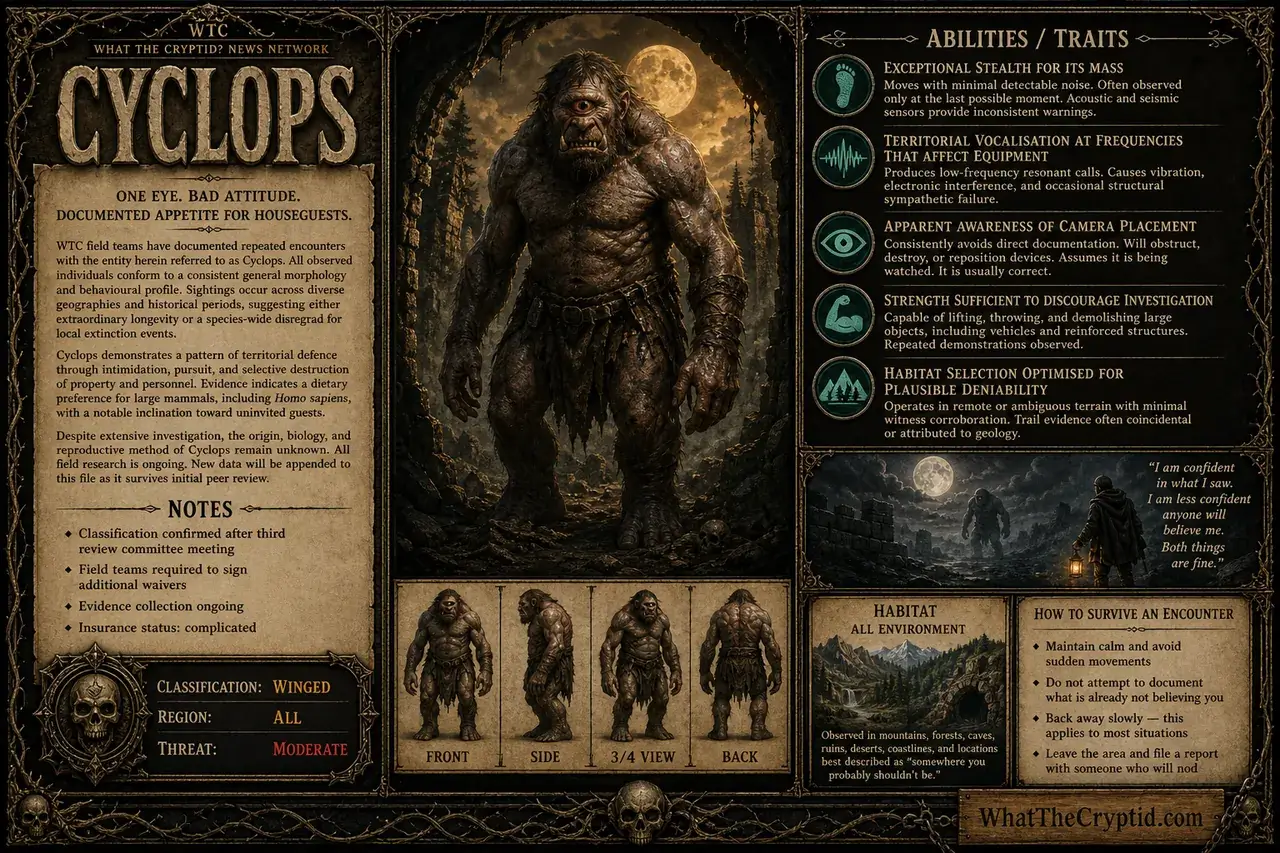
The Cyclops is a giant hominid entity documented primarily across the Mediterranean basin, characterised by singular, centrally-positioned ocular anatomy and a body mass estimated at several times that of an adult male human. The entity has been the subject of recorded observation for approximately three thousand years, making it one of the oldest continuously documented cryptids in the WTC database, a distinction that has done nothing to improve the quality of the available evidence. Classification as Hominid reflects its bipedal locomotion, use of rudimentary tools, and reported capacity for complex speech, though WTC notes that being able to hold a conversation is not, by itself, a guarantee of cooperative behaviour.
Multiple regional variants have been catalogued across Sicily, the Greek islands, and the broader Aegean coastal range, with physical and behavioural profiles varying sufficiently between populations to suggest either subspeciation or the kind of individual personality differences that field researchers generally prefer not to think about. The entity is not considered migratory. Primary threat vectors are physical in nature and well-documented. WTC has tabled the question of how an apex predator of this scale has avoided definitive photographic documentation for over thirty centuries for a later meeting.

History & Mythology
The earliest substantive field accounts appear in Hesiod’s Theogony, circa 700 BCE, which catalogues three named individuals — Brontes, Steropes, and Arges — described as possessing single eyes and specialised vocational knowledge of metallurgy. These accounts suggest an entity that is not merely large and aggressive but also technically skilled, a combination WTC considers more troubling than simple aggression. The later and more operationally relevant account appears in Homer’s Odyssey, also circa 700 BCE, in which the named individual Polyphemus is observed holding captive multiple crew members of a documented sea voyage, consuming two per meal at regular intervals with what witnesses described as apparent satisfaction.
Roman accounts, including Virgil’s Aeneid and Ovid’s Metamorphoses, corroborate the Homeric profile while adding detail on territorial behaviour and an apparent emotional capacity for romantic attachment that was, by all accounts, poorly received by its object. Medieval European folklore absorbed the entity under various local names, with accounts persisting in Sicilian oral tradition through the fifteenth century. The Sicilian accounts are of particular interest to WTC researchers because they are geographically specific to a degree that suggests direct observation rather than literary inheritance. The location of Polyphemus’s cave has been placed by various classical sources near Aci Trezza on the eastern Sicilian coast, a site WTC has visited twice, with results that remain inconclusive.
Physical Description
Documented height estimates range from twelve to thirty feet, a spread that either reflects genuine population variance or the well-established tendency of eyewitnesses to revise measurements upward with the passage of time. Cross-referencing the most structurally coherent accounts — those describing cave entrances, object-throwing trajectories, and confinement scenarios — suggests a working height estimate of fifteen to eighteen feet for the Sicilian population, with a corresponding body mass that our consulting structural engineer described as ‘a load-bearing problem for most cave systems.’
The defining anatomical feature is the single centrally-positioned eye, described consistently across independent cultural traditions spanning multiple centuries and at least four languages as large, pale, and capable of sustained forward-facing focus. The absence of binocular vision would be expected to compromise depth perception, a fact that field researchers have noted with what our editor described as ‘perhaps more optimism than the situation warrants.’ Skin tone in primary source accounts ranges from grey to ruddy depending on individual and region. The body is described as heavily muscled with dense body hair, and the hands — documented in accounts involving tool use and the manipulation of large stone implements — are consistently described as proportionally massive. Regional variants from the Cyclops Aetnaeus population, associated with the slopes of Mount Etna, are described as darker in complexion and markedly less communicative than the Sicilian coastal population, which itself was not communicative in any sense that benefited the witnesses.
Behaviour & Temperament
The Cyclops presents as a predominantly solitary entity, with no documented evidence of persistent social grouping beyond the familial unit mentioned in the Polyphemus account, in which the individual Polyphemus is noted to have a father. This parent-offspring relationship was not observed directly by any surviving witness and is therefore filed under secondary testimony. Daily activity patterns suggest the entity operates on a diurnal schedule structured around herd management — Polyphemus is consistently described as pasturing sheep and goats during daylight hours and returning to a fixed shelter at dusk, a routine that is, objectively, more organised than several WTC field researchers’ daily schedules.
Aggression toward humans appears to be triggered primarily by territorial intrusion and, subsequently, by hunger. The Homeric account documents a clear progression: initial assessment of intruders, confinement, and systematic consumption — a pattern suggesting that aggression is instrumental rather than temperamental. The entity is not described as seeking human contact unprovoked. When encountered unexpectedly, accounts suggest a brief period of assessment before action is taken, which represents the only documented window for human withdrawal. The entity has been observed in at least one account to engage in extended verbal negotiation, which ended badly for one party. WTC does not recommend verbal negotiation as a primary strategy.
Habitat & Territory
The Cyclops demonstrates a consistent preference for cave systems in coastal highland terrain, typically at elevations between 800 and 2,400 feet, with access to grazing land and a reliable fresh water source within approximately one mile. The caves documented in primary accounts are large enough to require a stone door of sufficient mass to be immovable by groups of adult men, which narrows the relevant geological candidates considerably. The eastern Sicilian coastline, and in particular the volcanic terrain of Mount Etna’s lower slopes, satisfies all documented habitat criteria and has been the site of the highest concentration of historically recorded encounters.
Territory size has not been formally measured, though the Polyphemus account implies a range sufficient to support a flock of sheep large enough to feed an entity of documented body mass, which WTC’s consulting agricultural economist estimated would require a minimum of eighty to one hundred animals. The entity does not appear to range far from its primary shelter and has not been associated with population centres or transit routes in any account where the witness had time to file a report afterward.
Diet & Hunting
The Cyclops is documented as a generalist opportunist with a primary diet of sheep and goat milk products — the Polyphemus account specifically describes cheese production and organised milking — supplemented by the animals themselves. This suggests a food management strategy more sophisticated than simple predation, which WTC considers relevant to the overall risk assessment. The entity maintains its own food supply, which implies planning capacity and an interest in sustainability that does not extend to visiting sailors.
Human consumption is documented in the Homeric account at a rate of two individuals per meal, twice daily, over a period of several days, suggesting that humans represent a dietary supplement of opportunity rather than a primary prey category. Whether this distinction is meaningful to the humans in question is a question WTC has declined to put to a vote. No modern accounts have documented direct evidence of predation, which is either encouraging or reflects an absence of surviving witnesses rather than an absence of incidents.
Notable Sightings
Odysseus of Ithaca, commanding a crew of twelve, reported encountering a single male Cyclops designated Polyphemus in a coastal cave system near what is now identified as the eastern Sicilian coastline. The entity was described as approximately the height of a ship’s mast, with a single pale eye occupying the center of its forehead, and was observed to consume two crew members upon first discovering the intruders and two more at the following morning’s meal. The encounter lasted three days and resulted in the loss of six crew members and the blinding of the entity via a sharpened wooden implement. Odysseus subsequently departed the region. No formal follow-up investigation was conducted, as the relevant administrative bodies would not exist for approximately eight hundred years.
Aeneas of Troy, commanding a fleet of survivors from the Trojan War, reported visual contact with multiple Cyclops individuals on the slopes of Mount Etna during a coastal stop documented in Virgil’s Aeneid. Witnesses described the entities as blind, disfigured, and moving in a group — the only documented multi-individual sighting in the primary source record. A survivor identified as Achaemenides, who had been stranded in the area for three months, was recovered during this encounter and provided supplementary testimony. His account was described by Virgil as consistent with the Homeric profile, which Achaemenides confirmed without apparent enthusiasm.
A Sicilian fisherman identified in regional records only as Russo reported to the parish at Messina that he had observed a large humanoid figure standing in shallow coastal water near the strait’s northern approach, estimated at ‘twice the height of the tallest mast he had seen,’ with a single eye described as ‘the colour of old milk.’ The entity was observed for approximately four minutes before wading back toward the Sicilian shore. Russo’s account was recorded by the parish priest, who noted in the margin that the fisherman was ‘not a man given to invention.’ Russo retired from fishing the following season.
The crew of a Greek merchant vessel, the Artemis, reported a collision at low speed with what the first mate described as ‘a submerged mass of unusual texture’ during a calm crossing. Three crew members on deck at the time of impact reported seeing a large pale object rise briefly to the surface before submerging. The ship’s log described the object as ’rounded, possibly biological, approximately three metres in diameter, pale grey, with a single dark aperture.’ The vessel was not damaged. The captain filed a standard maritime incident report attributing the event to floating debris. The first mate filed a separate account, which he submitted to the Hellenic port authority in Piraeus. The Hellenic port authority has not responded to WTC’s records request.
Threat Assessment
WTC assigns the Cyclops a threat rating of High based on documented body mass, confirmed predatory behaviour toward humans, territorial aggression, and the entity’s established practice of blocking the only exit. The primary risk scenario involves accidental entry into occupied territory — specifically, enclosed terrain such as cave systems, narrow coastal ravines, or other natural structures offering the entity positional advantage. WTC strongly recommends maintaining a minimum distance of 300 metres from any cave system matching the documented habitat profile in the eastern Sicilian and Aegean coastal zones, and advises against sheltering in any cave that shows evidence of livestock management, cheese production, or a very large stone near the entrance.
If visual contact is established, WTC recommends immediate withdrawal in the direction of open terrain without drawing attention to yourself, which is acknowledged to be easier advice to give than to follow. Engagement under any circumstances is not recommended. The Homeric account documents successful close-quarters engagement by a group of trained soldiers using improvised weapons, but WTC notes this required prior planning, a cooperative unit of seven, and a level of resourcefulness that field researchers should not assume they can replicate under field conditions. Emergency beacons and GPS devices are standard recommended kit for survey operations in identified habitat zones, not because they will affect the outcome of a direct encounter, but because WTC’s insurance provider specifically asked us to include this instruction.
WTC Field Notes
WTC has maintained an open file on the Cyclops for eleven years, during which time we have conducted two site surveys near Aci Trezza, a desk review of Homeric source material, a consultation with a classicist at the University of Palermo who asked not to be named in connection with the project, and one very unproductive afternoon in the Hellenic port authority’s records archive in Piraeus. Total photographic evidence collected to date: zero. Total audio recordings: zero. Total incidents of equipment malfunction during site surveys: one, attributed by the field team to ‘salt air.’
The primary obstacle to WTC’s ongoing research is not the age of the primary source material, which we consider a documentation challenge rather than a disqualifying factor. The obstacle is that the caves in the Aci Trezza coastal zone are structurally unstable, the terrain above Mount Etna’s 800-metre line requires technical climbing equipment our current budget does not cover, and our most experienced Mediterranean field researcher is on indefinite leave following an unrelated incident in Croatia that she has declined to discuss. WTC is continuing to accept applications for a field position covering the Mediterranean Hominid portfolio. Relevant language skills and a working knowledge of classical Greek are considered an advantage. Applicants are encouraged to review the full threat assessment before submitting.