
Carrion Warden
It was there before you arrived. It will remain.
All
Active
SpiritEuropeBattlefieldUndead-AdjacentCustodial
Overview
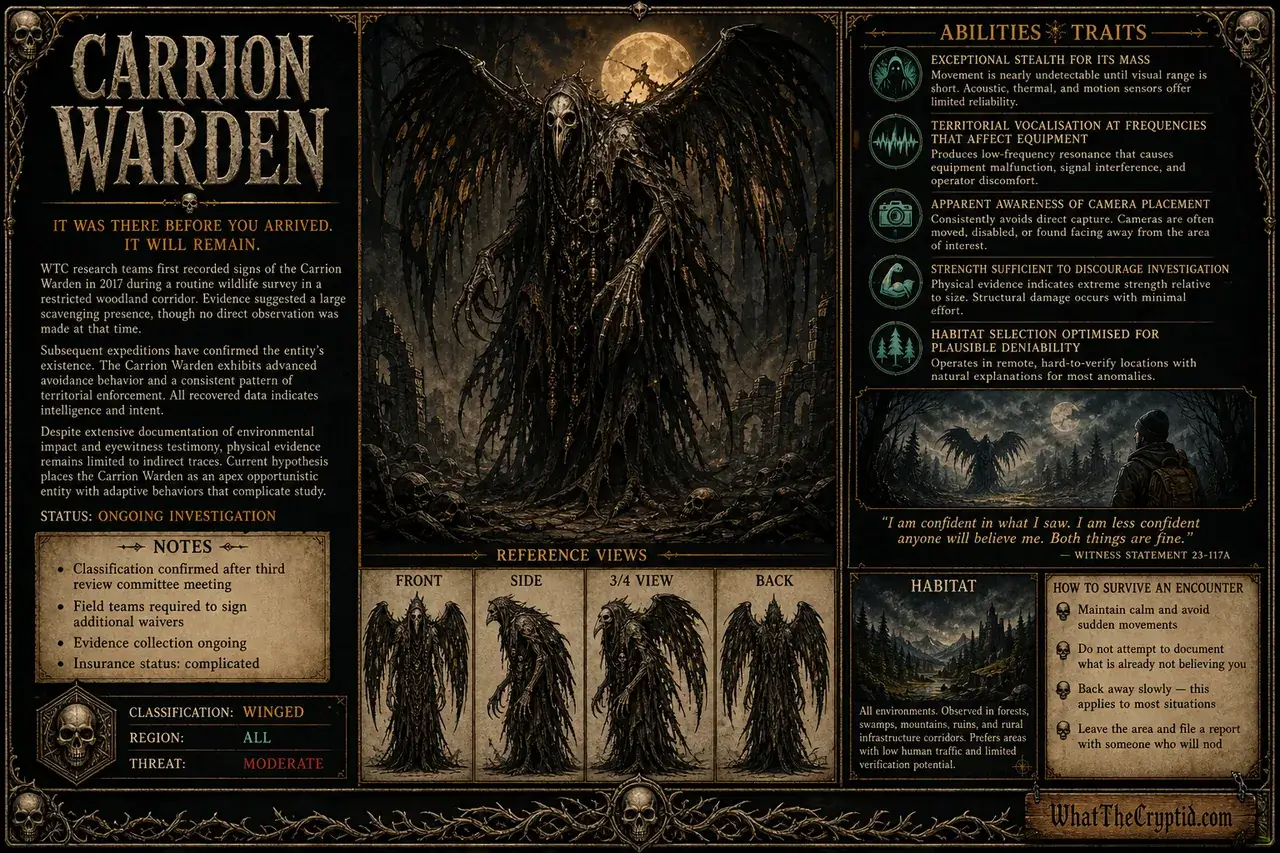
The Carrion Warden is a large, semi-corporeal entity documented primarily at sites of significant mortality: battlefields, plague pits, sites of catastrophic accident, and — with increasing frequency in modern records — the outer perimeters of industrial livestock operations. It does not cause death. This point is worth stating clearly, as it is the source of considerable confusion in the field, and has led to at least two documented instances of witnesses attempting pre-emptive action they later described as ‘a precaution.’ The Carrion Warden appears after death has occurred, and appears to consider this distinction self-evident.
Classified as a Spirit entity on the basis of its documented semi-translucent morphology, its apparent immunity to physical obstruction, and the consistent failure of thermal imaging equipment to register its presence despite visible confirmation from multiple simultaneous observers — a discrepancy our equipment vendor has described as ‘not a product defect, exactly.’ It operates alone, demonstrates no apparent territorial aggression toward humans who maintain appropriate distance, and has been observed at the same geographic locations across centuries of separate documentation, suggesting either extreme longevity or a navigational instinct for tragedy that WTC researchers find professionally relatable.

The entity’s apparent function — insofar as a function can be attributed — appears custodial. It moves among the dead. It does not disturb remains. It does not communicate in any documented language. What it is doing, precisely, is a question the WTC Cryptid Classification Committee has been actively not resolving since 2019.
History & Mythology
The earliest unambiguous textual record of what WTC identifies as the Carrion Warden appears in a 12th-century Benedictine manuscript recovered from a monastery in the Moravia region, now held in a private collection whose owner declines to be identified. The manuscript describes ‘a grey figure of great height that walks among the fallen without disturbing them, whose face is known to no man who has looked upon it directly.’ The scribe noted the observation in the same measured tone used to record grain yields and weather patterns, which WTC’s consulting medieval historian describes as either deeply significant or completely ordinary, depending on context she did not elaborate on.
Folkloric traditions across Central and Eastern Europe carry consistent structural variants of the Carrion Warden across German, Czech, Polish, and Hungarian oral traditions — locally named but recognisably consistent in description, behaviour, and apparent purpose. The Slavic designation ‘Hvala-Mors,’ translating approximately as ‘thanks-to-death’ or ‘death’s acknowledgement,’ suggests a tradition in which the entity was understood not as a threat but as a form of institutional response to mortality that predated the institutions. Following the Thirty Years’ War, sightings recorded in parish death registers across Bohemia spiked to a documented 34 separate accounts between 1618 and 1648, which represents either a genuine increase in entity activity or the natural consequence of an unprecedented number of people standing in fields containing bodies.
The industrial era produced a notable gap in formal records — approximately 1820 to 1910 — which WTC attributes to a general institutional reluctance to document experiences that complicated the prevailing materialist worldview, rather than any actual reduction in sightings. Reports resurface consistently after both World Wars, with particular density in accounts from battlefield clearance teams, military grave registration units, and, in one 1946 case from Lower Saxony, an agricultural surveyor who filed his report in triplicate and requested that it be reviewed by someone senior to himself.
Physical Description
The Carrion Warden stands between 7 and 8 feet in height based on reference-point triangulation from sighting accounts, with a documented range of 7’2″ to 7’11” that may reflect genuine individual variation or the inherent imprecision of estimating the height of a semi-translucent entity in low-light conditions by a person who is actively trying to remain calm. Its build is consistently described as extremely lean — ‘as if the body were a suggestion of a body,’ in the phrasing of a 2003 witness account WTC found unusually apt — with elongated limbs that multiple witnesses have noted appear slightly too long in proportion for the torso, a characteristic the entity shares with approximately no documented biological organism.
Colouration runs from ash-grey to a deep charcoal that some witnesses describe as shifting between the two depending on proximity to remains, though WTC cannot confirm this as a documented chromatic response rather than a function of poor lighting and elevated stress hormones. The face, where it has been described at all, is consistently reported as featureless at distance — an absence of detail rather than the presence of concealment — though witnesses who have observed it at under 30 feet report the impression of ‘eyes that are aware of you without looking at you,’ a description that has proven difficult to operationalise into formal assessment criteria. The entity’s edges, particularly at the hands and the base of the feet, appear to lose definition in a manner that thermal imaging equipment would document if thermal imaging equipment produced any reading whatsoever in its presence.
A distinct regional variant documented in Scandinavian accounts — sometimes designated the ‘Pale Warden’ in WTC internal classification — presents with notably lighter colouration and a reported tendency to vocalise in low, non-linguistic tones during observation. Whether this constitutes a subspecies, a behavioural variant, or an entirely separate entity that has been conflated through superficial similarity is a question the WTC Classification Committee has placed on its agenda for the fourth consecutive year.
Behaviour & Temperament
The Carrion Warden is, by all documented evidence, unhurried. Witnesses consistently describe movement that is deliberate and slow — an average transit pace estimated at roughly half normal human walking speed — that nonetheless covers ground in a manner several witnesses have described as ‘not quite adding up,’ without being able to specify the arithmetic involved. It moves between and among remains in a pattern that has variously been interpreted as inspection, inventory, and in one 2011 account from a Polish researcher who later published a paper on entirely unrelated folklore topics, ‘something that looked administrative.’
The entity does not interact with human observers beyond a consistent orientation response — it becomes aware of witness presence and adjusts its facing toward them — but has not been documented approaching, pursuing, or making contact with living individuals in any verified sighting. When observers withdraw, the Warden does not follow. When observers remain stationary, the Warden, after a period of between two and eleven minutes, resumes its previous activity. The implication that it considers the matter resolved in either case has not been lost on field researchers, some of whom have found this more unsettling than active threat behaviour would have been.
Vocalisation is documented in approximately 40% of sightings, consistent with the Scandinavian variant but not exclusive to it. The sound is described variously as a low drone, a sustained exhalation, and — in three separate accounts from different decades and countries — as resembling a chord played on an instrument the witness could not name. No recording of the vocalisation has been obtained at sufficient quality for acoustic analysis. The entity appears aware that this is the case and has adjusted its behaviour accordingly only in the imagination of the researchers involved, who acknowledge this is not a scientifically supportable interpretation.
Habitat & Territory
The Carrion Warden demonstrates a consistent preference for locations with significant mortality history rather than any specific terrain type, elevation range, or proximity to water — a habitat selection criterion that is, WTC acknowledges, somewhat difficult to map. Documented appearances cluster at: former battlefield sites, mass grave locations, sites of industrial or transport disaster, and occasionally the margins of large natural die-off events. It has been sighted at coastal locations, inland forests, open plains, and, in a 2017 account from outside Kraków, the perimeter of a commercial poultry processing facility, which the facility’s management declined to address in their public communications.
There is no documented evidence of a fixed territory or nesting site. The entity does not appear to reside at locations between events — it arrives, is present for a period ranging from hours to days depending on the scale of mortality, and is not subsequently observed. Where it goes in the interim is unknown. Several WTC researchers have theories. None of them have put these theories in writing.
Diet & Hunting
No feeding behaviour has been documented. The Carrion Warden does not consume remains, does not appear to derive sustenance from any observable source, and has never been recorded eating in any verified sighting across the entirety of the WTC database. This presents a classification difficulty, as an entity requiring no food presents challenges for the standard metabolic frameworks used to assess cryptid behaviour and intent.
The leading WTC hypothesis is that the entity, as a Spirit-class classification, does not sustain itself through conventional caloric intake — that whatever energetic requirement it operates under is met through mechanisms outside the current assessment framework. The secondary hypothesis, advanced by one researcher and not formally adopted, is that it feeds on something present at sites of mass death that does not register on any instrument currently available to WTC, which is either a significant finding or an unfalsifiable claim, depending on which side of that particular methodological argument one sits. The researcher in question is aware of both interpretations and finds one of them more interesting than the other.
Notable Sightings
During post-war remains recovery operations near Fort Douaumont, French Army grave registration officer Lieutenant Armand Delcourt submitted a formal report describing a ‘tall grey figure of unusual proportion’ observed moving among unrecovered remains in a sector his team had not yet cleared. Delcourt estimated the figure at approximately 7-8 feet in height and noted that it moved ‘with the ease of someone who had been there considerably longer than we had.’ He observed it for approximately twelve minutes before it moved into a section of collapsed trench and was not subsequently located. The report was filed, stamped, and placed in a category his commanding officer created specifically for it.
A member of an international forensic investigation team working at a secondary mass grave site reported observing a tall, grey figure standing at the edge of the excavation perimeter at approximately 0340 hours. The observer, who has requested anonymity in all subsequent WTC documentation, noted that the figure did not react to torch light and did not appear to cast a shadow despite being observed in direct beam illumination for approximately four minutes. Two other team members were present and confirmed the sighting. The team’s official log records ‘unexplained visual anomaly, 0340 hrs’ and the entry is followed by three hours of no recorded observations before the next shift notation.
Forestry worker Marek Szymański reported encountering a large grey figure standing in a clearing adjacent to a documented World War II execution site during a routine timber survey. Szymański described the figure as standing completely still and oriented toward a section of ground that subsequent inquiry confirmed had been marked for archaeological assessment related to the site’s history. He estimated the encounter lasted six minutes before he withdrew along his access route. Szymański filed his account with local authorities, who forwarded it to a regional folklore archive, which forwarded it to WTC. He has since changed his assigned survey sector.
Security personnel at a large-scale poultry processing facility reported a figure matching the Carrion Warden’s documented description observed at the outer fence perimeter across three separate nights in November, following a significant on-site mortality event attributed to avian influenza. The sightings were captured on perimeter CCTV, which recorded a large grey shape at the fence line during each incident. The footage was submitted to WTC by an anonymous employee. It is the only known footage of a potential Carrion Warden sighting and it is, as our imaging analyst noted in her written assessment, ‘not quite conclusive in a way that feels deliberate.’
Threat Assessment
The Carrion Warden does not, in any documented sighting, initiate contact with living humans. WTC’s threat rating of Moderate reflects not the entity’s recorded behaviour but the documented psychological impact of the encounter itself, and the practical risks associated with the environments in which encounters occur. Individuals reporting post-sighting effects consistently describe sleep disruption, intrusive recall, and a heightened sensitivity to mortality-related news and imagery lasting between three weeks and, in two cases, a duration the witnesses described as ‘ongoing.’ These effects are consistent with standard trauma response and are addressed in WTC’s standard post-encounter support documentation, which exists and has been updated as of this year.
If you observe what you believe to be the Carrion Warden: maintain a distance of no less than 50 metres. Do not approach the remains it is attending. Do not attempt to address it verbally, as no documented exchange has produced a response and the attempt appears to extend the duration of the orientation response directed at the observer. Withdraw slowly and without sudden movement — not because the entity has demonstrated threat behaviour in response to sudden movement, but because the terrain in which encounters occur is frequently hazardous and rapid movement is inadvisable for reasons entirely unrelated to the entity. WTC recommends that all persons entering documented Carrion Warden habitat carry standard emergency communications equipment. We acknowledge this advice does not address the primary source of distress reported by witnesses, and we are working on that.
WTC Field Notes
WTC first added the Carrion Warden to the active database in 2007 following a review of archival European sighting reports that had been sitting in a physical filing cabinet in our Bratislava correspondent’s spare room for approximately eleven years. The decision to upgrade the entity from ‘pending assessment’ to ‘active file’ was not made lightly, and was made, ultimately, because the filing cabinet needed to be returned to the correspondent’s landlord. Field investigation has proceeded at what our editor describes as ‘a measured pace’ and what our lead European researcher describes as ‘the pace you set when nobody wants to go first.’
WTC has to date deployed two field teams to documented Carrion Warden sites. The first, dispatched to a former battlefield site in northeastern France in 2011, returned with seventeen hours of audio, two malfunctioning thermal cameras, and a written request from both team members to be reassigned to aquatic cryptid research, citing a preference for ‘threats that exist in one dimension.’ The second team, sent to document the Tuchola Forest site in 2014, encountered no entity activity but produced an extensive photographic survey of the site that our imaging department rates as technically excellent. WTC continues to seek researchers with relevant experience and what our HR coordinator has taken to describing, in job listings, as ‘a measured relationship with occupational existentialism.’ Applications remain open.