
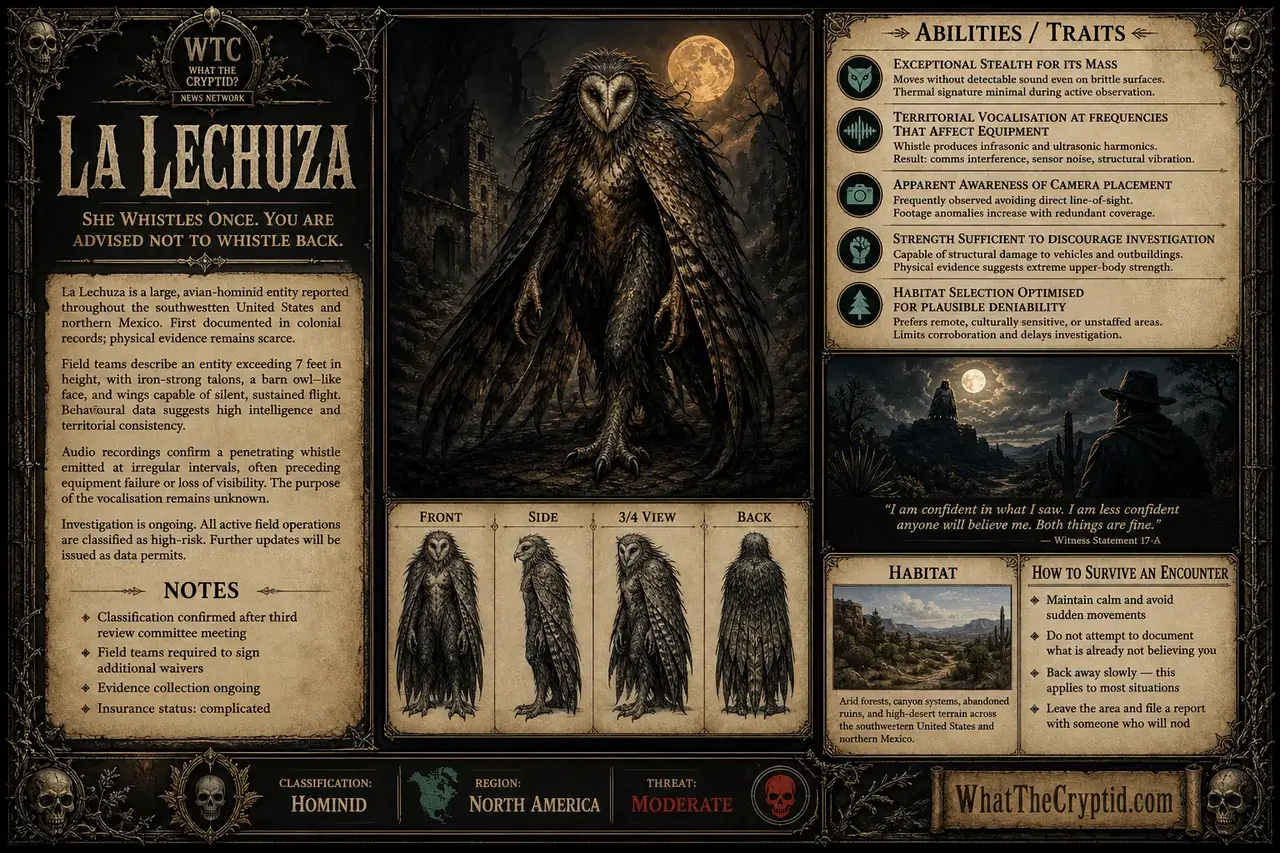
La Lechuza
She whistles once. You are advised not to whistle back.
North America
Active
ShapeshifterBrujeríaNocturnalTex-Mex FolkloreOwlBorder Region
Overview
La Lechuza is a shapeshifting entity documented across northern Mexico and the southern United States, most densely reported in the border regions of Texas, Nuevo León, and Tamaulipas. The entity presents as an oversized owl — field estimates placing wingspan between five and thirteen feet, depending on the witness and the ambient lighting — but is understood by regional tradition and a growing body of circumstantial WTC field evidence to be a human woman who has undergone deliberate transformation, either through a pact with diabolical forces or through the practice of what regional informants describe, with consistent specificity, as brujería. WTC has not taken an official position on the mechanism of transformation. The outcome, however, is documented.
The entity is notable among shapeshifter classifications for retaining, in its owl form, a human face. This detail is reported independently across hundreds of sightings spanning three countries and approximately four centuries of recorded encounters. It is the kind of detail that becomes harder to dismiss the more times it appears in unconnected testimonies, and WTC researchers have discussed this at length in a series of memos that remain, as of publication, unresolved.

La Lechuza is not considered a passive or territorially defensive entity. She pursues. Witnesses who have attempted flight on foot report that the pursuit continued. Witnesses who have locked their doors report sounds consistent with large talons on wooden frames. The entity appears to operate with intent, which places her in a behavioural category that WTC’s threat committee has flagged for ongoing review.
History & Mythology
The earliest written references to an owl-woman entity in Mesoamerican traditions predate the colonial period, appearing in Nahuatl manuscripts documenting the tlāzohteōtl — a figure associated with transgression, night, and women operating outside sanctioned social roles. Whether La Lechuza descends directly from this tradition or represents a parallel and independent development is a question WTC has forwarded to three academic consultants, two of whom responded. The colonial period produced a significant volume of Inquisition records from New Spain documenting trial testimony related to women accused of transforming into nocturnal birds. WTC notes that the Inquisition’s investigative methodology was considerably more aggressive than our own and declines to endorse it.
By the nineteenth century, La Lechuza had consolidated into a recognisable regional figure across what is now northern Mexico and southern Texas, appearing in corridos, cautionary oral narratives, and — beginning in the 1880s — occasional Spanish-language newspaper reports that treated the subject with a seriousness that would later embarrass their editorial successors. The first documented English-language field report appears in the 1953 archives of a now-defunct Texas paranormal society, describing a sighting near Laredo that included a sketch the illustrator apparently found distressing enough to sign with a pseudonym.
The folklore stabilised around a consistent origin narrative: La Lechuza is a woman who sold her soul to the devil following a personal grievance — most commonly the death of a child at human hands, though variants include betrayal by a husband and disputes over land. This narrative specificity is either a remarkably coherent mythological tradition or evidence of a consistent real-world trigger for transformation. WTC has tabled the distinction for a future editorial meeting.
Physical Description
In owl form, La Lechuza presents with white or pale grey plumage across the majority of the body, with darker banding reported on the wing feathers in approximately 40% of accounts. The wingspan, as noted, ranges considerably across testimonies, but a working estimate of six to eight feet is consistent with the majority of close-proximity sightings where the witness had a reference object for scale. The body mass is estimated to be substantially greater than any extant owl species, with several witnesses independently describing the sound of wingbeats as felt rather than merely heard — a detail that has required no editorial embellishment to be alarming.
The defining and taxonomically impossible feature is the face. Across sightings where the witness achieved sufficient proximity and maintained sufficient composure to report facial detail, La Lechuza presents with a human female face positioned where an owl’s facial disc would be. The face is typically described as that of an older woman, though age estimates vary. The eyes are almost universally reported as dark, large, and forward-facing, which is consistent with owl anatomy but not with the human faces they are embedded in. No witness has described the face as appearing distressed by its situation. The subject appeared unconcerned.
A minority of accounts — concentrated in Tamaulipas and the Lower Rio Grande Valley — describe a fully human woman observed in the moments before or after an apparent transformation, typically at significant distance. These accounts describe a woman of middle age in dark clothing who then rises vertically without apparent mechanical assistance. WTC treats these transitional sightings as a distinct evidential category and has filed them accordingly.
Behaviour & Temperament
La Lechuza is documented as primarily nocturnal, with the overwhelming majority of sightings occurring between 10 PM and 3 AM, with a concentration around midnight that is consistent enough to suggest either biological preference or a flair for the theatrical that cannot currently be distinguished from it. The entity vocalises in two documented modes: a cry described as similar to an infant or a woman in distress, which witnesses have uniformly found difficult to ignore for understandable reasons, and a whistle of human-like quality and pitch. Regional tradition is unambiguous on this point — the whistle is a lure, and you are not to respond to it. WTC endorses this recommendation without reservation.
The entity demonstrates selective targeting behaviour that distinguishes her from purely territorial cryptids. La Lechuza is widely reported to pursue individuals connected to perceived historical wrongdoing — most specifically those involved in harm to women or children — though she has been documented pursuing witnesses with no apparent connection to any grievance, which suggests either a degree of error in targeting or criteria that WTC cannot currently evaluate. She is further reported to circle vehicles on rural roads, to perch above homes for extended periods prior to an aggressive approach, and to disable outdoor lighting before making contact. The lighting-suppression behaviour has been reported often enough that WTC treats it as documented rather than anecdotal.
Social structure, if any, has not been established. La Lechuza is almost exclusively reported as solitary. One account from Monterrey in 1998 described two entities operating in apparent coordination, but this account was filed by a single witness and has not been corroborated. WTC notes it without endorsing it.
Habitat & Territory
La Lechuza demonstrates a strong preference for the semi-arid brushland and mesquite scrub of the South Texas Plains and the adjoining Mexican states, with the highest concentration of documented sightings occurring within twenty miles of the Rio Grande corridor. The terrain is characterised by poor road infrastructure, limited ambient lighting, and a population accustomed to encounters that they do not expect to be taken seriously by external authorities — conditions that, WTC acknowledges, either facilitate cryptid activity or facilitate the underdocumentation of it. Possibly both.
The entity is reliably reported near bodies of water, old ranch roads, and properties that have stood for multiple generations. She appears with particular frequency at the boundaries of settled land — fencelines, tree lines, the edges of dirt roads where the light from a house window stops being useful. Elevations of her documented range run from sea level at the Gulf Coast to approximately 2,000 feet in the foothills west of Monterrey. She has not been documented above 3,000 feet, though WTC notes that there are fewer people above 3,000 feet to document her.
Diet & Hunting
The diet of La Lechuza in owl form is incompletely documented, which is itself a data point worth noting. Standard owl prey — rodents, rabbits, small ground birds — has been found in the vicinity of reported nesting sites, suggesting that the entity maintains baseline biological function in transformed state and is not sustained entirely by supernatural means. Whether this represents genuine hunger or the persistence of animal instinct through the transformation process is a question WTC has not been equipped to answer and does not currently have the budget to pursue.
Multiple witness accounts describe the entity making contact with livestock — particularly chickens and small goats — with kills displaying characteristics inconsistent with known predators in the region: entry wounds at the neck, exsanguination without significant tissue consumption, and an absence of the disorganisation typical of mammalian predator attacks. WTC does not use the word ‘vampiric’ in official documentation, but notes that the description has been applied independently by four separate ranch owners in three counties, none of whom appeared to be coordinating their accounts.
Notable Sightings
Truck driver Edmundo Salinas reported that a large white bird — which he initially assumed was a barn owl — struck his windshield at approximately 11:45 PM before landing on the hood of his stationary vehicle. Salinas stated that the creature turned to face him through the glass, at which point he observed what he described as ‘an old woman’s face, clear as anything.’ The entity remained on the hood for an estimated four minutes before departing. Salinas drove without stopping to the nearest fuel station, approximately 22 miles distant, and remained there until daylight. The windshield showed three talon impact marks that his mechanic confirmed were inconsistent with any bird species the mechanic was aware of, a fact the mechanic mentioned once and did not bring up again.
Three members of the Garza family reported that a large pale bird had circled their property for four consecutive nights, emitting a crying sound that the youngest witness, then fourteen, described as sounding ‘like a baby from far away.’ On the fifth night, the outdoor light on the north side of the property failed without electrical explanation, and the family reported hearing what they described as talons dragging along the exterior wall below the window of the main bedroom. The family consulted a local curandera the following morning, who performed a cleansing ritual and recommended a specific arrangement of herbs above the doorways. The sounds were not reported again. The curandera charged three hundred pesos and described the case as straightforward.
Reyna Espinoza filed a report with the Maverick County Sheriff’s Office describing a creature she initially identified as a very large bird standing in the road at approximately 1:15 AM. She braked to avoid it, at which point the creature turned toward her headlights and she observed a human female face above a bird’s body. Espinoza stated that the entity then spread its wings — she estimated the span at ‘the full width of the road, which is two lanes’ — before ascending vertically and disappearing above the tree line. The responding deputy noted that the road surface showed marks consistent with large talons at the reported location. The report was filed under ‘animal encounter — species undetermined.’
Ranch foreman Aurelio Vásquez and two ranch hands reported repeated incidents over a six-week period, including the deaths of eleven goats displaying the exsanguination pattern documented in regional livestock cases, four instances of outdoor lights failing simultaneously before sounds were heard on the roof, and one direct visual sighting in which Vásquez observed a large white bird perched on the water tower at approximately 2 AM, which turned its face toward him when he directed a flashlight at it. Vásquez described the face as that of a woman he did not recognise, approximately sixty years of age, and stated that she appeared to look directly at him ‘like she already knew I was there.’ WTC contacted the ranch to request a site visit. Vásquez replied that WTC was welcome to come but that he would not be present during the visit, and that this was not negotiable.
Threat Assessment
La Lechuza presents a High threat rating under WTC’s modified Cryptid Risk Framework, accounting for documented aggression toward vehicles, evidence of livestock predation, and the targeting behaviour described across multiple independent witness accounts. Individuals travelling rural roads in South Texas and northern Mexico after 10 PM should be considered within the active encounter zone. WTC recommends remaining in your vehicle if a large pale bird is observed on or adjacent to the road. Do not exit the vehicle to investigate. Do not respond to vocalisations of any kind, including crying sounds, whistling, or any sound that appears to be coming from a direction that is difficult to identify. This last point is emphasised.
If you believe a Lechuza encounter is ongoing at a property, the following actions have been reported as effective by witnesses with repeat exposure: salt lines at thresholds, the burning of copal resin, and the recitation of prayers specific to regional Catholic-folk synthesis practice. WTC is not in a position to rank these interventions by efficacy and recommends consulting a local curandera, who will likely be less surprised by your situation than you expect. Do not attempt to photograph the entity using flash photography at close range. WTC notes that this recommendation is based on inference from available evidence and acknowledges that we have not established exactly what happens if you do.
WTC Field Notes
WTC’s Southwest Field Division has been attempting to establish a monitoring presence in Starr and Maverick Counties since 2019, an effort that has been complicated by equipment issues, scheduling conflicts, and the refusal of two consecutive field researchers to return to the region after their initial site assessments. The second researcher submitted an expense report and a brief written statement confirming that the assignment had been completed to the best of her ability, and has not responded to follow-up communications. WTC wishes her well.
The La Lechuza file is currently one of the ten largest active files in the WTC Cryptid Database by volume of submitted witness reports, a distinction that our editorial team finds significant and that our insurance provider has noted in writing. A formal field expedition has been proposed for the fourth quarter of the current fiscal year, contingent on budget approval and the identification of field personnel willing to conduct overnight observation in the documented encounter zone. Applications are open. The stipend is, we are told, competitive.