Yucca Man
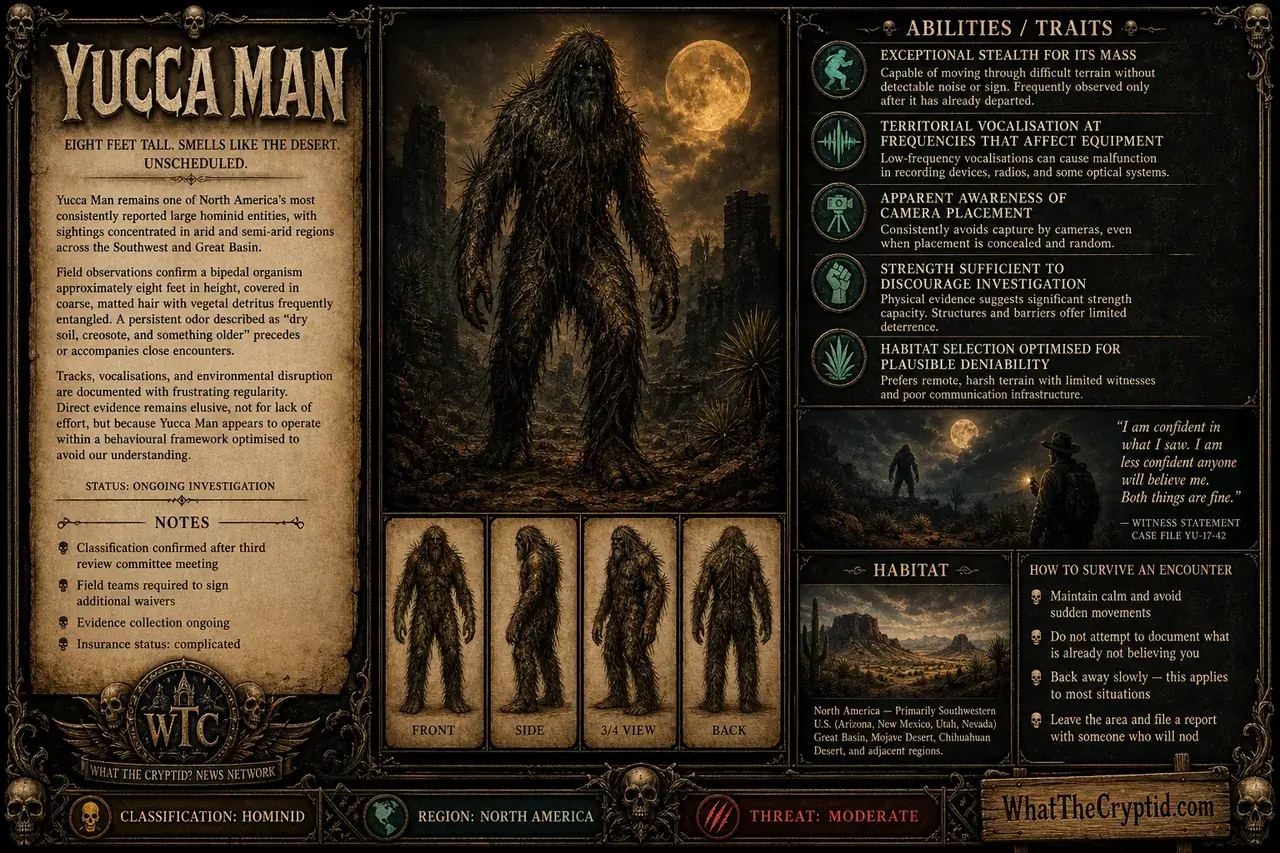
Eight feet tall. Smells like the desert. Unscheduled.
North America
Active
Overview
The Yucca Man is a large bipedal hominid reported primarily within and around the boundaries of the Mojave Desert, with the highest concentration of documented sightings clustered near Twentynine Palms, California, and the western edges of Joshua Tree National Park. Standing between seven and nine feet tall by most witness estimates, the entity shares a general morphological profile with other North American hominids of the Bigfoot class, but has established a clear regional specialisation: it lives in one of the most inhospitable environments on the continent and appears, by all available evidence, entirely comfortable with this choice.
Unlike its Pacific Northwest counterpart, the Yucca Man operates in an environment that offers almost no concealment — a fact that has not, according to the sighting record, discouraged it in any meaningful way. Witnesses describe encounters at close range, in open terrain, during daylight hours, with a frequency that WTC’s regional coordinator has described in internal correspondence as ‘statistically inconvenient for the sceptical position.’

The entity takes its common name from the Joshua tree yucca (Yucca jaegeriana), the distinctive arboreal succulent that dominates its primary habitat. Whether the Yucca Man has any particular relationship with the Joshua tree beyond geographic proximity has not been established. WTC has tabled this question for a later meeting.
History & Mythology
The earliest documented accounts of an abnormally large bipedal figure in the Mojave region come from the oral traditions of the Cahuilla and Serrano peoples, both of whom inhabited the high desert long before European contact. Cahuilla accounts describe a powerful desert being of considerable stature whose presence near water sources was considered significant, if not always welcome. WTC notes that ‘significant if not always welcome’ also describes how most witnesses characterise contemporary encounters, suggesting a consistency of impression across several centuries.
The first written account that WTC considers methodologically useful dates to 1971, when personnel stationed at the Marine Corps Air Ground Combat Center in Twentynine Palms reported a large, hair-covered figure approaching the perimeter fence on two consecutive nights. The incident was logged in base security records — copies of which WTC obtained after a request process that took eleven months — and subsequently classified under the heading ‘wildlife intrusion, unspecified.’ The Marines involved were reassigned within the month, which the base communications office described as routine rotation.
Through the 1970s and 1980s, reports accumulated steadily from civilian sources: campers, park rangers, and Highway 62 motorists, the latter category producing accounts that are geographically precise if observationally compressed, given the speeds involved. The Yucca Man’s presence in regional folklore became sufficiently established that a 1978 edition of the San Bernardino Sun ran a brief item on the phenomenon, which the paper’s editor later described as a slow news week. The sighting reports did not slow down.
Physical Description
Witness accounts place the Yucca Man’s height consistently between seven feet two inches and nine feet, with the majority of estimates clustering around eight feet. Body mass is difficult to assess in the absence of tracks across all terrain types, but encounters on sandy washes have produced footprints measuring between fifteen and seventeen inches in length, with a depth suggesting considerable weight. A consulting geologist who examined cast impressions from a 1994 Twentynine Palms sighting estimated the subject weighed ‘somewhere north of five hundred pounds’ and then requested that WTC not attribute the estimate to him by name, which we have respected.
The body is uniformly described as covered in coarse hair ranging from reddish-brown to dark grey, with several witnesses noting that the coloration appeared to provide effective, if presumably unintentional, camouflage against the desert floor and rock formations of the region. The face, on the occasions witnesses have been close enough to observe it, is described as broad and flat-featured, with prominent brow ridges and dark eyes. One witness described the expression as ‘like it had seen people before and had come to reasonable conclusions.’ The arms are long relative to the torso, and the gait is described as fluid and efficient — a description that most researchers find noteworthy given the rocky, irregular terrain the Yucca Man routinely crosses at speed.
No confirmed regional variants have been documented, though WTC has received two separate accounts of a smaller individual observed in proximity to a larger one near the Cottonwood Springs area. Whether this represents juvenile behaviour, pair bonding, or an unrelated coincidence of separate sightings is currently unresolved.
Behaviour & Temperament
The Yucca Man is predominantly nocturnal but has been observed with notable regularity in the hours immediately following dawn, suggesting either crepuscular activity patterns or a sleep schedule that accommodates the desert’s thermal conditions with more pragmatism than strict nocturnal classification allows. It moves efficiently across broken terrain, has been tracked across boulder fields that experienced hikers would approach with caution, and is reported to cover distances that imply a territorial range of several hundred square miles — which, in the Mojave, is a reasonable amount of space for any large animal to require.
Temperamentally, the Yucca Man is most accurately characterised as indifferent. It does not, based on the sighting record, seek out human contact. It does not, equally, appear to be particularly alarmed by it. The most common encounter pattern involves the entity observing a witness from a distance of between thirty and one hundred yards, maintaining its position for a period of one to several minutes, and then departing at a pace witnesses consistently describe as ‘unhurried.’ Two accounts from the Twentynine Palms military perimeter describe the entity approaching to within twenty feet of structures before losing interest and leaving. It did not attempt to breach the fence on either occasion, which the security logs noted without further analysis.
Vocalisations are reported rarely, but when documented include low resonant calls described variously as ‘like something very large clearing its throat’ and ‘a sound that seemed too big for the space it was coming from.’ One 2009 account from a Joshua Tree backcountry ranger includes the description ‘it sounded like it was commenting on something,’ which the ranger included in her written report with apparent sincerity and which WTC has included in the database with equal sincerity.
Habitat & Territory
The Yucca Man’s primary habitat is the high Mojave Desert, specifically the transition zone between the lower Colorado Desert and the upper Mojave at elevations between 1,800 and 4,500 feet. This range corresponds closely to the distribution of the Joshua tree, and also to a network of seasonal water sources — springs, seeps, and flash-flood washes — that represent the only consistent fresh water across a landscape that receives fewer than six inches of annual precipitation. The entity’s known range encompasses Joshua Tree National Park, the combat center at Twentynine Palms, and a corridor extending northeast toward the Twentynine Palms basin and south toward the Salton Sea trough.
The terrain preference appears to be rocky highland punctuated by open sandy washes, with brush cover sufficient to account for a large bipedal figure moving without reliable detection — a logistical achievement the Mojave barely provides but which the Yucca Man appears to manage regardless. No confirmed denning site has ever been located. This is either because the entity ranges too broadly to maintain a fixed shelter, or because WTC’s two field expeditions to the area were both conducted during summer months, which, in retrospect, explains some of the equipment failures.
Diet & Hunting
The Yucca Man is assessed as omnivorous based on observational evidence and the practical demands of desert survival. Witnesses have reported the entity in proximity to desert bighorn sheep, jackrabbits, and on one occasion a mule deer carcass, though whether the deer represented a kill or scavenged opportunism was not determined. The Mojave’s large mammal populations are sparse enough that a predatory hominid of the Yucca Man’s probable caloric requirements would supplement substantially with plant material, and the desert provides more of this than its appearance suggests: prickly pear cactus pads and fruit, pinyon pine nuts at higher elevations, desert willow seeds, and the flowers and seed pods of the Joshua tree itself.
Of specific note: three independent accounts from the Twentynine Palms area describe the Yucca Man in proximity to the trash and refuse areas of campgrounds and the combat center’s outer perimeter. WTC’s position is that this reflects opportunistic foraging behaviour consistent with large omnivores in areas of human activity, rather than evidence of dependency. The Yucca Man’s estimated body mass, against the caloric density of available desert food sources, implies either a foraging efficiency that exceeds documented estimates or regular access to food sources that have not yet been catalogued. Neither conclusion is particularly convenient.
Notable Sightings
Security personnel at the combat center perimeter reported a hair-covered bipedal figure, estimated at eight to nine feet tall, approaching the outer fence line at approximately 0230 hours on the nights of March 14th and 15th. The figure was observed by two sentries on the first night and three on the second, with the additional witness having been positioned specifically to confirm the previous night’s account. The entity approached to within approximately twenty-five feet of the fence before stopping, remaining stationary for an estimated four minutes, and withdrawing into the dark. The incident was logged as ‘wildlife intrusion, unspecified.’ The three personnel who filed the second-night report were transferred to Camp Pendleton six weeks later as part of what base records describe as a scheduled rotation.
A motorist identified in county records only as D. Harrington reported that a large upright figure crossed Highway 62 from north to south directly in front of her vehicle at approximately 11:45 PM, requiring her to brake sharply from a speed she estimated at fifty miles per hour. She described the figure as ‘much taller than a man, covered in dark hair, and not running — it was walking and it had plenty of time.’ Harrington pulled over and waited approximately ten minutes before continuing toward Twentynine Palms, where she reported the incident to the sheriff’s substation. The deputy who took the report noted that Harrington was ‘calm, specific, and had not been drinking,’ and filed the account under ‘animal crossing, unidentified.’ Harrington’s insurance company later declined her claim for new brake pads.
Two backpackers, James Foley and Carol Merek, reported observing a very large bipedal figure drinking from the Cottonwood Spring water source at approximately 6:10 AM, from a distance they estimated at sixty yards. The figure was crouched at the water’s edge and remained in this position for approximately three minutes before standing to full height — which both witnesses independently estimated at over eight feet — and moving south into the boulder field at a pace Merek described in her written account as ‘like it was late for something.’ Footprint casts taken by a park ranger the following day measured sixteen and a half inches in length. Foley and Merek completed their planned four-day itinerary before filing the report, which they later explained was because they had already paid for the permit.
A backcountry ranger identified in park records as Officer T. Sandoval reported a sighting at approximately 5:50 AM while conducting a routine patrol on foot near the Pinto Basin wash. She observed a large dark figure standing approximately forty yards to her east, fully upright, and apparently stationary. Sandoval halted and the figure remained in place for what she estimated as six to eight minutes before moving north along the wash and out of sight. She noted in her report that the figure appeared to track her position throughout the observation period without otherwise reacting to her presence, and that it produced a single low vocalisation she described as ‘like someone very large exhaling a word I couldn’t make out.’ Sandoval filed a full written report the same afternoon and subsequently applied for a transfer to the park’s visitor centre division, citing a preference for interpretive programming.
Threat Assessment
The Yucca Man’s documented behaviour does not indicate predatory interest in humans. No account in WTC’s database includes an unprovoked approach by the entity to within ten feet of a witness, and retreat or departure is the most consistently reported outcome of encounters at close range. WTC assesses the threat level as Moderate — not because the entity has demonstrated aggressive tendencies, but because its size and documented capability to move at speed across difficult terrain means that a threat, if it materialised, would be difficult to respond to effectively. The desert environment compounds this: there is rarely cover to retreat to, and the terrain that slows a human means comparatively less to something that weighs several hundred pounds and has presumably been navigating it for years.
WTC’s recommended approach for individuals entering known Yucca Man habitat is as follows: maintain awareness of the hours immediately before and after dawn, when sighting frequency is highest; do not approach water sources in low-visibility conditions without light; maintain a minimum distance of fifty yards if an entity is observed, and do not attempt to close that distance on the premise that it seems unconcerned; and carry a personal locator beacon, primarily because the Mojave Desert is a hazardous environment by any standard unrelated to this database. WTC acknowledges that these recommendations are based on a behavioural profile assembled from accounts that our insurance provider continues to classify as anecdotal.
WTC Field Notes
WTC’s Mojave research file currently spans three field expeditions, two of which were conducted in July and August, a scheduling decision that the field team lead has described as ‘an administrative oversight that will not recur.’ Equipment performance in extreme heat has been a consistent challenge: two trail cameras deployed near Cottonwood Springs in 2021 returned footage described by our technical editor as ‘thermally compromised,’ and a directional microphone array left at a documented vocalization site was recovered with sand in the housing in quantities that the manufacturer’s warranty does not cover under any listed category.
The Yucca Man file presents a particular editorial challenge that WTC’s senior staff have discussed at length and have not fully resolved: the entity operates in an environment that is dangerous to researchers independent of cryptid activity, which complicates both fieldwork planning and the liability language in our volunteer agreements. Our legal consultant has advised that ‘cryptid-adjacent heat exhaustion’ occupies an ambiguous position in California personal injury law, which is a sentence that has now appeared in two separate internal memos. WTC remains committed to expanding its Mojave dataset and is actively recruiting field correspondents who are comfortable in temperatures exceeding 110 degrees Fahrenheit, have their own transport, and are familiar with the permit process for Joshua Tree backcountry access. Compensation is available in the form of byline credit and the personal satisfaction of contributing to a field that a growing number of academics are willing to describe, on background, as ‘not without merit.’