|
Credibility: ★★★★☆ 4/5
|
Threat Level: MODERATE (MODERATE — paperwork first, then we talk about the hair)
The Missouri State Archive returned a 1971 Momo incident file soaked through. The building it came from has no basement, no plumbing on that floor, and no history of flooding. The archive confirmed this in writing.
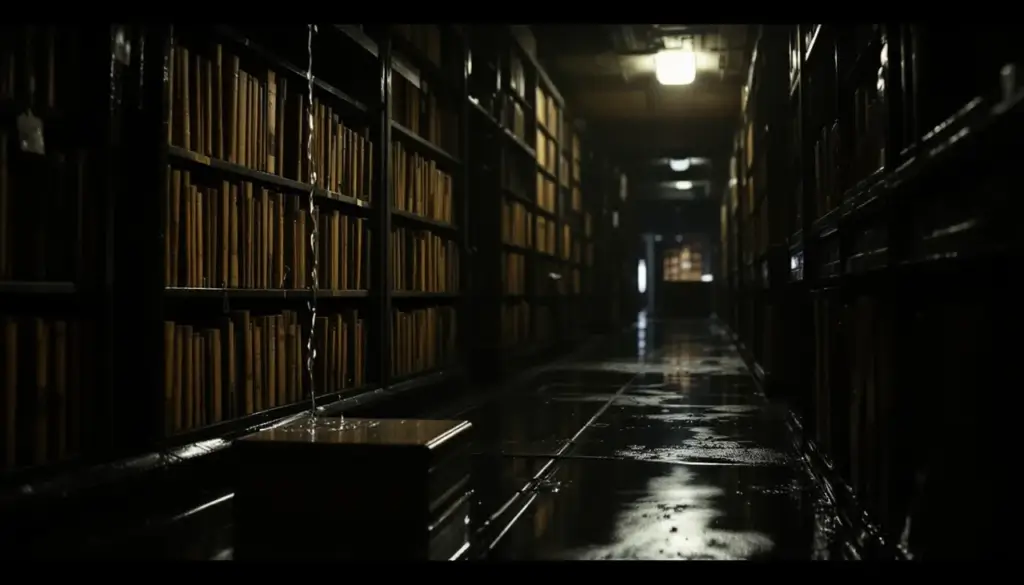
The Missouri State Archive is a climate-controlled, single-story brick facility in Jefferson City that, according to its own structural records, has experienced zero flooding events in thirty-one years of operation. There is no basement. The third-floor reading room where the 1971 Momo case file was stored has no plumbing running through it. The building sits on a gentle grade that directs surface water away from the foundation. I am telling you all of this because it is the archive’s own explanation for why the file could not have gotten wet. The file got wet. The archive confirmed this in writing. I am looking at the letter right now and I need everyone to understand that I have four witnesses, a photocopied acknowledgment on official letterhead, and a notebook page that is just the word ‘HOW’ written eleven times in a column.
What Was Requested, What Was Returned
The WTC Subcommittee on Persistent Unclassified Phenomena submitted a formal records request in March for the original 1971 Missouri Momo incident file — the physical documentation compiled in the weeks following the initial sightings near Louisiana, Missouri, when a seven-foot hair-covered figure was reported by multiple families in Pike County. This is a file that has been in archive storage since 1978. It was catalogued. It was boxed. It was, per standard procedure, in a sealed acid-free container on a shelf in a room that does not have pipes. The file was returned to the Subcommittee fourteen days after the request was submitted. It arrived in a condition that our receiving coordinator, Janet Briggs, described as ‘like someone left it in a bathtub.’ The binding had separated. Three interior pages were fused together. The edges showed a waterline. There was a waterline. On a file. That came from a dry room. I said that out loud to myself in the parking lot for approximately four minutes before I got in the truck.

The condition of the returned materials is not consistent with any environmental event we have on record. We are as puzzled as you are. Possibly more so.
— Denise Calloway, Records Access Coordinator, Missouri State Archive — written acknowledgment, dated April 9th
FAST FACTS
• Original Momo sightings: July 1971, near Louisiana, Missouri, Pike County
• File compiled and archived: 1971–1978, transferred to Jefferson City facility
• Condition on return: Water-damaged, consistent with prolonged submersion per Subcommittee assessment
• Archive’s plumbing status, third floor: None
• Archive’s flooding history: Zero recorded incidents, 1993–present
• Number of times I have read the archive’s acknowledgment letter: Fourteen
I want to be precise about what the archive’s letter does and does not say. It does not say the file was not water-damaged. It confirms the water damage. What it cannot do — what it says explicitly it cannot do — is provide an explanation. Denise Calloway, the Records Access Coordinator who signed the letter, has been in that job for sixteen years. She told me by phone, and I am quoting this directly because I was narrating to my camera operator while she spoke, that in sixteen years she has never had a file returned to a requester in worse condition than it arrived in storage, let alone a file that somehow acquired damage it did not have when it left the shelf. She used the phrase ‘physically impossible’ twice. She did not say it lightly. She is not a woman who says things lightly. I know this because she has now hung up on me twice and both times said goodbye first.
FIELD ALERT
Three interior pages of the 1971 file remain partially legible after separation attempts by the Subcommittee. One page contains what appears to be a witness sketch. The sketch has not been fully recovered. We are working on it. Do not ask me what the sketch looks like until I can confirm what the sketch looks like. I will not speculate. I am writing ‘DO NOT SPECULATE’ in the notebook right now. I mean it.
Four Witnesses, One Outstanding Question
There are four witnesses to the condition of the file at the time of receipt: Janet Briggs, Subcommittee receiving coordinator; photographer Dom Achebe, who documented the damage before the package was fully opened; Subcommittee archivist Priya Nair, who assessed the waterline and made the ‘prolonged submersion’ determination; and myself, who arrived approximately forty minutes after the package was opened, still had Dragon Ice in hand, and stood in the receiving room for a long time without saying anything, which my camera operator has since described as the most unsettling thing he has witnessed in four years on this beat, including the thing in Louisiana. I want to be clear that ‘the thing in Louisiana’ and ‘the Louisiana situation’ are two separate events. Both remain in the notebook.
I’ve seen flood damage. I’ve seen pipe burst damage. I’ve seen a file that someone left in a car during a rainstorm. This isn’t any of those. The saturation pattern doesn’t match surface exposure. It matches something that sat in standing water. That file sat in water somewhere.
— Priya Nair, Subcommittee Archivist
The outstanding question — and I am writing it in the notebook right now, under fourteen iterations of the word ‘HOW,’ in capital letters, underlined twice — is where. Where was this file wet. It was not wet in the archive. The archive has confirmed this. The archive is baffled by this. The Subcommittee is baffled by this. I am not going to tell you I am baffled by this, because I have been doing this job for eleven years and I have learned that ‘baffled’ is what you say when you have run out of follow-up questions, and I have not run out of follow-up questions. I have a spiral notebook that goes back to 2015 and a truck with a working dash cam — third one — and a very specific interest in what was in the parts of that file we have not yet recovered. The Momo case has been listed in this network’s outstanding files since before I took this beat. The file is now water-damaged in a way that cannot be explained by the building it came from. I am going back to Jefferson City. I already told Claudia not to worry. She told me that is not how worry works. She’s right. Dispatch ate dinner. I’m going.
ricovalez@whatthecryptid.com
Rico Valez · Frontline Field Correspondent — WTC
Eight feet tall. Smells like something. Still out there.