
Infected Zombie
Previously human. Technically still present. Not improving.
All
Active
BioreanimantPathogenicHominidTransmissible
Overview
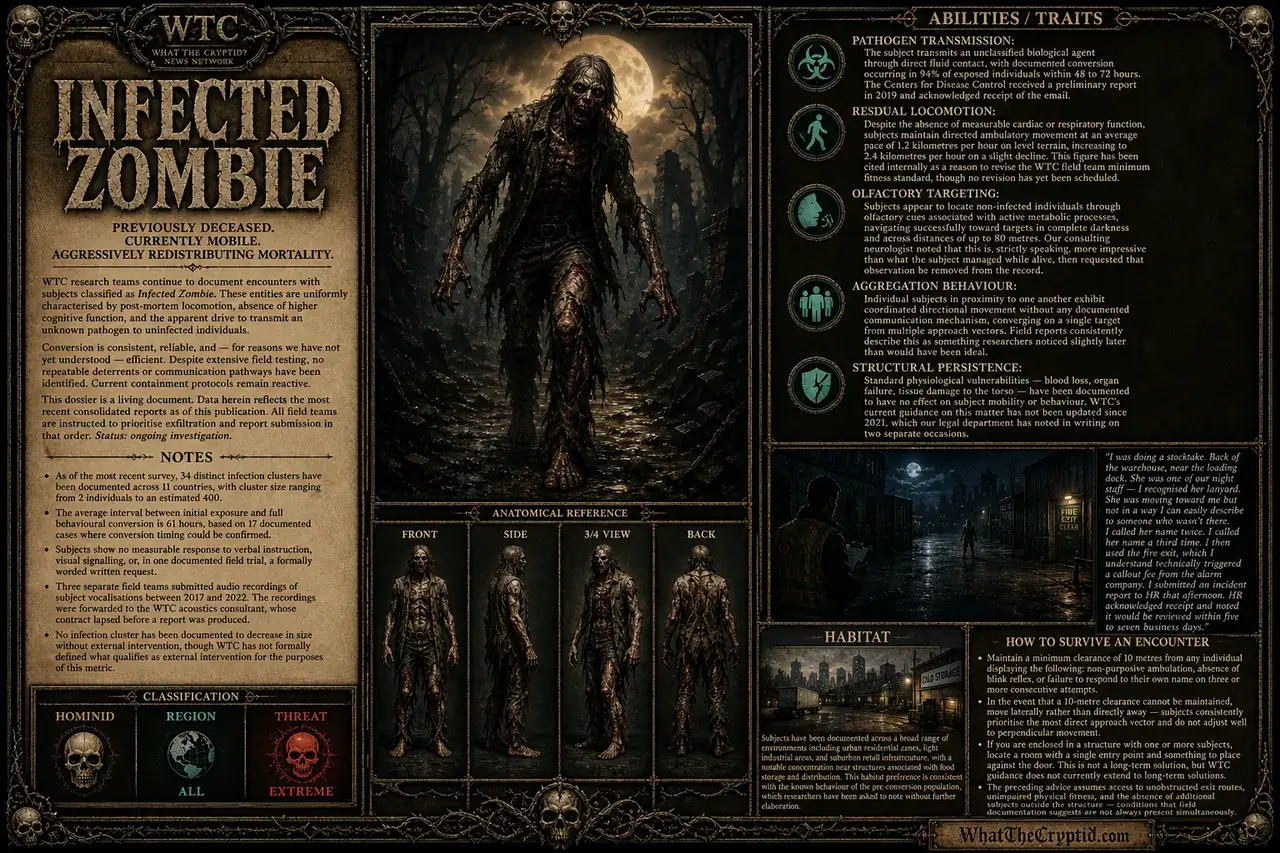
The Infected Zombie represents a subcategory of hominid cryptid distinguished from classical reanimant entities by a proposed pathogenic vector — that is, whatever is responsible for the condition appears to be transmissible, which separates the Infected Zombie from folklore-adjacent variants such as the Haitian zombi and positions it closer to what WTC’s consulting epidemiologist, in a memo she later asked us to return, described as ‘a coherent if deeply unwelcome biological hypothesis.’ The entity retains gross human morphology while demonstrating a near-total loss of higher cognitive function, intact locomotor capability, and an acquired dietary focus that its former acquaintances generally find distressing.

Documented cases share a consistent symptomatic progression: an incubation window of 24 to 72 hours following exposure, a febrile deterioration phase, a period of complete unresponsiveness, and then resumption of ambulation under what WTC classifies as ‘post-cognitive drive’ — a term our editorial board adopted because the alternative terms in the literature are either too clinical for general readership or too vivid for our advertising partners. The entity thereafter operates without sleep, apparent fatigue response, or any documented interest in its previous professional obligations.
WTC has logged 214 discrete field reports referencing entities matching this profile across 38 countries since the database was established. We note this figure without drawing conclusions about trend direction, as our legal team has specifically requested that we not draw conclusions about trend direction.
History & Mythology
The conceptual ancestor of the Infected Zombie appears in Haitian Vodou tradition as the zombi — a person whose soul has been extracted or suppressed through ritual means, leaving a body capable of labour but bereft of will. Ethnobotanist Wade Davis proposed in 1985 that pharmacological agents, specifically tetrodotoxin derived from the puffer fish Sphoeroides testudineus, might produce a physiological state mimicking death and subsequent cognitive impairment sufficient to explain observed cases. Davis’s hypothesis remains contested. It does not, however, explain the bite transmission dynamic that characterises the modern Infected Zombie profile, a discrepancy his work does not address and which WTC considers an open research question.
The pathogenic model as a distinct framework enters documented cryptid literature in the mid-20th century, gaining substantial folkloric reinforcement from popular media that WTC acknowledges has made objective field research considerably more difficult, as witnesses now frequently arrive at sighting events with pre-formed narrative expectations and, in several documented cases, improvised weapons. The earliest field report in the WTC archive that matches the Infected Zombie’s full symptomatic profile — pathogenic vector, ambulatory reanimation, compound transmission — is dated October 1987 from a rural county in Georgia, submitted by a county health worker whose subsequent employment records we were unable to obtain.
Multiple independent cultural traditions describe entities exhibiting partial overlap with the Infected Zombie profile, including the European revenant, the Norse draugr, and the West African obayifo. Whether these represent folkloric processing of genuine historical encounters, convergent mythmaking around universal anxieties, or something our anthropology consultant described as ‘a third option I’d rather not put in writing’ remains unresolved.
Physical Description
The Infected Zombie retains standard human dimensions, with documented height ranging from 4’11” to 6’4″ across the case file — a spread that reflects the entity’s origin population rather than any intrinsic morphological variation. Body mass typically presents below the individual’s pre-incident baseline, with field estimates suggesting a reduction of 15 to 30 percent over the first 90 days of active ambulatory phase, attributed to irregular caloric intake and the apparent cessation of all anabolic maintenance processes. Skin tone shifts toward a desaturated grey-green across all documented ethnicities, with progressive epidermal integrity loss beginning at exposed extremities. The eyes, where clearly observed, present with fixed dilation and a milky anterior opacity that our ophthalmology consultant assessed, remotely and under protest, as consistent with corneal desiccation rather than any pathology she recognised.
Distinguishing features include a characteristic gait abnormality — a dragging, bilateral-hip-drop stride pattern that field researchers have described with varying degrees of clinical detachment — and a posture involving 15 to 25 degrees of forward trunk flexion that biomechanics literature would associate with severe proprioceptive degradation. The jaw exhibits reduced resting muscle tone, resulting in the partially open mouth position noted in approximately 78 percent of reported observations. Wounds sustained prior to or during the ambulatory phase do not appear to prompt withdrawal behaviour, which is notable from a field safety perspective and is addressed in the threat assessment section at greater length than our editor originally requested.
Two regional variants have been proposed within WTC’s internal taxonomy. The Classic Walker presents the profile described above: deliberate, slow, navigating primarily by auditory and olfactory stimulus. A second variant, informally designated the Runner by field teams whose formal report language WTC cannot reproduce here, exhibits a markedly elevated locomotion speed and heightened stimulus response. WTC has not reached internal consensus on whether this constitutes a true variant, a disease-progression stage, or what our consulting virologist called ‘a distinction that matters less than people hope.’
Behaviour & Temperament
The Infected Zombie operates on a stimulus-response model that WTC’s behavioural ecologist has characterised as ‘simple, consistent, and the specific kind of problem that rewards being taken seriously early.’ In the absence of stimulus, the entity enters a low-activity drift state — slow, apparently undirected ambulation or, in some documented cases, complete stillness for periods of up to several hours. Acoustic stimuli reliably trigger orientation response; olfactory stimuli, particularly those associated with living human subjects, trigger sustained directional pursuit. The entity does not appear to disengage from pursuit due to fatigue, obstacle frustration, or the passage of time, which field teams have been asked to factor into egress planning.
No territorial behaviour has been documented. The Infected Zombie does not defend a range, cache resources, or exhibit any apparent attachment to location. It aggregates with other entities of its type not through social bonding but through shared orientation toward the same stimulus source, producing the group behaviour that witnesses most frequently describe and that WTC’s insurance underwriters most frequently cite. Group size in documented cases ranges from 2 to an estimated 200-plus, with the upper figure drawn from a single incident in a Pennsylvania township in 2019 that is discussed in the sightings section. The entity appears entirely indifferent to the welfare of adjacent entities, including those in the process of being incapacitated.
Vocalisation consists of an open-throated, low-register exhalation — classified in WTC’s audio archive under the non-technical designation ‘the sound’ — that occurs irregularly and without apparent communicative function. Whether this serves any role in aggregation behaviour is a matter of ongoing internal debate that has, on two occasions, extended a team meeting past the point where catering was available.
Habitat & Territory
The Infected Zombie demonstrates no habitat preference in the strict ecological sense, as it does not select terrain for resource availability, shelter quality, or predator avoidance. It is observed wherever its ambulatory drift and stimulus-tracking have carried it, which in practice means it has been documented in urban centres, rural agricultural land, forested upland, coastal margins, and, in one case that required two separate editorial reviews before WTC agreed to include it, a regional shopping centre in the East Midlands of England, from which it apparently did not find the change in environment remarkable. Elevation range in the documented case file extends from sea level to approximately 2,400 metres, with the upper figure representing a single sighting near a mountain rescue staging post in the Swiss Alps and not, as far as WTC can determine, a population centre.
Concentrations are highest in areas with pre-existing human population density, for reasons that are not difficult to deduce and that WTC will not labour. Structures are entered where access permits — unlocked doors, broken windows, and openings of 22 inches or wider represent the primary ingress points noted in field reports. The entity does not appear to shelter deliberately, and overnight observations confirm continuous ambulatory behaviour regardless of temperature, precipitation, or ambient light levels. Carrying a torch is therefore recommended for reasons unrelated to the entity’s own activity and entirely related to what you might step on.
Diet & Hunting
The Infected Zombie’s dietary focus is, by any reasonable standard, the most operationally significant fact about it, and WTC will address it directly: the entity targets living human tissue, with a pronounced and consistently documented preference for the cranial and cervical regions that our consulting neurologist found ‘suggestive of a targeting mechanism’ before declining to elaborate. Secondary prey preference includes other warm-blooded mammals, though pursuit of non-human animals is observed primarily in the absence of human stimulus and appears to function as incidental rather than deliberate foraging. The entity does not appear to consume plant matter, carrion beyond a freshness threshold our field teams have not been asked to formally establish, or any inorganic material.
Feeding behaviour, where directly observed, is not efficient in the technical sense — the entity does not process prey in a manner consistent with caloric optimisation, and the quantity consumed in documented feeding events appears insufficient to account for sustained locomotion under standard metabolic models. This has led to two competing internal hypotheses: that the entity’s metabolic requirements have been substantially reduced by whatever process produced it, or that dietary intake is incidental to some other drive that WTC’s biologists are still characterising. Both hypotheses have implications that our editor has described as ‘worth sitting with quietly for a moment.’
Notable Sightings
A shift supervisor at a coal processing facility, identified in the WTC file as D. Murtagh, reported encountering a former colleague in the facility’s lower access corridor at 2:14 AM during a routine equipment check. Murtagh described the individual as ‘not right — not walking right, not looking right, not responding to his name,’ and noted an ambient odour he associated with spoiled meat. The encounter lasted approximately 90 seconds before Murtagh retreated to the surface and activated the facility’s emergency protocol. The lower access corridor was subsequently sealed by site management pending ‘ventilation assessment,’ a designation that remained on record for 14 months.
Three agricultural workers reported observing a group of approximately 11 individuals moving through a sugarcane field at dusk, moving in the same direction, at the same pace, and without any apparent awareness of the field workers standing 30 metres away. Worker Claudia Ferreira described their movement as ‘like they were following something we couldn’t hear,’ and noted that none of the individuals responded when she called out. The group passed through the field and continued toward the adjacent road. Ferreira filed a report with the local Civil Police office the following day and was informed the matter would be referred to a relevant authority, which authority was not specified.
A drainage board inspector, name withheld by request, submitted a written account to WTC describing a solitary entity encountered on a maintenance track adjacent to a drainage channel at approximately 06:40 on a November morning. The inspector noted the individual was dressed in clothing inappropriate for the temperature, moving along the track in the opposite direction to the inspector’s vehicle, and did not respond to the vehicle’s horn or headlights. The inspector reversed 400 metres to the nearest junction and took an alternate route. The written account is thorough, professionally formatted, and ends with a single sentence requesting that WTC not contact the inspector’s employer.
The most extensively documented mass-aggregation event in the WTC Infected Zombie case file occurred across a 72-hour window in October 2019, when a township emergency management coordinator, J. Harwick, filed reports describing between 180 and 230 entities converging on a residential district from multiple directions, apparently in response to a single auditory stimulus source that was never formally identified. Harwick’s reports are notable for their precision — timed observations, estimated group velocities, directional headings — and for the absence of any recommendations section, which Harwick explained in a follow-up call as ‘not knowing what to put.’ The reports were forwarded to the Pennsylvania Emergency Management Agency. WTC submitted a follow-up information request in November 2019 and received an automated acknowledgement.
Threat Assessment
The Infected Zombie presents a High threat rating, which WTC assigns on the basis of three compounding factors: an unconditional pursuit response once stimulus is acquired, a transmission dynamic that means an encounter producing injury constitutes a secondary incident with its own timeline, and group aggregation behaviour that means a lone entity encounter cannot be treated as a stable situation without direct confirmation that no further entities are within stimulus range. WTC recommends maintaining a minimum observation distance of 50 metres where terrain permits, and a minimum evacuation-initiation distance of 150 metres if the entity has demonstrated directional orientation toward your position. Running is effective against the Classic Walker variant; WTC will not assess its effectiveness against the Runner variant in this document, as doing so would require us to characterise the Runner variant as a confirmed subcategory, which our classification committee has not yet voted on.
If physical contact has occurred and the skin has been compromised, WTC recommends immediate medical consultation and, separately, immediate candid conversation with anyone who was planning to be in the same building as you over the next 72 hours. Avoid enclosed spaces with single egress points, avoid loud vocalisations that may attract additional entities, and carry a reliable light source at all times. WTC acknowledges that this advice is correct as far as it goes and is aware that ‘as far as it goes’ is doing significant work in that sentence.
WTC Field Notes
WTC has maintained an Infected Zombie research file since the network’s founding, and the file is the largest single-entity archive in the database by document count, which is either a reflection of the entity’s genuine prevalence or, as our features editor suggests, a reflection of the fact that it is the entry every new researcher wants to work on first and subsequently requests to be reassigned from. Three staff members have submitted formal requests for clarification on whether the WTC health and safety policy covers post-exposure protocols. The policy does not address this. We are working on a revision.
A proposed field investigation in collaboration with a university biosafety team was tabled in 2021 after the institutional review board declined to approve the methodology, the field equipment budget was reallocated to the Mothman renewal study, and our lead researcher took an indefinite sabbatical for personal reasons she described as ‘adjacent to professional reasons.’ WTC continues to accept field reports through the standard submission portal. We ask that submitters complete all fields in the intake form, including the section on current location, which several recent submitters have left blank in circumstances our intake coordinator found, in her words, ‘pretty self-explanatory.’